On the night of 30 April 1564, Prince Andrei Kurbsky, one of Ivan the Terrible's leading commanders, fled from the Livonian town of Dorpat to the enemy, the Grand Duchy of Lithuania. Soon afterwards he wrote to the tsar from the town of Wolmar, accusing him of killing the commanders who had won his wars. Ivan answered on 5 July 1564 with a letter almost twenty times as long, defending the absolute, God-given power of the Russian ruler: "We have always been free to reward our servants, and free to execute them." The exchange continued, with long gaps, until 1579. Two letters by Ivan and three by Kurbsky survive.
The correspondence is one of the most famous texts of Russian history, the clearest statement of how Ivan saw his own power. It is also one of the most debated. In 1971 the Harvard historian Edward Keenan argued that the letters were forgeries of the seventeenth century. Most specialists have rejected his case, but the debate has never quite closed.
Ivan and Kurbsky at a glance
| Andrei Mikhailovich Kurbsky | c. 1528 – 23 May 1583; prince of the Yaroslavl line, boyar and commander |
| Defection | Night of 30 April 1564, from Dorpat (Yuryev, today Tartu) to the Grand Duchy of Lithuania |
| Kurbsky's letters | First letter from Wolmar, probably May 1564; a short second reply; a third letter finished at Polotsk in September 1579 |
| Ivan's letters | First (long) letter, Moscow, 5 July 1564; second letter, Wolmar, 1577 |
| Kurbsky's later life | Estates at Kovel in Volhynia; died there in May 1583 |
| Other work | History of the Grand Prince of Moscow, usually dated around 1573 |
| Authenticity | Questioned by Edward Keenan (1971); defended by most Russian and Western editors |
Who was Prince Andrei Kurbsky?
Kurbsky was born about 1528 into a branch of the princes of Yaroslavl, descendants of Rurik, and was a distant relative of Ivan's first wife, Anastasia. He rose fast in Ivan's service. He fought on the campaigns against the Khanate of Kazan, and at the storming of Kazan on 2 October 1552 he led a strike force against the Elbugin gate and was knocked from his horse and badly wounded while attacking at the head of 200 men. By 1556 he was a boyar.
When the Livonian War began in 1558, Kurbsky was one of its leading commanders. In 1560 he commanded the main army in Livonia. In March 1563 he was sent to govern the conquered town of Dorpat for a year, a posting that Ivan himself later called a "disgrace with mercy". By then Ivan's mood had darkened. His advisers of the 1550s, the priest Silvester and the courtier Alexei Adashev, had fallen from favour, and their friends were being arrested.
Why did Kurbsky flee to Lithuania?
According to the Orthodox Encyclopaedia, Kurbsky knew of an investigation or of denunciations against him, and he had received a letter inviting him into the service of King Sigismund II Augustus of Poland and Lithuania. On the night of 30 April 1564 he left Dorpat with a small band of servants. The historian Alexander Filyushkin describes the journey: at Helmet the local Livonians arrested and robbed him, at Armus the nobles took his fox-fur hat and his horses, and he reached Wolmar "stripped to the thread".
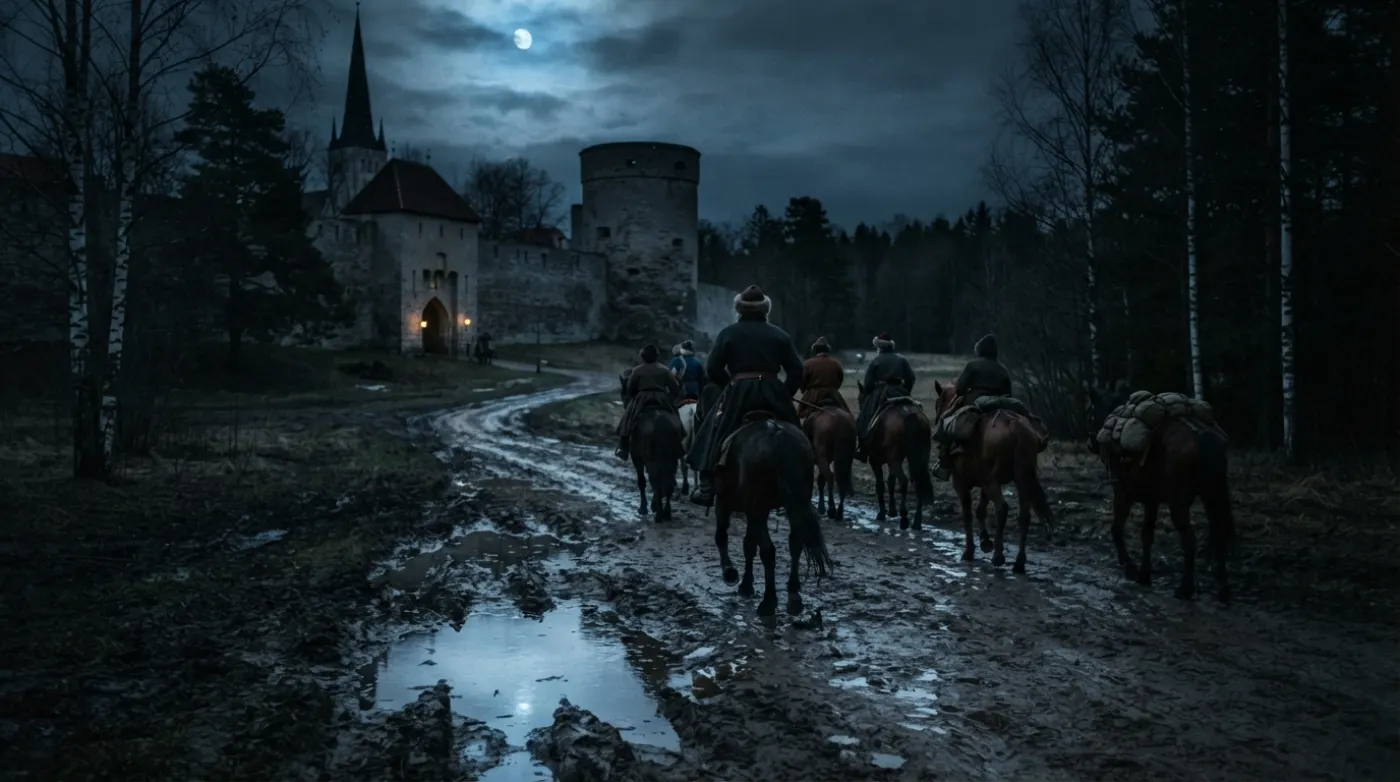
He did not arrive penniless. The Lithuanian records cited by the historian Ruslan Skrynnikov show that when he crossed the border he carried 300 gold pieces, 30 ducats and 500 German thalers, but only 44 Muscovite roubles. Skrynnikov took this as a sign that he had been paid by Lithuania. Filyushkin, reviewing the historiography in 2007, shows that historians have divided ever since between those who call Kurbsky a traitor and those who see a man saving his life.
Kurbsky left his family behind. According to the Orthodox Encyclopaedia, his mother, wife and son were imprisoned. In Lithuania the king rewarded him well. On 4 July 1564 Sigismund Augustus granted him estates in Lithuania and in Volhynia, including the town of Kovel with its castle and 28 villages. In 1567 Ivan's envoys met him at the king's court, and from then on Muscovite diplomats always called him the izmennik, the traitor.
What did Kurbsky write to Ivan?
His first letter is short, carefully composed and full of biblical language. It begins with a famous accusation:
"Why, O tsar, have you slain the mighty in Israel, and torn apart by various deaths the commanders given you by God against your enemies, and shed their victorious holy blood in God's churches, and stained the thresholds of the churches with the blood of martyrs?"
(The translations from the Old Russian in this article are our own.)
Kurbsky reminds Ivan of his own service and his wounds, and declares that God will reward him "even for a cup of cold water". He ends with a curse: "you will not see my face again until the Day of the Last Judgement". He will cry out against the tsar to the Trinity "until the end of my life", and he will have the letter, wet with his tears, laid in his coffin. He signs it from "the town of Wolmar, of my sovereign, King Sigismund Augustus".
How did Ivan the Terrible answer?
Ivan's answer, dated "in the year 7072, the 5th day of July", that is 5 July 1564, is one of the longest texts of the period. The historian Yakov Lurie noted that it is "almost twenty times longer" than Kurbsky's letter and falls into six parts. In the title it carries in its oldest copies, it is addressed not to Kurbsky alone but "to all his Russian realm, against those who broke their oath, against Prince Andrei Kurbsky and his comrades, about their treason". Lurie thought it was meant to be read publicly, and that in the five or six weeks available it must have been prepared with the help of the chancery, with Ivan dictating key passages.
Its central claim is that the tsar's power comes from God and answers to no one:
"The Russian autocrats from the beginning have ruled their realms themselves, not the boyars and grandees!"
To Kurbsky's charge of murdering his commanders, Ivan replies: "We have always been free to reward our servants, and free to execute them too." The word he uses for his servants, kholopy, also means bondmen or slaves.
Ivan accuses Kurbsky of breaking his oath "by a dog's treason" and of joining the enemies of Christianity. He shames him with the example of his own servant, Vasily Shibanov, who "kept his piety; standing before the tsar and all the people at the gates of death, he did not renounce his oath to you". Much of the letter is a bitter account of Ivan's own past: his orphaned childhood under the boyars, and how Silvester and Adashev, as he saw it, had taken his power from him.
Kurbsky replied briefly to Ivan's "broad-broadcasting and loud-roaring missive". By his own account, the border was closed and he could not send it.
What happened to Vasily Shibanov?
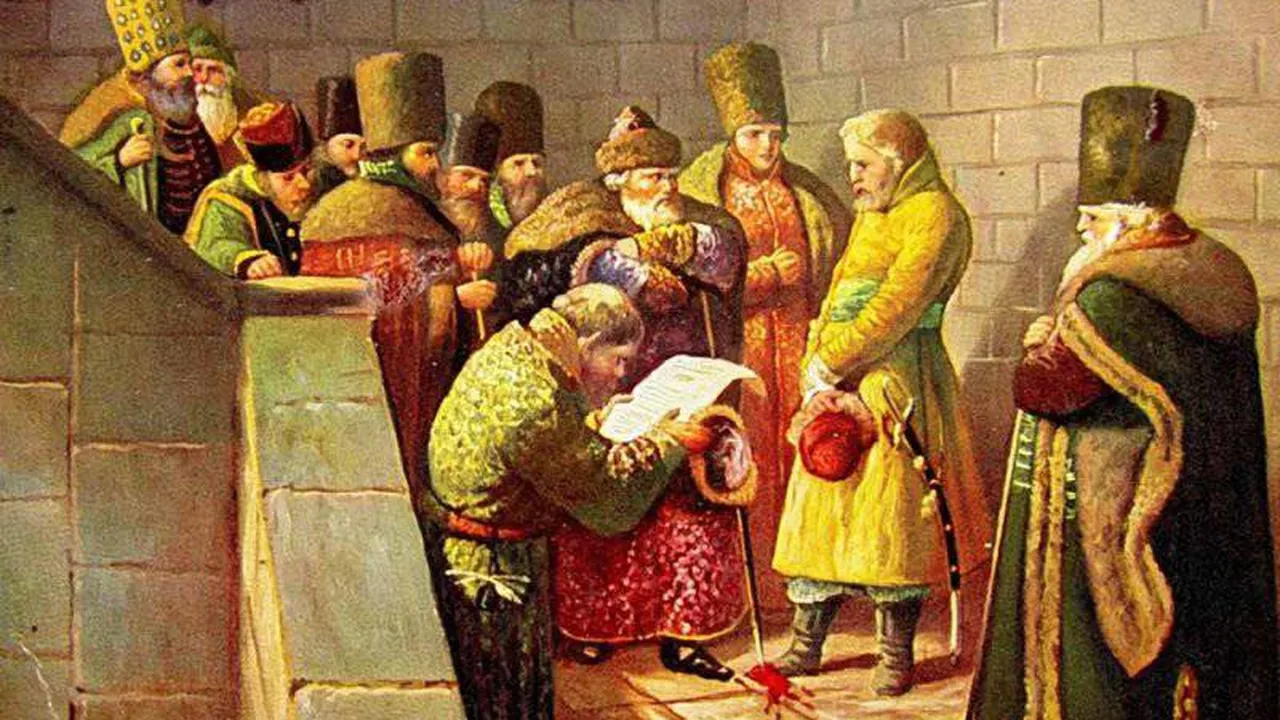
Shibanov's story became the most famous scene of the whole affair, but it exists in two versions.
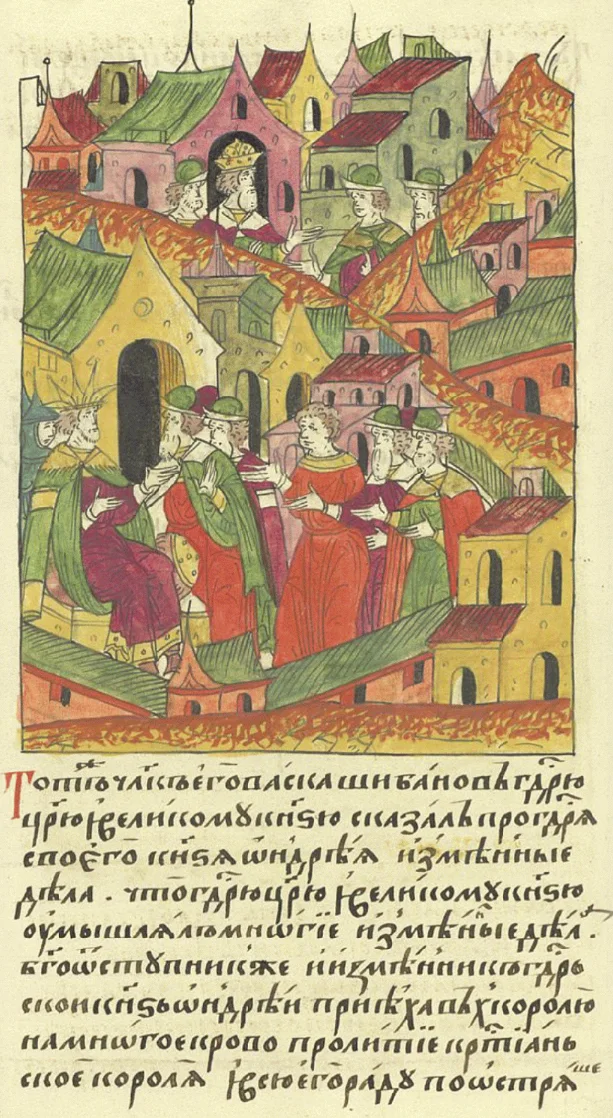
The official chronicle of Ivan's own time says that after Kurbsky's flight the commanders "seized his man Vaska Shibanov and sent him to the sovereign", and that Shibanov "told the sovereign of his master Prince Andrei's treasonous deeds". A book of the late seventeenth century tells it differently: Kurbsky sent "his faithful slave" to Moscow with "an insulting letter from Lithuania", and Shibanov handed it to the tsar on the Red Porch of the Kremlin.
The later version became the legend. The historian Nikolai Karamzin used it, the poet Alexei Tolstoy turned it into a ballad, and Fyodor Dostoevsky retold it in 1877: the tsar drove the sharp tip of his staff into Shibanov's foot, leaned on it and read the letter, while Shibanov did not move. Lurie pointed out that a prisoner could not have handed the tsar a letter in public. The staff through the foot appears only in the late retellings.
What did Ivan write in 1577?
Thirteen years later, Ivan wrote again, in triumph. In the summer of 1577 his army overran much of Livonia and took Wolmar, the very town from which Kurbsky had written. Ivan dated his letter "in our patrimony of the Livonian land, in the town of Wolmar, in the year 7086", that is 1577, and mocked his former commander: "And where you had hoped to rest from all your labours, in Wolmar, there too God has brought us to your resting place."
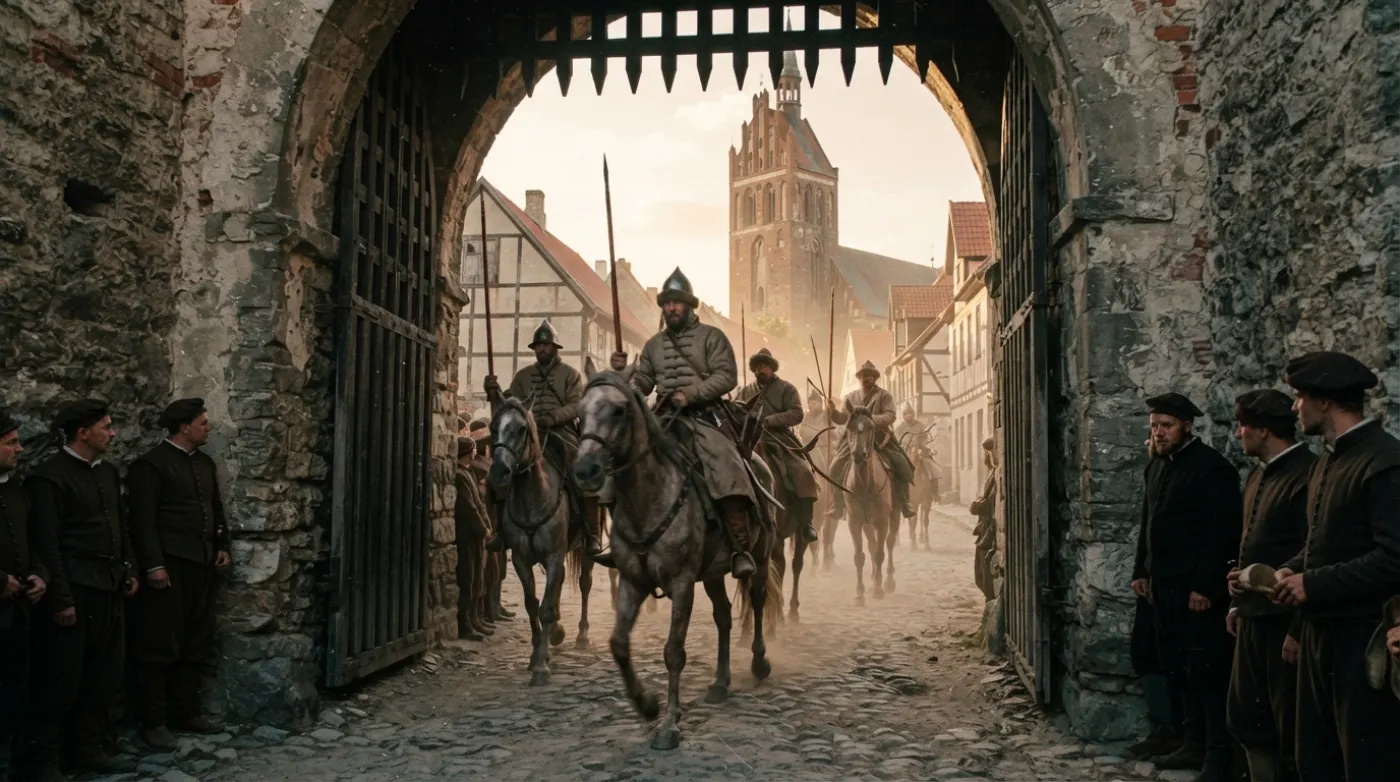
Two years later the war had turned. Kurbsky joined King Stefan Batory's campaign of 1579 and, after Batory took Polotsk, finished his third letter there, "in the most glorious city of Polotsk … on the third day after the taking of the city". The editors date the final additions to 15 September 1579. He reminded Ivan of the burning of Moscow by the Crimean khan in 1571 and of the rumour that the tsar had hidden "from the Tatars in the forests" with his oprichniki. There is no evidence that Ivan received Kurbsky's second and third letters.
What did Kurbsky write in exile?
Kurbsky lived the rest of his life in Volhynia, now in Ukraine, as the lord of Kovel. His estates were granted only for his lifetime use at first, and neighbouring lords encroached on them, so he spent years in disputes and lawsuits. He married twice more: in 1570 to Princess Maria Golshanskaya, from whom he was divorced in 1578, and in April 1579 to Alexandra Semashko, with whom he had a daughter, Marina, and a son, Dmitry. He learned Latin, gathered a circle of translators and worked on translations of the Church Fathers, among them sermons of John Chrysostom.
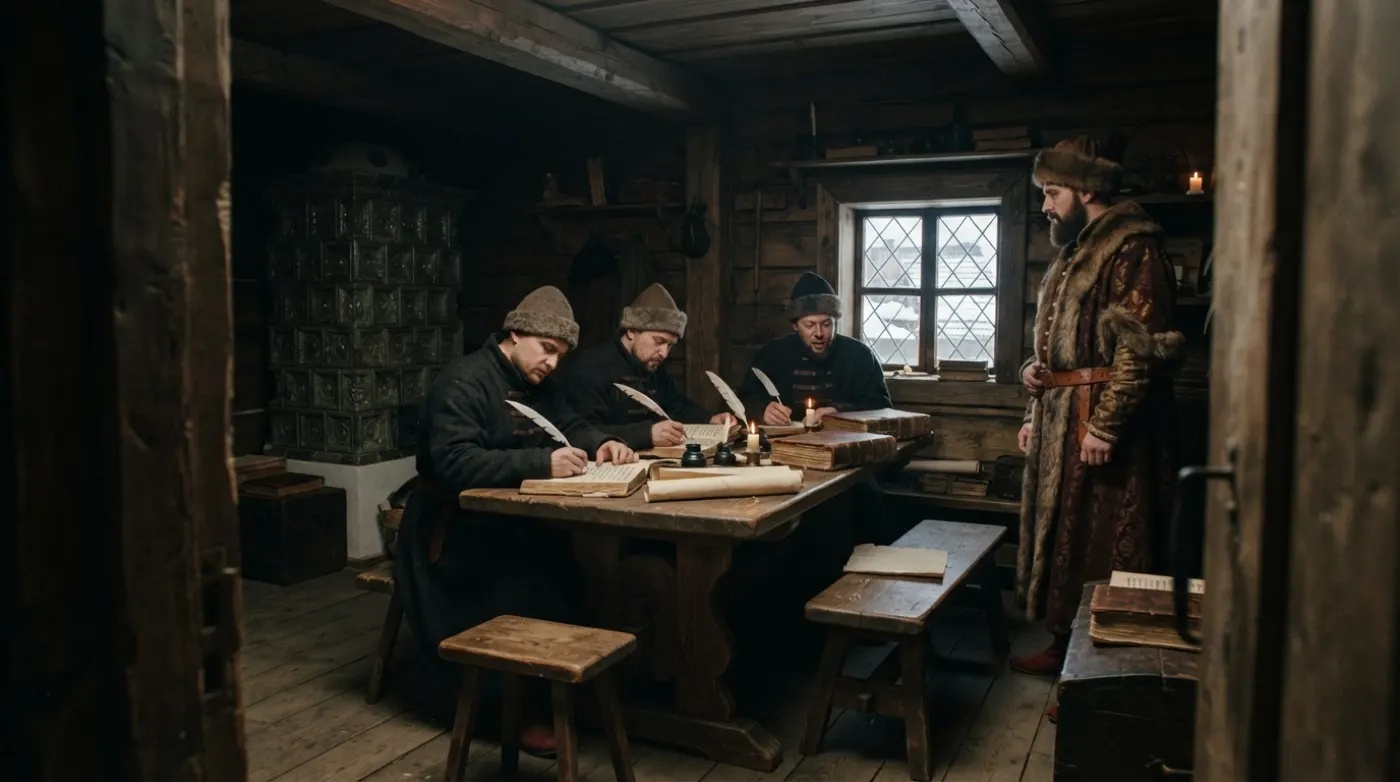
His most important work is the History of the Grand Prince of Moscow, a pamphlet against Ivan. It is usually dated to about 1573, though some passages were written later. It is the source of a famous phrase. Kurbsky called the circle of advisers around the young tsar in the 1550s the izbrannaya rada, the "Chosen Council": "and those counsellors of his were then called the Chosen Council". Historians still use the term, though no other source does. Kurbsky's account of Ivan's later reign, as a good ruler turned tyrant by evil counsellors, shaped the image of Ivan the Terrible for centuries.
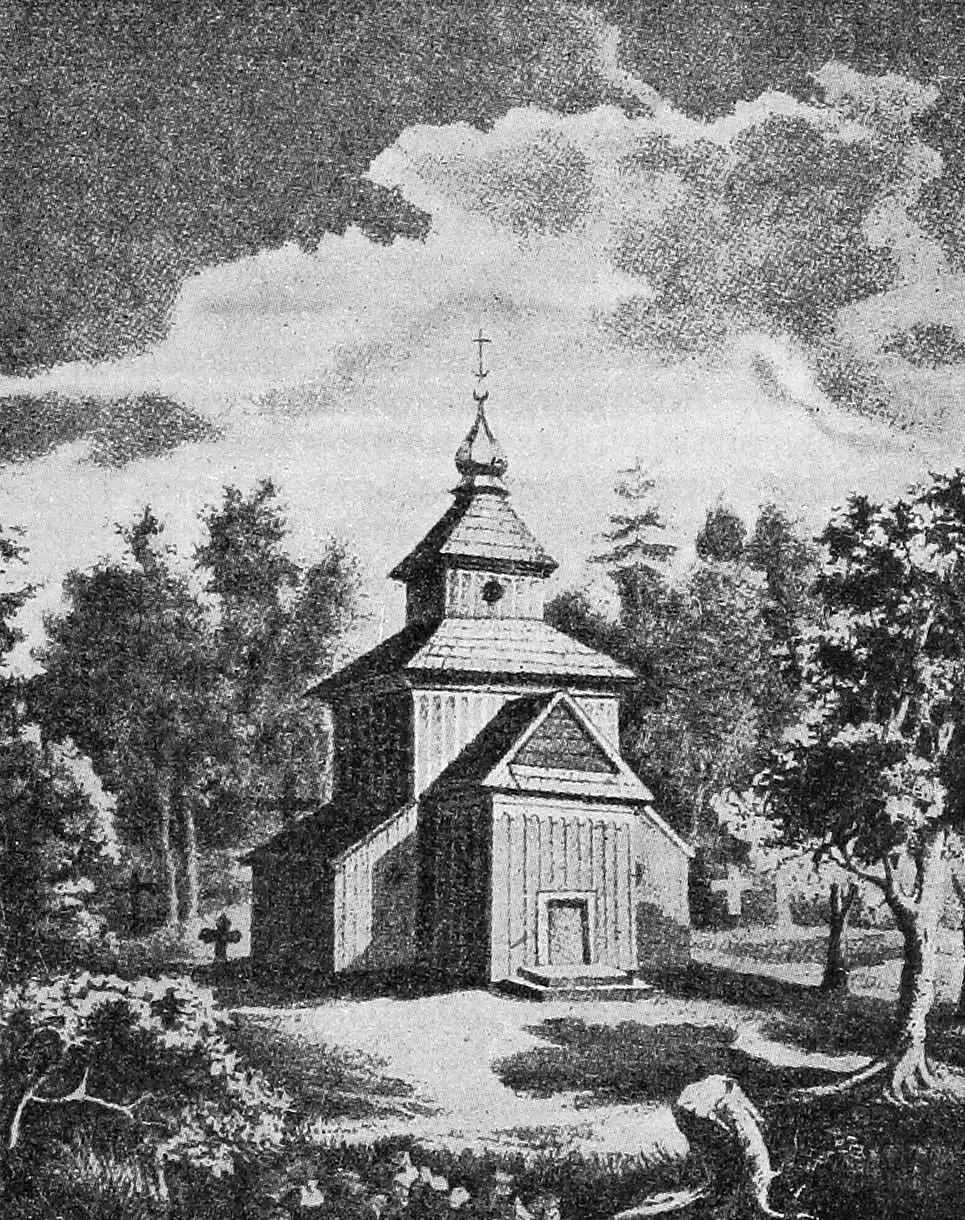
Kurbsky died on his Kovel estate on 23 May 1583 and, according to the Russian Biographical Dictionary, was buried in the Holy Trinity monastery about three versts from Kovel.
Are the letters genuine?
No original of any letter survives, and no copy from the 1560s. The editors of the Pushkin House edition explain that Kurbsky's letters were forbidden reading in Muscovy. The oldest known copy of his first letter is in a manuscript of the late sixteenth or early seventeenth century, found in 1986 by the historian Boris Morozov. Ivan's first letter survives in copies of the 1620s, his second in two copies of the 1680s, and Kurbsky's later letters and his History in collections made in the 1660s–1670s.
The Keenan debate
In The Kurbskii–Groznyi Apocrypha (1971), Edward Keenan of Harvard argued that the whole correspondence was composed in the seventeenth century. His key evidence was a set of passages that Kurbsky's first letter shares with the writings of Isaiah, a Ukrainian monk held in Muscovy in the 1560s. Keenan took Isaiah's text to be the original, so Kurbsky's letter could not be older than 1566. He suggested that the "first letters" were written by Prince Semyon Shakhovskoy in the early seventeenth century.
The response was fierce.
- Ruslan Skrynnikov answered with a book, The Correspondence of Ivan the Terrible and Kurbsky: The Paradoxes of Edward Keenan (1973).
- Alexander Zimin (1976) argued that Keenan had never proved that Isaiah's text came first.
- Yakov Lurie, in the 1979 edition of the letters, reversed the argument. In the shared passage about God rewarding "even a cup of cold water", Kurbsky's version is coherent and Isaiah's muddled, so Isaiah had borrowed from Kurbsky. That would show the letter circulated in Ivan's lifetime.
The editors of the modern Pushkin House edition (2001) also judged Isaiah's text "clearly secondary". They point to sixteenth-century echoes of the correspondence. Among them is a letter of 1580 in which King Stefan Batory mocked the boastful "sheets" that Ivan had written "to us and to Prince Kurpski".
Keenan did not give way. In later work he doubted that Kurbsky had written or translated anything at all. The American historian Donald Ostrowski has kept the question open. In a 2015 study of the attributions he concluded that "no one issue has been defined conclusively in the favor of one side or the other".
The Orthodox Encyclopaedia (2020) summarises the state of the field: Keenan and others have argued that Kurbsky was poorly educated and wrote little or none of what is attributed to him, while their opponents argue that he wrote most of it. The safest summary is that most specialists accept the letters as genuine, while a minority still doubts.
How is Kurbsky remembered?
For Muscovite diplomats he was simply "the traitor", and that label has never quite left him in Russia. But in the nineteenth century Russian writers also began to see him as the first of a long line of political exiles. The Brockhaus and Efron encyclopaedia, in its article on Russian emigration, begins: "in the sixteenth century the well-known Prince Kurbsky emigrated". Dostoevsky called him "a Russian emigrant of the sixteenth century", writing his "oppositional and almost abusive letters" from the safety of abroad.
Common myths about Ivan and Kurbsky
| Myth | What the evidence says |
|---|---|
| Shibanov handed Kurbsky's letter to Ivan on the Red Porch, and Ivan pinned his foot with his staff | This comes from a book of the late 17th century and 19th-century retellings; the official chronicle says Shibanov was captured and sent to the tsar |
| Kurbsky fled in 1563 | He fled on the night of 30 April 1564 |
| The letters were a private exchange | Ivan's first letter was addressed "to all his Russian realm" and was meant to circulate |
| Ivan answered every letter | Ivan wrote two letters; there is no evidence he received Kurbsky's second and third |
| There is a portrait of Kurbsky | No likeness from life survives; chronicle miniatures show him only conventionally |
| The letters have been proved to be forgeries | Keenan argued this in 1971; most editors reject it, though the debate continues |
Timeline
| Date | Event |
|---|---|
| c. 1528 | Kurbsky born |
| 2 October 1552 | Kurbsky wounded at the storming of Kazan |
| 1558 | Livonian War begins; Kurbsky one of its commanders |
| March 1563 | Sent to govern Dorpat |
| 30 April 1564 | Kurbsky flees to Lithuania |
| May 1564 | Kurbsky's first letter, from Wolmar |
| 4 July 1564 | Sigismund Augustus grants him Kovel and other estates |
| 5 July 1564 | Ivan's first letter |
| 1567 | Muscovite diplomats begin to call him "the traitor" |
| c. 1573 | Kurbsky's History of the Grand Prince of Moscow |
| 1577 | Ivan's second letter, from Wolmar |
| September 1579 | Kurbsky's third letter, finished at Polotsk |
| 23 May 1583 | Kurbsky dies at Kovel |
| 1971 | Edward Keenan argues the letters are 17th-century forgeries |
| 1979 | Lurie and Rykov publish the standard edition and reply to Keenan |
What the map shows
At 1564 the Tsardom of Russia is at war in Livonia with the Grand Duchy of Lithuania, to which Kurbsky fled; its king was also ruler of the Kingdom of Poland. Five years later, in 1569, Lithuania and Poland united as the Polish–Lithuanian Commonwealth; at 1580 it includes Kurbsky's estates at Kovel and the Polotsk he wrote from in 1579. For the tsar himself, see our article on Ivan the Terrible, and for the terror Kurbsky denounced, the oprichnina.
Sources
Primary sources
- Perepiska Ivana Groznogo s Andreem Kurbskim, ed. Ia. S. Lur'e and Iu. D. Rykov (Leningrad: Nauka, 1979; Literaturnye pamiatniki): https://archive.org/details/1979_20230109
- The letters of Ivan IV and Andrei Kurbsky and Kurbsky's Istoriia o velikom kniaze Moskovskom, in Biblioteka literatury Drevnei Rusi, vol. 11 (St Petersburg, 2001), Pushkin House online edition
- J. L. I. Fennell (ed. and trans.), The Correspondence between Prince A. M. Kurbsky and Tsar Ivan IV of Russia, 1564–1579 (Cambridge, 1955) (cited, not quoted)
Studies and reference works
- K. Iu. Erusalimskii, "Kurbskii", Pravoslavnaia entsiklopediia, vol. 39 (online 2020)
- "Kurbskii, Andrei Mikhailovich", Russkii biograficheskii slovar', via ru.wikisource
- A. I. Filyushkin, "Begstvo Kurbskogo: otsenki istochnikov i stereotipy istoriografii" (2007), via CyberLeninka
- E. L. Keenan, The Kurbskii–Groznyi Apocrypha (Cambridge, MA: Harvard University Press, 1971)
- E. L. Keenan, "Some Observations on R. G. Skrynnikov's Views…", Slavic Review 38:1 (1979), doi:10.2307/2497229
- R. G. Skrynnikov, Perepiska Groznogo i Kurbskogo: paradoksy Edvarda Kinana (Leningrad, 1973), as reviewed in American Historical Review 81:4 (1976)
- D. Ostrowski, "Attributions to Andrei Kurbskii and Inferential (Bayesian) Probability", Canadian-American Slavic Studies 49 (2015), doi:10.1163/22102396-04902006
- "Emigratsiia russkaia", Entsiklopedicheskii slovar' Brokgauza i Efrona, via ru.wikisource
- F. M. Dostoevsky, Dnevnik pisatelia, December 1877, via ru.wikisource
Image credits
- Title image: Vyacheslav Schwarz, Kurbsky's envoy Vasily Shibanov before Ivan the Terrible, 1860s. Public domain, via Wikimedia Commons, cropped to 16:9.
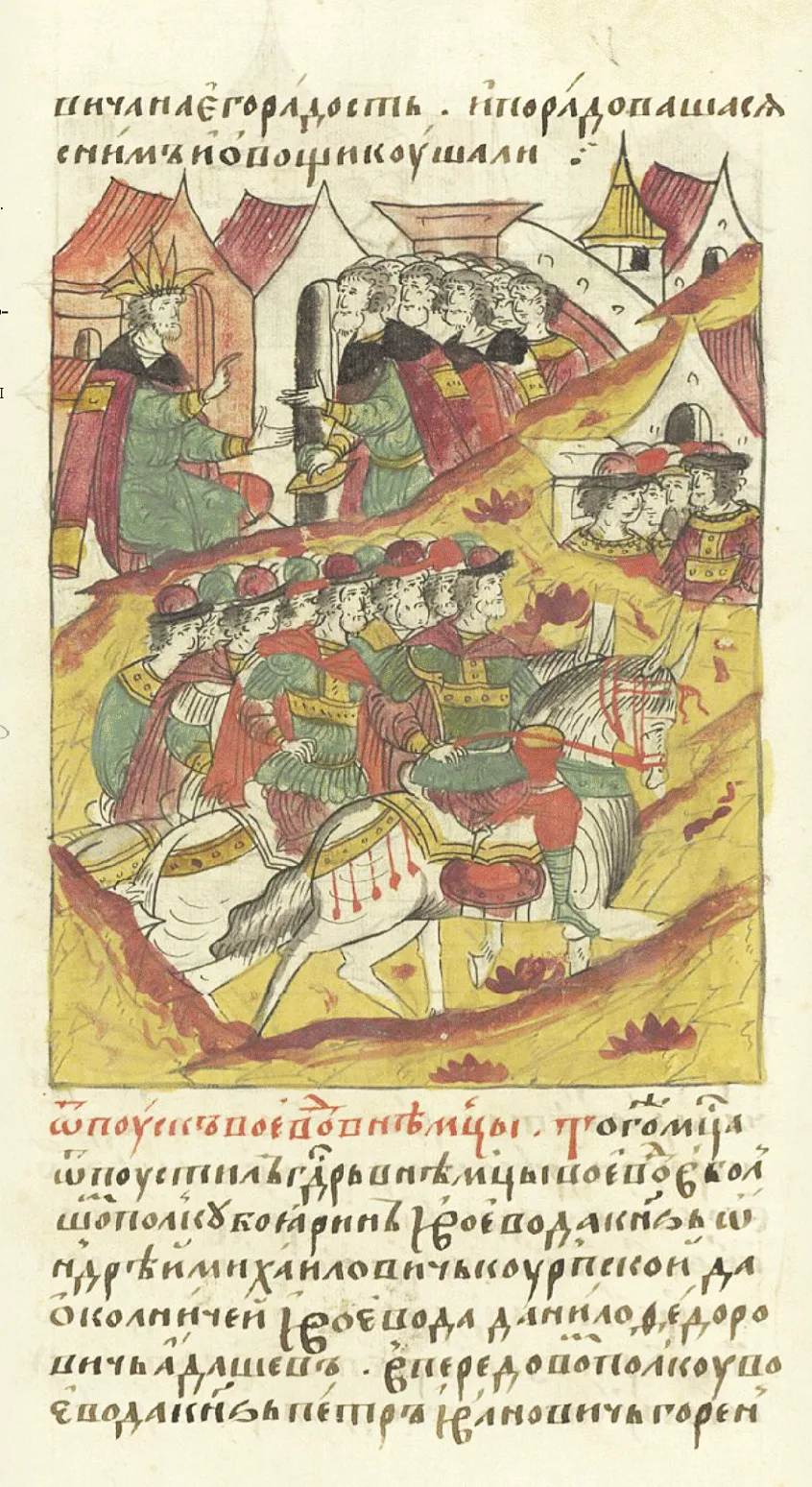
- Illustrated Chronicle miniatures of Shibanov and of the 1560 campaign. Public domain, via Wikimedia Commons.
- Verbki church near Kovel, after an engraving of 1848, from the Sytin Military Encyclopaedia. Public domain, via Wikimedia Commons.