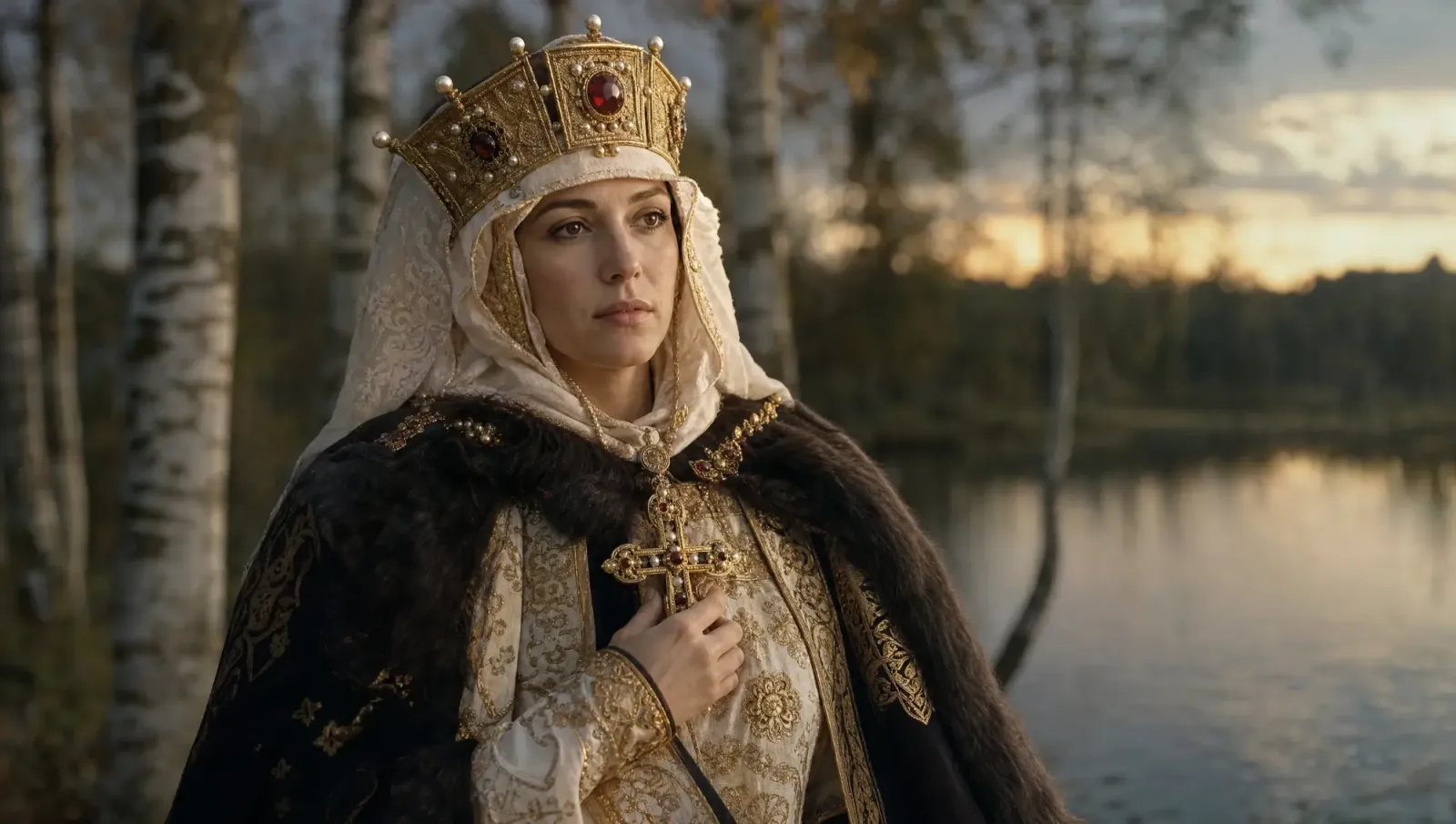
Olga of Kiev (Olga of Kyiv; Old Norse Helga; baptised Helena) was the widow of Prince Igor. She ruled Kievan Rus' as regent for their son Sviatoslav from AD 945 until around AD 960, which makes her the first woman known to have governed the Rus'. She is famous for a brutal four-stage revenge on the Drevlians who killed her husband, yet she was also the first member of the ruling dynasty to be baptised, and she is venerated as Saint Olga, Equal-to-the-Apostles. Most of her story comes from a chronicle written about 150 years after her death, so hard evidence and legend are tightly intertwined.
Who was Olga of Kiev?
Our main source is the Tale of Bygone Years (Povest' vremennykh let), better known in English as the Russian Primary Chronicle. It was compiled in Kyiv around 1113, and its final redaction is traditionally attributed to the monk Nestor. The standard English translation is by Samuel Hazzard Cross and Olgerd Sherbowitz-Wetzor (1953). Under the year 903 the Chronicle says that Oleg, Igor's guardian, brought Igor a wife from Pskov called Olga. Under 942 it records the birth of their son Sviatoslav. That 39-year gap between marriage and first child is one reason historians distrust the early chronology. Constantin Zuckerman, for example, argues that Igor actually reigned only from 941 to 945. Olga's birth year is unknown, and modern estimates range from c. AD 890 to c. AD 925.
Was Olga a Viking? The Byzantine emperor Constantine VII called her Elga, a Greek rendering of the Norse name Helga, and the Chronicle presents her as part of the Scandinavian-descended Rus' elite. Some think she was a Slav who took a Norse name when she married: Women in World History cites anthropological studies of her descendants suggesting Slavic ancestry, while the historian Judith Jesch has reportedly said it is impossible to know because the name could have been changed on marriage. Later traditions place her birth in the village of Vybuty near Pskov, and a minority theory reads "Pleskov" as the Bulgarian capital Pliska, because a 16th-century version of the Chronicle says Oleg brought Igor a wife "from Bulgary". None of these traditions rests on contemporary evidence.
How did Olga take revenge on the Drevlians?
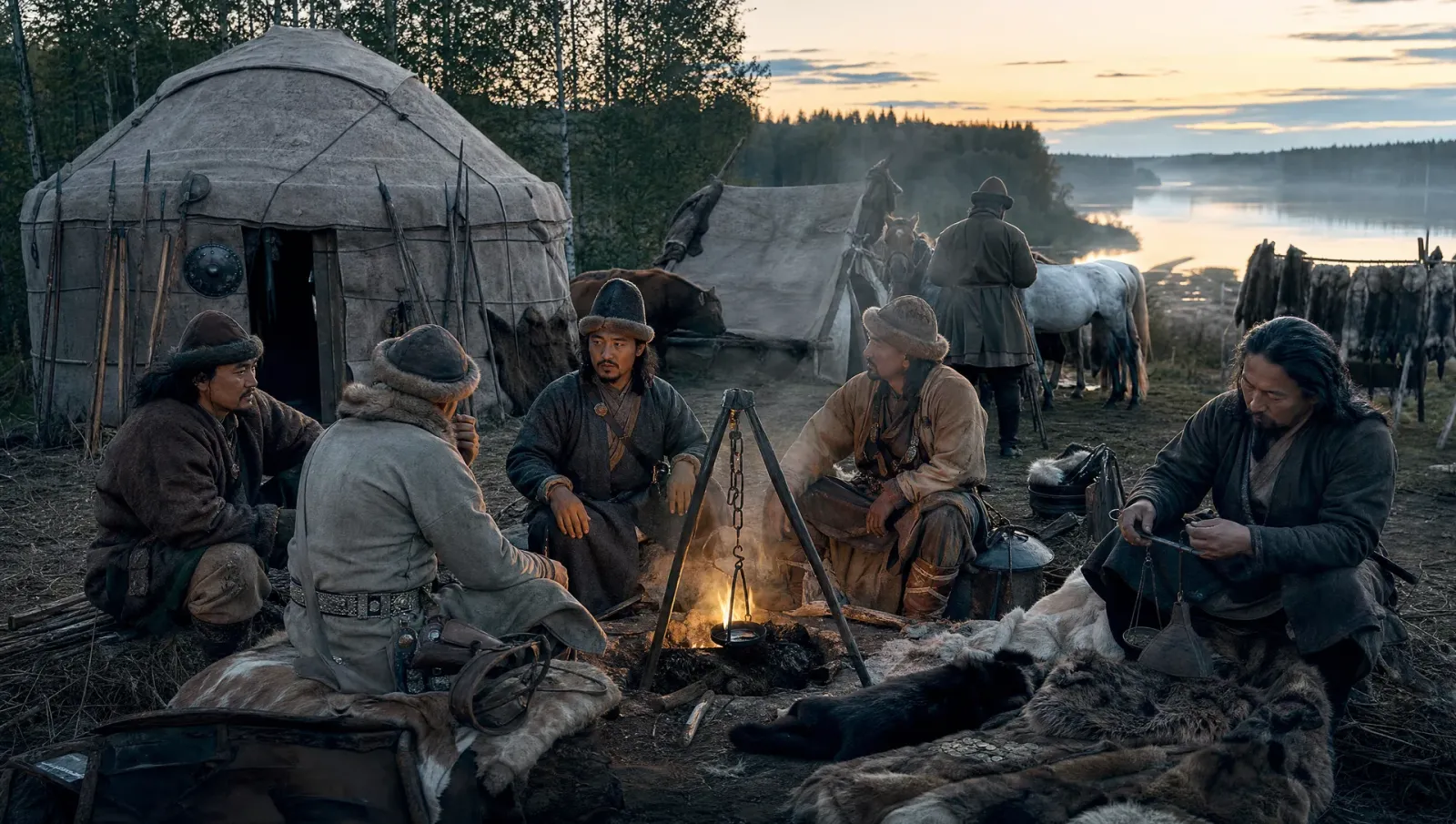
The Drevlians ("forest people") were an East Slavic tribe living in the woods west of the Dnieper, and their chief town was Iskorosten. In AD 945, the Chronicle says, Igor's retinue complained that they were poorer than the men of the commander Sveinald. Igor therefore squeezed the Drevlians for extra tribute and then turned back with only a few followers to demand still more. Tribute was usually collected on the poliudie, an annual winter circuit by the prince and his men. The Drevlian prince Mal reasoned that "if a wolf come among the sheep, he will take away the whole flock one by one, unless he be killed." The Drevlians killed Igor and then proposed that Olga marry Mal.
The Byzantine historian Leo the Deacon, writing in the late 10th century, adds that Igor was "captured by them, tied to tree trunks, and torn in two" (Talbot and Sullivan translation, 2005). Denis Sullivan suspects that Leo borrowed this lurid detail from Diodorus Siculus's story of the robber Sinis. The popular image of two bent birch trees is a later embellishment.
Olga answered the proposal with poisonous courtesy: "Your proposal is pleasing to me; indeed, my husband cannot rise again from the dead." What followed, according to the Chronicle:
| Stage | What the Primary Chronicle says happened | Chronicle year |
|---|---|---|
| 1 | Twenty envoys ask to be carried in their boat "in honour", are dropped into a trench and buried alive | AD 945 |
| 2 | A second embassy of Drevlian notables is invited to wash, then burned to death in a bathhouse | AD 945 |
| 3 | At a funeral feast on Igor's burial mound, Olga's men kill 5,000 drunken Drevlians | AD 945 |
| 4 | After a year-long siege, Iskorosten is burned using pigeons and sparrows carrying burning sulphur | AD 946 |
Did Olga really burn Iskorosten with birds?
Probably not. According to the Chronicle, Olga asked each household for "three pigeons and three sparrows" as a token tribute. She then had sulphur wrapped in cloth tied to the birds and released them at nightfall, and they flew home to their cotes and eaves and set the whole town alight. Birds panicked by fire are hardly reliable incendiaries. More tellingly, the same trick appears elsewhere: in Snorri Sturluson's Heimskringla (c. 1230), Harald Hardrada takes a Sicilian town by tying burning splinters to birds that nest under its roofs.
Scholars therefore read the revenge as literature built on older oral tales. Heidi Sherman points out that the four stages re-enact a Scandinavian-style funeral: a boat burial, cleansing by fire, a funeral feast and a sacrifice. Aleksandr Koptev (2010) likewise interprets the episodes as a princely funeral ritual. The Drevlians also keep failing to decode double meanings, so the episodes read like a chain of riddles. The monk-chroniclers had a moral reason to dwell on the pagan widow's ferocity, because it makes her later conversion more dramatic.
What survives the scepticism is the outline: Igor was killed, and Kyiv crushed the Drevlians. At modern Korosten in Ukraine, A. V. Petrauskas and M. V. Khadadova report that the 2013 excavations of Settlement 1 found stratified deposits of the mid-10th century (Archaeology and Early History of Ukraine, 2021), but excavation cannot prove the birds.
How did Olga rule Kievan Rus'?
Olga's lasting achievement was administrative. After the war, the Chronicle says, she went through the Drevlian land with her son "establishing laws and tribute". The Old East Slavic words are ustavy and uroki, meaning rules and fixed dues. In AD 947 she went north towards Novgorod and set up pogosty and tribute along the Msta and Luga rivers. A pogost was a fixed collection and trading point run by the prince's agents. The Internet Encyclopedia of Ukraine describes the change as replacing the risky poliudie with local centres that "collected uniform taxes for Kyiv". Wikipedia calls it "the first legal reform recorded in Eastern Europe", but that claim carries a citation-needed tag and the label is a modern one.
Sources disagree on when her regency ended: 957 (Encyclopedia of Ukraine), 962 (Sherman) or 964 (Britannica). The most defensible answer is that Sviatoslav had taken real power by AD 961–962. Even then, Olga went on running Kyiv during his long campaigns.
Why did Olga go to Constantinople?
Olga's visit to the Byzantine Empire is the best-documented moment of her life. Constantine VII's De Ceremoniis (Book of Ceremonies, II.15) describes two receptions for "Elga, archontissa of the Rus'". Archontissa is Greek for a female ruler. The receptions took place on Wednesday 9 September and Sunday 18 October. Her entourage included envoys, 43 merchants according to Christian Raffensperger and Donald Ostrowski (2023), female relatives and a priest named Gregory. The text never mentions a baptism, and it gives no year. Only AD 946 and AD 957 fit those weekday dates. Michael Featherstone argues for 957, while G. G. Litavrin, Otto Kresten and Constantin Zuckerman argue for 946. Jonathan Shepard, like Simon Franklin in their joint book The Emergence of Rus 750–1200 (1996), sees strong arguments on both sides.
| Source | Written | What it says about the baptism |
|---|---|---|
| De Ceremoniis | 950s–960s | Two receptions; no baptism mentioned |
| Continuator of Regino of Prüm | c. 967 | "Helena, queen of the Rugi" was baptised in Constantinople under Emperor Romanos |
| Jacob the Monk, Memory and Praise of Vladimir | 11th century | She lived as a Christian for 15 years before dying on 11 July 969 |
| John Skylitzes, Synopsis of Histories | late 11th century | "Helga" came to Constantinople after her husband's death and was baptised |
| Primary Chronicle | c. 1113 | Baptised by the patriarch, with the emperor as godfather (entry for 955) |
The Chronicle adds a famous tale. Constantine wants to marry Olga, so she makes him her godfather and then points out that a godfather cannot marry his goddaughter: "Olga, you have outwitted me." This is legend. Constantine already had a wife, the empress Helena Lekapene, and Shepard suggests Olga's baptismal name honoured her, not Constantine the Great's mother as the Chronicle claims. Omeljan Pritsak argued in 1985 that she was baptised in Constantinople in 957. Others place the baptism in Kyiv before the trip; Women in World History thinks it likely she was baptised in Kyiv around 955 and christened again in Constantinople.
Byzantium apparently did not give Olga what she wanted, perhaps a church hierarchy of her own. In AD 959 her envoys went to Otto I, ruler of the German kingdom, asking for a bishop and priests. The first bishop appointed, Libutius, died before he could leave. His replacement, the monk Adalbert, reached Kyiv in 961 and fled in 962 after some of his companions were killed. Adalbert, later the first archbishop of Magdeburg in the new Holy Roman Empire, is thought to be the Continuator who sourly called the embassy a deception.
Why is Olga a saint?
Olga never converted her son. The Chronicle has Sviatoslav refuse because "my followers will laugh at that." In AD 968, while he campaigned in the Balkans, Pecheneg nomads besieged Kyiv, and the elderly Olga held the city with her grandsons until he returned. She died in AD 969. Jacob the Monk gives the date as 11 July. At her own request she received a Christian burial with a priest and no trizna, the pagan funeral feast.
Her grandson Vladimir, who made Christianity the religion of Rus' in AD 988, moved her remains to Kyiv's Church of the Tithes. In the Chronicle his boyars clinch the argument for conversion by noting that the Greek faith had been "adopted by your grandmother Olga, who was wiser than all other men." The date of her canonisation is disputed. The Encyclopedia of Ukraine says the first half of the 13th century, John Fennell proposed 1284, the historian Michael C. Paul thinks she was probably not formally canonised until the 14th century, and 1547 is often given for her formal recognition as Equal-to-the-Apostles. Orthodox and Greek Catholic churches call her isapostolos, "Equal-to-the-Apostles", a title reserved for saints who spread the faith to whole peoples. Her feast is 11 July, which falls on 24 July in the civil calendar for churches still on the Julian calendar. According to Britannica, she is the patron saint of widows and converts.
Both Ukraine and Russia claim her. Ukraine has awarded the Order of Princess Olga to women since 1997, and imperial Russia created an Insignia of Saint Olga in 1913. Her statue on Kyiv's Mykhailivska Square went up in 1911, was toppled in 1919 and was restored in 1996. Pskov added two monuments in 2003, and its airport has borne her name since 2019. Both countries have a genuine claim to her, because Kievan Rus' is the shared ancestor of modern Ukraine, Belarus and the Russian Federation.
What the map shows next
Olga's reforms gave her son a solid base. In the 960s Sviatoslav destroyed the Khazar Khaganate, the Turkic state that had dominated the steppe trade routes, and he then fought in the Balkans until his death in AD 972. To see her realm at its height as a regent, view Kievan Rus' around 957. For the Christian state her grandson built, jump ahead to AD 988 on the map. For a fuller scholarly treatment, read Heidi Sherman's essay in World History Connected and the Orthodox Church in America's life of St Olga.