Alexander Nevsky (c. 1221–1263) was a prince of the Rurikid dynasty who ruled Novgorod and, from 1252 to his death, the grand principality of Vladimir. He beat a Swedish force on the Neva in 1240 and the army of the Livonian Order near Lake Peipus in 1242. He spent the rest of his life working for the Mongol khans: he travelled to their courts, took their patent to rule, and helped their officials count the people of Novgorod for tribute. He died as a monk on 14 November 1263 and became one of Russia's most honoured saints.
The two halves of that life are why historians still argue about him. To one tradition he is the defender of Orthodox Russia against the Catholic West. To another he is a capable, ruthless prince who kept his throne by serving the strongest power in his world. The sources support parts of both.
Who was Alexander Nevsky?
Alexander was the second son of Yaroslav Vsevolodovich, a grandson of Vsevolod "Big Nest" of Vladimir, and of Feodosia, whom the historian Vladimir Kuchkin identifies as a daughter of Mstislav Mstislavich of Novgorod. Yaroslav had nine sons. The chronicles record the births of only the first and the last, so Alexander's own birth date has to be reconstructed.
The older date, 30 May 1220, goes back to the 18th-century historian Vasily Tatishchev. Kuchkin rejected it in 1986: the elder brother Fyodor was born in early 1220, and the prince's name saint was most likely Alexander of Rome, remembered on 13 May. "Alexander Nevsky's birth must therefore be dated to 13 May 1221," he concluded. Russia followed him when it celebrated the 800th anniversary in 2021, but the date is still a reconstruction.
| Born | c. 1221 (13 May 1221 in Kuchkin's reconstruction; 1220 in the older tradition) |
| Father | Yaroslav Vsevolodovich, grand prince of Vladimir 1238–1246 |
| Wife | A daughter of Briachislav of Polotsk, married 1239 |
| Prince of Novgorod | 1236–1240, 1241–1252 (with breaks), then through his sons |
| Grand prince of Vladimir | 1252–1263 |
| Died | 14 November 1263, at Gorodets on the Volga, after taking monastic vows |
| Buried | Nativity monastery, Vladimir |
| Canonised | locally venerated from the 1280s; church-wide in 1547 |
The ruling family of Vladimir sat in the north-east of the old Kievan Rus', in Rostov-Suzdal and the newer Vladimir-Suzdal, and it lent its younger princes to the city of Novgorod, which hired and fired its princes by contract. In 1236 Yaroslav left for Kyiv and, as the Novgorod chronicle puts it, "set his son Olexander in Novgorod". Alexander was about fifteen.
Why is he called Nevsky?
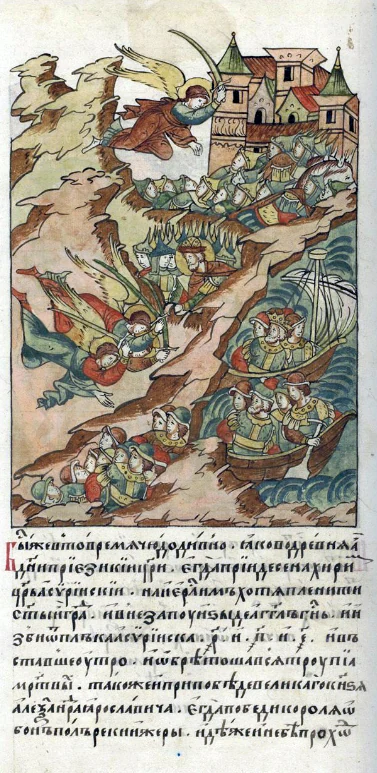
The name comes from the Neva, the river that links Lake Ladoga to the Gulf of Finland, where Alexander won his first battle on 15 July 1240. According to the Novgorod First Chronicle, the Swedes "came in great strength" with Norwegians and Finnish allies, "in very many ships", and halted at the mouth of the Izhora, "wishing to take possession of Ladoga, or in one word, of Novgorod". Alexander attacked with the men of Novgorod and Ladoga before more troops could arrive. The Swedish commander was killed, the survivors loaded "two vessels" with their dead and left by night, and the Novgorodian losses came to "twenty men in all with the men of Ladoga, or less, God knows" (trans. Michell and Forbes, 1914).
How big a battle this was is a matter of dispute. The British historian John Fennell, judging by the twenty dead, called it a minor clash. Kuchkin replied that the chronicle counted only notable men and that several thousand probably fought. The later Life of Alexander turns it into a duel with "the king of the Roman land" whom Alexander wounds in the face with his spear. The commentary to the modern edition of the Life points out that no Swedish king led the expedition, and identifies the leader as Birger or Ulf Fasi.
The surname itself is much later than the battle. "Nevsky" appears in none of the 13th-century sources: not in the Novgorod chronicle, not in the Laurentian Chronicle and not in the Life. The historian Aleksei Sirenov traced its first appearance to a list of princes copied into the Novgorod First Chronicle in the early 15th century, where Alexander is called "Nevsky the Brave". It was given at the same time as other famous nicknames such as Yuri "Long Arm" (Dolgoruky) and Ivan Kalita, about 150 years after his death.
How did Alexander rule Novgorod?
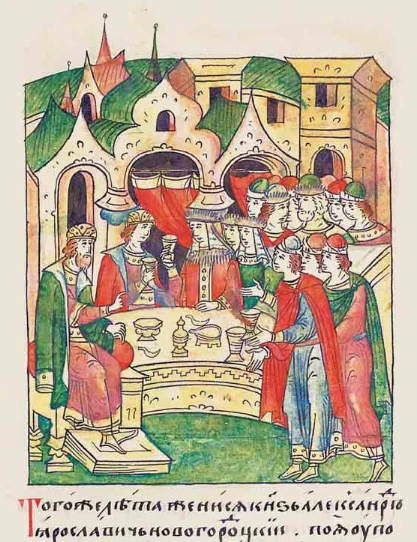
As a hired prince with a short contract. In 1239 he married the daughter of Briachislav of Polotsk, with a wedding at Toropets and feasts "both in Novgorod and in Toropets", and built forts along the Shelon river against Lithuanian raids. The bride's name is not recorded in the chronicle; the names Alexandra and Paraskeva come from later tradition.
Months after the victory on the Neva, the city threw him out. In the winter of 1240 "Knyaz Olexander went out from Novgorod with his mother and his wife and all his court, to his father in Pereyaslavl, having quarelled with the men of Novgorod." Within a year German knights, Estonians and Lithuanians were raiding to within thirty versts of the city, and the Novgorodians sent their archbishop to beg him back.
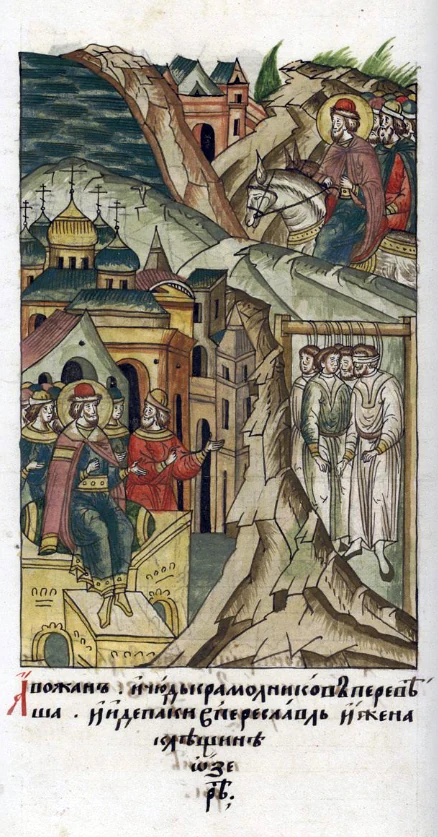
He returned in 1241 and showed what kind of ruler he was. He took the new German fort at Koporye, brought some prisoners to Novgorod, let others go, and "the Vod and Chud traitors he hanged", the chronicle says, meaning the local Finnic people who had sided with the Germans.
Did Alexander Nevsky fight the Teutonic Knights?
Yes, though the knights he fought were the Livonian branch of the Teutonic Order, the former Livonian Brothers of the Sword, who had merged with it in 1237, together with the vassals of the bishop of Dorpat (Tartu). In 1240 they had taken Izborsk and Pskov. In early 1242 Alexander retook Pskov and then marched into Estonian territory.
On Saturday 5 April 1242 the two armies met by Lake Peipus, "by Uzmen by the Raven's rock" in the chronicle's words. The Germans and Estonians charged in a wedge, the chronicle uses the word "pig" for it, and broke through, but the Novgorodians held, and pursued the fleeing army on the ice, "seven versts short of the Subol shore". The two sides' sources give very different numbers:
| Source | German losses |
|---|---|
| Novgorod First Chronicle, older copy (14th century) | "of the Nemtsy 400, and fifty they took with their hands" |
| Novgorod First Chronicle, younger copy (15th century) | 500 killed, 50 captured |
| Livonian Rhymed Chronicle (1290s) | "Twenty Brothers lay dead and six were captured" (trans. Smith and Urban, 1977) |
The usual reconciliation is that the Order counted only its own sworn brother-knights, while the Novgorodians counted everyone. Not every historian accepts this, and the Rhymed Chronicle's other claim, that the Russians had "easily sixty men for every one German knight", is a stock figure that the same chronicle uses for another battle in 1268.
Historians disagree about the battle's weight:
- Fennell saw a border fight, one of many between Novgorod and its neighbours.
- Russian historians such as Kuchkin and Anton Gorsky defend its importance, and the Pravoslavnaya entsiklopediya calls attempts to reduce it to an ordinary border skirmish "unjustified".
- Donald Ostrowski has shown how the story grew. No 13th- or 14th-century source says the ice broke or that anyone drowned. Later Moscow chronicles added drowning, and Sergei Eisenstein's film of 1938 fixed the image of knights crashing through the ice.
Alexander and the Mongols
While Alexander fought in the north-west, the Mongols conquered the rest of Rus'. From 1237 to 1240 Batu's army destroyed Ryazan, Vladimir and Kyiv; Novgorod was spared. Alexander's father went to Batu and was confirmed as grand prince, then travelled on to the court of the Mongol Empire in Mongolia. He died on 30 September 1246; the Laurentian Chronicle says he died "among foreigners" on his way back from the great khan. The papal envoy John of Plano Carpini, who was at the court, reported that he had been invited to eat and drink with the khan's mother, "within seuen dayes, died", and "his body was of a strange blew colour, and it was commonly reported, that the said Duke was poisoned, to the ende that the Tartars might freely and totally possesse his Dukedome" (Hakluyt's 16th-century translation).
In 1247 Alexander followed his brother Andrei to Batu, and Batu sent both on to the great khan. They came back late in 1249 with an odd division. In the words of the Laurentian Chronicle, "they gave Alexander Kiev and all the Russian land, and Andrei sat in Vladimir on the throne" (our translation). Kyiv was the old capital but now a ruin; Vladimir was the real power. Alexander never went to Kyiv and stayed in Novgorod.
The Life of Alexander tells this part as a triumph. Batu, seeing him, "marvelled and said to his nobles: 'You told me the truth, there is no prince like him'" (our translation). The chronicles are drier. A prince who wanted to rule now had to travel to the khans, bow and come home with their patent, later called a yarlyk.
Did Alexander Nevsky betray his brother?
This is the sharpest question about him. In 1252, the Laurentian Chronicle records, Alexander went to the Tatars, who "let him go with great honour, giving him seniority among all his brethren". In the same year Andrei "resolved with his boyars to flee rather than serve the tsars", meaning the khans, and fled. A Mongol army under Nevryuy caught him near Pereyaslavl, killed the wife of another brother, Yaroslav, took his children and carried off people "without number". Andrei escaped to Sweden. Alexander came back from the Horde and was received at the Golden Gate of Vladimir as grand prince.
Historians disagree:
- Fennell wrote bluntly that "Alexander betrayed his brothers": he went to the khan to denounce Andrei and brought Nevryuy's army down on him.
- Gorsky points out that "no medieval source mentions Alexander's complaint against his brother". It appears only in Tatishchev's 18th-century History.
- Kuchkin argues that the oldest account, the Laurentian Chronicle, has Alexander leave for the Horde before Andrei's revolt, and that the betrayal story rests on later compilations that muddle the order of events.
- The Pravoslavnaya entsiklopediya puts it neutrally: Alexander drove Andrei out of Vladimir "having secured Tatar help".
What no one disputes is the result. Alexander held the grand principality for the next eleven years, with Mongol backing, and his brother lived in exile.
Did Alexander reject the Pope?
Not as simply as the legend says. Pope Innocent IV wrote to him twice, on 23 January and 15 September 1248. The first letter invited him to follow his father, who according to Carpini had been ready to accept the Pope's authority. The second, as the historian Alexander Maiorov has shown, praised Alexander for agreeing to build a Latin cathedral in Pskov, so there had been talks and a reply. Gorsky reads the Pskov offer differently, as a reason for Alexander to turn away.
The famous refusal comes from the Life. It has two cardinals arrive, and Alexander answers with a summary of sacred history from Adam to the seventh ecumenical council and ends: "all this we know well, and we do not accept teaching from you" (our translation). The Life gives no date and calls the cardinals by names unknown to history. The Pravoslavnaya entsiklopediya places the answer in 1250, after the Pope's offer of union. Either way, the contacts ended once Alexander's future lay with the khans.
What did Alexander do as grand prince?
He enforced Mongol rule, including in Novgorod. In 1255 the city expelled his son Vasily; Alexander marched on it and demanded "surrender me my enemies" until the posadnik was removed. In 1257 Mongol officials counted the people of Suzdal, Ryazan and Murom for tribute, and Novgorod refused. Vasily, who had backed the city's resistance, fled to Pskov. The chronicle's account of what followed is short:
"And Knyaz Olexander drove his son out of Pleskov and sent him to the Low Country, and punished Alexander and his company. He cut off the noses of some, and took out the eyes of others, of those who had led Vasili to evil." — Novgorod First Chronicle, 1257 (trans. Michell and Forbes, 1914)
In the winter of 1259 the census came to Novgorod. Two Mongol officials arrived, the city split between the boyars and the common people, and the officials asked Alexander for guards, "lest they kill us". He gave them the sons of the boyars as an escort. Then "the accursed ones began to ride through the streets, writing down the Christian houses", and Novgorod paid. The Novgorodian chronicler, no friend of the Mongols, does not blame Alexander by name, but it was his men who made the count possible.
In 1262 the towns of Rostov, Vladimir, Suzdal and Yaroslavl rose against the Muslim tax-farmers who collected the tribute and drove them out. Alexander went to the Horde again, according to the Life "to pray the people out of trouble", since the khan wanted Russian troops for his wars. He spent the winter there and fell ill. He came back "in very bad health" in the autumn of 1263, and at Gorodets on the Volga he "was shorn on November 14", taking monastic vows, "and he died the same night". He was buried in the Nativity monastery in Vladimir on 23 November, a Friday, according to the Novgorod chronicle; the Life says 24 November.
The Life gives his metropolitan the line that later writers loved: "My children, know that the sun of the land of Suzdal has now set" (our translation). It is the land of Suzdal, not "the Russian land", as the line is often quoted.
How did Alexander Nevsky become a saint?
Slowly, and in stages. The Life is usually dated to the 1280s, written in the Nativity monastery in Vladimir in the circle of Metropolitan Kirill. Ostrowski argues it is later, from the mid-14th century, because it draws on both the Novgorod and the Laurentian chronicles. It is a mix of saint's life and war story: Alexander is compared with Joseph, Samson and the Emperor Vespasian, and the women of the "Moabites", meaning the Tatars, frighten their children with the words "Alexander is coming!"
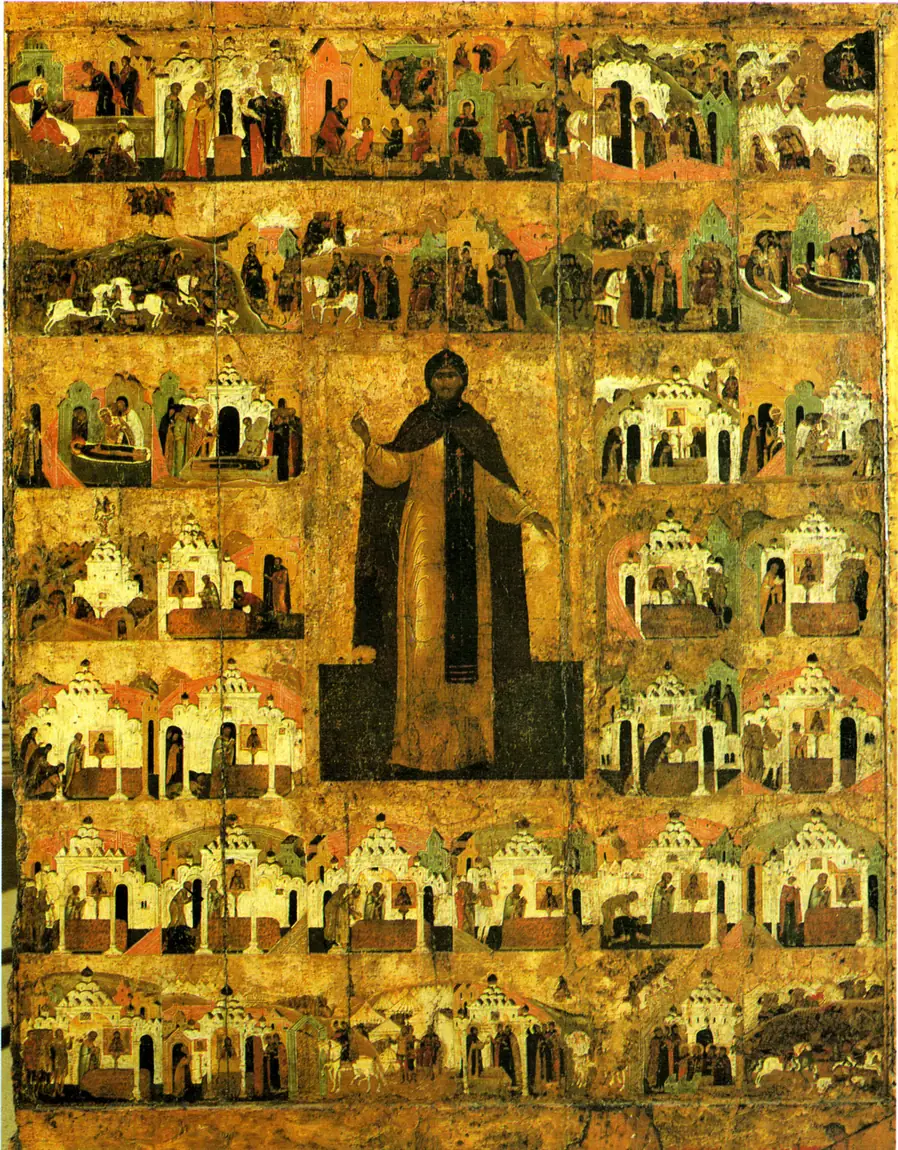
His relics were uncovered in 1380, the year of Kulikovo, and a local cult grew in Vladimir. The church council of 1547 under Metropolitan Makarii made him a saint of the whole Russian Church. Early icons show him as a monk, with a schema hood and a scroll, and the great vita icon in St Basil's Cathedral in Moscow surrounds him with scenes of his life.
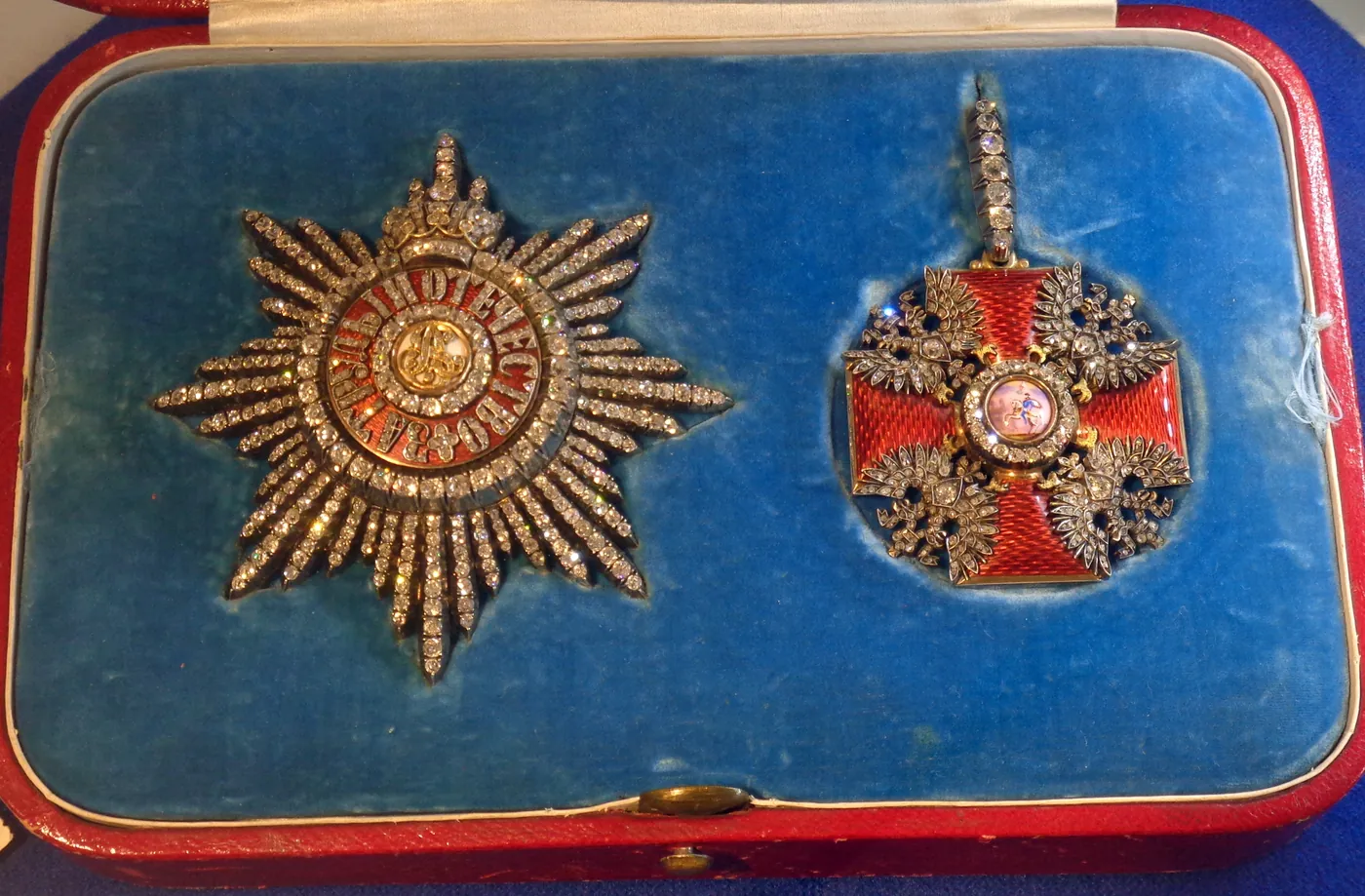
Peter the Great turned the monk into a soldier. In 1723 he ordered the relics brought from Vladimir to his new capital, and on 30 August 1724 they were received near the Izhora, close to the site of the Neva battle, and placed in the Alexander Nevsky monastery. The date was the anniversary of the peace of Nystad that had ended Peter's war with Sweden. On 15 June 1724 the Synod ordered that no one should paint the prince "in monastic form" any more, but "in grand-princely robes". From then on he appears in armour and an ermine-lined mantle. In 1725 Catherine I founded the Order of St Alexander Nevsky, which Peter had planned, as one of the highest awards of the Russian Empire.
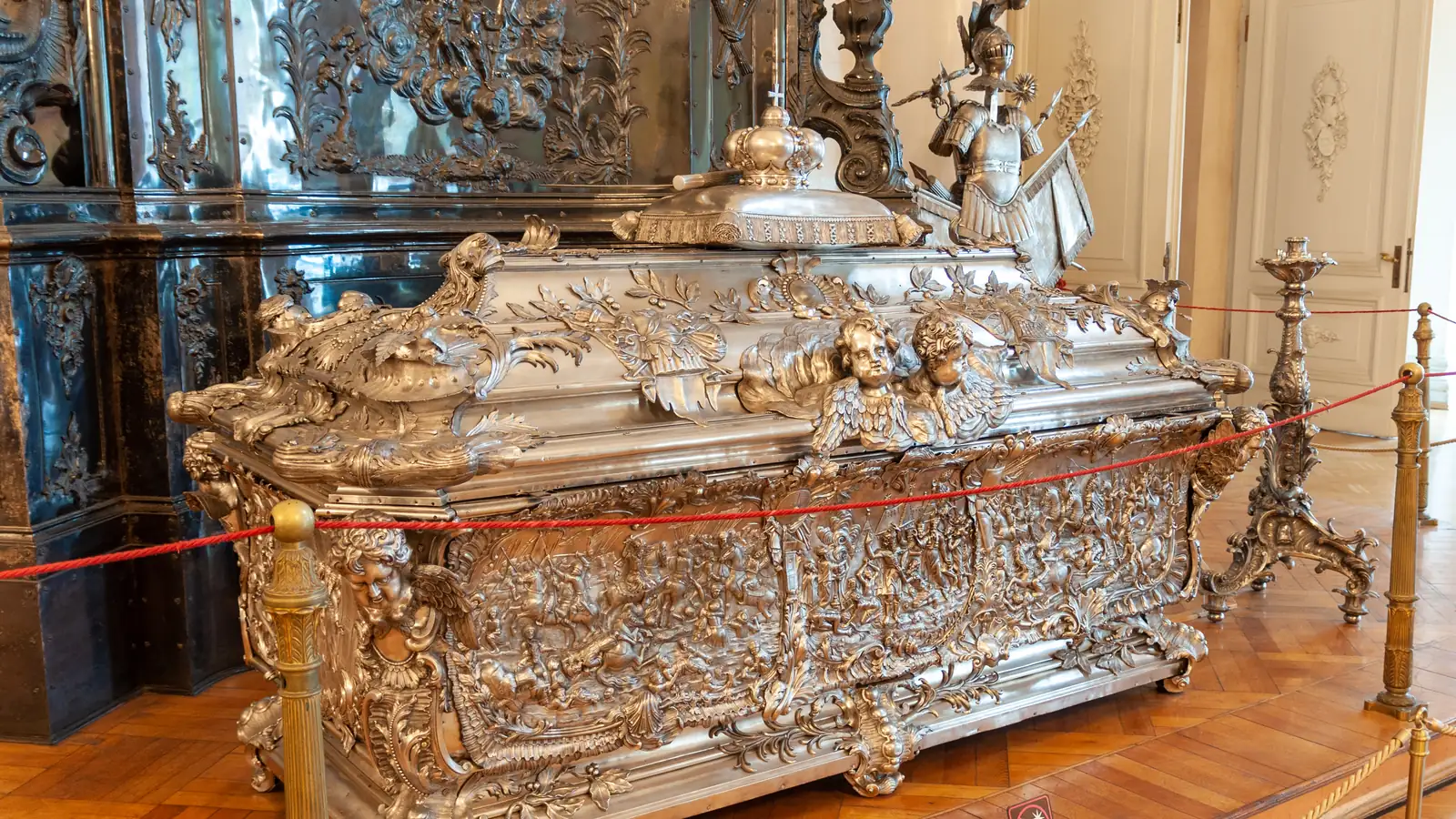
The empress Elizabeth gave the relics a silver shrine, made in 1750–1753. In 1922 the Soviet authorities opened the relics and took the shrine to the Hermitage, where it still stands. The bones went to an anti-religious museum and were returned to the Church in 1988–1989.
Alexander Nevsky in Soviet and modern Russia
The Soviet state at first had little use for a canonised prince. That changed in the 1930s. Eisenstein's Alexander Nevsky (1938), with music by Sergei Prokofiev, made him a hero against German invaders and became one of the most popular Soviet films. After the Molotov–Ribbentrop pact of August 1939 it disappeared from cinemas, and it came back after the German invasion in June 1941.
On 29 July 1942, in the middle of the war, the Presidium of the Supreme Soviet created a military Order of Alexander Nevsky for Red Army officers who had shown "personal daring, courage and bravery" and had led their units well. The film's line about those who come with the sword perishing by the sword is often quoted as Alexander's own words. It is not in the Life.
The cult survived the Soviet Union. In 2008 a Russian television poll to choose the greatest figure in the country's history, The Name of Russia, put Alexander first, ahead of the prime minister Pyotr Stolypin and Joseph Stalin, after "more than 50 million" votes, according to the BBC. A presidential decree of 23 June 2014 ordered national celebrations for his 800th birthday, held in 2021.
Common myths about Alexander Nevsky
| Myth | What the evidence says |
|---|---|
| He was called Nevsky in his lifetime | The name first appears in a list of princes from the early 15th century |
| He was born on 30 May 1220 | That is Tatishchev's date; Kuchkin's reconstruction of 13 May 1221 is now preferred, but neither date is recorded |
| The Teutonic Knights drowned when the ice broke on Lake Peipus | No 13th- or 14th-century source mentions breaking ice or drowning; the scene was made famous by Eisenstein's film |
| Thousands of knights died in 1242 | The Novgorod chronicle claims 400 Germans killed and 50 captured; the Order's chronicle admits 20 brothers dead and 6 captured |
| He refused the Pope at once | Innocent IV's second letter of 1248 thanks him for agreeing to a Latin cathedral in Pskov; the refusal in the Life is undated |
| He said "whoever comes to us with the sword shall perish by the sword" | The line is not in the Life or the chronicles |
| He fought the Mongols | No source records him fighting a Mongol army; he served the khans, enforced their census and kept his throne with their support |
What the map shows next
Alexander's son Daniel, born in 1261, received the small town of Moscow, and his descendants ruled Muscovy until 1598. By 1300 on the map the Rus' north-east is split between Vladimir-Suzdal, Moscow, Tver and Nizhny Novgorod, with the Golden Horde to the south and east.
At 1240 the Teutonic Order and the Livonian knights hold the lands west of Novgorod, Alexander's Swedish opponents lie across the Gulf of Finland, and the Mongol Empire reaches the edge of the Rus' lands. At 1380 on the map, Moscow's grand prince Dmitry, a great-great-grandson of Alexander, fights the Horde's warlord Mamai at Kulikovo, in the same year Alexander's relics were uncovered.
Sources
Primary sources
- The Chronicle of Novgorod, 1016–1471 (Novgorod First Chronicle), trans. R. Michell and N. Forbes (London, 1914), entries for 1236–1263: https://archive.org/details/chronicleofnovgo00michrich
- Laurentian Chronicle, Polnoe sobranie russkikh letopisei, vol. 1 (Leningrad, 1926–1928), entries for 6750–6771 (1242–1263): https://archive.org/details/psrl_tom1_lavrentyevskaya_letopis_1926
- Povest' o zhitii Aleksandra Nevskogo (Life of Alexander Nevsky), ed. and trans. V. I. Okhotnikova, Biblioteka literatury Drevnei Rusi, vol. 5 (Pushkin House, Russian Academy of Sciences): http://lib.pushkinskijdom.ru/Default.aspx?tabid=4962
- The Livonian Rhymed Chronicle, trans. J. C. Smith and W. L. Urban (Bloomington, 1977), pp. 31–32.
- John of Plano Carpini, Historia Mongalorum, ch. 30, in The Texts and Versions of John de Plano Carpini and William de Rubruquis, ed. C. R. Beazley (London, 1903), Hakluyt's translation: https://archive.org/details/textsversionsofj00hakluoft
- Decree of the Presidium of the Supreme Soviet of the USSR No. 600, 29 July 1942, establishing the Order of Alexander Nevsky: https://ru.wikisource.org/wiki/УказПрезидиумаВССССРот29.07.1942№_600
- Decree of the President of the Russian Federation No. 448, 23 June 2014, on celebrating the 800th anniversary of the birth of Prince Alexander Nevsky: http://kremlin.ru/acts/bank/38582
Studies
- A. V. Nazarenko, "Aleksandr Iaroslavich Nevskii", Pravoslavnaia entsiklopediia, vol. 1, pp. 541–544: https://www.pravenc.ru/text/64418.html
- V. A. Kuchkin, "Aleksandr Nevskii: gosudarstvennyi deiatel' i polkovodets srednevekovoi Rusi", Otechestvennaia istoriia 1996, no. 5, pp. 18–33 (archived copy): https://web.archive.org/web/20201128164336/http://istorja.ru/articles.html/russia/kuchkin-v-a-aleksandr-nevskiy-gosudarstvennyiy-deyatel-i-polkovodets-srednevekovoy-rusi-r786/
- A. A. Gorsky, "K otsenke deiatel'nosti Aleksandra Nevskogo", in Rus': ot slavianskogo rasseleniia do Moskovskogo tsarstva (Moscow, 2004) (archived copy): https://web.archive.org/web/20210616043319/https://statehistory.ru/books/Anton-Gorskiy_Rus-Ot-slavyanskogo-Rasseleniya-do-Moskovskogo-tsarstva/15
- A. V. Maiorov, "Aleksandr Nevskii, rimskii papa i mongol'skii khan", Drevniaia Rus'. Voprosy medievistiki 2021, no. 4, DOI 10.25986/IRI.2021.86.4.001: https://www.drevnyaya.ru/vyp/2021_4/part_1.pdf
- A. V. Sirenov, "O prozvishchakh drevnerusskikh kniazei", Peterburgskii istoricheskii zhurnal 2017: https://cyberleninka.ru/article/n/o-prozvischah-drevnerusskih-knyazey
- M. V. Shkarovsky, "Sud'ba moshchei sviatogo kniazia Aleksandra Nevskogo v XVIII–XX vekakh", Paleorosiia 2020, no. 1, DOI 10.24411/2618-9674-2020-10020: https://cyberleninka.ru/article/n/sudba-moschey-svyatogo-knyazya-aleksandra-nevskogo-v-xviii-xx-vekah
- D. Ostrowski, "Alexander Nevskii's 'Battle on the Ice': The Creation of a Legend", Russian History 33 (2006), pp. 289–312, DOI 10.1163/187633106X00186 (author's copy): https://donostrowski2.bitbucket.io/riseofeast/rh-legend2.pdf
- J. Fennell, The Crisis of Medieval Russia, 1200–1304 (London, 1983), as quoted by Kuchkin and Gorsky.
- Presidential Library, "Uchrezhden orden sviatogo Aleksandra Nevskogo" (1 June 1725): https://www.prlib.ru/history/619280
- O. Fedianina, "Pobochnye khudozhestvennye iavleniia: sovetsko-germanskii kul'turnyi obmen mezhdu avgustom 1939-go i iiunem 1941-go", Kommersant Weekend no. 27, 19 August 2016: https://www.kommersant.ru/doc/3060057
- "Stalin voted third-best Russian", BBC News, 28 December 2008: https://news.bbc.co.uk/2/hi/europe/7802485.stm
Image credits
- Title image: the silver shrine of Alexander Nevsky in the Hermitage. Photo: Don-vip, CC BY-SA 4.0, via Wikimedia Commons, cropped to 16:9.
- The Battle of the Neva, Illustrated Chronicle, vol. 6, p. 36. Public domain, via Wikimedia Commons.
- Alexander's wedding in 1239, Illustrated Chronicle, Golitsyn volume. Public domain, via Wikimedia Commons.
- Koporye, 1241, Illustrated Chronicle, vol. 6, p. 68. Public domain, via Wikimedia Commons.
- Vita icon of Alexander Nevsky, sixteenth century, St Basil's Cathedral, Moscow. Public domain, via Wikimedia Commons.
- Badge and star of the Order of St Alexander Nevsky, Tallinn Museum of Orders of Knighthood. Photo: Borodun, CC BY-SA 4.0, via Wikimedia Commons_-_Tallinn_Museum_of_Orders.jpg).