The Battle on the Ice was fought on Saturday 5 April 1242 near the narrows between Lake Peipus and Lake Pskov, on today's border between Estonia and Russia. Prince Alexander Yaroslavich of Novgorod, later called Alexander Nevsky, defeated an army of the Livonian branch of the Teutonic Order, the bishop of Dorpat (Tartu) and their Estonian levies. The Novgorod chronicle says 400 Germans were killed and 50 captured; the Order's own chronicle admits 20 knight-brothers dead and 6 taken prisoner.
Almost everything else people know about the battle comes later. No source written in the 13th or 14th century says that the ice broke or that knights drowned. The armies' sizes are unknown, and the place has never been found. What the sources actually say is enough for a good story, and a better one than the legend.
What was the Battle on the Ice?
It was the last and largest clash of a two-year war between Novgorod and the crusader powers of Livonia, the lands that are now Latvia and Estonia. In Russian it is the Ledovoe poboishche, "the slaughter on the ice"; older English books call it the Battle of Lake Peipus or Lake Chud, after the Russian name for the Estonians, the Chud.
| Date | Saturday 5 April 1242 (Julian calendar); 12 April in today's calendar |
| Place | "By Lake Chud at Uzmen by the Raven's rock" (Novgorod chronicle): the narrows between Lake Peipus and Lake Pskov; exact site unknown |
| Novgorod side | Alexander Yaroslavich of Novgorod, his brother Andrei with troops from Vladimir-Suzdal, the men of Novgorod |
| Opponents | Knight-brothers of the Livonian branch of the Teutonic Order, the vassals of Bishop Hermann of Dorpat, Estonian levies, probably Danish vassals from northern Estonia |
| Result | Novgorodian victory; the Germans give up their conquests and make peace the same year |
| Losses (Novgorod source) | 400 Germans killed, 50 captured, "countless" Estonians |
| Losses (German source) | 20 brothers killed, 6 captured |
Why did Novgorod and the Teutonic Order go to war?
The war grew out of the German conquest of Livonia. The Livonian Brothers of the Sword had been destroyed by the Lithuanians in 1236, and in 1237 their survivors were taken into the Teutonic Order as its Livonian branch. In 1238 a treaty returned northern Estonia to the Danish crown. The bishops of Riga, Dorpat and Ösel and the Order now faced the Rus' principalities across a long, open frontier.
In 1240, the year the Mongols took Kyiv far to the south, the Germans moved east. The Novgorod First Chronicle records that men from Odenpäh, Dorpat and Fellin, "with Knyaz Yaroslav Volodimirich", an exiled prince of Pskov, took the fortress of Izborsk. The Pskov army that came out against them was beaten, its commander killed, and the Germans besieged Pskov for a week. Then Pskov gave in: according to the chronicle, the boyar "Tverdilo Ivankovich with others had got them to come and himself began to rule in Pleskov with the Nemtsy", the chronicle's word for the Germans (trans. Michell and Forbes, 1914).
The Livonian Rhymed Chronicle, written by a member of the Order in the 1290s, tells the same story from the other side. Bishop Hermann of Dorpat "began to quarrel with the Russians", called the Brothers for help, and "the Master came to him straightaway with many noble heroes", joined by "the king's men", the Danish vassals of Estonia. They stormed "Isborg", and Pskov submitted. Two brothers stayed behind as governors (trans. Smith and Urban, 1977).
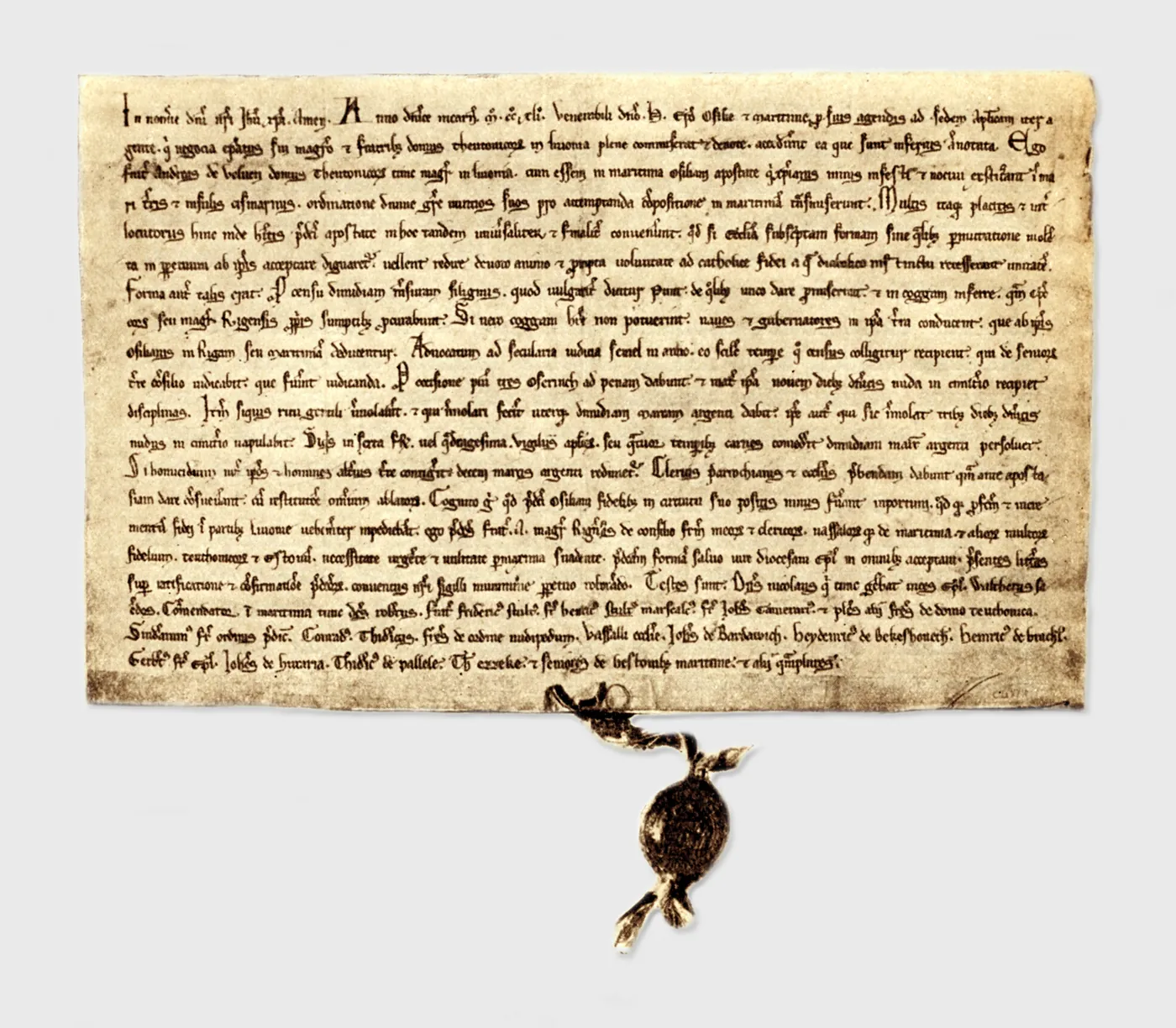
Novgorod itself was in trouble. That winter it quarrelled with its young prince Alexander, who had beaten the Swedes on the Neva a few months earlier, and he left the city. German and Estonian raiders imposed tribute on the Vod people west of Novgorod, built a fort at Koporye and rode to within thirty versts of the city. The Novgorodians sent their archbishop to bring Alexander back. His career is covered in our article on Alexander Nevsky.
How did Alexander win back Pskov?
Quickly. In 1241 Alexander took Koporye and "the Vod and Chud traitors he hanged". In the winter of 1241–1242 his father, Grand Prince Yaroslav of Vladimir-Suzdal, sent his younger son Andrei with troops from the north-east. The brothers "occupied all the roads right up to Pleskov", retook the town, and sent its German and Estonian garrison to Novgorod in chains.
Alexander then marched into the bishop of Dorpat's lands and let his army forage. A detachment under Domash Tverdislavich, the brother of Novgorod's posadnik, ran into Germans and Estonians "by a bridge" and was beaten; Domash was killed. Alexander pulled back towards the lake, and the Germans followed him.
Where was the Battle on the Ice fought?
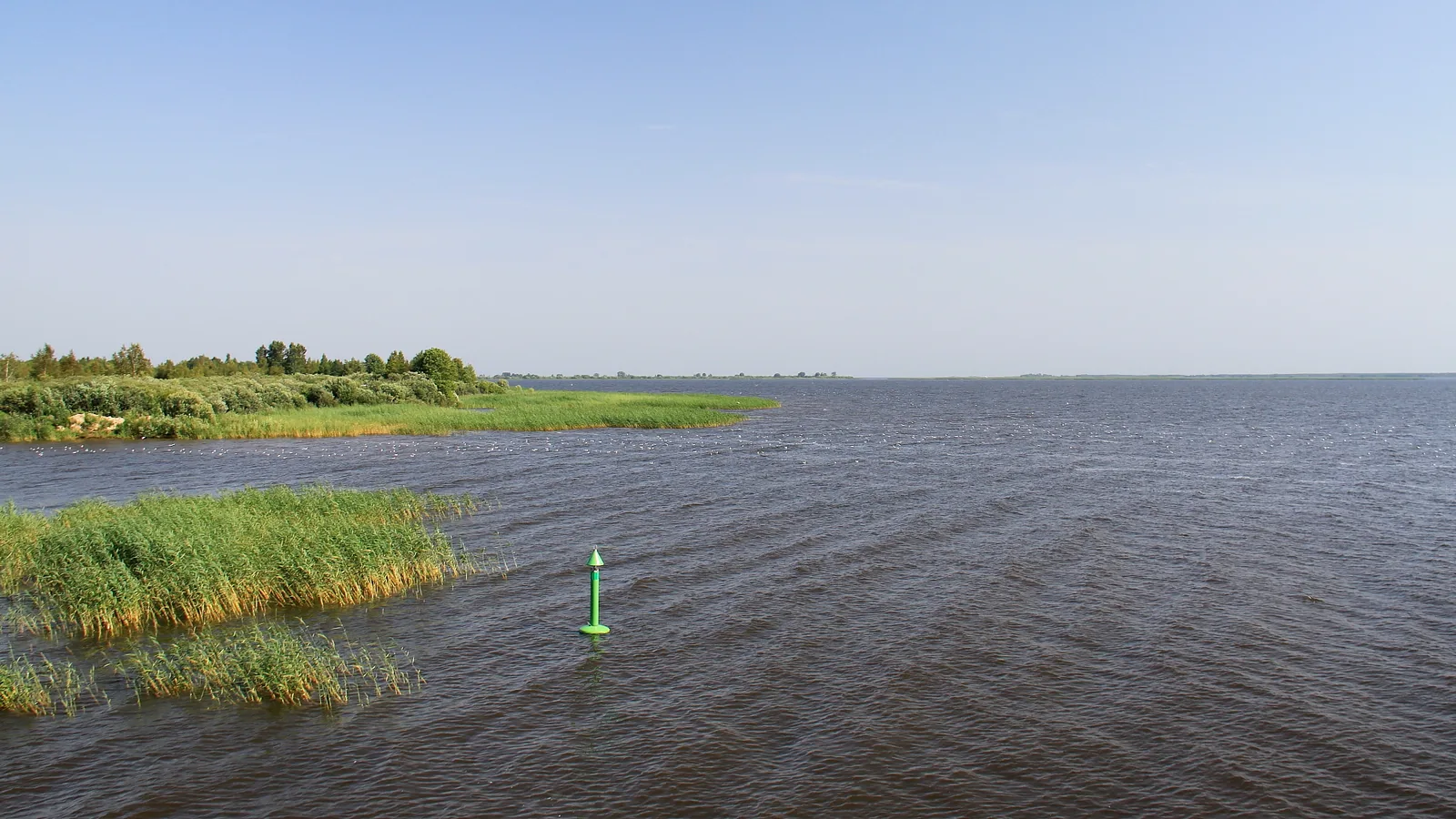
Nobody knows exactly. The oldest description, in the Novgorod First Chronicle, places the Novgorodian line "by Lake Chud at Uzmen by the Raven's rock". Uzmen is the narrow channel, today called Lämmijärv in Estonian and Teploe ozero in Russian, that joins Lake Peipus to Lake Pskov. The Raven's Stone (Voronii kamen') has never been identified for certain.
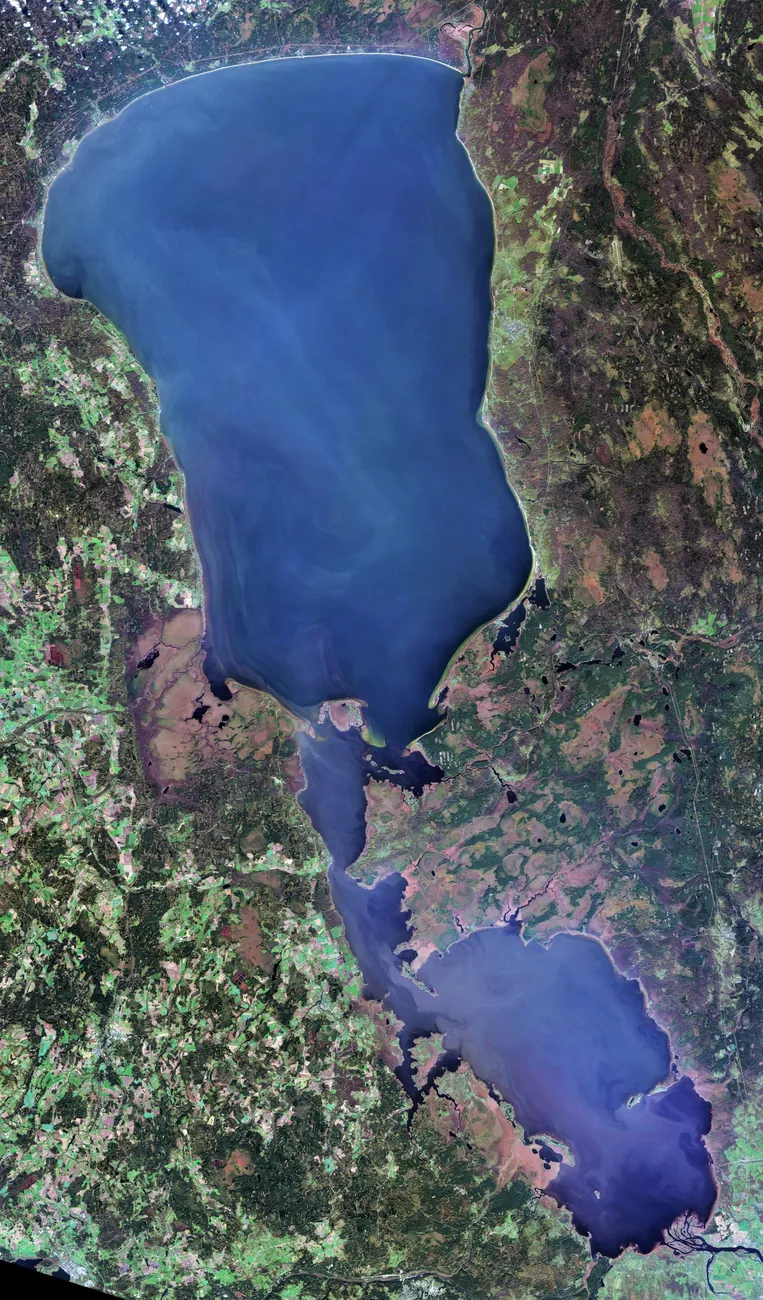
The Soviet Academy of Sciences sent a large expedition under Major-General Georgy Karaev in 1958–1962 to settle the question. It concluded that the lake level had risen since the 13th century and placed the Raven's Stone at a submerged rock north-west of Voronii island, near the eastern (Russian) shore. Divers searched the bottom of the northern Teploe ozero in 1958 and 1959 and found nothing connected with the battle, as Donald Ostrowski notes from Karaev's own report. An expedition of St Petersburg University in 2008 and 2013 defended Karaev's location, and a later underwater survey, reported by TASS, found scattered fragments of a rock that, as local people told the historian Ernst Paklar in the 1930s, had been blown up in the early 1920s as a danger to shipping.
Not a single weapon, bone or other object from 1242 has been found. Ostrowski doubts any ever will be.
What happened in the battle?
The oldest account is short. The Novgorod First Chronicle says that the Germans and Estonians "rode at them driving themselves like a wedge through their army; and there was a great slaughter of Nemtsy and Chud men". The Russian word for the wedge is svinya, "pig" or "swine". Then:
"And the Nemtsy fell there and the Chud men gave shoulder, and pursuing them fought with them on the ice, seven versts short of the Subol shore. And there fell of the Chud men a countless number; and of the Nemtsy 400, and fifty they took with their hands and brought to Novgorod." — Novgorod First Chronicle, 1242 (trans. Michell and Forbes, 1914)
Two details are easy to miss. The armies were drawn up "by" the lake, and the chronicle puts only the pursuit "on the ice". And seven versts is about seven or eight kilometres.
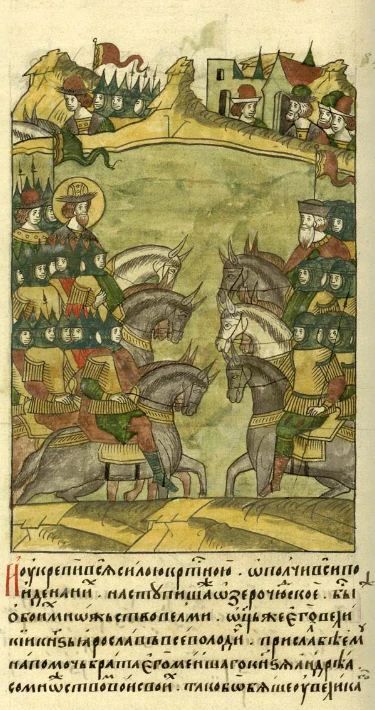
The German account is just as brief and differs in its details. In the Livonian Rhymed Chronicle the Rus' had "many archers", and the battle began with their attack on "the king's men". The Brothers' banners were "soon flying in the midst of the archers", and "many from both sides fell dead on the grass". Then:
"Then the Brothers' army was completely surrounded, for the Russians had so many troops that there were easily sixty men for every one German knight. The Brothers fought well enough, but they were nonetheless cut down. Some of those from Dorpat escaped from the battle, and it was their salvation that they had been forced to flee. Twenty Brothers lay dead and six were captured. Thus the battle ended." — Livonian Rhymed Chronicle (trans. Smith and Urban, 1977)
The German poet says nothing about a lake. His dead fall "on the grass", which may be a stock phrase. The other early Rus' accounts are shorter still. The Laurentian Chronicle, from the north-east, says only that Grand Prince Yaroslav sent his son Andrei "to help Alexander against the Germans, and they defeated them beyond Pskov on the lake and took many prisoners" (our translation). A later continuation in the same manuscript adds the Raven's Stone and a chase "over the ice" for seven versts.
How many soldiers fought at Lake Peipus?
No source gives a number for either army. The two chronicles count only the dead and the captured, and they do it very differently:
| Source | Date written | Losses on the German side |
|---|---|---|
| Novgorod First Chronicle, older (Synodal) copy | 14th century | 400 Germans killed, 50 captured, Estonians "beyond number" |
| Novgorod First Chronicle, younger copy | 15th century | 500 Germans killed, 50 captured |
| Livonian Rhymed Chronicle | 1290s | 20 brothers killed, 6 captured |
| Laurentian Chronicle | copied 1377 | "many prisoners" |
The usual way to reconcile the figures is that the Order's poet counted only the sworn knight-brothers, while the Novgorodians counted every German horseman, including squires, soldiers and the bishop's vassals. The Soviet editors of 1966 accepted this, and so does the military historian David Nicolle. Ostrowski suggests that the chronicle's "Germans" and "Chud" may mean mounted men and foot soldiers rather than nationalities.
Historians disagree about the figures and the scale:
- John Fennell accepted that just over 100 knights of the Order may have been present, but thought the 450 Germans killed and captured "clearly an exaggeration" (quoted by Ostrowski).
- Igor Danilevsky called the reconciliation doubtful, since no chronicler could count the enemy's dead, and argued that Alexander fought a small force of the bishop of Dorpat with a few brothers, not the main army of the Order.
- The Pravoslavnaya entsiklopediya rejects attempts to reduce the battle to an ordinary border skirmish, and says the victory secured the status quo on the Livonian–Novgorodian frontier until the 15th century.
- Modern estimates of the armies, as gathered by Ostrowski, run from about 700 to 15,000 men on the crusader side and from 1,700 to 17,000 on the Novgorodian side. "It is anyone's guess how many troops were involved," he concludes.
The Rhymed Chronicle's "sixty men for every one German knight" is no help. Its Russian editors noted that sixty is a conventional figure, and the same chronicle uses the same odds for the battle of Wesenberg (Rakvere) in 1268.
Did the Teutonic Knights fall through the ice?
No early source says so. Ostrowski traced how the story grew, layer by layer:
- The 13th and 14th centuries. The Laurentian Chronicle, the Novgorod First Chronicle and the Livonian Rhymed Chronicle mention no breaking ice and no drowning.
- The Life of Alexander. This saint's life, usually dated to the 1280s, makes the battle a miracle. "The frozen lake seemed to move, and the ice could not be seen, for it was covered in blood," it says, and an eyewitness told the author "that he had seen God's host in the air, coming to help Alexander" (our translation). Still no one drowns.
- The late 15th and 16th centuries. Moscow chronicles add a few words. The Moscow chronicle of the late 15th century has "others drowned in the lake", and the Sofia I and Nikon chronicles have "the water drowned others".
- 1938. In Sergei Eisenstein's film Alexander Nevsky, the ice breaks under the fleeing army of knights and swallows it. Ostrowski found no historian before the film who told the story this way, and Eisenstein's biographer Marie Seton reported that he took the imagery from Milton's battle in heaven in Paradise Lost.
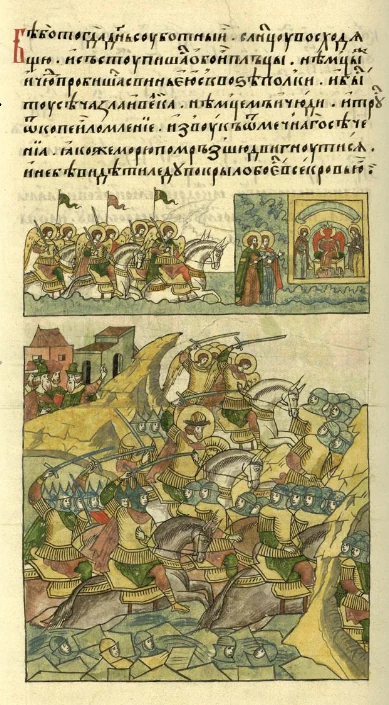
The film's influence is hard to overstate. Its translators made the point drily in a note to the Livonian Rhymed Chronicle: "Eisenstein's movie Alexander Nevsky is magnificent and worth seeing, but he tells us more about 1939 than 1242" (Smith and Urban, 1977). Danilevsky put it more bluntly: all the other "details" of the battle, "including knights sinking under broken ice, are the fruit of the 'reconstructors'' fantasy" (our translation). Lake Peipus is shallow, and it is possible that some men fell through near the shore in April, but no source written before the late 15th century says so.
What was the pig, the German wedge?
The Novgorod chronicle says the Germans "broke through our army svineyu", "like a pig". It is the only formation word in the account, and the chronicles use it for only two battles: Lake Peipus in 1242 and Wesenberg in 1268, both times for a German charge that pierced the Russian line. The Livonian Rhymed Chronicle speaks of the Brothers' banier, a unit fighting under one banner, and its Russian editor, Igor Kleinenberg, equated the two.
How the "pig" was arranged is a modern reconstruction. The historian Anatoly Bakhtin showed that Nikolai Karamzin, in the fourth volume of his History (1817), was apparently the first to turn it into a "sharp column" of knights, and later historians drew it as a precise wedge of horsemen around a core of infantry. The sources do not describe it.
What happened after the battle?
Peace came fast. "The same year", the Novgorod chronicle reports, the Germans sent envoys "in the absence of the Knyaz", that is, while Alexander was away, with an offer:
"The land of the Vod people, of Luga, Pleskov, and Lotygola, which we invaded with the sword, from all this we withdraw, and those of your men whom we have taken we will exchange, we will let go yours, and you let go ours." — Novgorod First Chronicle, 1242 (trans. Michell and Forbes, 1914)
The prisoners were exchanged and the Pskov hostages released. The Pskov chronicle remembers the prisoners being led "barefoot" over the ice, and dates the battle to 1 April. Danilevsky suggests the difference from 5 April may come from two calendars in use in Novgorod and Pskov.
The war did not change the frontier for long. Novgorod and the Livonian Order fought again at Wesenberg in 1268, a much bloodier battle by the chronicles' own account, which the Novgorod chronicler said was "such as neither fathers nor grandfathers had seen". The Livonian Rhymed Chronicle recorded the cost of 1242 for the Rus' prince as well: Alexander "paid for his victory, for he left behind many a bold man who would never again ride to war". Within a decade the real threat to Novgorod came from the Mongols, not from Livonia, and Alexander chose to serve them.
How is the battle remembered today?
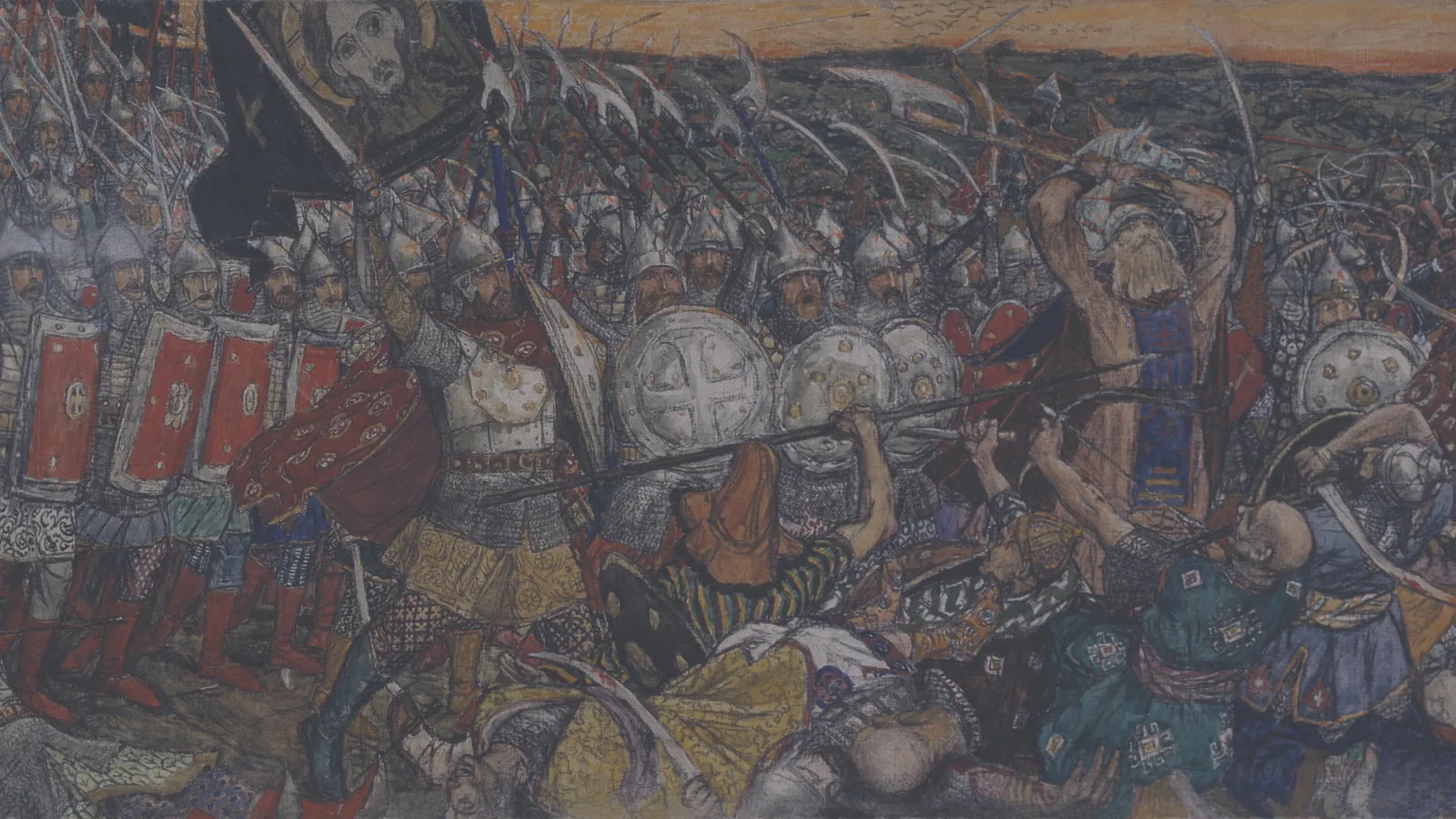
The battle was a minor episode in the chronicles and grew in later centuries. The 16th-century Illustrated Chronicle gave it several painted pages, and the Russian Empire celebrated Alexander as a saint and soldier. The Soviet Union turned it into a national epic: Eisenstein's film of 1938, with Sergei Prokofiev's music, made the charge across the ice the battle's defining image.
Modern Russia keeps the date. A federal law of 13 March 1995 made 18 April a Day of Military Glory, the "day of victory of the Russian soldiers of Prince Alexander Nevsky over the German knights on Lake Chud (the Battle on the Ice, 1242)". The date is 5 April plus 13 days, the modern difference between the Julian and Gregorian calendars; in 1242 the difference was only 7 days, so the true anniversary in today's calendar is 12 April. In 2021 a large memorial with a statue of Alexander and his retinue was unveiled at Samolva, on the Russian shore near the presumed battle site.
Common myths about the Battle on the Ice
| Myth | What the evidence says |
|---|---|
| The knights broke through the ice and drowned | No 13th- or 14th-century source says so. A few words about drowning appear in late 15th-century Moscow chronicles; the mass drowning comes from Eisenstein's film of 1938 |
| The whole battle was fought on the ice | The Novgorod chronicle has the armies drawn up "by" the lake and the pursuit "on the ice"; the German chronicle has the dead fall "on the grass" |
| Tens of thousands fought | No source gives army sizes. Modern guesses run from a few hundred knights and their men to over 10,000 on each side |
| Thousands of knights died | Novgorod claimed 400 Germans killed and 50 captured; the Order counted 20 brothers dead and 6 captured |
| The main army of the Teutonic Order was destroyed | The opponents were the Livonian branch and, above all, the bishop of Dorpat's men; the Order fought on in Prussia and Livonia for centuries |
| The battle site has been found | The Raven's Stone and the battlefield have never been identified; no object from 1242 has been recovered |
| 18 April is the anniversary | 18 April adds the modern 13-day calendar difference; in 1242 the gap was 7 days, so 5 April was 12 April in today's calendar |
Who told the story? The sources at a glance
| Source | Written | What it adds |
|---|---|---|
| Livonian Rhymed Chronicle | 1290s, by a member of the Order | Archers, encirclement, 20 brothers dead and 6 captured; no lake |
| Laurentian Chronicle | copied 1377 from earlier Vladimir annals | Andrei sent to help; victory "on the lake"; prisoners |
| Novgorod First Chronicle, older copy | 14th century | Uzmen, Raven's rock, the "pig", the 7-verst chase on the ice, 400 and 50, the peace terms |
| Life of Alexander | usually dated to the 1280s; Ostrowski argues for the mid-14th century | Blood on the ice, God's host in the air |
| Pskov First Chronicle | later medieval copies | Battle "on the ice" on 1 April; prisoners led barefoot |
| Moscow chronicles (Sofia I, Nikon) | late 15th–16th century | The first drownings |
What the map shows next
At 1240 the map still shows the old lands of the Brothers of the Sword in Livonia, with the Novgorod Republic to the east and Sweden across the Gulf of Finland. By 1300 on the map the Teutonic Order rules Prussia and much of Livonia, the Pskov Republic guards the frontier, and the Grand Duchy of Lithuania has become the great power between them.
Sources
Primary sources
- The Chronicle of Novgorod, 1016–1471 (Novgorod First Chronicle), trans. R. Michell and N. Forbes (London, 1914), entries for 1240–1242 and 1268: https://archive.org/details/chronicleofnovgo00michrich
- Novgorodskaia pervaia letopis' starshego i mladshego izvodov, ed. A. N. Nasonov (Moscow and Leningrad, 1950), entry 6750 in both copies: https://archive.org/details/novhorodskyj_litopys
- The Livonian Rhymed Chronicle, trans. J. C. Smith and W. L. Urban (Bloomington, 1977), pp. 29–32 and note 87: https://archive.org/details/livonian-rhymed-chronicle.-1977
- Laurentian Chronicle, Polnoe sobranie russkikh letopisei, vol. 1 (Leningrad, 1926–1928), entry 6750 and the Suzdal continuation: https://archive.org/details/psrl_tom1_lavrentyevskaya_letopis_1926
- Pskovskie letopisi, vol. 1, ed. A. N. Nasonov (Moscow and Leningrad, 1941), entry 6750: https://archive.org/details/pskovskieletopisivyp165
- Povest' o zhitii Aleksandra Nevskogo (Life of Alexander Nevsky), ed. and trans. V. I. Okhotnikova, Biblioteka literatury Drevnei Rusi, vol. 5 (Pushkin House): http://lib.pushkinskijdom.ru/Default.aspx?tabid=4962
- Federal Law No. 32-FZ of 13 March 1995, "On the days of military glory and memorable dates of Russia", art. 1: http://kremlin.ru/acts/bank/7640
Studies
- D. Ostrowski, "Alexander Nevskii's 'Battle on the Ice': The Creation of a Legend", Russian History 33 (2006), pp. 289–312, DOI 10.1163/187633106X00186 (author's copy): https://donostrowski2.bitbucket.io/riseofeast/rh-legend2.pdf
- I. N. Danilevsky, "Aleksandr Nevskii i Tevtonskii orden", Slovo.ru: baltiiskii aktsent 2011: https://cyberleninka.ru/article/n/aleksandr-nevskiy-i-tevtonskiy-orden
- Iu. V. Krivosheev and R. A. Sokolov, "Ledovoe poboishche 1242 goda: issledovateli i issledovaniia", Studia Slavica et Balcanica Petropolitana 2014: https://cyberleninka.ru/article/n/ledovoe-poboische-1242-goda-issledovateli-i-issledovaniya
- A. P. Bakhtin, "Ledovoe poboishche: o postroenii 'svin'ei', ili 'ostroi kolonnoi'", Slovo.ru: baltiiskii aktsent 2015: https://cyberleninka.ru/article/n/ledovoe-poboische-o-postroenii-sviniey-ili-ostroy-kolonnoy
- I. E. Kleinenberg, Russian translation and commentary of the Livonian Rhymed Chronicle, in Ledovoe poboishche 1242 g., ed. G. N. Karaev (Moscow and Leningrad, 1966), online edition: http://www.vostlit.info/Texts/rus12/Livl_Alte_Reimschronik/text1.phtml?id=827
- A. V. Nazarenko, "Aleksandr Iaroslavich Nevskii", Pravoslavnaia entsiklopediia, vol. 1, pp. 541–544: https://www.pravenc.ru/text/64418.html
- J. Fennell, The Crisis of Medieval Russia, 1200–1304 (London, 1983), pp. 105–106, as quoted by Ostrowski.
- D. Nicolle, Lake Peipus 1242: Battle of the Ice (London, 1996), as quoted by Ostrowski.
- "Spetsialisty planiruiut sozdat' 3D-model' kamnei vremen Ledovogo poboishcha na Chudskom ozere", TASS Nauka (archived copy): https://web.archive.org/web/20230603115801/https://nauka.tass.ru/nauka/11904413
- Kremlin, opening of the memorial "Prince Alexander Nevsky with his retinue", 11 September 2021: http://kremlin.ru/events/president/news/66661
Image credits
- Title image: Lämmijärv from Laaksaare. Photo: Ingvar Pärnamäe, 2010, public domain (released by the author), via Wikimedia Commons, cropped to 16:9.
- Treaty of 1241 between the Livonian Order, the bishop of Ösel-Wiek and the Oeselians, Swedish National Archives. Public domain, via Wikimedia Commons.
- Lake Peipus, Landsat 8, 20 October 2016. NASA/USGS, public domain, via Wikimedia Commons.
- Illustrated Chronicle, vol. 6, p. 84. Public domain, via Wikimedia Commons.
- Illustrated Chronicle, vol. 6, p. 86. Public domain, via Wikimedia Commons.
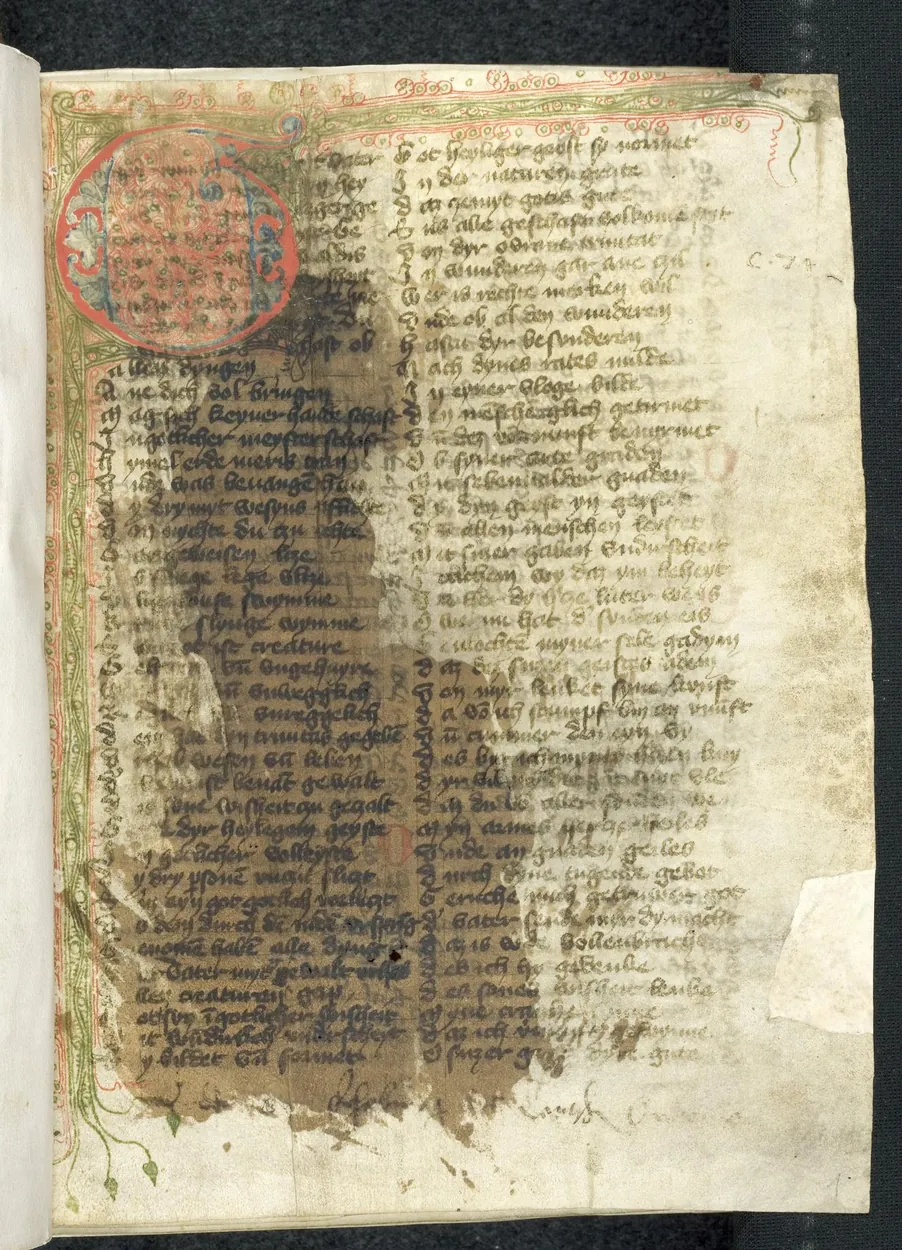
- Livonian Rhymed Chronicle, Heidelberg University Library, Cod. Pal. germ. 367, fol. 1r. Public domain, via Wikimedia Commons; the library's digitisation banner was cropped off.