The Battle of Kulikovo was fought on Saturday 8 September 1380 near the mouth of the Nepryadva river, a tributary of the upper Don, south of Moscow. Grand Prince Dmitry Ivanovich of Moscow and his allies defeated the army of Mamai, a Horde warlord who ruled the western steppe through puppet khans. It was the greatest victory of the Rus' princes over a Horde army up to that time, and Dmitry later received the name Donskoy, "of the Don".
It did not end Horde rule. Within weeks Mamai was overthrown by the khan Tokhtamysh, and two years later Tokhtamysh took and burned Moscow. Much of what is usually told about the battle, from the hundreds of thousands of soldiers to the duel of Peresvet and Chelubey, comes from texts written a century or more later. This article sets out what the earliest sources say and what was added afterwards.
The Battle of Kulikovo at a glance
| Date | Saturday 8 September 1380 (Julian calendar), the feast of the Nativity of the Mother of God; 16 September in today's calendar |
| Place | Kulikovo Field, near the mouth of the Nepryadva on the upper Don (Tula region, Russia) |
| Rus' side | Grand Prince Dmitry Ivanovich of Moscow and Vladimir, his cousin Vladimir Andreevich of Serpukhov, princes of Beloozero and other lands, two Lithuanian princes, Andrei and Dmitry Olgerdovich |
| Opponents | The army of Mamai and his khan Tyulyak (Tulunbek) |
| Absent allies of Mamai | Grand Duke Jogaila (Jagiełło) of Lithuania; Prince Oleg of Ryazan (accused of helping Mamai) |
| Result | Victory of Dmitry; Mamai flees and is soon overthrown and killed |
| Army sizes | Unknown; modern estimates for the Rus' side mostly between about 5,000 and 30,000 |
Who was Mamai?
Mamai was not a khan. He was a commander of the Golden Horde, the Mongol state on the Volga, who rose to power during the Horde's long civil war after 1359, the "great troubles" (velikaya zamyatnya), when khans followed each other in quick succession. Mamai was not a descendant of Genghis Khan and could not take the throne himself. Instead he married into the ruling family, which gave him the honorific title of güregen, "khan's son-in-law", and ruled the western half of the Horde through khans he placed on the throne (Varvarovsky, 1999).
The earliest Russian account of his power is blunt. Describing the year 1378, the chronicle explains that the Horde's khan "at that time ruled nothing and dared do nothing before Mamai, but Mamai held all seniority and ruled everything in the Horde" (our translation). In 1380 the khan in whose name Mamai ruled was Tyulyak, also called Tulunbek.
Why did Dmitry fight Mamai?
Moscow had grown into the leading Rus' principality by serving the Horde. Its princes collected the Horde's tribute from the other princes and held the patent (yarlyk) for the grand principality of Vladimir. In the chaos of the great troubles that service became harder to fix: whom should one pay, and which khan's patent counted?
In 1374, the chronicles report, there was a "breach of peace with the Tatars and with Mamai". The conflict grew. In 1377 a Russian army was routed on the Pyana river. On 11 August 1378 Dmitry won his first real victory, on the Vozha river in the land of Ryazan, over a Horde army under Mamai's commander Begich. Mamai answered by ravaging the land of Ryazan. In the summer of 1380 he gathered a large army to punish Moscow and restore its tribute, and made an alliance with Jogaila of Lithuania.
The campaign of 1380
Dmitry gathered his forces at Kolomna in August 1380. According to the Orthodox Encyclopedia, which reconstructs the campaign from the chronicles, troops came from his close relatives, the princes of Beloozero, and from many towns of the north-east: Vladimir, Pereyaslavl, Kostroma, Rostov, Dmitrov and others. Two sons of the Lithuanian grand duke Olgerd, Andrei of Polotsk and Dmitry of Bryansk, joined him.
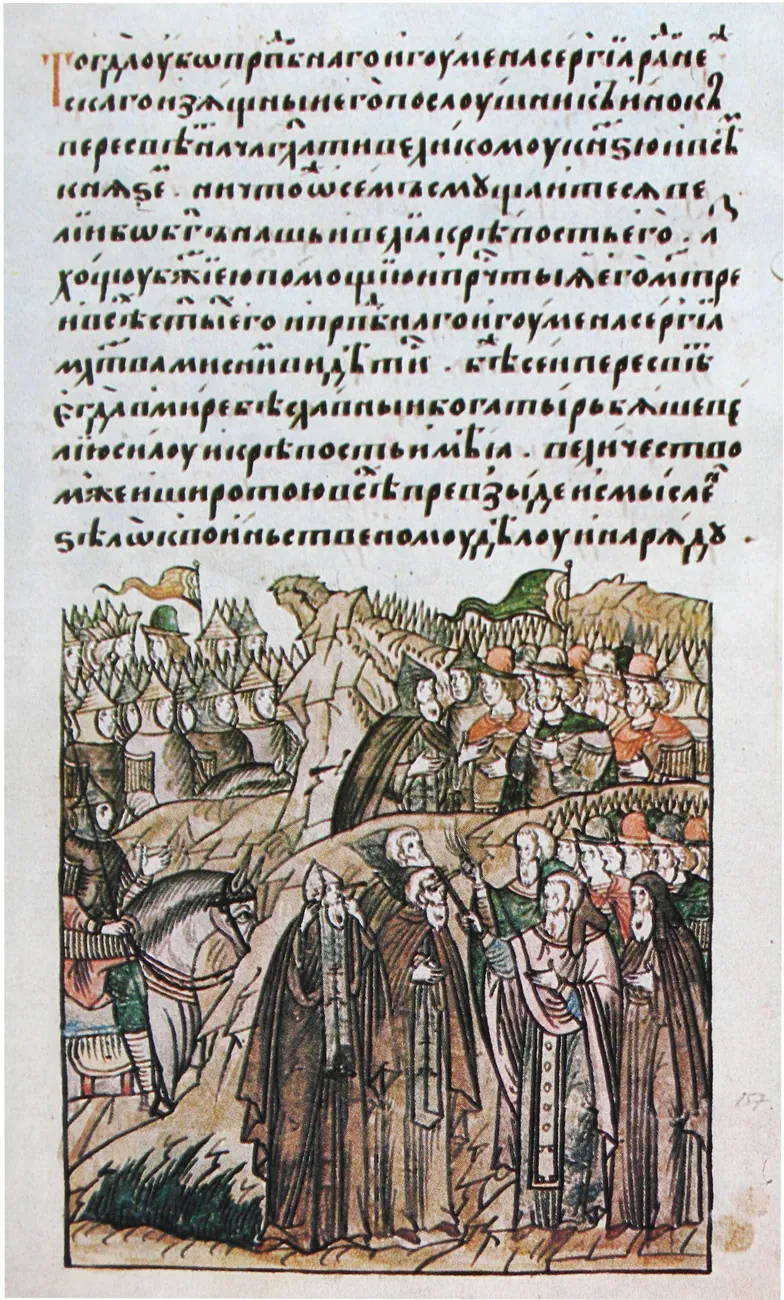
The army crossed the Oka and marched south towards the Don. The long chronicle tale, written in the 15th century, says Dmitry reached the Don "two days before the Nativity of the Holy Mother of God", that is, on 6 September. Then, it adds, "a letter with a blessing came from the venerable abbot Sergius": "That you, lord, should go forth, and God and the Holy Mother of God will help you" (trans. Salmina).
In the night of 7 to 8 September the army crossed the Don. It was a deliberate choice: with the river at its back, it could not retreat, but it also stood between Mamai and his Lithuanian allies. Jogaila had stopped near Odoev, about 140 kilometres away, and never arrived.
What happened on 8 September 1380?
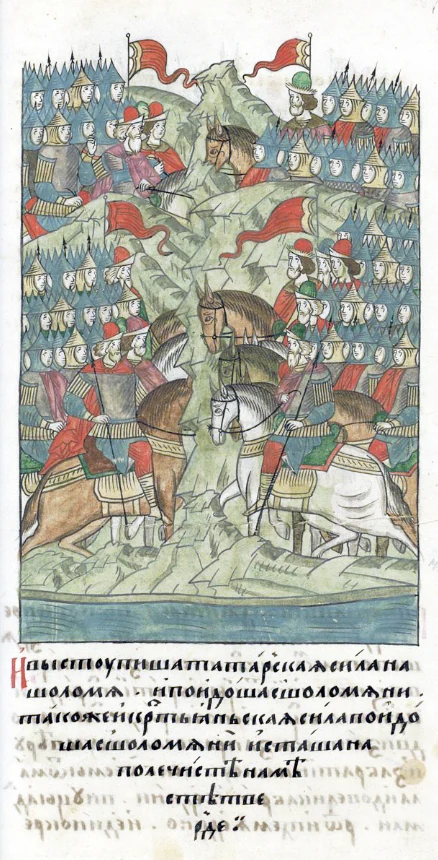
The oldest account is a short chronicle tale written soon after the battle and included in the chronicle compilation of 1408. Its description of the fighting is brief. The grand prince crossed the Don, "and there was a field, open and very large", and "the godless Polovtsians, the Tatar regiments" met them there, "for the field was open at the mouth of the Nepryadva river". The two armies clashed, "and for a long time there was a great shouting and an evil slaughter. All day long they cut at each other, and countless dead fell on both sides" (our translation, here and below).
Then "God helped Grand Prince Dmitry Ivanovich, and Mamai's pagan regiments fled, and ours pursued them, beating and cutting down the pagans without mercy". Many drowned in a river, and the Rus' chased them as far as the Mecha river. Mamai fled "with a small retinue into his Tatar land". The tale gives the date precisely: "And the battle was in the month of September on the 8th day, on the Nativity of the Holy Mother of God, on Saturday before dinner." In the Julian calendar used in Rus', 8 September 1380 was indeed a Saturday.
Then it lists the dead, starting with Prince Fyodor Romanovich of Beloozero and his son Ivan, followed by Moscow boyars such as Mikula Vasilievich and Mikhail Brenkov, and ending with "Alexander Peresvet and many others". That is all. The short tale has no ambush regiment, no duel and no monks.
The longer chronicle tale, written in the middle of the 15th century, adds detail, much of it hard to check. It sets the fighting from about the sixth to the ninth hour of the day, roughly late morning to early afternoon, and describes Peresvet as "formerly a boyar of Bryansk".
Historians disagree about almost everything beyond the outcome. The traditional battle plan, with six regiments, an infantry militia in the centre and a hidden ambush regiment in an oak wood, comes from texts of the late 15th and 16th centuries. The historian Dmitry Borovkov, summing up research since 2000, concludes that the course of the battle "as we know it from textbooks and popular literature is a later invention": its authors projected the military practice of their own time onto 1380. The Rus' army was probably entirely mounted, made up of the princes' household troops and the boyars' retinues; "the data on the participation of popular infantry militias in the battle are a later invention" (Borovkov, 2025). One element may be real: palaeobotanical research has found that an oak wood stood to the north-east of the main concentration of finds, near the Rus' left flank, where the ambush regiment is said to have waited.
How many soldiers fought at Kulikovo?
No reliable count survives. The medieval texts give ever larger figures the later they were written, and modern estimates have shrunk as research went on.
| Figure for the Rus' army | Source |
|---|---|
| 100,100 at Kolomna; "150,000 or 200,000" in all | Long chronicle tale, 15th century |
| 300,000 | Zadonshchina, a poem about the battle |
| "more than four hundred thousand horse- and footmen" | Nikon Chronicle, 16th century (trans. Zenkovsky) |
| 253,000 dead and 50,000 survivors | Tale of the Rout of Mamai, late 15th century or later |
| 50,000–60,000 | E. A. Razin, mid-20th century |
| about 36,000 | A. N. Kirpichnikov, 1976 |
| about 30,000 | George Vernadsky |
| 15,000–20,000 | A. V. Kuzmin, Orthodox Encyclopedia |
| 10,000–12,000 cavalry | V. V. Penskoi, 2020 |
| most likely 7,000–12,000, at most 15,000 cavalry | O. V. Dvurechensky, 2014 |
The most important new argument is the size of the field. Archaeologists working on the field in recent decades have found that the fighting took place on an area no more than about one kilometre wide and two kilometres long, not on a front of three and a half to four kilometres, as older reconstructions assumed (Borovkov, 2025). An army of hundreds of thousands, or even of 100,000, could not have deployed there. The Orthodox Encyclopedia puts the Rus' position at no more than 1.5 square kilometres, with the Don and the Nepryadva protecting its rear.
Victor Zenkovsky, the translator of the Nikon Chronicle, put the medieval figures in their place long ago: "In most of those works the number of Russian troops is considerably exaggerated. In any case, it could not have been four hundred thousand, as is mentioned in most descriptions."
Where was the battle fought?
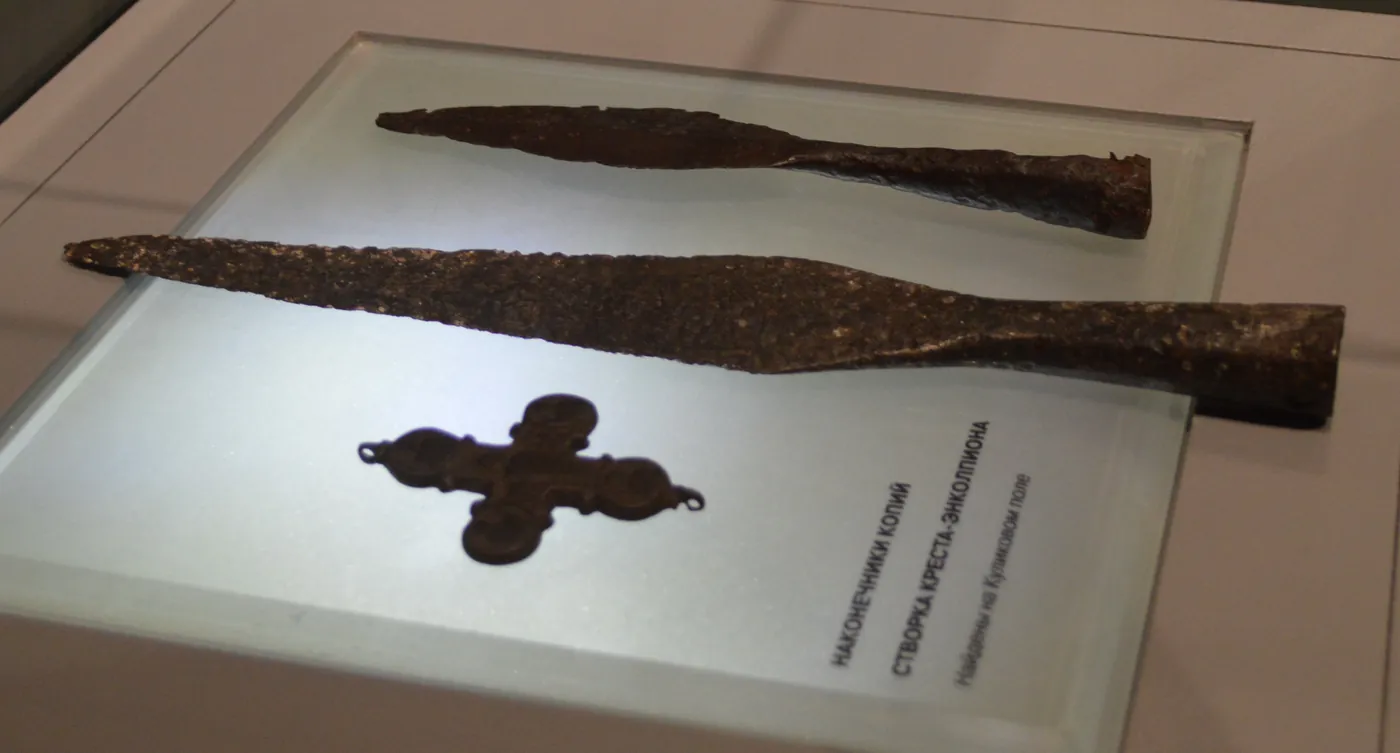
Near the mouth of the Nepryadva, as the oldest tale says. The archaeological work of the State Museum-Reserve "Kulikovo Field" and the Upper Don expedition led by Oleg Dvurechensky identified, in the seasons of 2002–2015, several clear clusters of weapons and equipment of the second half of the 14th century near the confluence, and in 2011–2015 a further large cluster to the south-west, probably where a fleeing unit of the Horde was cut down. Borovkov writes that this work has "completely refuted" the pseudo-scientific theories that the events of 1380 were invented: the battle at the confluence of the Nepryadva and the Don is now confirmed by material evidence (Borovkov, 2025).
Some writers still move the battle. Sergei Azbelev argued that the chronicles' "mouth" of the Nepryadva meant its source, which would put the battle some 40 kilometres upstream; others look for a "third mouth". These ideas have little support among historians and archaeologists.
Did Sergius of Radonezh bless Dmitry?
According to the famous story, Dmitry visited the Trinity monastery before the campaign, where its founder, St Sergius of Radonezh, blessed him and gave him two monks, Alexander Peresvet and Andrei Oslyabya, to fight in his army. The earliest sources tell it differently.
The short chronicle tale of the 1408 compilation does not mention Sergius at all. The long tale has only a letter of blessing that reached Dmitry on the Don on 6 September. The visit to the monastery and the two monks appear in the Tale of the Rout of Mamai and the Life of Sergius. The historian V. A. Kuchkin has argued that Dmitry did receive Sergius's blessing at the Trinity monastery, but before the battle on the Vozha in 1378, not before Kulikovo; the Orthodox Encyclopedia calls this "a well-founded hypothesis".
Peresvet and Chelubey: the duel that grew
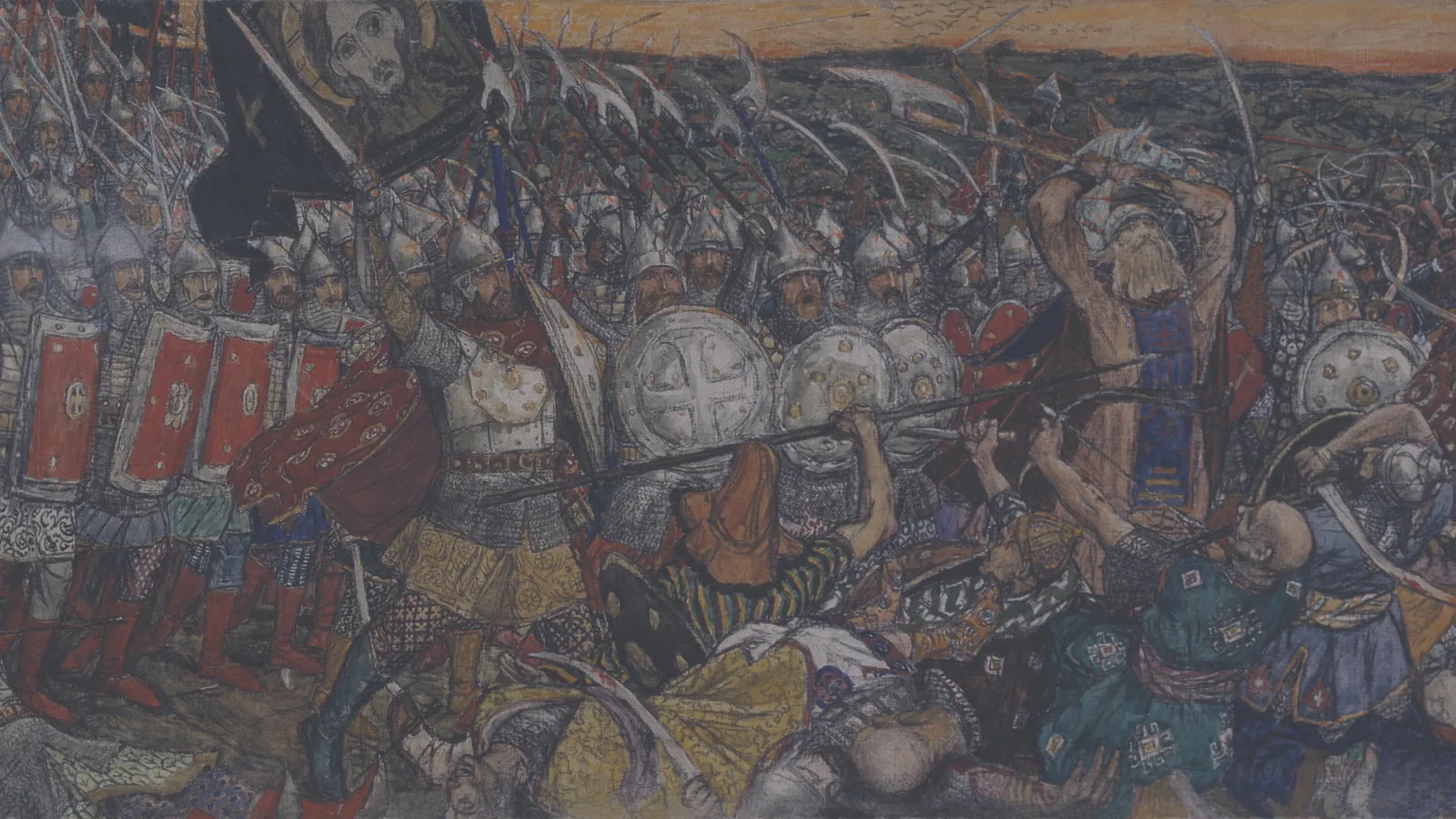
The best-known moment of the battle is the duel before it began: the monk Peresvet rides out against a giant Tatar champion, and both fall dead. It is told in every Russian schoolbook and painted by Viktor Vasnetsov and Mikhail Avilov. The sources show how it grew.
- The short chronicle tale (1408 compilation). Alexander Peresvet appears only in the list of the dead. No duel, no monk.
- The long chronicle tale (mid-15th century). Peresvet is "formerly a boyar of Bryansk". Still no duel.
- The Russian Chronograph of 1512 (written in the 1520s). Duels open the battle, and the one who distinguished himself is Oslyabya, a boyar of Lyubutsk. Later versions of the same text, and the Tale of the Rout of Mamai, transfer the deed to his brother Peresvet (Orthodox Encyclopedia).
- The Tale of the Rout of Mamai. Now Peresvet is a monk, and his opponent is "an evil Pecheneg … like the ancient Goliath: five sazhens his height and three sazhens his breadth". They strike each other with spears, "and both fell from their horses to the ground and died" (trans. Kolesov).
- The Nikon Chronicle (16th century). The champion has a name: "the Tatar knight, Temir Murza" (trans. Zenkovsky).
The name Chelubey, now inseparable from the story, does not appear in any of these texts. It belongs to a still later layer of the tradition. And the Zadonshchina and the Tale have Peresvet's companion, the monk Andrei Oslyabya, die in the battle too, yet documents of 1390–1393 mention "the monk Andrei Oslyabya" among the boyars of Metropolitan Cyprian (Orthodox Encyclopedia).
The texts of the Kulikovo cycle
The battle is known from a group of Russian texts called the Kulikovo cycle. Their dates matter, because each later text adds something:
| Text | Written | What it adds |
|---|---|---|
| Short chronicle tale | Soon after the battle; in the chronicle compilation of 1408 | Date, place, flight of Mamai, the list of the dead |
| Zadonshchina | Probably the 1380s (L. A. Dmitriev); disputed | A poetic lament and praise of the victory; 300,000 men; Peresvet and Oslyabya as monk-warriors |
| Long chronicle tale | Not before the middle of the 15th century (M. A. Salmina) | Sergius's letter, the hours of the battle, 150,000–200,000 men |
| Tale of the Rout of Mamai | Late 15th century or later (A. V. Kuzmin); about 200 copies in 8 redactions | Trinity visit, monks, duel, ambush regiment, visions, huge numbers |
| Nikon Chronicle | 1520s–1530s | Named champion, 400,000 men |
The Tale of the Rout of Mamai is the most influential and the least reliable. It has Metropolitan Cyprian bless the army, although, as its modern editor Lev Dmitriev noted, "Cyprian was not in Moscow in 1380", and it names Mamai's Lithuanian ally as Olgerd, who had died in 1377, instead of his son Jogaila. Dmitriev saw these not as mistakes but as "a deliberate literary and publicistic device" (our translation). The historian Anton Gorsky goes further and calls the Tale "a work of fiction written on the motifs of a real event" (Gorsky, 2023).
After the battle: Tokhtamysh and the burning of Moscow
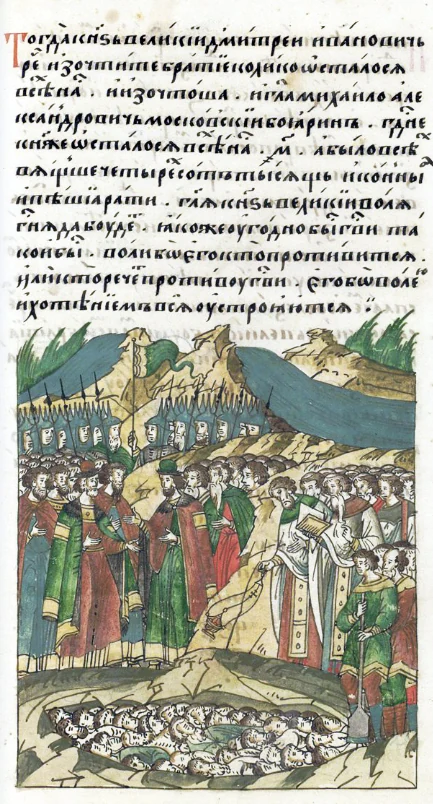
The victors stayed on the battlefield for several days, "standing on the bones", as the chronicle puts it, and burying the dead. The Orthodox Encyclopedia dates the army's departure for Kolomna to 14 September.
Mamai gathered what was left of his army and planned a new attack. But a rival had appeared in the east: Tokhtamysh, a descendant of Genghis Khan backed by the great conqueror Timur. The two armies met on the Kalka river, and Mamai's commanders "dismounted from their horses and bowed down to Khan Tokhtamysh, and swore oaths to him according to their faith, and left Mamai in disgrace", the chronicle says. Mamai fled to the Genoese port of Kaffa in the Crimea, where he was killed.
Tokhtamysh now ruled a reunited Horde, and the Rus' princes soon sent him envoys with gifts. In August 1382 he marched on Moscow. Dmitry left for Kostroma to raise troops; after three days of failed assaults the Horde took the city by a trick and burned it. The Horde's tribute was resumed, together with the arrears of the 1370s, which came to 8,000 roubles. In the autumn of 1382 Tokhtamysh confirmed Dmitry's patent to the grand principality.
The victory was not wasted. The Orthodox Encyclopedia argues that its political effects could no longer be undone, and in his testament of 1389 Dmitry left the grand principality to his son Vasily without asking the khan first, for the first time. But Horde overlordship lasted another century.
Dmitry Donskoy: the man and the name
Dmitry Ivanovich was born on 12 October 1350 and became prince of Moscow in 1359, aged nine. He spent his reign fighting for the grand principality against Tver and Lithuania, built the stone Kremlin of Moscow, the first stone fortress of its kind in north-eastern Rus', and died on 19 May 1389, aged 38. His contemporaries called him simply "Grand Prince Dmitry Ivanovich". According to the Orthodox Encyclopedia, he received the honorific name Donskoy only in the reign of Ivan the Terrible, in the 16th century. The Russian Orthodox Church canonised him in 1988.
How is Kulikovo remembered today?
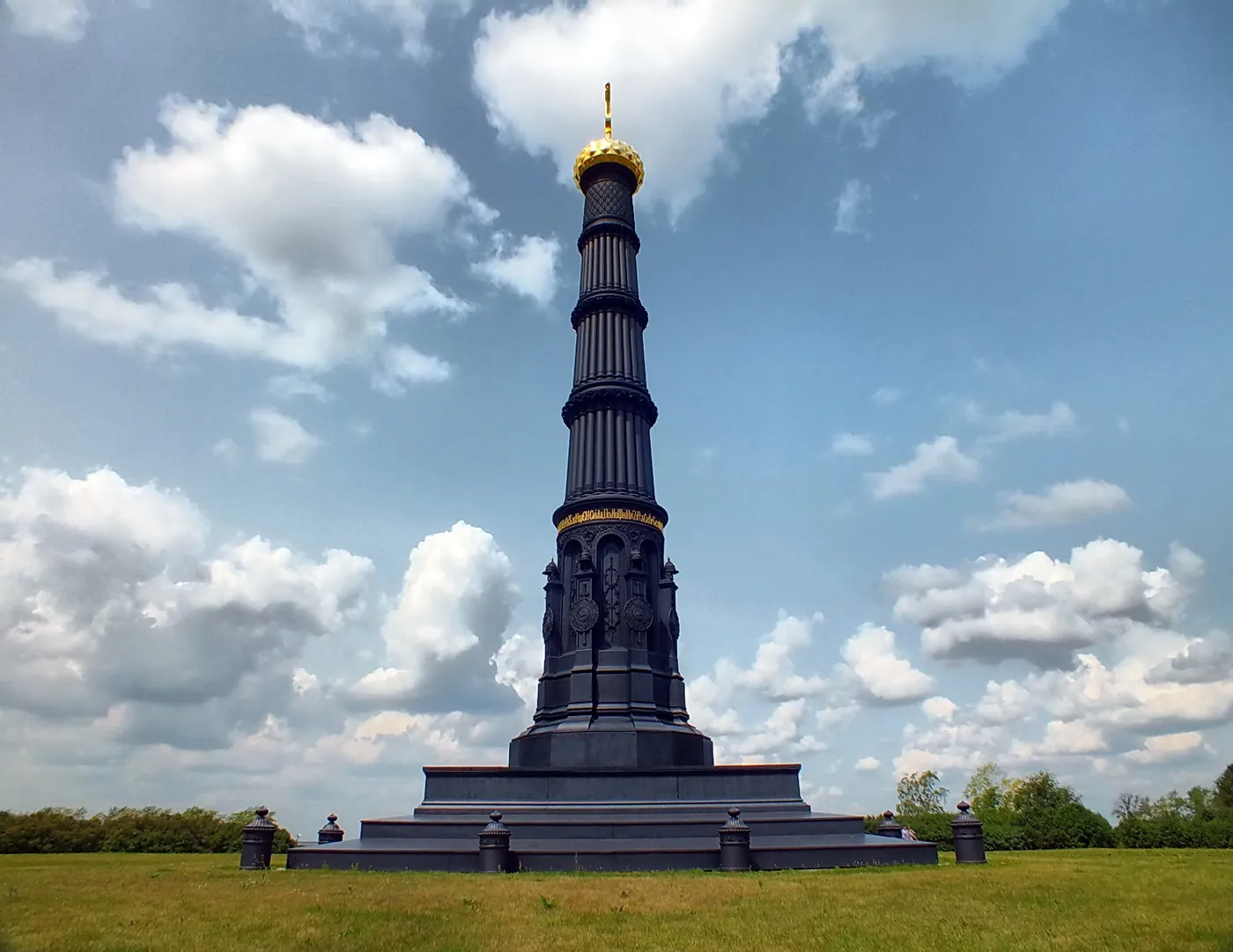
The battle became a founding event of Russian national history. In 1848–1850 a cast-iron column designed by Alexander Bryullov was erected on Red Hill, the highest point of the field. A church followed at Monastyrshchino near the Nepryadva in 1865–1894, on the traditional site of the warriors' burial, and a church of St Sergius by Alexei Shchusev on Red Hill in 1913–1917. Since 1996 the field has been a state museum-reserve.
A federal law of 13 March 1995 made 21 September a Day of Military Glory, the "day of the victory of the Russian regiments led by Grand Prince Dmitry Donskoy over the Mongol-Tatar troops in the Battle of Kulikovo". The date is 8 September plus 13 days, the modern difference between the Julian and Gregorian calendars. In the 14th century the difference was only eight days, so the anniversary in today's calendar falls on 16 September.
Common myths about the Battle of Kulikovo
| Myth | What the evidence says |
|---|---|
| Kulikovo freed Rus' from the Tatar yoke | Two years later Tokhtamysh burned Moscow, and tribute was paid for another century |
| Dmitry fought the Golden Horde and its khan | He fought Mamai, a non-royal warlord ruling half of a Horde in civil war; the legitimate khan Tokhtamysh destroyed Mamai weeks later |
| Hundreds of thousands fought | Medieval figures of 150,000–400,000 are literary; modern estimates are mostly 5,000–30,000 for the Rus' side |
| Peresvet fought Chelubey to open the battle | The earliest tale lists Peresvet only among the dead; the duel first appears in the 1520s; the name Chelubey is later still |
| Sergius blessed Dmitry at the monastery and sent two monks | The earliest tale does not mention Sergius; the long tale has only a letter; the visit may belong to 1378 |
| Infantry militias and six regiments fought | A projection of 16th-century warfare; the army was probably all cavalry |
| He was called Dmitry Donskoy in his lifetime | The name is first attested in the 16th century |
| 21 September is the anniversary | It adds the modern 13-day difference; the true equivalent is 16 September |
What the map shows next
The map of 1380 shows the Grand Principality of Moscow among its rivals Tver and Nizhny Novgorod, with the Novgorod Republic to the north and the Grand Duchy of Lithuania to the west. In the steppe the Horde appears split in two, the Blue Horde and the White Horde, as it was during the great troubles. By 1389, after Tokhtamysh had reunited it, the map shows the Golden Horde again.
Sources
Primary sources
- Short chronicle tale "O velikom poboishchi, izhe na Donu", in the Simeon Chronicle, Polnoe sobranie russkikh letopisei, vol. 18 (St Petersburg, 1913), pp. 127–131: https://archive.org/details/polnoesobranierusskihletopisejizdannoep74
- Letopisnaia povest' o Kulikovskoi bitve (long chronicle tale), ed. and trans. M. A. Salmina, Biblioteka literatury Drevnei Rusi, vol. 6 (Pushkin House): http://lib.pushkinskijdom.ru/Default.aspx?tabid=4981
- Zadonshchina, ed. and trans. L. A. Dmitriev, Biblioteka literatury Drevnei Rusi, vol. 6: http://lib.pushkinskijdom.ru/Default.aspx?tabid=4980
- Skazanie o Mamaevom poboishche, ed. V. P. Budaragin and L. A. Dmitriev, trans. V. V. Kolesov, commentary by L. A. Dmitriev, Biblioteka literatury Drevnei Rusi, vol. 6: http://lib.pushkinskijdom.ru/Default.aspx?tabid=4982
- The Nikonian Chronicle, vol. 3, ed. and trans. S. A. Zenkovsky and B. J. Zenkovsky (Princeton, 1986): https://archive.org/details/nikonian-chronicle-5
- Federal Law No. 32-FZ of 13 March 1995, "On the days of military glory and memorable dates of Russia", art. 1: http://kremlin.ru/acts/bank/7640
Studies
- A. V. Kuzmin, "Kulikovskaia bitva", Pravoslavnaia entsiklopediia: https://www.pravenc.ru/text/2462231.html
- "Dimitrii Ioannovich Donskoi", Pravoslavnaia entsiklopediia (2009): https://www.pravenc.ru/text/178205.html
- "Aleksandr (Peresvet) i Andrei (Osliabia)", Pravoslavnaia entsiklopediia: https://www.pravenc.ru/text/64384.html
- D. S. Borovkov, "Kulikovskaia bitva v XXI v.: mezhdu naukoi, mifom i obrazovatel'noi programmoi", Manuskript 2025, DOI 10.30853/mns20250109: https://cyberleninka.ru/article/n/kulikovskaya-bitva-v-xxi-v-mezhdu-naukoy-mifom-i-obrazovatelnoy-programmoy
- V. V. Penskoi, "Vozvrashchaias' k voprosu o chislennosti russkoi rati na Kulikovom pole", Arkheologiia evraziiskikh stepei 2020: https://cyberleninka.ru/article/n/vozvraschayas-k-voprosu-o-chislennosti-russkoy-rati-na-kulikovom-pole
- Iu. E. Varvarovsky, "'Mamaeva Orda' po dannym pis'mennykh istochnikov i numizmatiki", Stratum plus 1999: https://cyberleninka.ru/article/n/mamaeva-orda-po-dannym-pismennyh-istochnikov-i-numizmatiki
- A. A. Gorsky, "'Skazanie o Mamaevom poboishche', 'Povest' o razorenii Riazani Batyem', Nikonovskaia letopis'…", Istoricheskii vestnik 2023: https://cyberleninka.ru/article/n/skazanie-o-mamaevom-poboische-povest-o-razorenii-ryazani-batyem-nikonovskaya-letopis-o-nachale-russkoy-istoricheskoy-belletristiki
- S. N. Azbelev, "Kulikovskaia bitva po letopisnym dannym", Istoricheskii format 2016: https://cyberleninka.ru/article/n/kulikovskaya-bitva-po-letopisnym-dannym
- C. J. Halperin, "The Battle of Kulikovo Field (1380) in History and Historical Memory", Kritika 14.4 (2013), DOI 10.1353/kri.2013.0061.
Image credits
- Title image: Viktor Vasnetsov, The Battle on Kulikovo Field, 1915, Museum of the History of Religion, St Petersburg. Public domain, via Wikimedia Commons.jpg), cropped to 16:9.
- Illustrated Chronicle, vol. 9, pp. 475, 487 and 531. Public domain, via Wikimedia Commons.
- Spearheads from Kulikovo Field, Tula Regional Museum of Local Lore. Photo: Лапоть, CC0, via Wikimedia Commons.
- Memorial column on Red Hill. Photo: Quagdu, CC BY-SA 4.0, via Wikimedia Commons.