The Domostroy (Домострой, "household order") is a sixteenth-century Russian book of instructions for running a household. In 64 chapters, in its main version, it tells a wealthy Moscow householder how to pray and keep the fasts, how to bring up his children and teach his wife, how to treat servants, and how to stock his cellars, brew beer, pickle cucumbers and host a feast. Its best-known version is associated with Silvester, a priest of the Kremlin's Annunciation Cathedral and an adviser to the young Ivan the Terrible. It is one of the richest sources on daily life in Muscovy. Since the nineteenth century, though, the word domostroy has also stood in Russian for a harsh, patriarchal family life, mainly because of one passage on punishing a wife and children.
The Domostroy at a glance
| Name | Domostroy (also spelled Domostroi), "household order" or "household management" |
| Date | Compiled in the first half to the middle of the 16th century |
| Main version | The "Silvester" redaction of 64 chapters; oldest full copy, the Konshin manuscript (National Library of Russia, Q.XVII.149) |
| Surviving manuscripts | About 40, in three redactions (Kolesov) |
| Linked with | Silvester, priest of the Annunciation Cathedral in the Kremlin (died late 1560s) |
| Certainly by Silvester | Chapter 64, his letter of instruction to his son Anfim |
| Written for | The owner of a large town household with servants |
| First printed | 1849 |
| English translation | Carolyn Johnston Pouncy, The Domostroi: Rules for Russian Households in the Time of Ivan the Terrible (1994) |
What is the Domostroy?
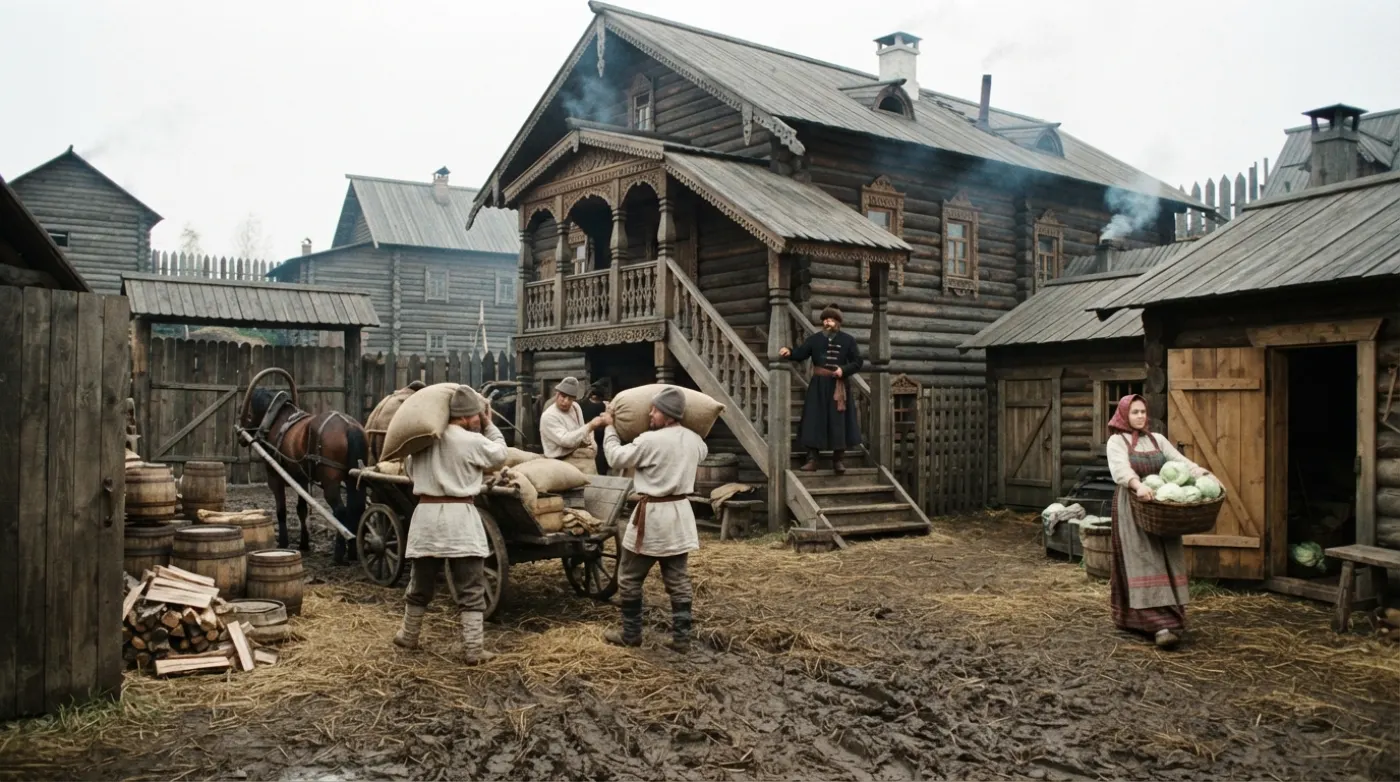
The Domostroy is a manual, not a law. Its readers were men of means. The Orthodox Encyclopaedia calls it a set of instructions for "the owner of a large town household", a man with servants, workshops, shops and stores. The heading of the main version announces "a book called Domostroy, which contains very useful things, teaching and instruction for every Christian: husband and wife, children, and menservants and maidservants".
According to its editor Vladimir Kolesov, it falls into three parts:
- Chapters 1–15 on religious life: how to believe, honour the clergy, pray at home and behave in church.
- Chapters 16–29 on family life: the duties of husband, wife, children and servants.
- Chapters 30–63 on housekeeping: the buying of supplies, cooking, clothing, cleaning, brewing, storage and feasts.
The last chapter, 64, is a separate work: a letter from Silvester to his son.
The text grew up over time from many sources. Kolesov notes that its repetitions and its mixture of regional dialect words show that "many people" took part in creating it. Its sources include Byzantine and Slavonic texts: the homilies of John Chrysostom, the Izmaragd collection, and a set of moral sayings attributed to Patriarch Gennadius of Constantinople. Chapter 20, the "Praise of Women", is a version of the passage on the good wife in Proverbs 31: "If God gives someone a good wife, she is more precious than a costly stone."
Who wrote the Domostroy?
The first editor, D. P. Golokhvastov, published the text in 1849 and attributed the whole book to Silvester. Scholars soon disagreed.
- Ivan Nekrasov (1872) argued that the book had grown up in Novgorod, in two redactions, and that the Moscow version linked with Silvester was a reworking.
- Alexander Orlov, who spent years on the manuscripts and published the Konshin copy in 1908, concluded that Silvester "edited and partly supplemented" an existing Novgorod compilation.
- Carolyn Pouncy, the American historian who translated the text in 1994, distinguished four redactions.
The Orthodox Encyclopaedia sums up the present view: Silvester was "probably the compiler", but there is disagreement over what he wrote and what he edited; only chapter 64 is certainly his. The Great Russian Encyclopaedia likewise calls the extent of his part in the other chapters "debatable".
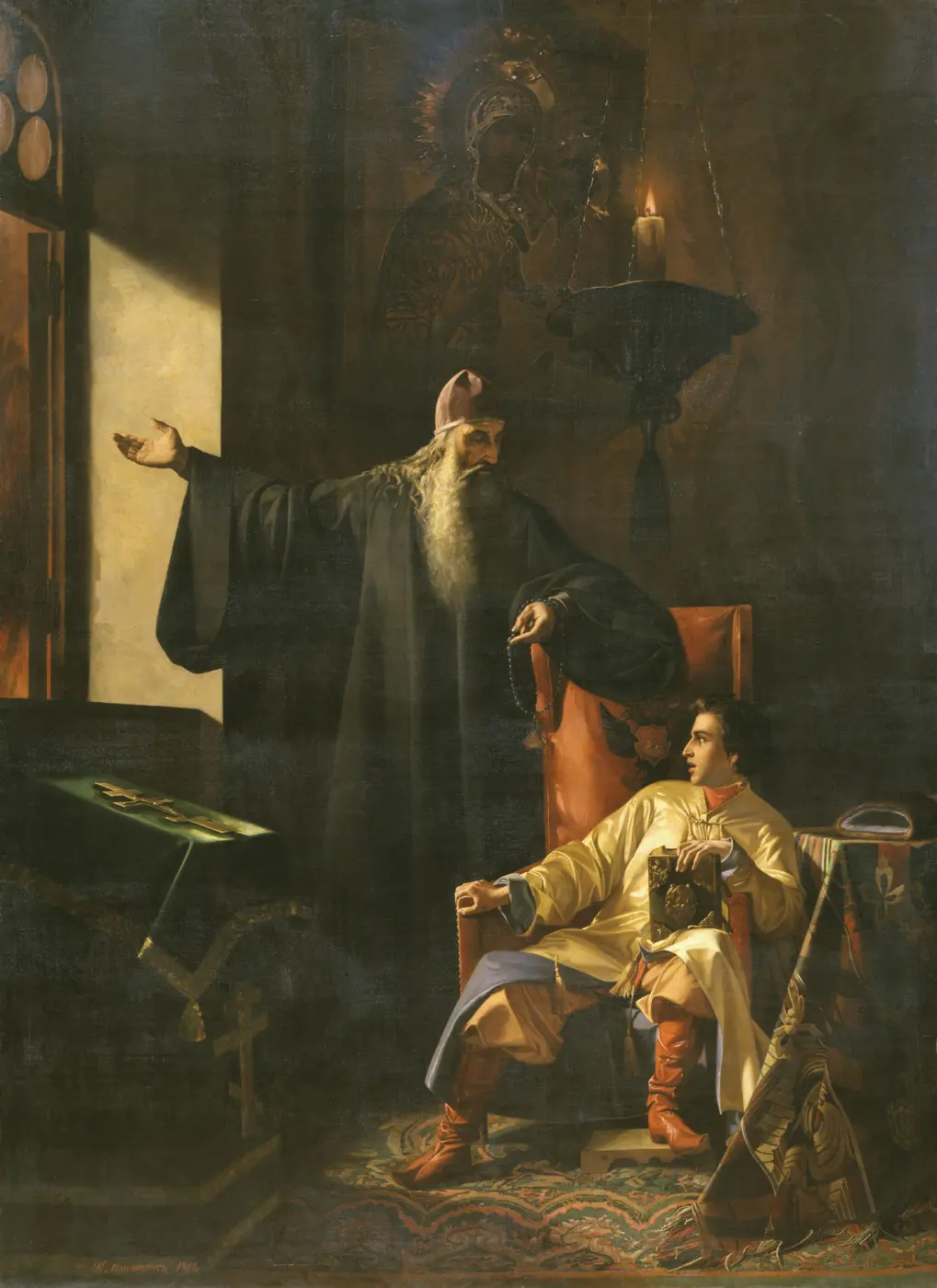
Silvester himself probably came from Novgorod. According to the accepted view he came to Moscow with Archbishop Makarii, the future metropolitan, in 1542; other sources give 1545 or the years 1543–1547. He served as priest of the Annunciation Cathedral, the tsar's own church in the Kremlin. From 1547 he had great influence on the young Ivan IV, and he is often named with Aleksei Adashev as a leader of the reforming circle that Prince Andrei Kurbsky later called the "Chosen Council" (see Ivan the Terrible and Prince Kurbsky). In 1560 he fell from favour and became a monk, Spiridon, at the Kirillo-Belozersky monastery. He died there in the late 1560s; the exact year is unknown.
What did the Domostroy say about the household?
Much of the book is about practical matters. It explains how to buy supplies in bulk and at the right season, how to cut and store clothes, how to keep the house clean and orderly, and how to stock cellars and ice-houses with "meat, fish, cabbage, cucumbers, plums, lemons, caviar, saffron milk-caps and milk mushrooms". It gives detailed instructions for brewing beer, mead and kvass and for running a feast.
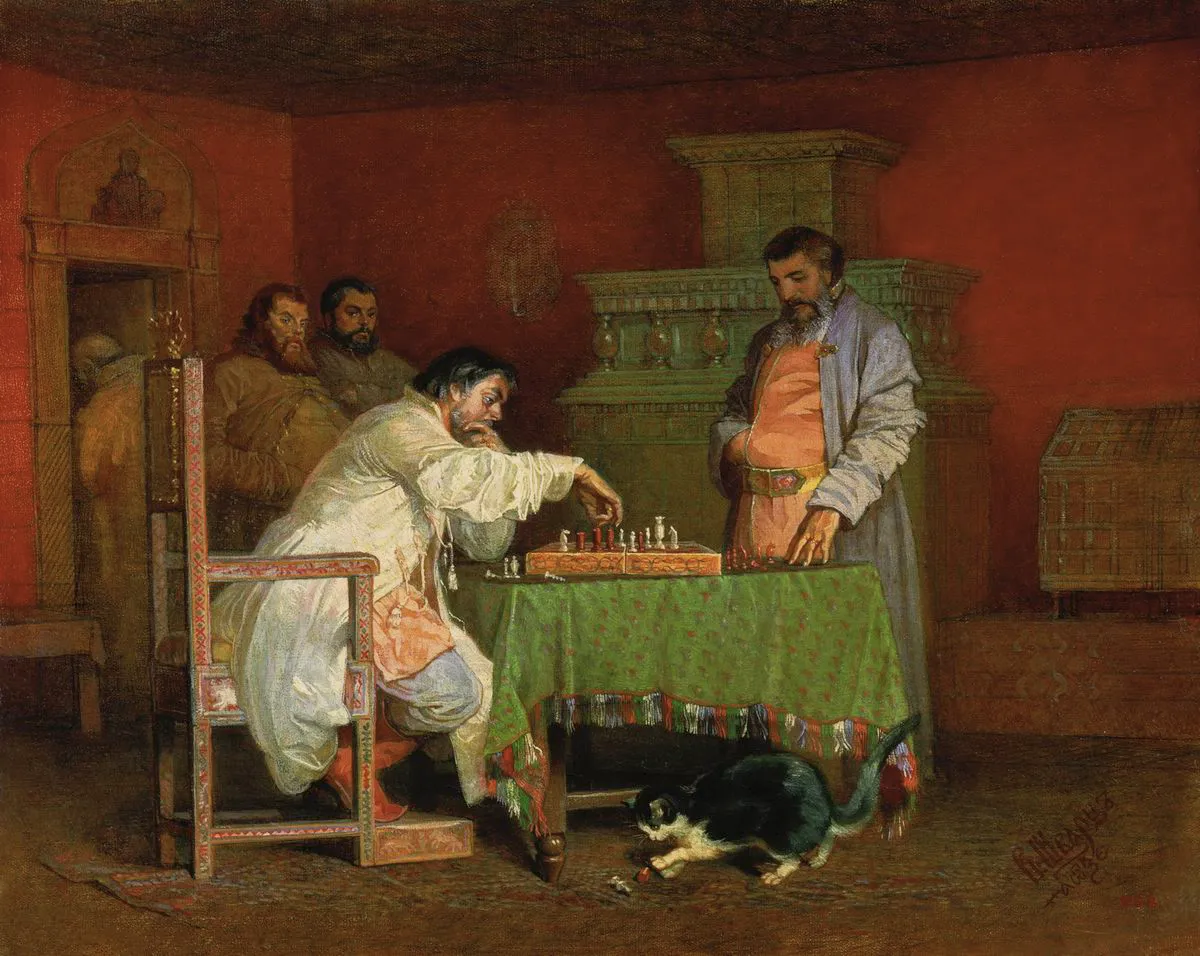
Religion runs through everything. A meal is a sacred occasion. If people at table indulge in "devilish songs", playing gusli, dancing, dice and chess, the book warns, the angels leave "as smoke drives away bees".
The book also demands care for the poor and for servants. Servants and the poor are to be fed "as one's own soul loves": "that is honour to God and salvation for oneself". Whoever does not care for them, the text declares, "let him be anathema".
What did it say about women?
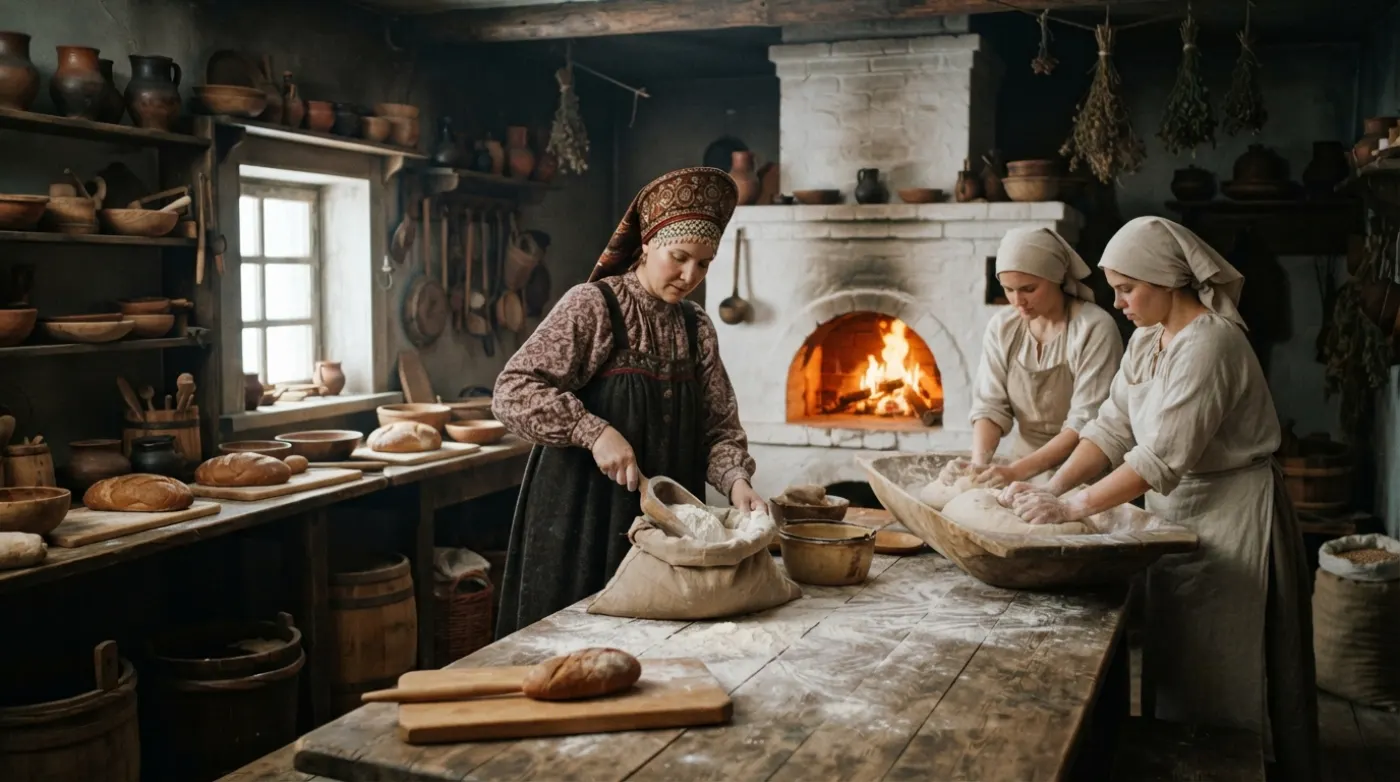
The Domostroy gives the wife, the gosudarynya or "mistress", a large role. She runs the kitchen, the textiles and the servants, and is expected to know herself how to bake, how to measure and what each quantity of flour or malt should yield. She consults her husband daily, and she visits and invites guests "with whom her husband permits". She should drink no alcohol at all, "neither wine, nor mead, nor beer", only unfermented braga and kvass. "A drunken husband is bad, but a drunken wife is unseemly in the world."
The husband's duty is to teach. A man who fails to instruct his wife and household, chapter 39 warns, "will himself be destroyed in this age and in the next, and will destroy his house".
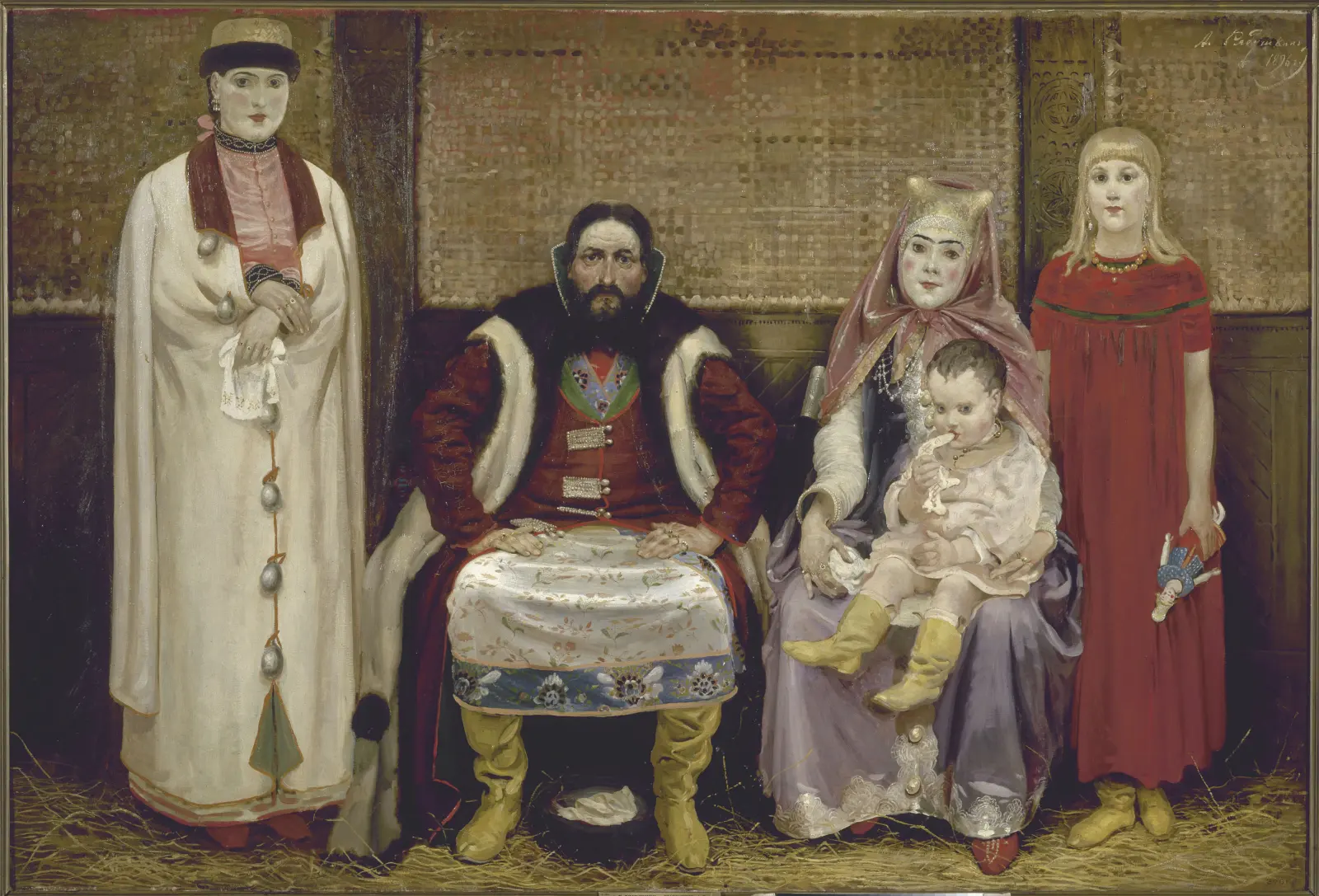
Kolesov, the book's modern editor, argues that the husband's and wife's spheres complement each other and barely overlap, which gave the mistress "a high social rank in the private life" of each household. That is his interpretation. Other readers stress that her movements and company depended on her husband's permission.
Did the Domostroy tell husbands to beat their wives?
This is the most famous question about the book, and the answer needs care. The relevant passage is not a chapter of its own. It comes in chapter 38, among instructions on keeping the house in order, and it covers the wife, the son and the daughter alike. The default it sets is teaching "with love", and it insists that "neither should the husband be angry with the wife, nor the wife with the husband".
But if a wife, son or daughter "does not heed word or instruction, does not listen, does not obey and does not fear", the book permits whipping "according to the fault", in private and not in front of others. It then sets limits:
"And for any fault do not strike on the ear or on the eyes, nor under the heart with the fist, nor kick, nor beat with a staff, nor with anything of iron or wood. Whoever beats like that, in anger or distress, causes much harm: blindness and deafness, and dislocated arm and leg and finger, and headache and toothache, and in pregnant women, injury to the child in the womb."
(The translations from the Old Russian in this article are our own.)
For great disobedience it allows the shirt to be removed and the wife to be beaten "politely" (vezhlivenko) with a whip, "holding her by the hands", after which the husband should speak kindly to her: "and let there be no anger, and let people not know or hear of it, and let there be no complaint."
The chapter on children is harsher still. "Punish your son in his youth, and he will give you rest in your old age," it says. "Do not laugh with him or play with him… but break his ribs while he is growing." Kolesov traces the wording to the homilies of John Chrysostom.
So the Domostroy does not command husbands to beat their wives. It permits corporal punishment of wife and children as a last resort and tries to regulate it. It is still a text that treats beating as part of a husband's and father's authority. The legal historian L. E. Lapteva, writing on the history of domestic violence in Russia, describes it as prescribing "well-reasoned" corporal punishment that was not supposed to cause injury or death.
Chapter 64: a father's letter
The last chapter is the most personal part of the book. It opens: "A blessing from the Annunciation priest Silvester to my beloved only son Anfim. My dear child!" Anfim worked in the tsar's treasury, in the customs.
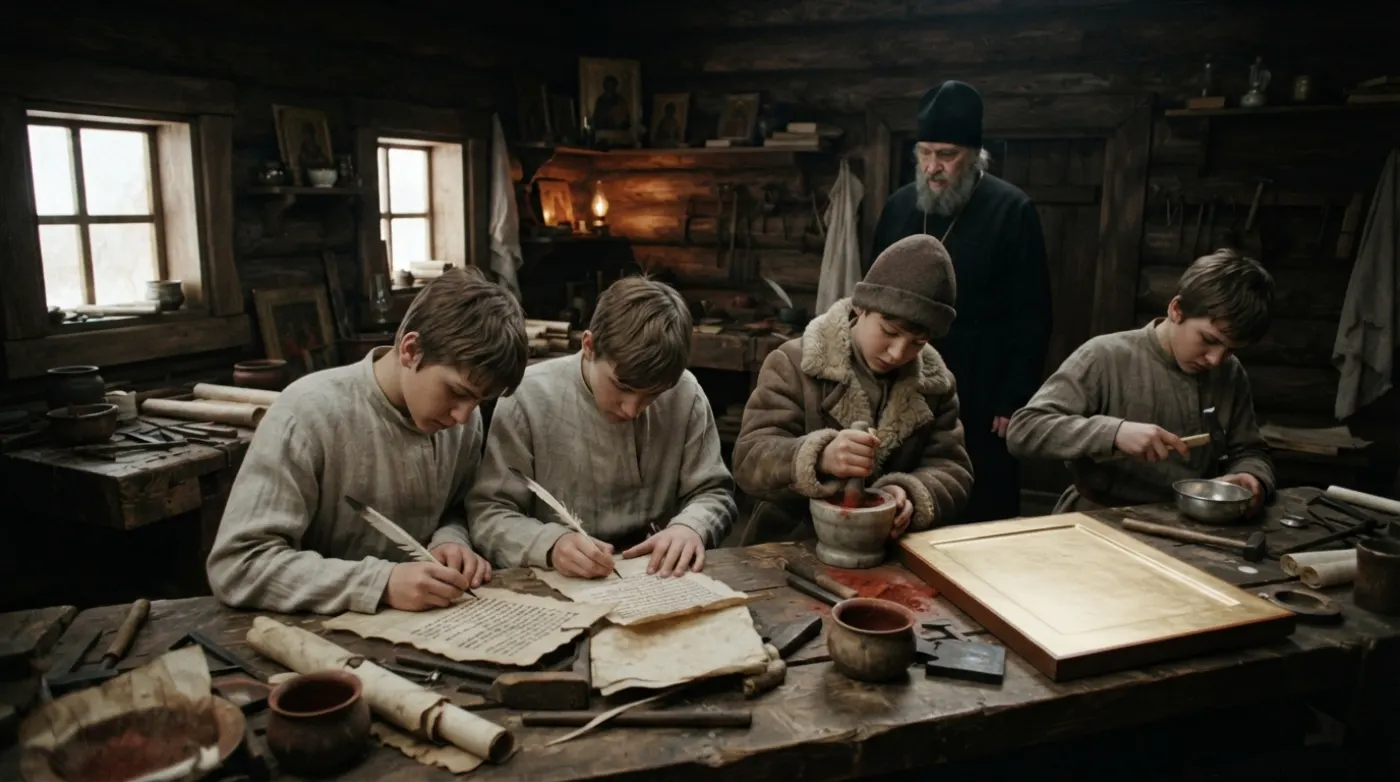
In it Silvester holds up his own household as an example. He says he freed all his bondservants and gave them property, and bought others out of servitude: "and now all our household people live with us freely, of their own will." He describes how he raised orphans and poor children "in Novgorod and here in Moscow" and taught them, each according to ability, to read and write, to sing, to paint icons, to copy books and to work silver. His wife, the letter adds, brought up many poor girls and widows, taught them needlework and housekeeping, and gave them dowries and married them off.
How did the Domostroy become a byword?
The Domostroy was first printed in 1849, when Russian writers were arguing over the country's past. According to Alexander Kravetsky, writing in Kommersant-Den'gi in 2014, the book became a symbol of everything the radical intelligentsia wanted to destroy. The revolutionary publicist Nikolai Shelgunov wrote that "the Domostroy reigned everywhere among us… everywhere, in one form or another, ribs were broken, or wives and children were 'politely' whipped." The philosopher Nikolai Berdyaev called it "the repulsive Domostroy", writing that "it is hard to imagine a greater perversion of Christianity". As Kolesov notes, the Slavophiles did not admire it either, while Westernisers pointed to it as a model of serfdom; Orlov, in the twentieth century, called it "a theory of family slavery and hoarding".
Kravetsky argues that this turned "a work that was quite progressive and humane for its time" into a bogeyman. Scholars also warn against reading it as a description of how all Russians lived. Kolesov quotes the nineteenth-century historian Alexander Pypin: it is "not a description of the practical foundations of life, but a didactic exposition of its theory".
Did the Domostroy have a European model?
Russian and Western scholars have long compared the Domostroy with European household books, such as the French Ménagier de Paris of about 1393 and Leon Battista Alberti's Italian dialogues on the family. Pouncy wrote in her 1985 dissertation that the resemblance was great enough "to suggest that the Domostroi could have a concrete European ancestor". Kolesov rejects a direct link and places the book in an older Russian tradition of instructions from father to son. Eugène Priadko, writing in Italian in 2017, argues for comparing the books as parallel products of similar societies rather than searching for a single model.
The Domostroy today
In modern Russian the word domostroy is used, usually disapprovingly, for strict patriarchal family life. The book has also come up in debates about domestic violence. On 7 February 2017 a federal law (No. 8-FZ) amended Article 116 of the Criminal Code so that a first act of family battery that causes no lasting harm became an administrative offence. According to The Moscow Times, the maximum penalty fell from two years in prison to 15 days' detention or a fine of up to 30,000 roubles; the Duma passed the bill by 380 votes to 3.
The law itself does not mention the Domostroy. The connection was made by commentators and historians: Lapteva, for instance, began her history of domestic violence in Russia with the book, writing in the wake of the 2017 law. A study of more than 1,400 Russian press articles by A. P. Kazun and colleagues (2022) found the debate framed around "traditional values" and quotes a 2014 newspaper article about men "who refer to the Domostroy".
Common myths about the Domostroy
| Myth | What the evidence says |
|---|---|
| The Domostroy commands husbands to beat their wives | It permits whipping of a disobedient wife or child as a last resort, in private, and forbids blows to the head, fists, kicks and weapons |
| It was written entirely by Silvester | Only chapter 64 is certainly his; he probably compiled and edited an existing text |
| It describes how all Russians lived | It was written for a wealthy town householder, and it is an ideal, not a description |
| Women had no role in the household | The mistress ran kitchen, stores, textiles and servants, though under her husband's authority |
| The Domostroy was a law | It was a manual of conduct, never a legal code |
| The 2017 law was based on the Domostroy | The law does not mention it; the link was made by commentators |
Timeline
| Date | Event |
|---|---|
| Late 15th – early 16th century | Material of the Domostroy takes shape |
| 1542 (accepted view) | Silvester comes to Moscow from Novgorod |
| 1546 | First dated record of Silvester in Moscow |
| 1547 | Silvester's influence on Ivan IV begins |
| 2nd half of the 1550s | Silvester writes his letter to Anfim (chapter 64) |
| 1560 | Silvester falls from favour and becomes a monk |
| Late 1560s | Silvester dies at the Kirillo-Belozersky monastery |
| 1849 | First edition, by Golokhvastov |
| 1872 | Nekrasov's study of the redactions |
| 1908 | Orlov publishes the Konshin copy |
| 1994 | Kolesov's Russian edition and Pouncy's English translation |
| 7 February 2017 | Law No. 8-FZ partly decriminalises family battery |
What the map shows
At 1550 the Tsardom of Russia of the young Ivan IV still lies between the Khanate of Kazan in the east and the Grand Duchy of Lithuania in the west. The Novgorod Republic, where the Domostroy may have begun, had been annexed by Moscow in 1478. For the tsar whose adviser Silvester was, see our article on Ivan the Terrible.
Sources
Primary sources
- Domostroi, ed. and trans. V. V. Kolesov, in Biblioteka literatury Drevnei Rusi, vol. 10 (St Petersburg: Pushkin House), online edition
- A. S. Orlov (ed.), Domostroi po Konshinskomu spisku i podobnym (Moscow, 1908): archive.org
- C. J. Pouncy (trans.), The "Domostroi": Rules for Russian Households in the Time of Ivan the Terrible (Ithaca: Cornell University Press, 1994) (cited, not quoted)
- Federal Law of 7 February 2017 No. 8-FZ, official internet portal of legal information
Studies and reference works
- O. V. Chumicheva, "Sil'vestr", Pravoslavnaia entsiklopediia
- A. M. Ranchin, "Domostroi", Bol'shaia rossiiskaia entsiklopediia
- "Sil'vestr", Entsiklopedicheskii slovar' Brokgauza i Efrona, via ru.wikisource
- V. V. Khorikhin, on the source study of the Domostroy, Vestnik MGUS (2007)
- E. Priadko, "Il metodo comparativo nello studio dei rapporti tra il Domostroj e i suoi equivalenti europei" (2017), open access via OAPEN
- A. S. Orlov, Domostroi: Issledovanie, part 1 (Moscow, 1917)
- A. Kravetskii, "'Domostroi' dlia progressivnoi obshchestvennosti", Kommersant-Den'gi, 9 June 2014
- L. E. Lapteva, "Domashnee nasilie: sila traditsii", Genesis (2017), doi:10.25136/2409-868X.2017.9.24125
- A. P. Kazun et al., "B'et — znachit liubit?…", Monitoring obshchestvennogo mneniia (2022)
- The Moscow Times, 27 January and 7 February 2017
Image credits
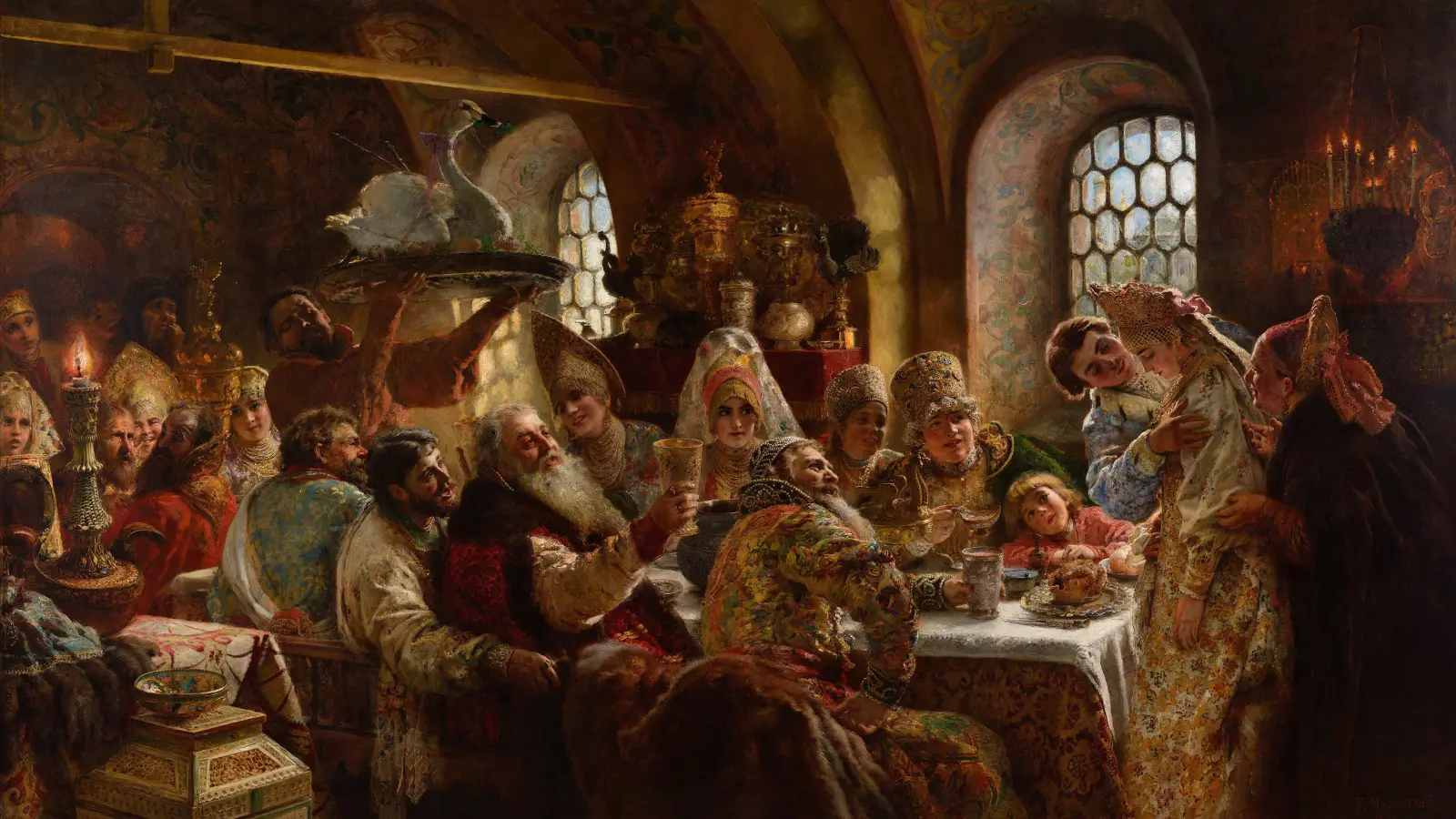
- Title image: Konstantin Makovsky, A Boyar Wedding Feast, 1883, Hillwood Estate, Museum & Gardens. Public domain, via Wikimedia Commons_Google_Cultural_Institute.jpg), cropped to 16:9.
- Pavel Pleshanov, Ivan the Terrible and the priest Silvester during the Moscow fire of 1547, 1856. Public domain, via Wikimedia Commons.
- Andrei Ryabushkin, Merchant Family in the 17th Century, 1896, Russian Museum. Public domain, via Wikimedia Commons.
- Vyacheslav Schwarz, Scene from the domestic life of the Russian tsars (chess), 1865. Public domain, via Wikimedia Commons.