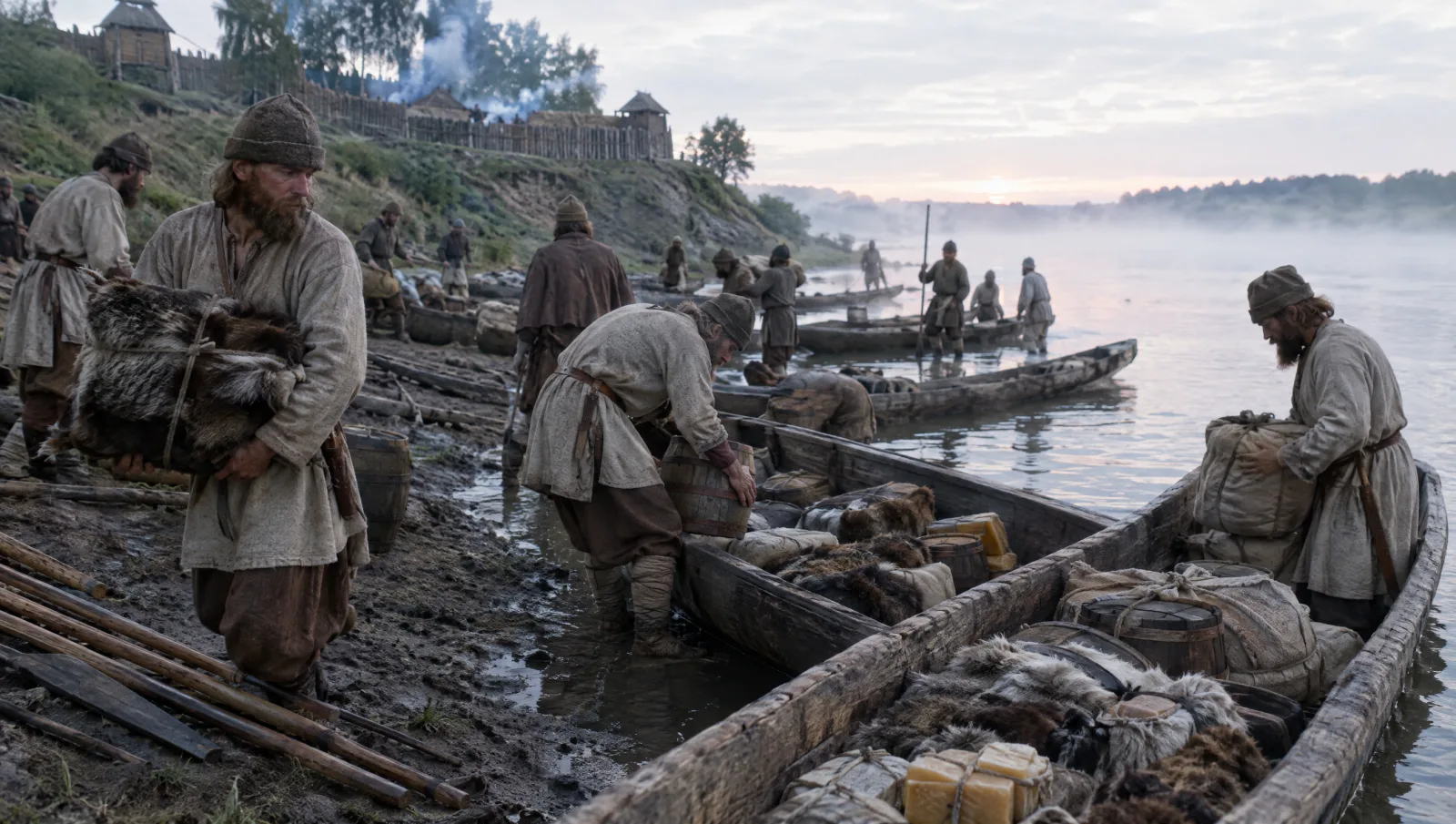
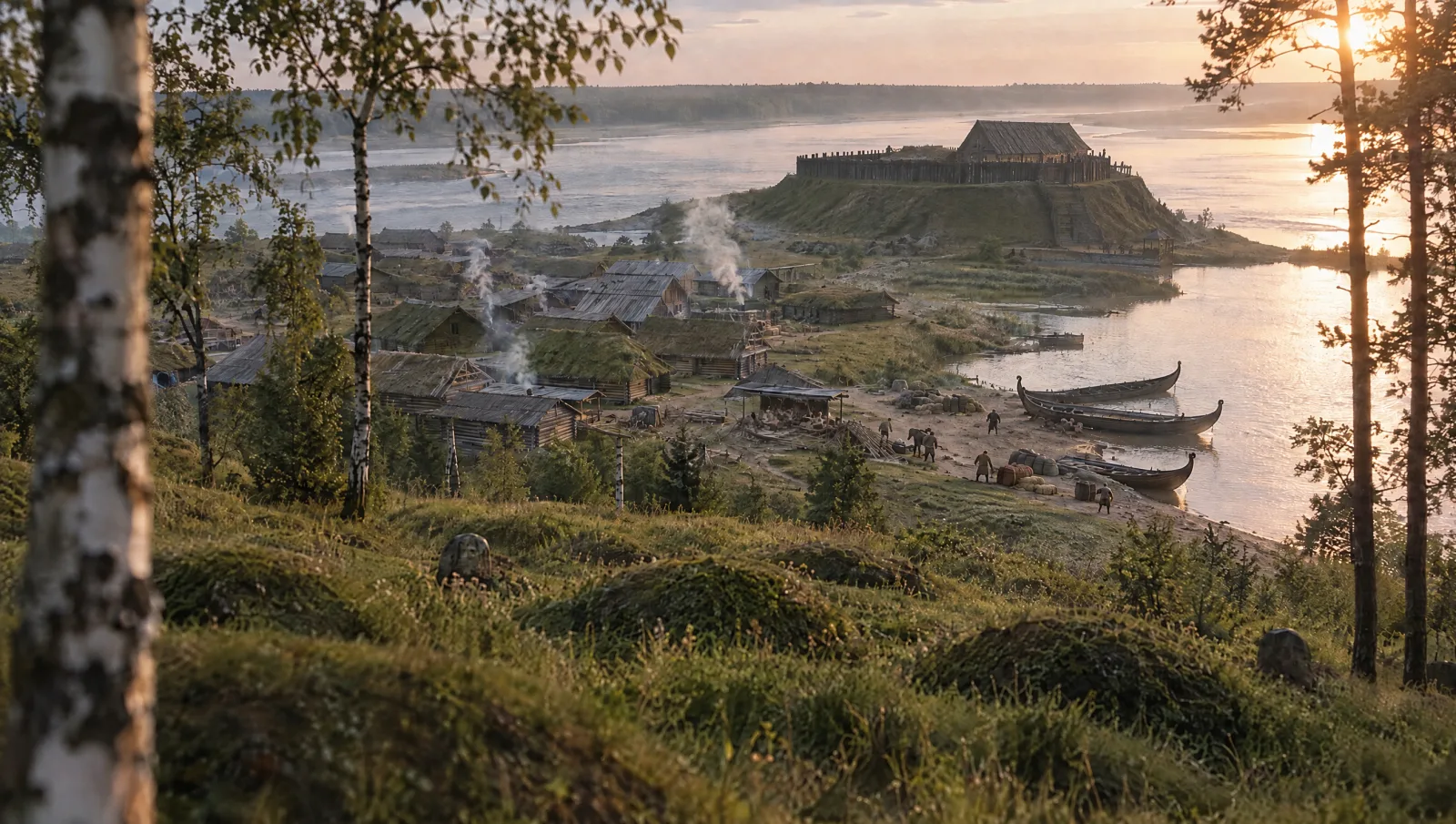
Gnezdovo is an archaeological site on the upper Dnieper, about 13 km west of Smolensk in Russia, and the largest Viking-Age settlement and cemetery complex in the lands of the Rus'. In the tenth century a busy trading and craft town stood here, at the point where boats from the Baltic left the river roads of the north and joined the Dnieper on the way to Kyiv and Constantinople. Around it lay thousands of burial mounds. Most of the dead were Slavs and local Krivichians, but a minority of rich graves, with swords, boats and Scandinavian jewellery, belonged to Norsemen and their families. Gnezdovo flourished from the early tenth century to the early eleventh, when Smolensk took over its role.
The site is also famous for a single word. A broken amphora from one of its graves carries the oldest known inscription in the language of Rus', and nobody is sure what it says.
Where is Gnezdovo?
The site lies on the right bank of the Dnieper, "near the confluence of the small river Svinets", and covers 207.4 hectares of fields, woods and mounds (Pushkina, Eniosova and Murasheva, 2012, pp. 4–5). At its heart is a small hillfort of about 1 hectare on a promontory above the Svinets. Around it spreads an open settlement on the river terrace and the floodplain below. A second hillfort stood further west on the Olshanka. The barrows surround the settlement in groups to the north, east and west, with a smaller group across the Dnieper.
The position explains everything. From the Dnieper near Smolensk, short overland portages led to the Western Dvina and the Lovat, and so north to Lake Ilmen, Novgorod and the Baltic. According to the Encyclopedia of Russian History, Gnezdovo "was a key portage and transshipment point along the 'Route to the Greeks' in the late ninth through the early eleventh centuries" (Heidi Sherman, "Gnezdovo"). Boats and goods coming down from the north changed here to the Dnieper (see our article on the Viking trade routes to the East).
How many burial mounds are there at Gnezdovo?
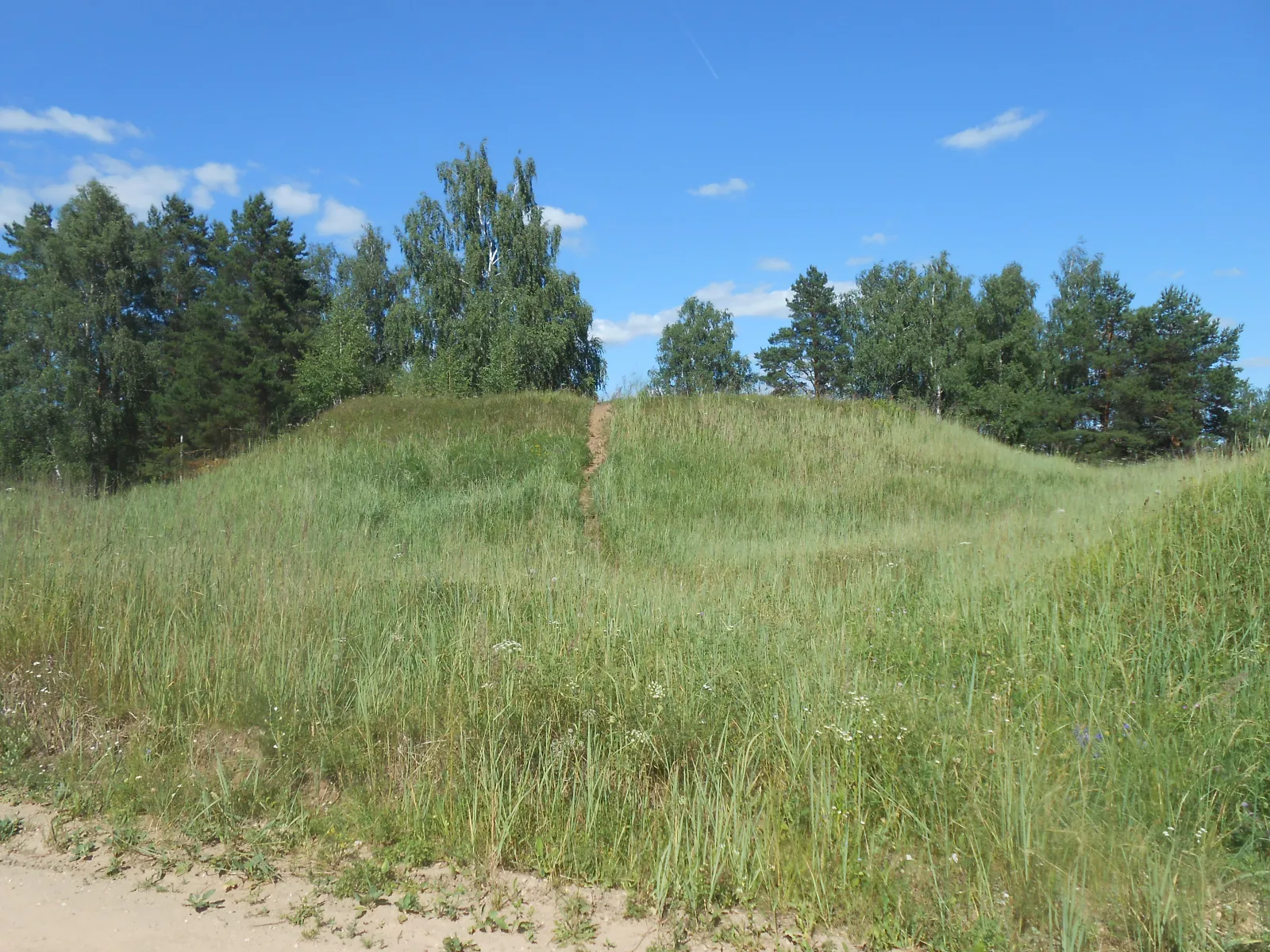
Nobody knows exactly, because ploughing, roads, a railway and war have destroyed many. Estimates of the original number "vary from between 3000–5000 to even 6000" (Duczko, Viking Rus, 2004, p. 158). The Encyclopedia of Russian History gives 3,500 to 4,000 mounds, of which more than 1,200 have been excavated. The excavators describe it as "the largest early medieval cemetery known today in Europe" (Pushkina, Eniosova and Murasheva, p. 4). That is their own claim, but no other site in eastern Europe comes close.
The mounds fall into several groups. The Central, Glushchenkovskaya and Lesnaya ("Forest") groups ring the settlement. The Dnieper and Olshanskaya groups lie downstream to the west, and the Olshanskaya group was destroyed by road building in 1975 (p. 6). In the Lesnaya group most mounds are up to 1.5 metres high, though some reach 2.5 metres (p. 20), and a handful of giants stand out.
Who discovered Gnezdovo?
The site came to light by accident. In 1867, workers building a railway line found a tenth-century hoard of silver ornaments (p. 4). The first barrows were dug in 1874 by M. F. Kusitsyn. Vasily Sizov of the Historical Museum in Moscow then excavated about 400 mounds between 1881 and 1901 and published the first monograph on the cemetery in 1902. Rescue digs followed when the railway embankment was widened in 1898–1901.
Modern research began in 1949, when Daniil Avdusin brought the Smolensk expedition of Moscow State University to the site. Between 1949 and 2012 his team and its successors excavated about 700 mounds (p. 5). Since 1995 the State Historical Museum has dug on the floodplain, where a blanket of later river silt, 0.7 to 3 metres thick, has preserved wood and other organic remains, and since 1998 the two institutions have worked together under Tamara Pushkina and Veronika Murasheva. By 2012 they had studied some 1,200 mounds and nearly 7,000 square metres of the settlement.
When was Gnezdovo founded?
For decades the settlement was dated to around AD 900. The 2012 summary by the excavators puts its beginning at "the transition from the IXth to the X centuries, its peak development to the middle and second half of the Xth century", with its active life ending "in the first half of the XIth century" (p. 7). The Encyclopedia of Russian History puts the most intense period at AD 920 to the AD 960s, "when its settlements had reached their maximum size and when many of the largest burial mounds were raised".
A study published in 2020 pushed the start back. Murasheva and colleagues radiocarbon-dated timber from the earliest layers on the floodplain using the tree-ring "wiggle-matching" method, and their dates fell in the last quarter of the eighth century (Rossiiskaia arkheologiia 2020, no. 4, pp. 70–86). That makes the first settlement at Gnezdovo older than anyone had thought. It does not change the date of the cemetery. "The overwhelming majority of all burial mounds are dated to the period termed 'Late Gnezdovo'", and the oldest mounds, in the Lesnaya group, date from the first quarter of the tenth century (Pushkina, Eniosova and Murasheva, pp. 9, 21).
At its height the settlement held an estimated 800 to 1,000 people (p. 9), far more than any village around it. Its people ploughed fields, grew wheat, worked iron, made jewellery and produced wheel-thrown pottery, as well as trading.
Were there Vikings at Gnezdovo?
Yes, but they were a minority in a mixed town. The excavators describe a population made up of Slavs, people from Northern Europe and the local Krivichians (p. 4), on land that had earlier been Baltic. Most of the dead were cremated under small mounds, with their ashes and burnt belongings placed in an urn or on the ground.
Only a small share of the graves can be called Scandinavian with confidence. The Encyclopedia of Russian History puts it at "no more than fifty mounds". Pushkina counted about sixty, but the historian Władysław Duczko points out that typical Norse objects often vanished in the cremation fire, so the real number was probably higher (Viking Rus, p. 159). Duczko still calls Gnezdovo "the largest Norse site in Russia" (p. 9). The Scandinavian graves are also among the richest. According to the excavators, Gnezdovo has produced "the largest number of finds of Scandinavian origin among all sites" of Rus', and "the majority of Carolingian swords of the Xth century found in the Ancient Rus' originate from Gnezdovo" (p. 9).
Genetic studies of Viking-Age skeletons, including burials from Gnezdovo, have confirmed people of Scandinavian ancestry living among the local population (Margaryan et al., Nature, 2020; see our article on who the Varangians were).
What are the most famous graves at Gnezdovo?
The boat graves. Some of the largest mounds covered cremations in boats. In mound No. 16 of the Central group, a flat-topped mound 38 metres across at the base and 2.9 metres high, the excavators found 234 iron rivets, "making it clear that a boat of about 7–10 m in length had been used in the burial" (Duczko, p. 165). Beside the cremation stood an iron cauldron holding a ram's head and a sword with small silver faces beneath its hilt. The rite recalls the Rus' ship funeral that Ibn Fadlan watched on the Volga in AD 922 (see our article on Ibn Fadlan and the Rus').
The chamber graves. A smaller group of people were not cremated but buried in timber chambers under mounds, a rite known from the elite graves of Birka in Sweden. Three of them, published by Avdusin and Pushkina in 1988, are among the best-dated graves in early Rus':
- Mound C-301. A woman was buried with 50 glass beads, a cross pendant, a bronze brooch, a wooden bucket and a birch-bark box of linen, wool and silk. Two wax candles stood on the floor and nine more on the chamber roof (Duczko, pp. 176–177).
- Mound C-306. A woman wore a pair of oval brooches of Scandinavian type with a silk-trimmed shirt. Three large and nine thin candles stood on the floor. The chamber's timbers give a tree-ring date of AD 979.
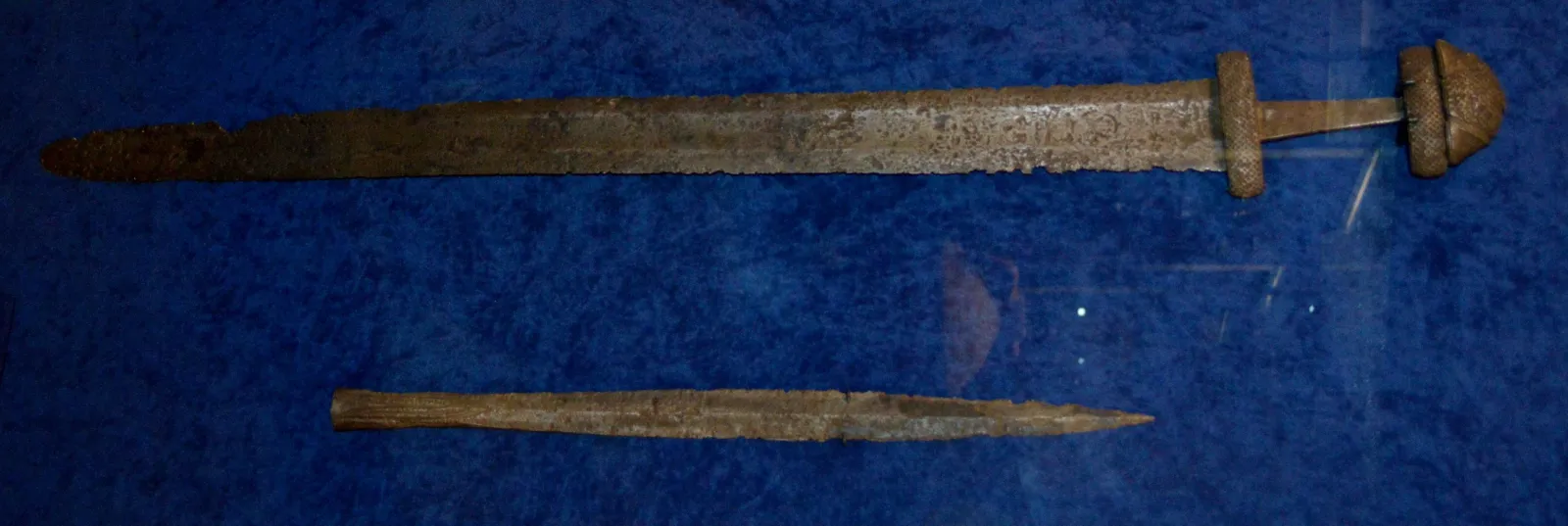
- Mound Dn-4. A man was laid with a horse's head and bridle, stirrups, a Scandinavian sword and spear, an axe, and "a cast silver cross pendant", wearing a caftan with silk ribbons and 24 bronze buttons. The grave dates to AD 975, and apart from the sword and spear most of his gear was of eastern, not Scandinavian, type (pp. 177–178).
The crosses and candles make these graves remarkable. They show Christians at Gnezdovo more than a decade before Vladimir's official baptism of Rus' in AD 988. As Duczko puts it, "For the first time we meet the symbols of a new faith in the mortuary practice of Rus" (p. 178). (See Christians in Rus' before 988.)
What does the Gnezdovo inscription say?
In 1949 Avdusin excavated mound No. 13 of the Lesnaya group. It had been raised over a pyre on which, according to the excavators, a Scandinavian warrior and two women had been cremated. With them were a Carolingian sword, an iron neck-ring, Arab silver coins, carnelian and crystal beads, silver temple rings, a Byzantine jug and a two-handled amphora from the Black Sea region, "ritually broken during the funeral" (Pushkina, Eniosova and Murasheva, p. 21).
On the shoulder of the amphora someone had scratched a single Cyrillic word. It is the oldest known inscription in Old East Slavic, the language of Rus', usually dated now to the second quarter or middle of the tenth century. Scholars do not agree what it says.
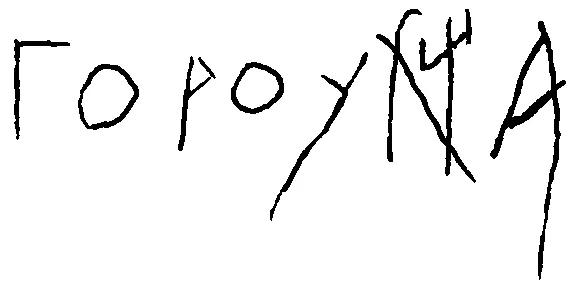
| Reading | Meaning | Proposed by |
|---|---|---|
| gorouchshcha (гороухща) | Uncertain | D. A. Avdusin and M. N. Tikhomirov, 1950 (first publication) |
| gorushna (гороушна) | "Mustard", the contents of the jar | P. Ya. Chernykh; later Avdusin himself |
| gorouscha (гороуща) | "Burning", a flammable liquid such as lamp oil | G. F. Korzukhina; A. S. Lvov, 1971 |
| Gorukh psal | "Gorukh wrote" | F. V. Mareš |
| Goroun / Gorouniа | A personal name, the owner of the jar | R. Jakobson; the excavators' 2012 guide |
The "mustard" reading is the one most often repeated online, but it is only one proposal. Even the date has moved: the first publishers placed the inscription in the first quarter of the tenth century, while later scholars, including Avdusin himself, moved it to the middle or third quarter of that century (Lvov, 1971). Whatever the word, it shows that someone at Gnezdovo, or somewhere on the road to Byzantium, could write in Cyrillic decades before the conversion of Rus'.
What else was found at Gnezdovo?
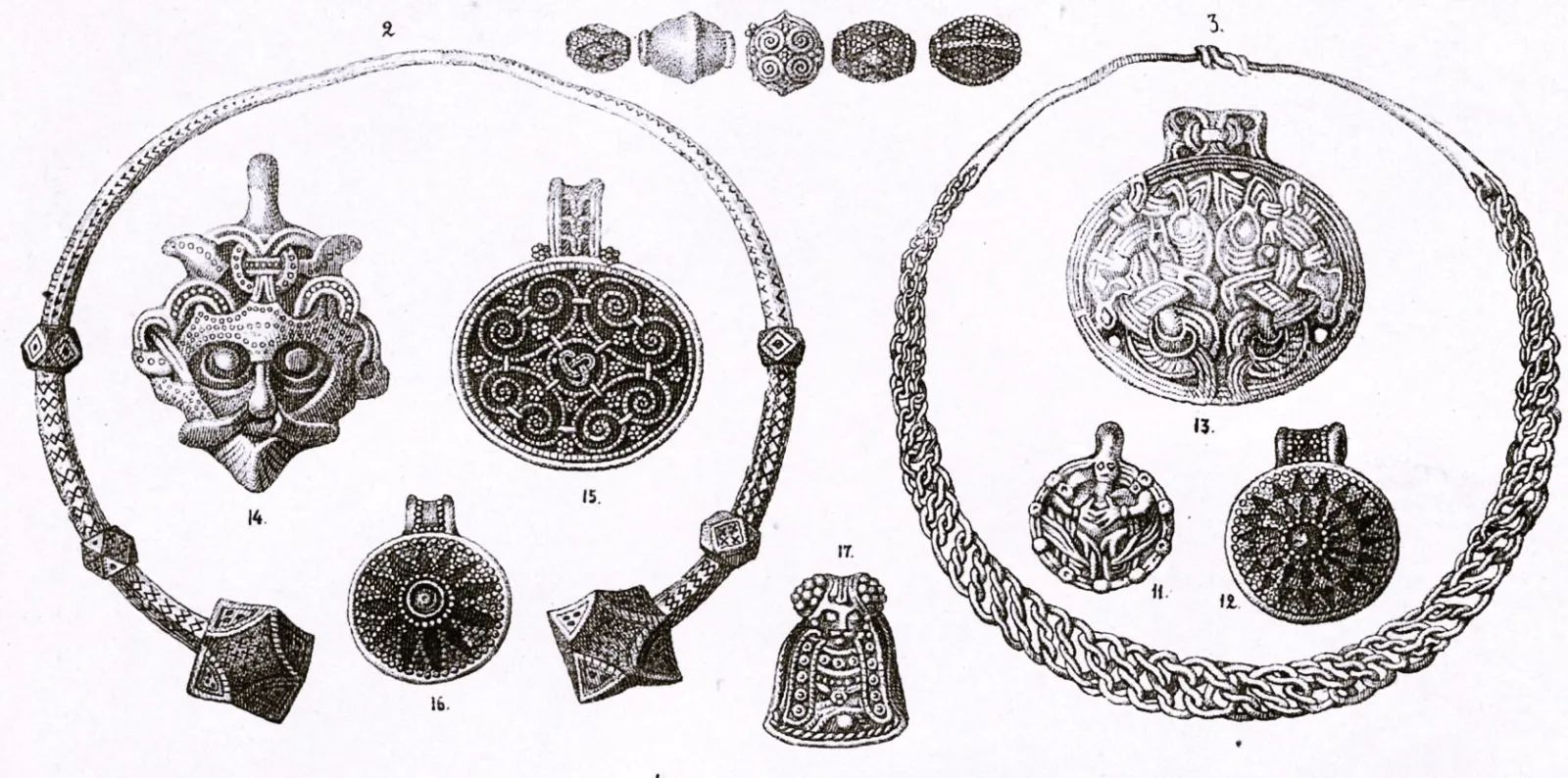
Hoards. The excavators list 11 hoards of Arab silver coins and ornaments from the site (p. 9). Like most tenth-century hoards in Rus', they are dominated by dirhams of the Samanid rulers of Central Asia, the silver that paid for the furs and slaves of the north. The first hoard, found in 1867, held massive silver neck-rings and pendants decorated in Scandinavian styles.
Weapons. Gnezdovo has yielded more tenth-century swords than any other site in Rus', along with spearheads, axes, arrowheads and riding gear.
Byzantine goods. Silk, glazed pottery, glass, amphorae, coins and even lead seals of Byzantine officials. The excavators call this "the most representative collection of such artefacts from all Ancient Rus' sites" and think it shows Gnezdovo had a special connection with Constantinople "from the first decades up to the last quarter of the Xth century" (p. 8).
Crafts. Workshops for ironworking, casting and jewellery making show that the town made goods in "southern Slavic and northern Scandinavian traditions" side by side (p. 8).
Was Gnezdovo the original Smolensk?
This is the oldest debate about the site. The Primary Chronicle names Smolensk as the city of the Krivichians and says that in AD 882 Oleg "arrived with his Krivichians before Smolensk, captured the city, and set up a garrison there" (trans. Cross and Sherbowitz-Wetzor, pp. 55, 61). The Byzantine emperor Constantine VII, writing around AD 950, lists boats coming down to Constantinople "from the city of Smolensk" (De Administrando Imperio, ch. 9, trans. Jenkins); his Greek form is Miliniska. Icelandic sagas call the place Smaleskia.
For a long time Smolensk itself had no finds older than the eleventh century, while Gnezdovo had a tenth-century town. Many scholars therefore concluded that Gnezdovo was the Smolensk of the chronicles, and that the name moved to the present city later. Duczko still wrote in 2004 that the original name of Gnezdovo "could have been, as most of scholars will have it, Smolensk" (p. 155).
Recent excavations have changed the picture. On Cathedral Hill in Smolensk, archaeologists led by Nikolai Krenke found a settlement founded around AD 700 and fortified with a rampart in the first half of the ninth century, covering about 4 hectares. It declined in the tenth century, "apparently due to the rise" of Gnezdovo, and revived as a Christian town in the early eleventh. They conclude that it is "most likely" this settlement that the chronicle means by Smolensk, the town of the Krivichians (Russian Academy of Sciences news release, 2023; published in Kratkie soobshcheniia Instituta arkheologii). On this view Smolensk and Gnezdovo were two centres of the same district, one rising as the other declined, rather than one town that moved.
Why did Gnezdovo decline?
Gnezdovo faded in the first half of the eleventh century. The Encyclopedia of Russian History says it was "abandoned in the early eleventh century, when a new center, Smolensk, assumed Gnezdovo's role in international and regional trade". The reasons were probably several. The flow of Arab silver dried up around AD 1000, Christian Rus' stopped raising pagan mounds, and the princes of Kyiv built their power around fortified towns with churches and bishops. By the twelfth century Smolensk was the capital of a principality of its own, while Gnezdovo had become a quiet place of fields and mounds.
Common myths about Gnezdovo
- "Gnezdovo was a Viking town." It was a mixed Slavic, Baltic and Scandinavian community. Only a few dozen of more than a thousand excavated graves are clearly Scandinavian.
- "The inscription says 'mustard'." That is one reading among at least five.
- "The inscription comes from barrow Ts-13." It comes from mound No. 13 of the Lesnaya (Forest) group, excavated in 1949.
- "Gnezdovo is old Smolensk." Possibly in part, but the latest excavations suggest that the chronicle's Smolensk stood on Cathedral Hill in the present city.
- "Gnezdovo is named in the chronicles." It is not. The site takes its name from a later village; what its people called it is unknown.
What the map shows next
At AD 950 on the map, Kievan Rus' stretches along the river road from Novgorod to Kyiv, with Gnezdovo at its watershed and the Byzantine Empire at the end of the route. By 1100 on the map Gnezdovo has faded and Smolensk has taken its place. At 1200 on the map, the Principality of Smolensk rules the upper Dnieper as one of the strongest of the Rus' principalities.
Sources
Primary sources (in translation)
- The Russian Primary Chronicle: Laurentian Text, trans. S. H. Cross and O. P. Sherbowitz-Wetzor (Cambridge, MA: Mediaeval Academy of America, 1953), pp. 55, 61.
- Constantine VII Porphyrogenitus, De Administrando Imperio, ed. Gy. Moravcsik, trans. R. J. H. Jenkins (Washington, DC: Dumbarton Oaks, rev. edn 1967), ch. 9. Excerpt: https://faculty.washington.edu/dwaugh/rus/texts/constp.html
Excavation reports and studies
- T. Pushkina, N. Eniosova and V. Murasheva, "Gnezdovo archaeological complex: history of research and general characteristic", and "Stop 2. Forest ('Lesnaya') group of mounds", in Geoarchaeological Issues of the Upper Dnieper – Western Dvina River Region (Western Russia): Fieldtrip Guide (Moscow–Smolensk, 2012), pp. 4–9, 20–21: https://istina.msu.ru/media/publications/books/adc/fd9/1207836/2012_Geoarchaeological_issues_of_the_Upper_Dnieper_-_Western_Dvina_River_region_Western_Russia._Fieldtrip_guide.pdf
- W. Duczko, Viking Rus: Studies on the Presence of Scandinavians in Eastern Europe, The Northern World 12 (Leiden: Brill, 2004), ch. 4 "The Upper Dnieper", pp. 155–188.
- D. A. Avdusin and T. A. Pushkina, "Three chamber graves at Gniozdovo", Fornvännen 83 (1988), pp. 20–33 (cited via Duczko 2004).
- H. M. Sherman, "Gnezdovo", Encyclopedia of Russian History (Macmillan Reference, 2004), via Encyclopedia.com: https://www.encyclopedia.com/history/encyclopedias-almanacs-transcripts-and-maps/gnezdovo
- V. V. Murasheva, A. V. Panin, A. O. Shevtsov, N. N. Malysheva, E. P. Zazovskaya and N. E. Zaretskaya, "Vremia vozniknoveniia poseleniia Gnëzdovskogo arkheologicheskogo kompleksa po dannym radiouglerodnogo datirovaniia", Rossiiskaia arkheologiia 2020, no. 4, pp. 70–86. Report: https://www.nkj.ru/news/40618/
- A. S. Lvov, "Eshche raz o drevneishei russkoi nadpisi iz Gnezdova", Izvestiia AN SSSR, Otdelenie literatury i iazyka 30/1 (1971), pp. 47–52: http://www.philology.ru/linguistics2/lvov-71.htm
- D. A. Avdusin and M. N. Tikhomirov, "Drevneishaia russkaia nadpis'", Vestnik Akademii nauk SSSR 1950, no. 4, pp. 71–79.
- Russian Academy of Sciences, "Уточнено наиболее вероятное расположение града Смоленска" (news release on N. A. Krenke et al., Kratkie soobshcheniia Instituta arkheologii, 2023).
- A. Margaryan et al., "Population genomics of the Viking world", Nature 585 (2020), pp. 390–396, DOI 10.1038/s41586-020-2688-8.
- V. I. Sizov, Kurgany Smolenskoi gubernii. Vyp. 1: Gnezdovskii mogil'nik bliz Smolenska, Materialy po arkheologii Rossii 28 (St Petersburg, 1902).
Image credits
- Title image (Gnezdovo on the Dnieper in the mid-tenth century): AI-generated illustration.
- A mound of the Central group at Gnezdovo (2019). Photo: Mikra72, CC0, via Wikimedia Commons.
- Drawing of the Gnezdovo inscription. Drawing: RedAndr, CC BY-SA 3.0, via Wikimedia Commons.
- Sword and spearhead from mound No. 4, State Historical Museum, Moscow. Photo: Lapot, CC0, via Wikimedia Commons.
- Neck-rings, beads and pendants from Gnezdovo, from V. Prokhorov, Materials for the History of Russian Dress (1881). Public domain, via Wikimedia Commons.