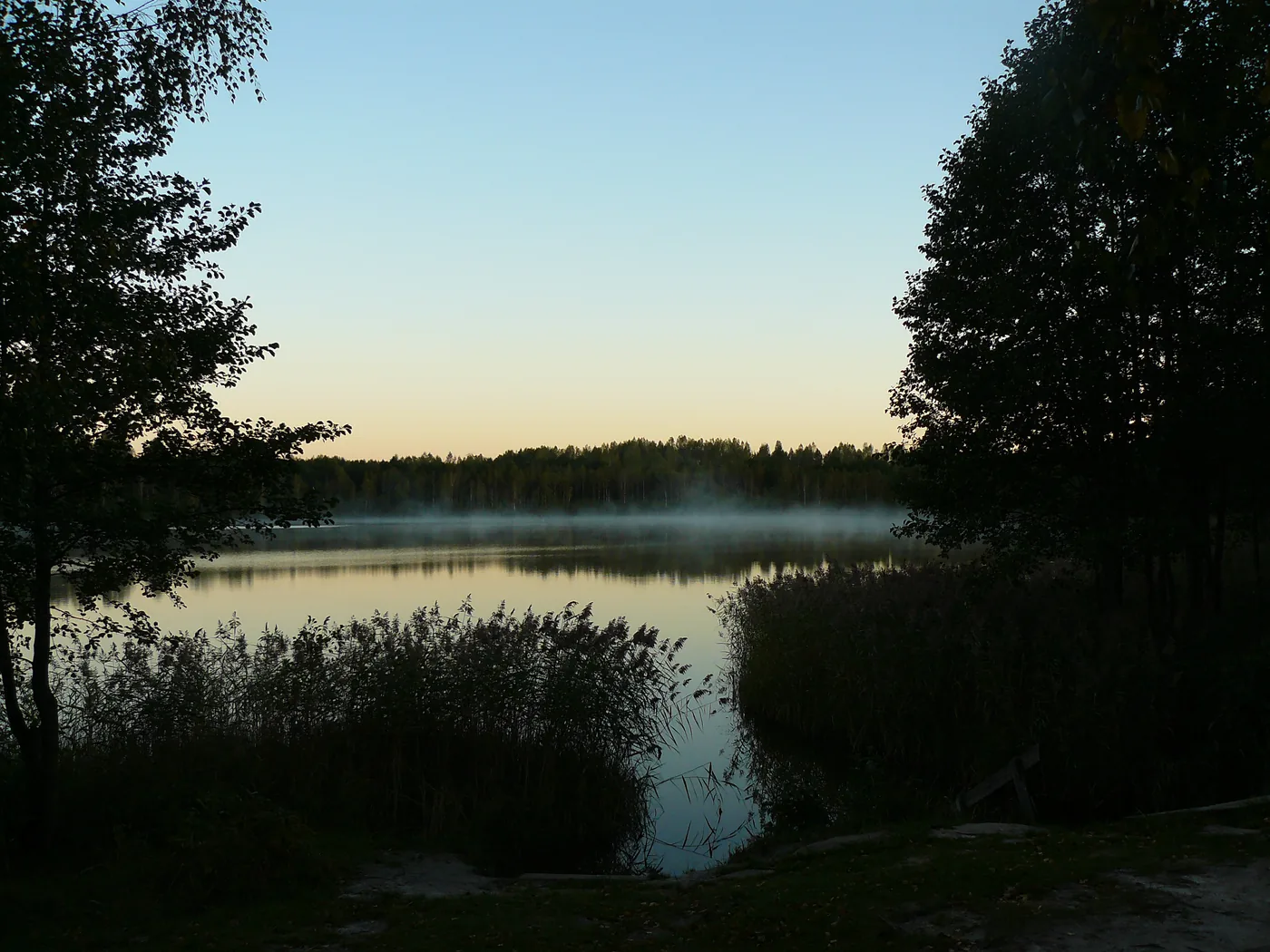
Kitezh is the legendary Russian city that God made invisible to save it from Batu Khan's Mongols in 1238. According to the legend it still stands on the shore of Lake Svetloyar, in the forests north of the Volga, north-east of Nizhny Novgorod, but only the righteous can see it or hear its bells. Every year on the eve of the feast of the Vladimir icon of the Mother of God, at the start of July in today's calendar, pilgrims walked around the lake with candles in the hope of a glimpse.
There is no evidence that Kitezh existed. No chronicle of the 13th century names it. The only written source is an Old Believer book that claims to have been written in 1251 but survives only in copies made after 1790. The prince whom the legend says died defending Kitezh, Grand Prince Yuri (Georgii) Vsevolodovich of Vladimir, was killed in a battle on the river Sit, far to the north-west. This article traces the legend from its source to the opera that made it famous.
Kitezh at a glance
| What | A legendary city said to have become invisible during the Mongol invasion |
| Where | Lake Svetloyar, near the village of Vladimirskoe, Nizhny Novgorod region (Great Kitezh); Gorodets on the Volga (Lesser Kitezh) |
| Founder in the legend | Grand Prince Georgii (Yuri) Vsevolodovich |
| Destroyer in the legend | Batu, "the godless tsar" |
| Written source | The Book Called Chronicler (Kniga glagolemaia letopisets), an Old Believer text |
| Oldest copies | On paper made in Yaroslavl in the 1790s |
| Earliest historical record of Kitezh | None before that text |
| Best-known retelling | Rimsky-Korsakov's opera The Legend of the Invisible City of Kitezh and the Maiden Fevroniya, first staged in 1907 |
What does the Kitezh legend say?
The legend's written form, the Book Called Chronicler, tells the story in two parts. The first is about the prince. Georgii Vsevolodovich, the text says, built Lesser Kitezh on the bank of the Volga, then went on through the forests and built Great Kitezh of stone on the shore of Lake Svetloyar, a hundred poprishcha (roughly a hundred kilometres) from the first town.
Then Batu came. Georgii fought him at Lesser Kitezh, then slipped away by night to Great Kitezh. A captured man who could not bear torture showed Batu the way, and the Mongol "took that city of Great Kitezh, which is on the shore of Lake Svetloyar, and killed the faithful prince Georgii on the 4th day of the month of February" (our translation).
The second part, the Tale and Search for the Hidden City of Kitezh, explains what happened to the city. It did not fall. It became invisible:
"And Great Kitezh shall be invisible until the coming of Christ." (our translation)
The text warns that only the worthy will find it. Whoever goes looking for it with the wrong intentions, or boasts about it, "will see only forest and an empty place".
Did Kitezh really exist?
There is no sign of it in any medieval source. The chronicles that describe the Mongol campaign of 1237–1238 in detail, the Laurentian Chronicle from north-eastern Rus' and the Novgorod First Chronicle, list the towns the Mongols took. Kitezh is not among them.
The Kitezh book itself makes impossible claims. It says it was written in the year 6759 of the Byzantine era, that is 1251. Yet it names Georgii as the son of Prince Vsevolod-Gavriil of Pskov, who died in 1137 or 1138; the real Georgii was the son of Vsevolod "Big Nest" of Vladimir. It dates the building of Great Kitezh to 1165–1167, decades before Georgii was born. And its oldest copies are not medieval at all.
The literary scholar Vasily Komarovich, who published the first full study of the legend in 1936, examined the paper of these copies. Its watermarks show that it was made in the 1790s at the Yaroslavl paper mill of the heirs of Savva Yakovlev. He showed that the Book draws on another Old Believer text dated 1702, so it cannot be older than that.
Who wrote the Kitezh chronicle?
The Book is an Old Believer work. The Old Believers were the Russians who rejected the church reforms of Patriarch Nikon in the 1650s and were persecuted by church and state. Many fled into the forests beyond the Volga, where Lake Svetloyar lies.
The text's own voice is unmistakably theirs. The saints of the hidden city, it says, mourn day and night "for our apostasy, of the whole Muscovite state, that the Antichrist reigns in it" (our translation). Komarovich traced the final version to the beguny ("runners"), a radical Old Believer group that rejected all contact with the state and even owning money. He suggested that it was put together at one of their "councils" in the 1780s or 1790s, perhaps at their centre in the village of Sopelki near Yaroslavl, where the oldest copies come from.
Modern scholars broadly agree. N. V. Ponyrko, who edited the text for the Pushkin House library of Old Russian literature, writes that the Book "took its final form in the second half of the 18th century among one of the priestless Old Believer groups, the beguny", but that both of its parts go back to the 17th century. The Orthodox Encyclopedia dates the Kitezh tale to Old Believer circles at the end of the 17th century.
What really happened to Prince Yuri in 1238?
The real Yuri (in church usage Georgii) Vsevolodovich was born in 1188 and was grand prince of Vladimir from 1212 to 1216 and again from 1218. When Batu's army invaded north-eastern Rus' in the winter of 1237–1238, Yuri left his capital to gather troops in the north. The Laurentian Chronicle says he "camped on the Sit, waiting for his brother Yaroslav with his troops".
The Mongols took Vladimir in February 1238; Yuri's wife, sons and grandchildren died in the burning city. Then a Mongol army under the commander Burundai found Yuri's camp. The chronicle dates the disaster precisely: "this evil happened on the 4th day of the month of March", and "there the grand prince Yuri was killed, on the Sit river" (our translation). Bishop Kirill of Rostov later found his headless body and took it to Rostov.
The Novgorod First Chronicle, written further away, was less sure of the details: "And God knows how he died; for some say much about him" (trans. Michell and Forbes). The Sit is a small river west of Yaroslavl, several hundred kilometres from Lake Svetloyar.
The legend kept the prince, the enemy and even the day of the month, but moved the place and the month. Ponyrko suggests that it preserves a genuine memory of these events. The link with Gorodets, the "Lesser Kitezh" of the legend, may also have a basis: according to her commentary, Georgii held Gorodets as his own territory from 1216 to 1219.
Why Lake Svetloyar?
Komarovich argued that the lake was a sacred place long before the Old Believers came. He collected local reports of ancient "devilish games" held there, and suggested that it had been a site of midsummer rites, the Kupala festival; the pilgrims' night at the lake falls at about the same time of year. He also connected the legend with the "Zauzolye land", a district west of the lake that the Book says Batu laid waste so that "the forest grew over" it, and looked for later events that local memory might have transferred to Batu. These ideas remain hypotheses.
The lake itself is unusual: small and almost round, about 350–400 metres across, and up to 33 metres deep. Its origin is disputed. Geologists have proposed karst collapse, glacial and tectonic origins; in 2009 the geologist Sviatoslav Engalychev argued in a press interview that it is a meteorite crater about 3,000 years old. None of these theories supports the idea that the lake formed in 1238.
Has anyone found Kitezh?
People have looked. In the 1870s a local amateur archaeologist, A. P. Polivanov, dug on the hills by the lake. In 1968–1970 the newspaper Literaturnaya Gazeta organised an expedition with folklorists, geologists and divers. On the lake bottom, the folklorists later reported, "in fact only pieces of wood of various sizes and shapes with traces of working by cutting tools were found" (Blinkova et al., 1973).
In 2011 archaeologists from Nizhny Novgorod University found traces of a small settlement on the slope of a hill by the lake. The theologian D. V. Semikopov described it as a Russian settlement of the 13th to 15th centuries, about half a hectare in size. The leader of the excavation, Evgeny Chetvertakov, was more cautious: "Most likely it was not a town but a single homestead," with one house and outbuildings for ten to fifteen people, and its dating was provisional (Ogonyok, 2012). Divers of the Russian Geographical Society explored the lake again in 2013.
Nothing has been found that resembles a city.
The pilgrims of Svetloyar
By the 19th century Lake Svetloyar had become a place of pilgrimage, mostly for Old Believers. The Brockhaus and Efron Encyclopedia reported around 1900 that "up to a thousand or more people, mostly schismatics" came from several provinces on the night of 23 June (Julian calendar), the eve of the feast of the Vladimir icon, to walk around the lake three times with candles and singing.
The writer Vladimir Korolenko visited in 1890 and described the scene:
"Pious people crawl three times around the lake on their knees, then float the stubs of their candles on wood chips on the water, and press themselves to the earth and listen." (Korolenko, In Deserted Places, our translation)
Korolenko had expected a place where people "of different faiths" came from as far as Perm and beyond the Urals to pray, listen for the bells of Kitezh and "stand firm in disputes for their faith". He noted that the old forest life was disappearing: "The 'mystery' of Kitezh lies exposed by the high road."
The invisible city in literature, art and music
The legend reached a wide audience through literature. Pavel Melnikov-Pechersky described the Svetloyar pilgrimage in his novel In the Forests (written in the 1870s), and Korolenko and the writer Mikhail Prishvin wrote about the lake. In the early 20th century Kitezh became a symbol of a hidden, holy Russia for poets and thinkers of the Silver Age.
In 1903 Nikolai Rimsky-Korsakov and his librettist Vladimir Belsky were working on an opera, The Legend of the Invisible City of Kitezh and the Maiden Fevroniya. It combined the Kitezh legend with the story of Fevroniya, a wise peasant girl, and was first staged at the Mariinsky Theatre in St Petersburg in 1907. The folklorists of the 1968–1970 expedition found that the oral legend was alive only around the lake itself; its wider fame, they concluded, was due to Rimsky-Korsakov's opera and to the works of Melnikov, Korolenko and Prishvin (Blinkova et al., 1973).

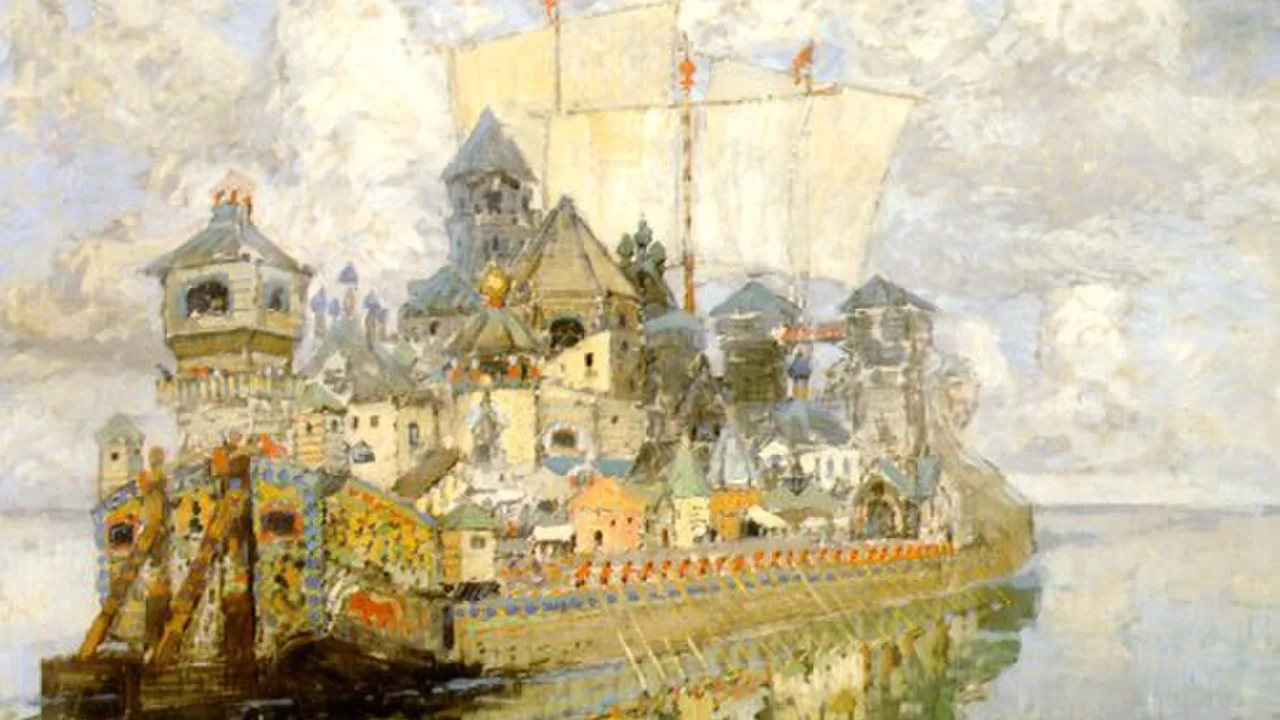
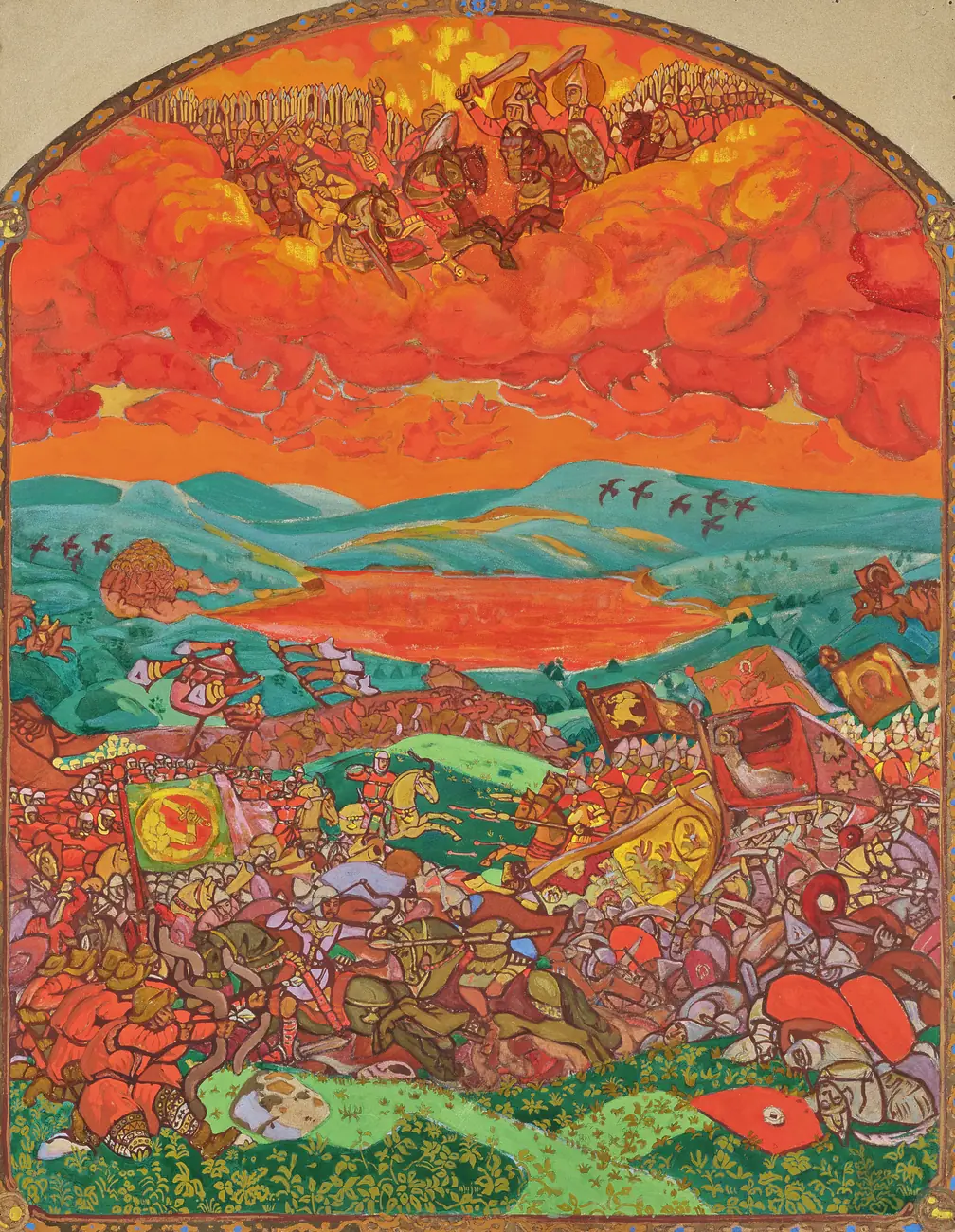
Painters took up the theme too. Nicholas Roerich designed scenes for the opera, among them the Battle of Kerzhenets (1913), in which the Russian and Tatar armies fight below a heaven of red clouds. Konstantin Gorbatov painted the floating city in 1913, and Mikhail Nesterov painted Kitezh in 1922.
Did Kitezh sink into the lake?
In the Book the city does not sink. It becomes invisible, "covered by the hand of God". Folklorists distinguish three versions of the story as it was told around the lake: an underwater Kitezh at the bottom of the lake, an underground Kitezh inside the hills, and a heavenly Kitezh (Groza, 2008). The popular image of a city beneath the water, with bells ringing from the depths, belongs to oral tradition and to the art and literature of the 19th and 20th centuries.
Common myths about Kitezh
| Myth | What the evidence says |
|---|---|
| A chronicle of 1251 records Kitezh | The text claims that date, but survives only in copies of the 1790s and was composed in the 17th–18th centuries |
| Medieval chronicles mention Kitezh | No 13th-century source names it |
| Prince Yuri died defending Kitezh | He was killed on the Sit river on 4 March 1238 |
| Kitezh sank into the lake | The written legend says it became invisible; the sunken city is a later, oral version |
| Archaeologists have found Kitezh | Divers found worked wood; excavators found a small rural site, probably one homestead |
| The lake was formed when Kitezh disappeared | The lake's origin is disputed, and no theory puts it in 1238 |
What the map shows next
The map of 1238 shows north-eastern Rus', the land of Vladimir and Suzdal ruled by Yuri Vsevolodovich, under the name of Rostov-Suzdal. Around it lay Ryazan, the first principality destroyed by the Mongols in December 1237, the Novgorod Republic to the north-west, which Batu's army did not reach, and the expanding Mongol Empire.
Sources
Primary sources
- "Legenda o grade Kitezhe" (Kniga glagolemaia letopisets), ed. and trans. N. V. Ponyrko, Biblioteka literatury Drevnei Rusi, vol. 5 (Pushkin House): http://lib.pushkinskijdom.ru/Default.aspx?tabid=4960
- Laurentian Chronicle, Polnoe sobranie russkikh letopisei, vol. 1 (Leningrad, 1926), s.a. 6746: https://archive.org/details/psrl_tom1_lavrentyevskaya_letopis_1926
- The Chronicle of Novgorod 1016–1471, trans. R. Michell and N. Forbes (London, 1914), s.a. 1238.
- V. G. Korolenko, V pustynnykh mestakh (1890), ch. 2 "Svetloiar": ru.wikisource.org: В пустынных местах (Короленко)
- "Svetloe ozero", Entsiklopedicheskii slovar' Brokgauza i Efrona, vol. 29 (1900).
Studies
- V. L. Komarovich, Kitezhskaia legenda: Opyt izucheniia mestnykh legend (Moscow and Leningrad, 1936): https://archive.org/details/kitezhskaia_legenda__opyt_izucheniya_mestnykh_legend
- A. A. Gorsky, "Georgii (Iurii) Vsevolodovich", Pravoslavnaia entsiklopediia: https://www.pravenc.ru/text/164457.html
- M. Blinkova et al., "Kitezhskaia legenda i neskazochnaia proza Zavolzh'ia", Sovetskaia etnografiia 1973, no. 4: https://eo.iea.ras.ru/wp-content/uploads/1973/04/eoarchive_1973_4_113_blinkova-et-al.pdf
- A. B. Groza, "Muzeefikatsiia kul'turnogo landshafta na primere ozera Svetloiar…", Izvestiia RGPU 2008: https://cyberleninka.ru/article/n/muzeefikatsiya-kulturnogo-landshafta-na-primere-ozera-svetloyar-i-legendy-o-sokrovennom-grade-kitezhe
- D. V. Semikopov, "Grad Kitezh – poteriannyi rai", 2012: https://cyberleninka.ru/article/n/grad-kitezh-poteryannyy-ray-legenda-o-grade-kitezhe-v-bogoslovskom-i-religiovedcheskom-aspektah
- "Uzh Kitezh nevterpezh", Ogonyok no. 23, 11 June 2012: https://www.kommersant.ru/doc/1951210
- RIA Novosti, 20 October 2009, interview with S. Engalychev (archived): https://web.archive.org/web/20091028041548id_/http://www.rian.ru/science/20091020/189754883.html
Image credits
- Title image: Konstantin Gorbatov, The Invisible Town of Kitezh, 1913. Public domain, via Wikimedia Commons, cropped to 16:9.
- Lake Svetloyar before sunrise. Photo: Dmfff, CC BY-SA 4.0, via Wikimedia Commons.
- Title page of the vocal score, 1906. Public domain, via Wikimedia Commons.
- Nicholas Roerich, The Battle of Kerzhenets, 1913. Public domain, via Wikimedia Commons.