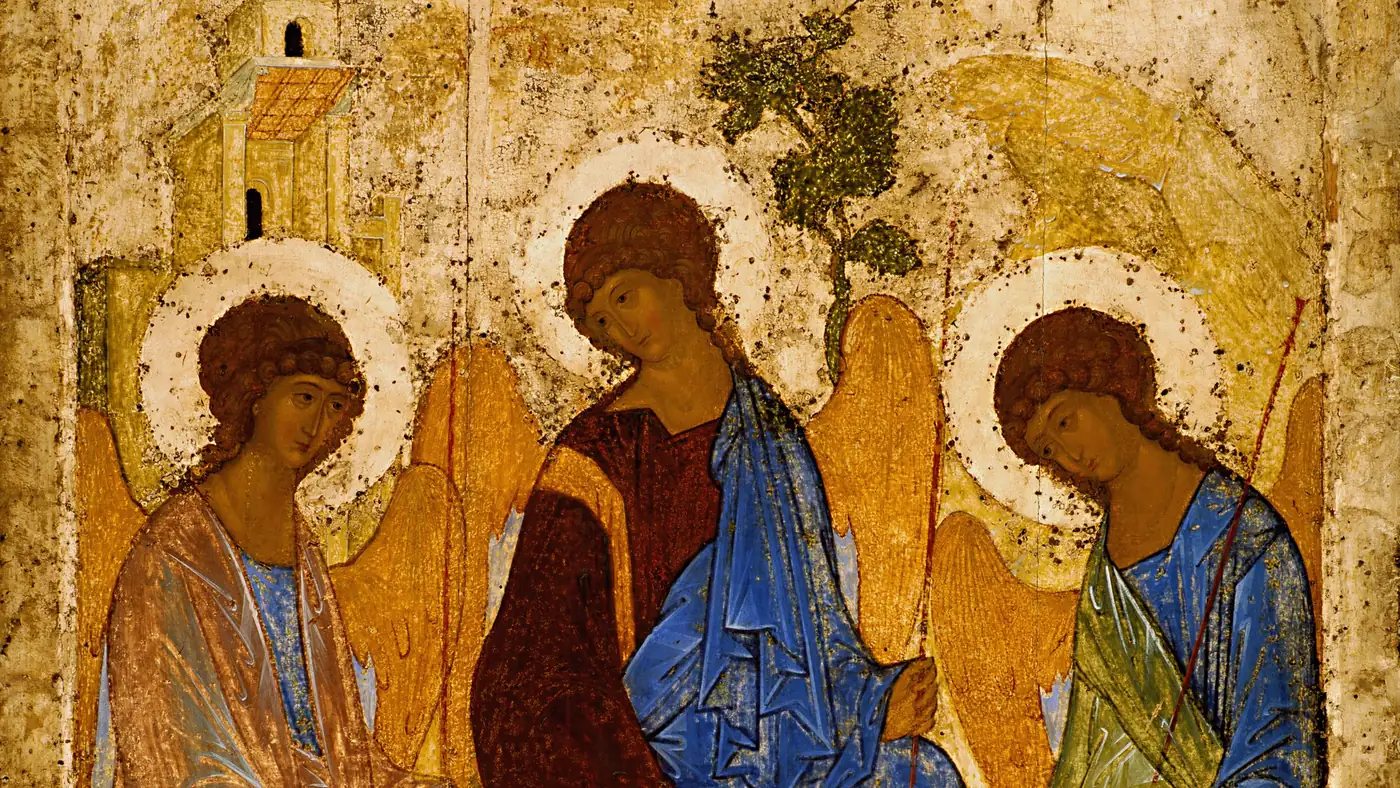
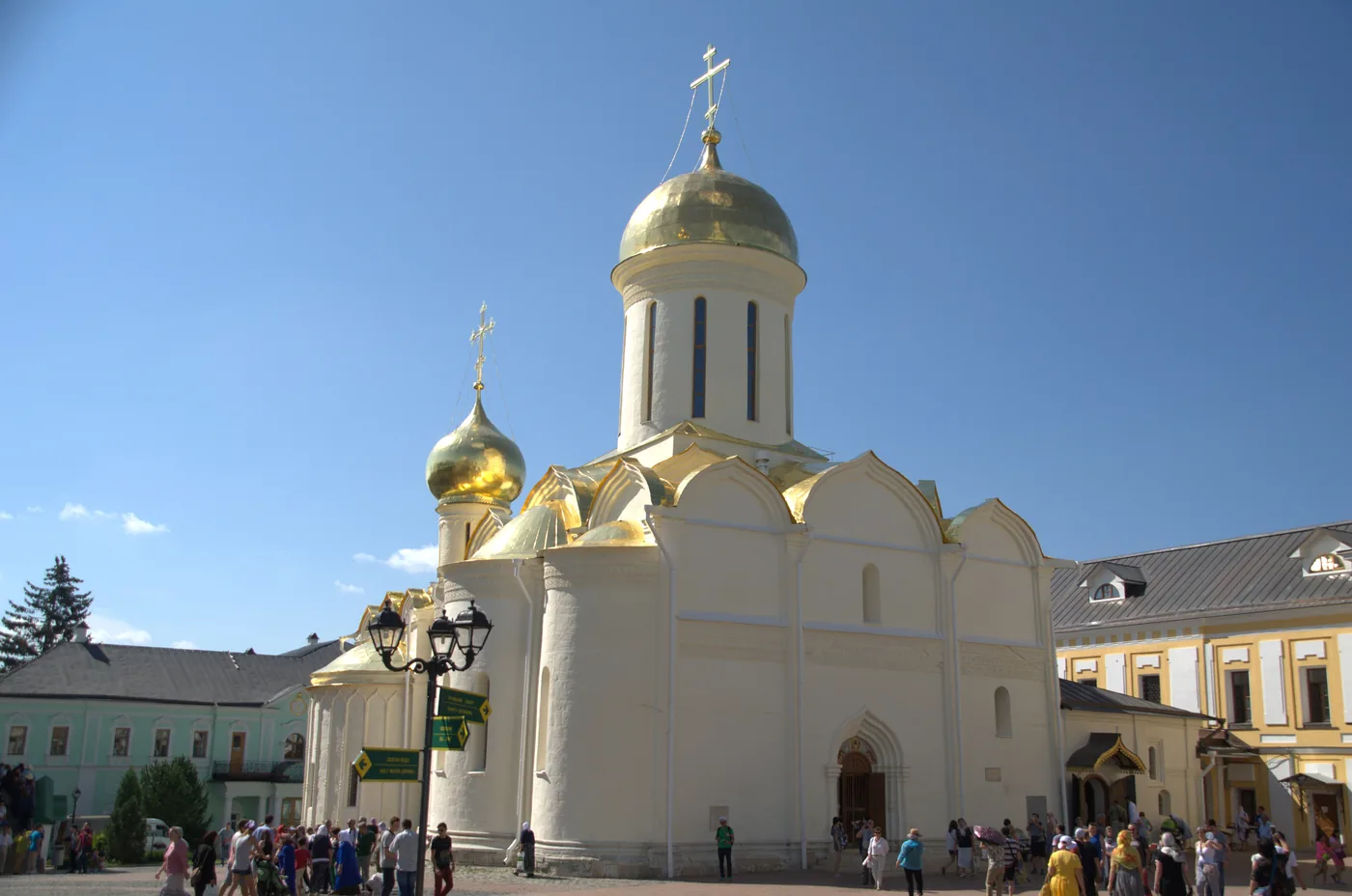
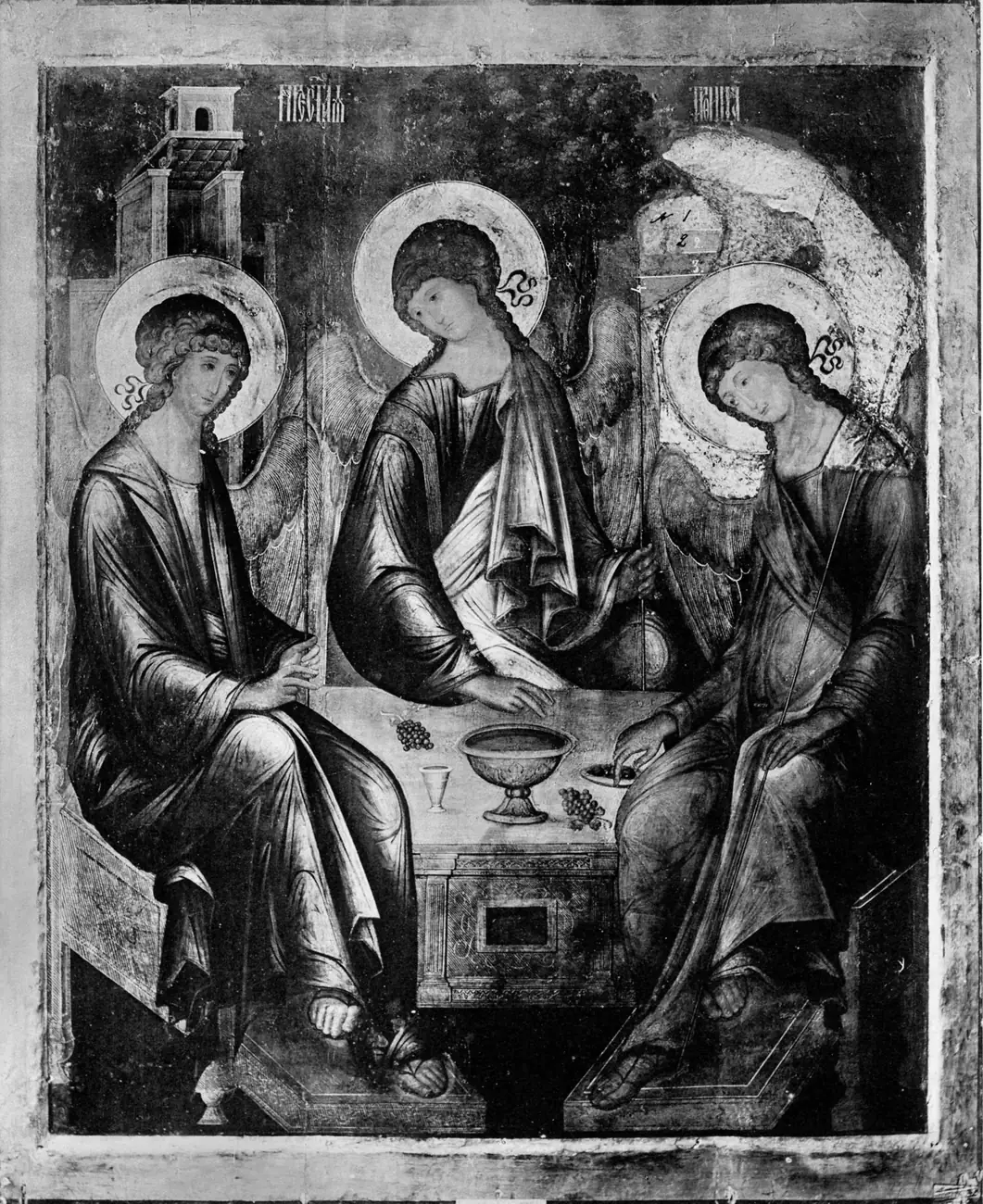
Andrei Rublev's Trinity is an icon painted in egg tempera on a lime-wood panel, 142 by 114 centimetres, for the Trinity monastery founded by St Sergius of Radonezh, north-east of Moscow. It shows the three angels who visited Abraham in the Book of Genesis, read as an image of the Christian Trinity. It was painted either about 1411 or in the 1420s; historians still disagree.
It is now the most famous Russian icon, but much of its fame is recent. For centuries it was hidden under a gold cover and layers of overpaint, and its attribution to Rublev rests on a text written some 250 years after his death. In 2023, after almost a century in the Tretyakov Gallery, it was handed back to the Russian Orthodox Church for its use, against the warnings of museum experts. In September 2026 reports that its climate case had failed raised fresh fears for its condition.
Rublev's Trinity at a glance
| Painter | Andrei Rublev, monk and icon painter (c. 1360? – 1430?) |
| Date | About 1411, or 1420s; the Tretyakov catalogue gives 1422–1427 |
| Material | Egg tempera on gesso over cloth, lime-wood panel |
| Size | 142 × 114 cm |
| Made for | Trinity monastery of St Sergius (today the Trinity Lavra, Sergiev Posad) |
| Tretyakov Gallery | 1929–2023, inventory no. 13012 |
| Since 2023 | Lent to the Church for 49 years; still federal property |
| Current place | Trinity Cathedral of the Lavra, since 22 June 2024 |
What does the Trinity icon show?
The subject comes from Genesis 18. Three men appear to Abraham by the oaks of Mamre. Abraham bows before them and offers them hospitality: Sarah bakes cakes, a servant prepares a calf, and the guests eat under the tree. Christian writers read the scene in two ways. Some, like Ambrose and Augustine, saw in the three visitors a revelation of the Trinity; others, like John Chrysostom, saw the Lord accompanied by two angels (Orthodox Encyclopedia).
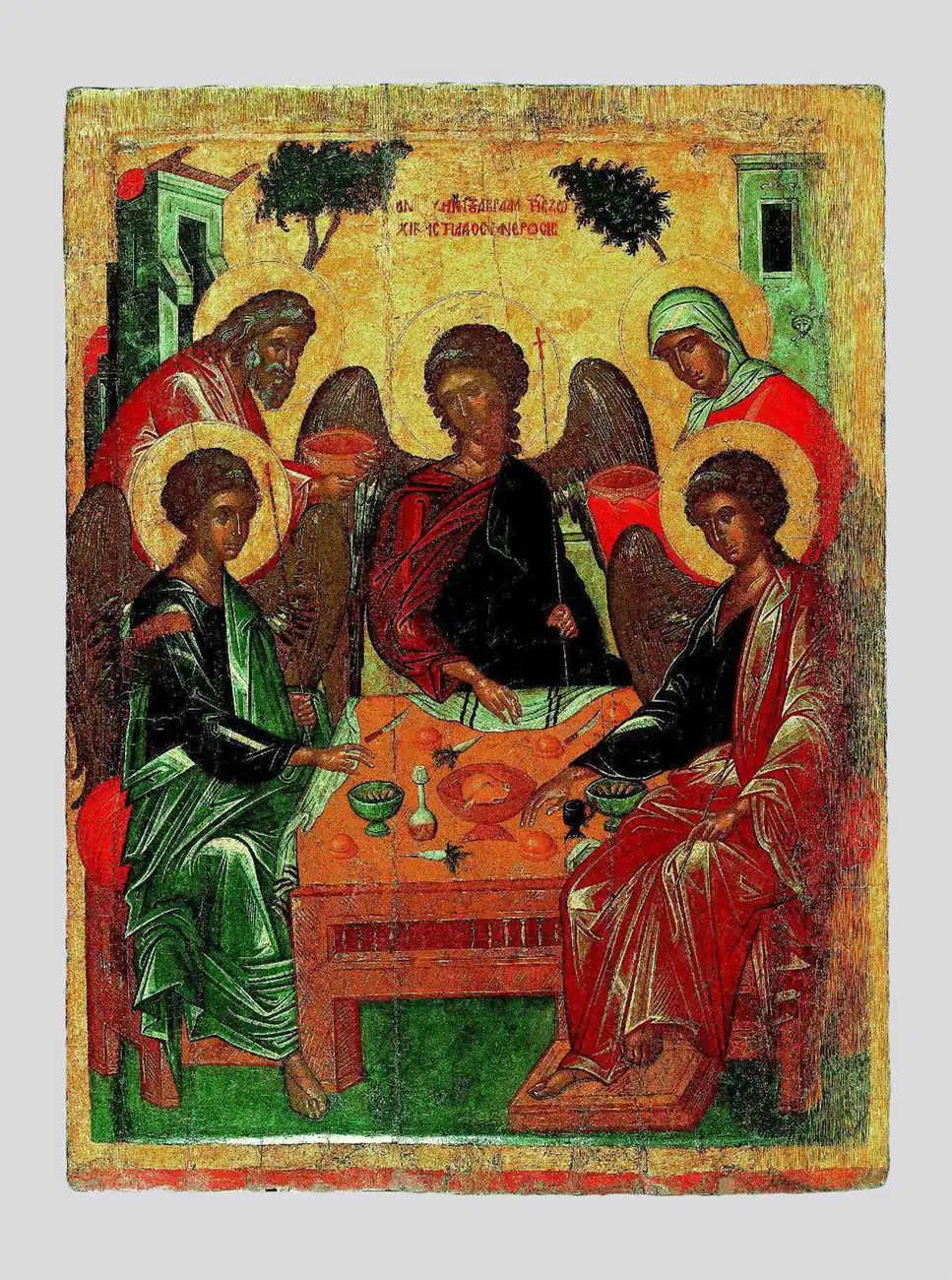
Earlier images of the scene, Byzantine and Russian, show the whole story, with Abraham and Sarah serving the guests. Rublev removed them. "In A. R.'s icon there are no images of Abraham and Sarah, or of the servant with the calf," the Orthodox Encyclopedia notes. What remains are three angels seated around a table, their figures fitting into a circle, their heads inclined towards each other.
The angels, the house, the tree and the mountain
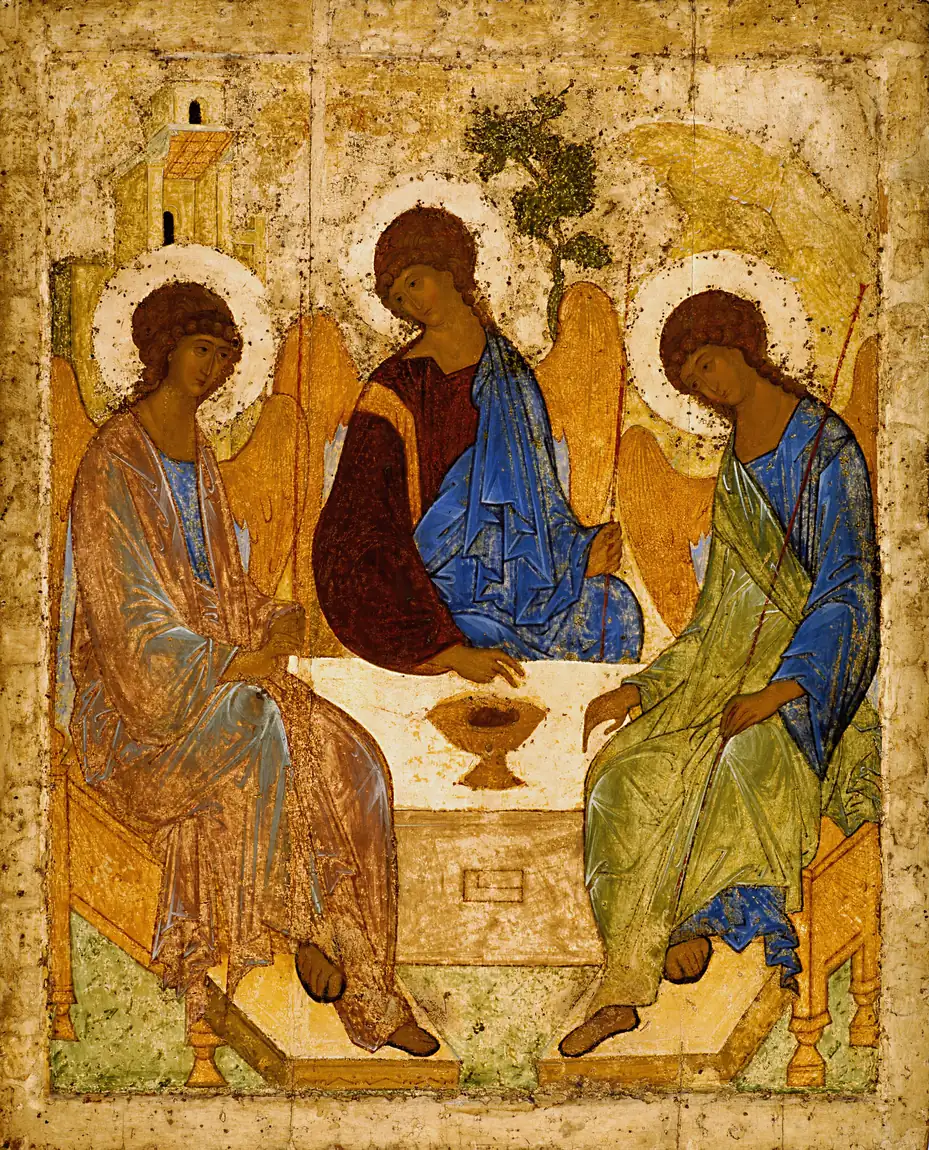
On the table stands a chalice with the head of a calf, the sacrificial animal of the story, which turns the meal into an image of the Eucharist. The table itself looks like an altar. In the front it has a small rectangular opening, like the openings in early altars through which relics could be venerated. The Tretyakov catalogue of 1963 connects it with the "table of Abraham", a relic shown in Hagia Sophia in Constantinople, which a deacon of the Trinity monastery named Zosima described after his journey there in 1420 (Antonova and Mneva).
Behind the angels are three objects, which the Orthodox Encyclopedia reads as signs of the three persons of the Trinity: the building behind the left angel points to the Father, "Creator of heaven and earth"; the tree behind the middle angel, who wears the dark cherry-red tunic with a stripe (clavus) and the blue cloak that are Christ's traditional clothes, points to the Son; and the mountain behind the right angel, "a symbol of spiritual ascent", points to the Holy Spirit.
That is the most common reading, also given in the 1963 catalogue. It is not the only one. As N. V. Kvlividze wrote in the journal of the Moscow Patriarchate in 2023, there are still "various versions of the identification of the angels with the persons of the Holy Trinity".
Rublev's blues
The 1963 catalogue describes the colours: "Shades of blue (lapis lazuli) dominate the colouring." The middle angel's cloak is a deep, saturated blue; the right angel's cloak is a pale green; there is golden ochre in the faces and wings. The inscription "Holy Trinity", of which only fragments survive, was written in cinnabar red. Much has been lost. The icon once had a gold background and gold haloes; today only fragments of the gold remain, with the holes of the nails that held the later metal cover (Antonova and Mneva).
Who was Andrei Rublev?
Very little is known. Andrei was his name as a monk; his name before he took vows is unknown. The usual birth date, about 1360, is a calculation: a late source, the Description of Russian Saints, says he died in 1430 "in great old age", and historians assumed great old age meant about seventy (Orthodox Encyclopedia). Some have argued that he was born in the 1370s or 1380s.
The earliest reliable evidence comes from the Trinity Chronicle, a Moscow chronicle of the early 15th century:
- 1405. Theophanes the Greek, "the elder Prokhor of Gorodets and the monk Andrei Rublev" painted the Annunciation cathedral in the Moscow Kremlin. Their frescoes are lost; the present cathedral was built later.
- 1408. "By order of the grand prince, the masters Danilo the icon painter and Andrei Rublev" began painting the Dormition cathedral in Vladimir. Parts of their Last Judgment survive there.
Later texts add a little. Pachomius the Serb, writing in the 1440s, gives two versions. His Life of Nikon says that Rublev and his companion Daniil painted the stone Trinity cathedral of the Trinity monastery in the 1420s and that Rublev died soon afterwards; his Life of Sergius says that Rublev's last work was the Saviour cathedral of the Andronikov monastery in Moscow, where he died. At the end of the 15th century Joseph of Volokolamsk recorded, from the words of an abbot of the Trinity monastery, that Daniil was Rublev's "teacher" and that through "great zeal for fasting and the monastic life" Rublev was able to raise "mind and thought to the immaterial and divine light" (Orthodox Encyclopedia).
Other works are attributed to Rublev on grounds of style: the Zvenigorod icons, found in 1918 near the Dormition cathedral in Zvenigorod, and icons in the Annunciation and Trinity cathedrals. The Russian Orthodox Church canonised him as a saint in 1988.
When was the Trinity painted?
There are two dates, and each has strong supporters.
| Dating | Argument | Supporters |
|---|---|---|
| About 1411 (or the 1410s) | Painted for the wooden Trinity church that Abbot Nikon built in 1411, after the monastery was burned in Edigu's raid of 1408; the style is close to the Vladimir frescoes of 1408 | V. N. Lazarev, G. V. Popov, E. S. Smirnova |
| 1420s (often 1422–1427) | Painted for the stone Trinity cathedral begun in 1422, when the relics of St Sergius were found | V. I. Antonova, G. I. Vzdornov, the Tretyakov catalogues of 1963 and 2019 |
The Orthodox Encyclopedia lists both camps and dates its own illustration "1412 (?), 1420s (?)". Lazarev's argument was one of style: he saw the icon as close to Rublev's work of 1408 and firmer than the icons of the Trinity cathedral of the 1420s. The opposing camp points to the stone cathedral, where the icon later stood as the principal icon of the church, in the lowest tier of the iconostasis. The question is not settled, and the Moscow Patriarchate itself used the date "1422–1427" in 2026.
How do we know it is Rublev's work?
Not from any document of his own time. No 15th- or 16th-century text says that Rublev painted this icon.
The famous mention of Rublev in 1551 is about how to paint the Trinity, not about this particular icon. The church council of that year, known as the Stoglav ("Hundred Chapters"), was asked whether a cross-shaped halo should be painted on one angel or on all three. Its answer, in chapter 41, was that icon painters should paint "from the ancient models, as the Greek icon painters painted and as Andrei Rublev painted and other renowned icon painters", sign it "Holy Trinity", "and add nothing of their own invention" (our translation). By then Rublev had become a model for icon painters. The council did not say which icon he painted.
The monastery's first surviving inventory, of 1641–1642, puts the icon in first place among its treasures but says nothing about Rublev; it dwells instead on the precious cover. The attribution first appears in the Tale of the Holy Icon Painters, a compilation of the late 17th or early 18th century:
"The venerable father Andrei of Radonezh, icon painter, called Rublev, painted many holy icons, all wonder-working … And before that he lived in obedience to the venerable father Nikon of Radonezh. He commanded him to paint in his lifetime an image of the Most Holy Trinity in praise of his father, St Sergius the Wonderworker." (our translation, after Nersesian 2012)
The Orthodox Encyclopedia calls this text unreliable, because it is late and compiled from other sources. Scholars nevertheless accept the attribution, because of the icon's place in the monastery Rublev worked for and its closeness in style to his documented work in Vladimir. It is one of the very few works that specialists regard as reliably his.
How did the icon look for most of its history?
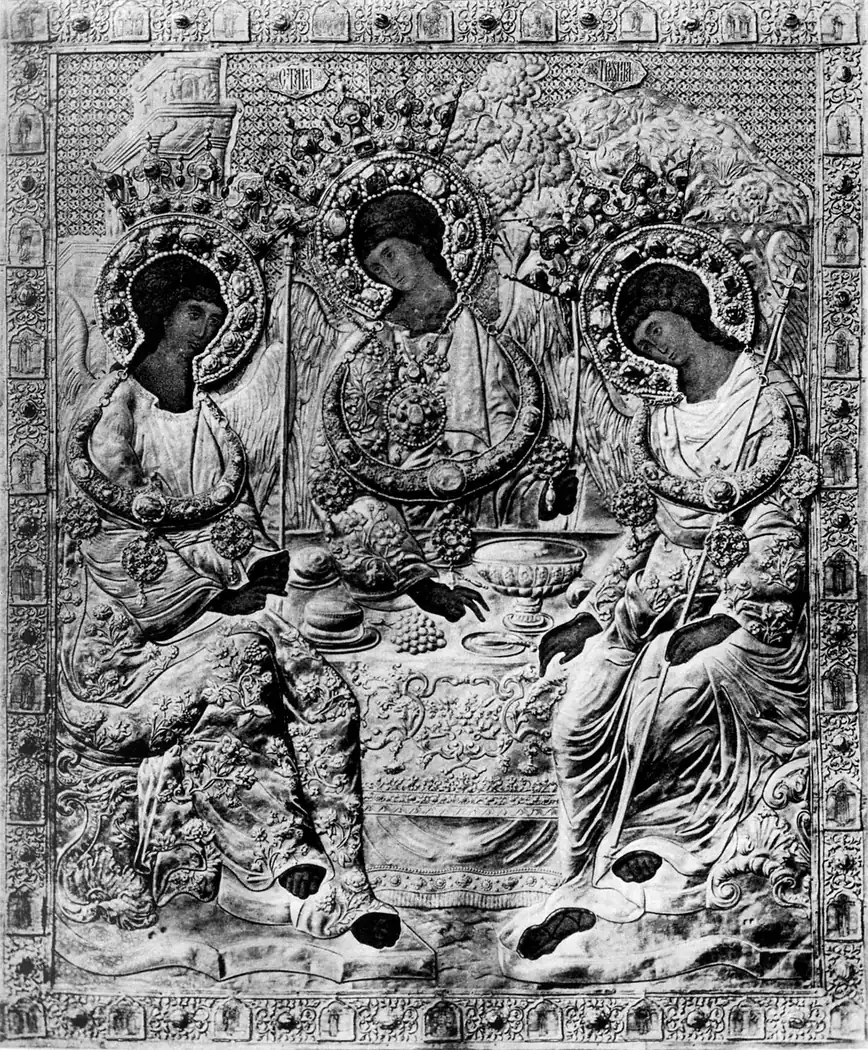
For more than three centuries almost no one saw Rublev's painting. In 1575 Tsar Ivan IV gave the icon a gold cover, and in 1599 Boris Godunov gave it a new one of gold; a copy was painted to carry Ivan's old cover (Kvlividze 2023). These covers, called oklady, left only the faces and hands visible.
The painting under the cover was also changed. It was overpainted in the early 17th century and again in the late 18th, and in 1835 and 1854 the painter I. M. Malyshev from Palekh restored it (Antonova and Mneva). By 1900 much of the visible paint was not Rublev's.
Uncovering the icon, 1904–1926
In 1904–1905, on the initiative of the collector Ilya Ostroukhov, the icon painter and restorer Vasily Gur'ianov removed the cover and began cleaning the later paint. The result was disappointing. As the Tretyakov Gallery curator Levon Nersesian writes, "almost immediately after the uncovering, the icon was completely overpainted by Gur'ianov and closed again with the cover" (Nersesian, 2012). Gur'ianov had even straightened one of the middle angel's fingers, which Rublev had painted bent.
The real cleaning came after the revolution. In 1918–1919 restorers of the Central State Restoration Workshops removed the later layers: G. O. Chirikov uncovered the faces, V. A. Tiulin and I. I. Suslov the rest. In 1926 E. I. Briagin removed further later fills and the later painting of the oak of Mamre (Antonova and Mneva). The Bolsheviks had closed the monastery in 1920 and turned it into a museum. In 1929 the icon was moved to the Tretyakov Gallery in Moscow.
Was it a wonder-working icon?
Today the icon is often called the greatest holy object of Russian Orthodoxy. Historically, that is doubtful. The fact-checking site Provereno.Media points out that it had no feast of its own, no special services and no processions, the marks of a venerated wonder-working icon. The Tale of the Holy Icon Painters calls all of Rublev's icons "wonder-working", without singling out the Trinity. "This icon has never been considered to be one that produced miracles," Elizaveta Likhacheva, director of the Pushkin Museum, told TASS in 2023 (as reported by The Art Newspaper).
Its fame grew with its cleaning, and with the Soviet celebration of Rublev's 600th anniversary in 1960, when it was the centrepiece of a great exhibition in the Tretyakov Gallery. According to Provereno, those events gave the young Andrei Tarkovsky the idea for his film Andrei Rublev.
From the Tretyakov back to the Church, 2022–2024
The Church first tried to borrow the icon for the Lavra in 2008, without success. In July 2022 it was taken to the Lavra for the 600th anniversary of the finding of St Sergius's relics, despite protests from restorers, and it was back on display in the Tretyakov in December. Reports circulated that restorers had recorded 61 changes in its condition after the trip; the Tretyakov never confirmed that figure.
15 May 2023. The Moscow Patriarchate announced that, "in response to numerous requests of Orthodox believers", President Vladimir Putin had made "a decision" to return the icon to the Church. No decree was published; the Kremlin's website said nothing about it (Provereno).
What followed:
| Date | Event |
|---|---|
| 4 June 2023 | Shown for Pentecost in the Cathedral of Christ the Saviour, Moscow |
| 12 July 2023 | Contract between the Culture Ministry and the Patriarchate: free use by the Lavra for 49 years, renewable |
| 19 July 2023 | Moved to the Grabar restoration centre for examination |
| 5 January 2024 | Back in the Cathedral of Christ the Saviour |
| 22 June 2024 | Moved to the Trinity Cathedral of the Lavra; installed in a climate-controlled case to the right of the royal doors |
| End of July 2024 | A new German-made climate case installed |
The icon did not become Church property. As deputy culture minister Nadezhda Prepodobnaya told the State Duma, "it remains in the collection … it has not left the property of the Russian Federation" (Interfax).
Museum experts had warned against the move. "It could simply be lost; it could disintegrate into several pieces," Likhacheva said in 2023. "It consists of three plates that are not very securely attached to each other." (The Art Newspaper)
What happened in 2026?
In June 2026 the Tretyakov Gallery said that its first ten-day inspection of the icon at the Lavra, in the summer of 2025, had found "certain changes in its state of preservation" (The Art Newspaper Russia). On 12 September 2026 the radio station Ekho reported, citing an anonymous source, that the climate case had been out of order for several months and that the humidity inside had reached 80 per cent instead of the required 50–55 per cent (Meduza).
The next day the Patriarchate said that the icon had been removed from the iconostasis for a planned inspection under the contract. On 14 September the Tretyakov Gallery told TASS that the icon was being restored and that museum staff would examine it (Meduza). As of this writing no official report on its condition has been published.
Common myths about Rublev's Trinity
| Myth | What the evidence says |
|---|---|
| A document of Rublev's time records that he painted it | The attribution first appears in a text of the late 17th or early 18th century |
| The 1551 Stoglav council named this icon | It named Rublev as a model for painting the Trinity, not this icon |
| It was always Russia's great wonder-working icon | It had no feast or processions; its fame dates from 1904 and especially 1960 |
| What we see is exactly what Rublev painted | The gold background and haloes are largely lost, and some areas are later |
| Putin signed a decree giving it to the Church | The Patriarchate announced a "decision"; no decree was published |
| The Church now owns it | It is on loan for 49 years and remains federal property |
| It returned to the Tretyakov in 2024 | It went the other way, to the Lavra, on 22 June 2024 |
What the map shows next
The map of 1422 shows the Grand Principality of Moscow, which included the Trinity monastery, beside Tver, the Novgorod Republic and the Grand Duchy of Lithuania. To the south lay the Golden Horde, whose commander Edigu had burned the monastery in 1408.
Sources
Primary sources
- Stoglav, ed. D. E. Kozhanchikov (St Petersburg, 1863), ch. 41, question 1: https://archive.org/details/stoglav32
- Genesis 18:1–15, New Revised Standard Version: https://bible.oremus.org/?passage=Genesis+18
Studies
- E. N. Telitsyna et al., "Andrei Rublev", Pravoslavnaia entsiklopediia, vol. 2, pp. 380–387: https://www.pravenc.ru/text/115312.html
- V. I. Antonova and N. E. Mneva, Katalog drevnerusskoi zhivopisi Gosudarstvennoi Tret'iakovskoi galerei, vol. 1 (Moscow, 1963), no. 230, as reproduced by icon-art.info: https://www.icon-art.info/masterpiece.php?lng=ru&mst_id=161
- N. V. Kvlividze, "Ikona 'Sviataia Troitsa' prepodobnogo Andreia Rubleva v istorii Rossii", Zhurnal Moskovskoi Patriarkhii 2023, no. 8: https://moseparh.ru/ikona-svyataya-troica-prepodobnogo-andreya-rubleva-v-istorii-rossii.html
- L. Nersesian, "Rublev do Rubleva", Cahiers du monde russe 53/2–3 (2012), 441–452, DOI 10.4000/monderusse.9392: https://journals.openedition.org/monderusse/9392
- "Pravda li, chto 'Troitsa' Rubleva — velichaishaia sviatynia?", Provereno.Media, 6 June 2023: https://provereno.media/blog/2023/06/06/pravda-li-chto-troica-rubleva-velichayshaya-svyatynya/
News reports
- Moscow Patriarchate statement, 15 May 2023 (archived): https://web.archive.org/web/20230515183230id_/http://www.patriarchia.ru/db/text/6026913.html
- Interfax, 19 July 2023, on the 49-year contract: https://www.interfax.ru/russia/912336
- Mediazona, 16 July 2022 (archived): https://web.archive.org/web/20220716205826id_/https://zona.media/article/2022/07/16/rublev
- The Art Newspaper, 18 May 2023: https://www.theartnewspaper.com/2023/05/18/putin-now-orders-return-of-russias-most-precious-icon-to-the-church
- TASS, 22 June 2024 (archived): https://web.archive.org/web/20240622162410id_/https://tass.ru/obschestvo/21171677
- RIA Novosti, 23 June 2024: https://ria.ru/20240623/troitsa-1954812346.html
- RIA Novosti, 21 August 2024: https://ria.ru/20240821/troitsa-1967636640.html
- The Art Newspaper Russia, 14 September 2026: https://www.theartnewspaper.ru/posts/20260914-roqg/
- Meduza, 14 September 2026.
Image credits
- Title image and full icon: Andrei Rublev, Trinity, Tretyakov Gallery. Public domain (Google Art Project), via Wikimedia Commons; title image cropped to 16:9.
- Hospitality of Abraham, Zakynthos, 15th century, Byzantine and Christian Museum, Athens. Public domain, via Wikimedia Commons.
- Trinity Cathedral, Sergiev Posad. Photo: Rakoon, CC0, via Wikimedia Commons.
- The icon in its cover and before cleaning, 1904. Public domain, via Wikimedia Commons.