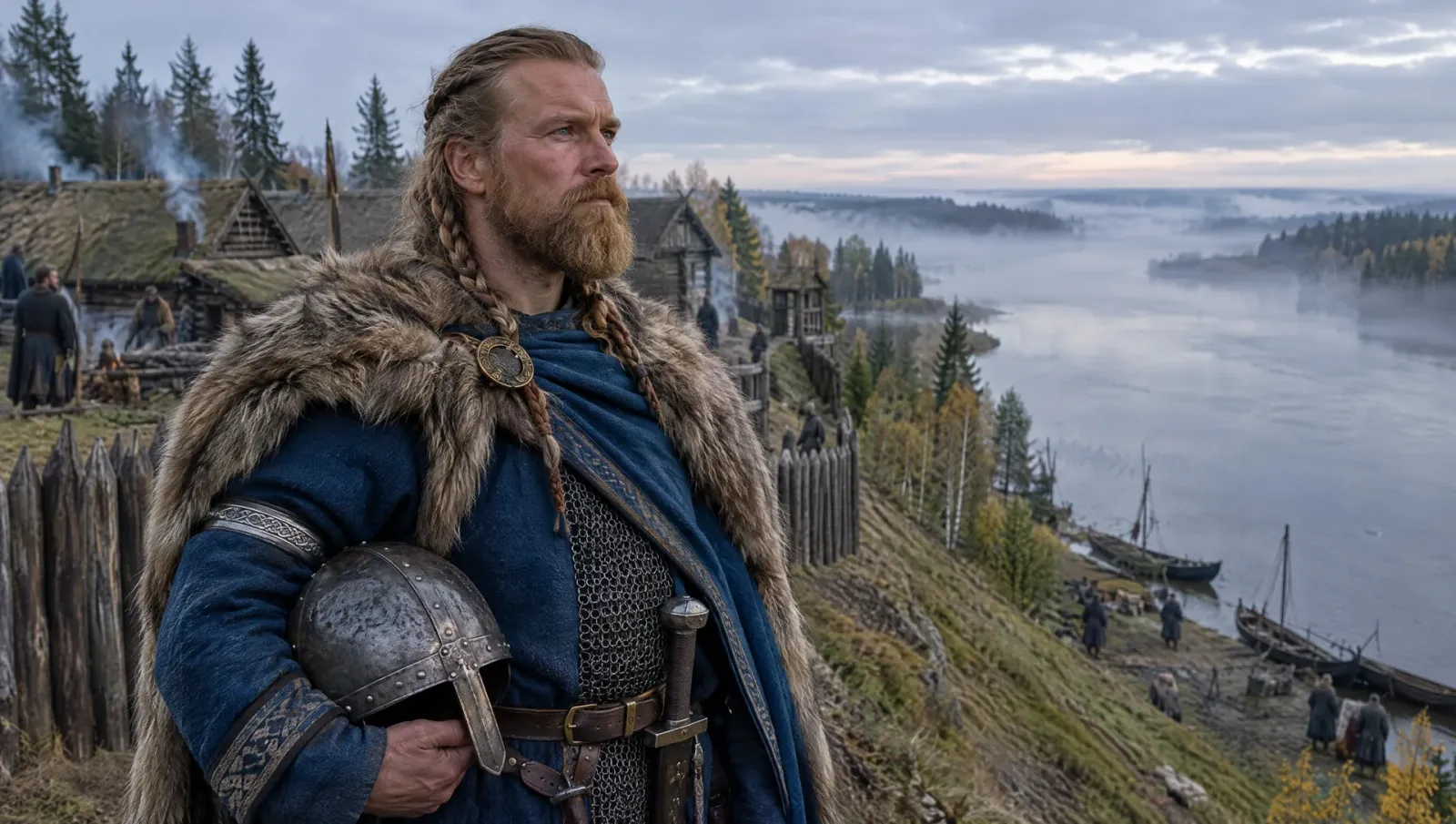
Rurik (Old Norse Hrœrekr, Old East Slavic Рюрикъ) was a Scandinavian chieftain who, according to the Rus' Primary Chronicle, came to rule the Novgorod region in AD 862 and died there in AD 879. He is the man every later prince of Kiev, Vladimir and Moscow claimed as an ancestor, which makes him the namesake of the Rurikid dynasty, a family that held thrones in Eastern Europe until 1598 and, through a junior branch, until 1610. The catch: no source written in his own lifetime mentions him, so almost everything we "know" comes from a chronicle compiled about 250 years later.
Who was Rurik?
In the tradition, Rurik was a Varangian (the Rus' term for Scandinavians in the east) invited by feuding Slavic and Finnic tribes to bring order. Encyclopaedia Britannica calls him the "semilegendary founder" of the dynasty and stresses that his story "is not accepted at face value by modern historians". He was never a king in the Western sense, and he was certainly never a tsar: that title was first formally taken by Ivan IV at his coronation on 16 January 1547, almost 700 years after Rurik's supposed arrival.
His birth date is unknown. The "c. 830" or "c. 832" found on genealogy sites is modern guesswork with no medieval source behind it. His name is usually explained as a compound of hróðr ("fame") and ríkr ("ruler, powerful"), the same Germanic name that gives English "Roderick". The name was common across Viking-Age Scandinavia, which matters later when we look at a famous namesake in Frisia.
This article is about the man and his dynasty. For the wider story of the Rus', the Normanist debate and the Ladoga and Gnezdovo digs, see our explainer Who were the Varangians?.
What does the Primary Chronicle say about Rurik?
The Povest' vremennykh let (Tale of Bygone Years), usually called the Primary Chronicle, was compiled in Kiev around 1113. Its annal for AD 860–862 tells how the tribes expelled the Varangians, fell into feuding, then sent overseas to "the Rus'" for a prince. Three brothers came. In the standard English translation by Samuel Hazzard Cross and Olgerd Sherbowitz-Wetzor (1953, Laurentian text): "The oldest, Rurik, located himself in Novgorod; the second, Sineus, at Beloozero; and the third, Truvor, in Izborsk."
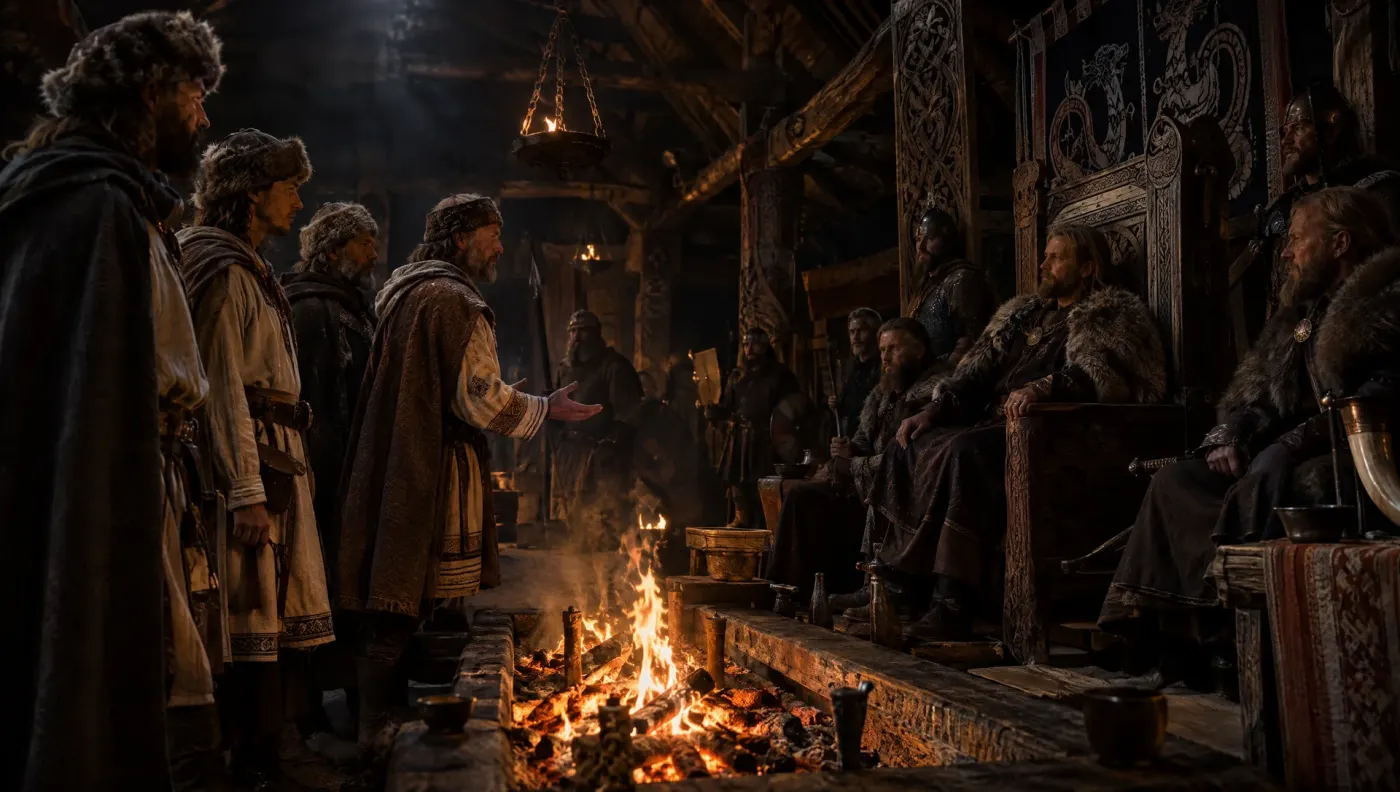
The chronicle then compresses two years into one line. Sineus and Truvor die, Rurik "assumed the sole authority" and hands towns to his men: Polotsk, Rostov and Beloozero, with Murom also listed among the peoples under him. Two of his followers who were not his kin, Askold and Dir, sail down the Dnieper, find a small town paying tribute to the Khazars, and settle there. That town was Kiev. The next time Rurik appears is his death, dated AD 879: he "bequeathed his realm to Oleg, who belonged to his kin, and entrusted to Oleg's hands his son Igor, for he was very young."
That is nearly all of it. Rurik has no battles, no speeches, no wife and no grave in the chronicle. For comparison, here is what each major source adds.
| Source | Written | What it says about Rurik |
|---|---|---|
| Primary Chronicle, Laurentian Codex | compiled c. 1113; manuscript 1377 | Invited in 862, rules from Novgorod, dies 879, leaves Igor to Oleg |
| Primary Chronicle, Hypatian Codex | manuscript c. 1420s | Rurik settles first at Ladoga, later moves to Novgorod |
| Novgorod First Chronicle, Younger Redaction | 15th-century copies | Tells the calling story; Igor is the central heir, Oleg his military commander (voivode) |
| Nikon Chronicle | 16th century | Adds later legends, e.g. a Novgorodian revolt against Rurik led by "Vadim the Brave" |
| Joachim Chronicle (via Tatishchev) | known only from an 18th-century historian | Gives Rurik a wife, "Efanda"; the original is lost and scholars treat it as unreliable |
| Frankish annals | 9th century, contemporary | Never mention Rurik of Novgorod; they do record a Danish Rorik in Frisia |
Was Rurik a real person?
The honest answer: probably someone like him existed, but the chronicle's Rurik is a literary construction. Three problems stand out. First, the Primary Chronicle was written roughly 250 years after 862, and its earliest dates were calculated backwards by the compilers, not copied from records. Second, the story is suspiciously neat, and the chronicle itself served the ruling family: it explained why only Rurik's descendants could rule. Third, even medieval lists disagree. The regnal list in the Hypatian Codex starts the princes of Kiev with Askold and Dir and does not name Rurik at all, while the chronology at the start of the Laurentian Codex begins with Oleg.
Historians split along a spectrum. The Internet Encyclopedia of Ukraine summarises it well: Aleksei Shakhmatov accepted Rurik as a historical figure but rejected his two brothers; Dmitry Likhachev saw him as legendary or semi-legendary; and a third group (N. T. Belyaev, P. Kovalevsky, Omeljan Pritsak) identified him with the Danish Rorik of Frisia. The brothers are the weakest part of the story. Valentin Yanin judged their existence doubtful, and a popular (but contested) theory reads "Sineus" and "Truvor" as garbled Norse phrases for "his kin" and "trusty retinue".
Even Rurik's link to the later dynasty is shaky. The same encyclopedia calls Igor Rurik's "son (or grandson)", and Britannica notes that Igor, "believed to be Rurik's son, is considered the real founder of the Russian princely house". Some scholars, such as Constantine Zuckerman, argue for a lost generation between Rurik and Igor.
Was Rurik Swedish or Danish? The chronicle only says he came from the Varangians "called Rus'", a name that, in Max Vasmer's standard etymology, came to the Slavs via Finnic Ruotsi ("Sweden") and goes back to Old Norse words for rowing or to Roslagen, the coast of eastern Sweden. Britannica allows for origins "from the Scandinavian peninsula or from Jutland". Genetic studies of modern Rurikid princes are covered in our Varangians article; they tell us about the male line of later princes, not about Rurik's birthplace.
Was Rurik the same man as Rorik of Dorestad?
This is the most famous identification theory, argued at length by N. T. Belyaev in "Rorik of Jutland and Rurik of the Russian Chronicles", published in the Saga-Book of the Viking Society, vol. X (1928–29), pp. 267–97. Rorik of Dorestad was a real, well-documented Danish exile who served several Carolingian kings in Frisia, the North Sea coast of today's Netherlands.
The Frankish annals track him closely. The Annals of Fulda for 850 say Emperor Lothar I of Middle Francia, unable to drive him out of Dorestad, took him into fealty on condition that he handle the royal taxes and "resist the piratical attacks of the Danes". The Annals of St Bertin place him at Dorestad in 855, show Danes withdrawing on his advice in 863, report him expelled by local Frisians in 867, and record meetings with Charles the Bald in 870 and 872. The Annals of Xanten show him swearing loyalty to Louis the German in 873, his last datable appearance alive. By 882 the annals speak of the lands Rorik "had held", now given to the Viking Godfrid. For how Viking rule actually worked in the port, see Dirk Cooijmans's study The Controlled Decline of Viking-Ruled Dorestad.
| Rurik of Novgorod | Rorik of Dorestad | |
|---|---|---|
| Evidence | One chronicle tradition, c. 1113 | Several contemporary Frankish annals |
| Active | 862–879 (chronicle dates) | c. 850–873 |
| Base | Ladoga / Novgorod | Dorestad, Frisia, briefly southern Jutland |
| Death | 879 (Primary Chronicle) | Between 873 and 882 |
| Heir | Igor, with Oleg as regent | Lands passed to Godfrid (882) |
The case for: same name, overlapping dates, and a gap in Rorik's Western record in the mid-860s, which supporters such as Boris Rybakov and Anatoly Kirpichnikov later linked to archaeological parallels between Ribe and Ladoga. The case against is stronger. Rorik is back in Frisia in 867 and busy with Frankish kings from 870 to 873, which leaves no room for a Novgorod reign lasting to 879. The name was common, no written source shows Danish contacts with the Rus' at this date, and scholars such as Alexander Nazarenko and Elena Melnikova have rejected the match. Verdict: an intriguing hypothesis, not a finding. It survives mainly because the chronicle's own dates cannot be trusted enough to rule it out.
Where did Rurik rule: Ladoga or Novgorod?
The manuscripts disagree. The Laurentian text seats Rurik in Novgorod from the start; the Hypatian text has him settle first at Ladoga (Staraya Ladoga, Old Norse Aldeigja) and only later move south. The Viking settlements along the Volkhov give archaeologists a way to test both versions.
Archaeology adds a twist: in 862 Novgorod, the "new town", did not yet exist. Tree-ring dating (dendrochronology, which dates timber by its growth rings) of Novgorod's wooden street pavements, notably at the Troitsky excavation opened in 1973, puts its earliest reliably dated layers in the 920s–930s. What did exist was a fortified settlement 2 km upstream where the Volkhov leaves Lake Ilmen: the site now called Rurikovo Gorodishche ("Rurik's hillfort"), usually identified with the Norse Holmgarðr. Excavations run since 1966 by the St Petersburg Institute of the History of Material Culture, long led by Evgeny Nosov (see his Ryurik Gorodishche near Novgorod, 1990), found a mid-ninth-century settlement with strong Scandinavian finds, and a burnt layer that fits the turbulent 860s–870s. The "Rurikovo" part of its name is only an early nineteenth-century addition, inspired by the chronicle.
Władysław Duczko, in Viking Rus (2004), describes Staraya Ladoga and Rurikovo Gorodishche as "two points on the ends of an axis", the Volkhov, forming the original land of the Rus'. So the chronicle's "Novgorod" most plausibly means Gorodishche. If a real Rurik ruled, he ruled that river corridor. The legend of "Oleg's grave" at Ladoga, a large burial mound, belongs to Novgorodian tradition and is not proof of anything.
Who succeeded Rurik?
On the chronicle's account, Rurik's kinsman Oleg ruled as regent for the infant Igor. In AD 882 Oleg moved south, killed Askold and Dir by a ruse and made Kiev his seat, the traditional birth of Kievan Rus'. The Novgorod First Chronicle tells it differently: Igor is the prince and Oleg merely his voivode (military commander), and it dates Oleg's death to 922 rather than 912. Even Oleg's grave is disputed, placed in Kiev by the Primary Chronicle and at Ladoga by Novgorodian sources.
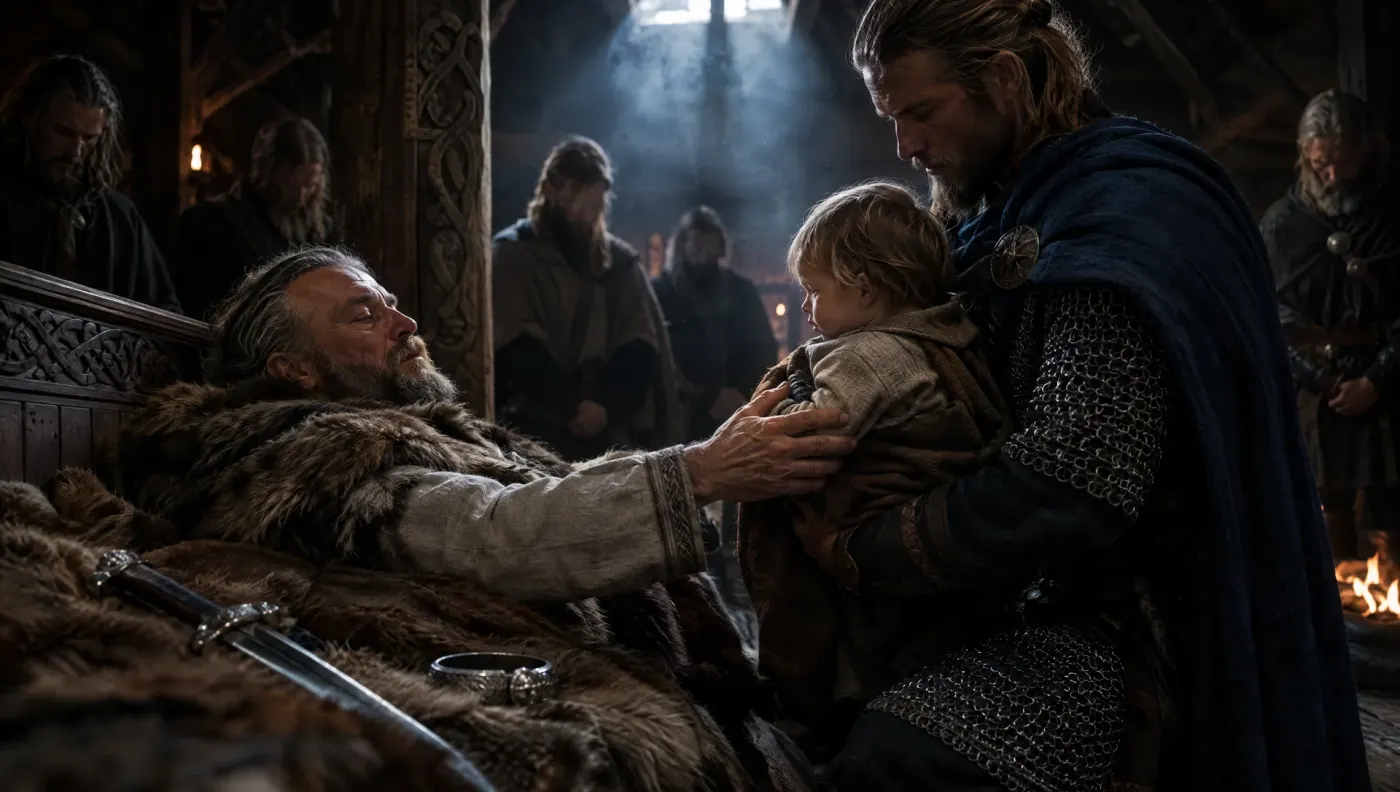
Igor ruled until he was killed by the Drevlians in AD 945, when his widow Olga of Kiev took over as regent for their son Sviatoslav. Sviatoslav's son Vladimir converted Rus' to Christianity, as told in our article on Vladimir the Great and the baptism of Rus', and Vladimir's son Yaroslav the Wise gave the dynasty its classic Kievan form. From Igor onwards the family tree rests on firmer ground, confirmed in part by the Russo-Byzantine treaties of 911 and 944 and by Byzantine writers.
The Rurikid dynasty: from Novgorod to the Kremlin
After Yaroslav's death in 1054 the dynasty did not rule as a single monarchy. Rus' split into principalities held by branches of the family under a rotating system of seniority, with the grand prince (the senior prince, originally of Kiev) at the top. Minor princes received appanages, meaning hereditary estates carved out for younger sons, which multiplied the family and fragmented power. Novgorod went its own way as the Novgorod Republic, inviting and dismissing Rurikid princes by contract. In the south-west, the Romanovichi of Galicia-Volhynia ruled until 1340.
The Mongol invasion of 1237–1240 made the Rurikid princes tributaries of the Golden Horde, and the khans chose which Rurikid held the title of grand prince of Vladimir. The descendants of Daniel of Moscow, a son of Alexander Nevsky, used that system to build the Grand Principality of Moscow. Ivan III gathered the Russian lands, and in 1547 Ivan IV was crowned tsar (a title derived from Caesar), creating the Tsardom of Russia.
| Ruler | Reign | Realm |
|---|---|---|
| Rurik | 862–879 (traditional) | Ladoga / Novgorod |
| Oleg (regent) | 879–912 (or 922) | Novgorod, then Kiev |
| Igor | 912–945 | Kiev |
| Olga (regent) | 945–c. 960s | Kiev |
| Vladimir the Great | c. 980–1015 | Kiev |
| Yaroslav the Wise | 1019–1054 | Kiev |
| Ivan III | 1462–1505 | Grand Principality of Moscow |
| Ivan IV | 1533–1584 (tsar from 1547) | Tsardom of Russia |
| Feodor I | 1584–1598 | Tsardom of Russia |
| Vasily IV Shuisky | 1606–1610 | Tsardom of Russia |
When did the Rurik dynasty end?
The senior Moscow line ended on 17 January 1598 with the death of the childless Feodor I, son of Ivan IV. Britannica's entry on the Rurik dynasty treats this as the dynasty's end on the throne. His brother-in-law Boris Godunov, not a Rurikid, was elected tsar, opening the Time of Troubles (1598–1613), a period of famine, pretenders and foreign invasion.
There was one last Rurikid tsar. Vasily Shuisky, from a junior branch descended from the princes of Suzdal, seized the throne in 1606 after the murder of the first False Dmitry. He was deposed in 1610 and died a prisoner in Poland in 1612. In 1613 an assembly elected Michael Romanov. The Romanovs were not Rurikids; their claim came through marriage, since Michael's great-aunt Anastasia Romanovna was Ivan IV's first wife and Feodor I's mother. From Rurik's traditional arrival in 862 to Shuisky's fall in 1610, the dynasty's reign spans about 750 years.
Are there Rurik descendants today?
Yes, at least in the genealogical sense. Dozens of Russian princely families trace their male line to Rurikid princes, among them the Gagarins, Obolenskys, Dolgorukovs, Volkonskys, Vyazemskys, Lobanov-Rostovskys, Shakhovskoys and Belosselsky-Belozerskys. The Shuisky line itself died out. Descent "from Rurik" really means descent from Vladimir the Great's family; whether that family really goes back to a ninth-century Rurik is exactly the question the sources cannot settle.
Is Rurik the founder of Russia?
Only as a symbol. In 1862 Russia celebrated its "millennium" with the Millennium of Russia monument in the Novgorod Kremlin, designed by Mikhail Mikeshin with the architect Viktor Hartmann and unveiled on 8 September 1862 (Old Style; 20 September New Style) in the presence of Alexander II, according to the Veliky Novgorod city portal. Rurik stands among its bronze tiers of rulers, saints and writers. At Staraya Ladoga a modern statue by Oleg Shorov shows Rurik and Oleg together; its plaque reportedly gives 2015 as the installation year, although some guides link it to the 1,150th anniversary of Russian statehood, which would point to 2012.
Soviet historians often played down Rurik's Scandinavian origins, and today Ukraine and Russia both claim Kievan Rus' as their heritage. Ukraine's coat of arms, the golden tryzub (trident), was adopted in 1918 and again on 19 February 1992; it derives from the Rurikid tamga (a clan or ownership mark) stamped on Vladimir the Great's coins, while earlier princes such as Sviatoslav used a two-pronged "bident". The popular idea that the sign depicts a diving falcon, from the Slavic rarog, is speculation. In pop culture, Rurik is a playable ruler in the 867 start of Crusader Kings III, while the board game Rurik: Dawn of Kiev (PieceKeeper Games, 2019) is actually set among Vladimir's heirs after 1015.
So: Rurik did not found Russia, Ukraine or Belarus, and he ruled no state recognisable as any of them. What he founded, or what was founded in his name, was a legitimising ancestry. That fiction, or half-fiction, held together more than seven centuries of princes, and it is the real reason his name is still worth searching.
What the map shows next
Three years after Rurik's death, the chronicle's Oleg sails down the Dnieper and takes Kiev. Open AD 882 on the map to see the Rus' power centre shift from the Volkhov to the Dnieper, or compare the Rus' around AD 880.