The streltsy (singular strelets, "shooter") were Muscovy's first standing infantry: foot soldiers armed with matchlock handguns, paid by the state and settled with their families in their own quarters of Moscow and the frontier towns. A chronicler records that in 1550 Ivan IV established "chosen streltsy with handguns, 3,000 men" and settled them in the Vorobyovskaya sloboda outside Moscow. They fought at Kazan in 1552 and in almost every war of the next 150 years, and by the late 17th century the corps had grown, by one estimate, to 55,000 men. In Moscow they also became a political force. In May 1682 they stormed the Kremlin and killed the Naryshkin party's leaders; in June 1698 four regiments marched on the capital, were broken by artillery, and Peter I answered with mass torture and executions. The corps was ordered disbanded soon afterwards, though the last town streltsy outlived Peter by decades.
The streltsy at a glance
| What | Standing infantry with firearms (pishchal'), plus the long axe (berdysh) and sabre |
| Founded | 1550 under Ivan IV: 3,000 "chosen" (vybornye) streltsy in six units of 500 |
| Administration | The Streletsky prikaz (musketeers' department) in Moscow |
| Units | Stat'ya, then prikaz (500–1,000 men), divided into hundreds, fifties and tens; renamed regiments (polki) in the 1680s |
| Size | 24 Moscow prikazy in the 1660s–early 1680s; about 14,000 Moscow streltsy in February 1682; up to 55,000 in all (BRE) |
| Pay and privileges | Money and grain wages, cloth, a house plot; free to trade and work crafts, in some towns without paying the town tax |
| First major campaign | Siege and capture of Kazan, 1552 |
| Revolts | Moscow, 15–17 May 1682 and the "Khovanshchina"; the march on Moscow, June 1698 |
| End | Disbanding ordered after 1698, halted in 1700; largely complete by the 1720s |
(Russian dates are Old Style, the Julian calendar used in Muscovy; in the 17th century add ten days for the modern calendar. Johann Georg Korb, quoted below, dated his diary New Style.)
Who were the streltsy?
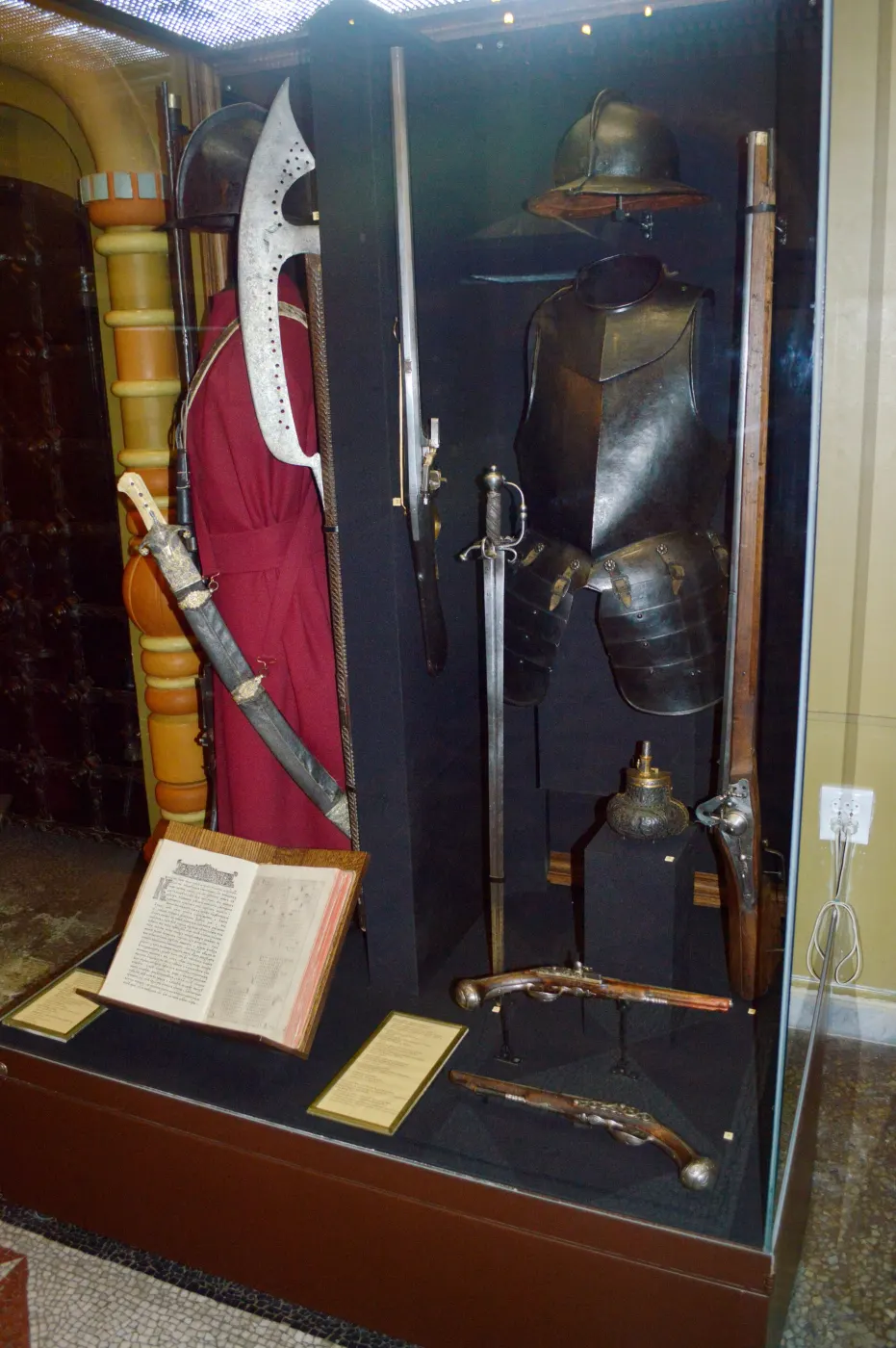
The word strelets simply meant "shooter": the historian V. N. Glazyev finds it in the Laurentian Chronicle as early as the entry for 1097. From the mid-16th century it came to mean a man armed with a handgun who belonged to a distinct group in the Muscovite state. The Great Russian Encyclopaedia (BRE) defines the streltsy as servicemen "armed with firearms (hence their name) – the pishchal' – and also the berdysh and sabre".
They were not nobles. Streltsy were recruited from personally free townspeople and peasants, and their service became lifelong and then hereditary. Grigory Kotoshikhin, a Muscovite clerk who wrote a description of Russia in Swedish exile in 1666–67, said of new streltsy regiments that the men "are in the streltsy forever, and their children and grandchildren are streltsy after them". Their officers, by contrast, came from the gentry. Kotoshikhin notes that heads and colonels, half-heads and captains of hundreds were chosen "from the dvoryane and the deti boyarskie", while the fifty-men and ten-men were promoted from the ranks.
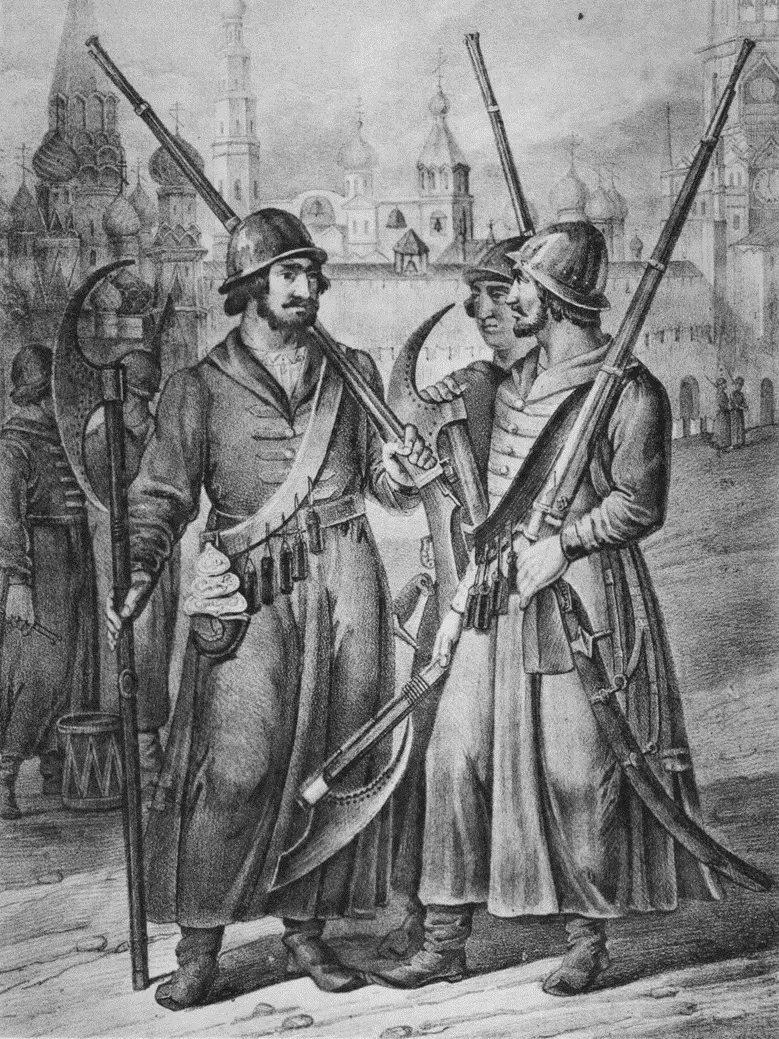
How and why did Ivan IV create the streltsy in 1550?
No decree founding the streltsy survives. The historian A. V. Chernov pointed out in 1954 that documents on their creation "have not survived, and perhaps never existed". What we have is a chronicle note under the year 7058 from the Creation (1550), in a continuation of the Russian Chronograph, as quoted by Chernov:
"…the tsar established for himself chosen streltsy with handguns, 3,000 men, and ordered them to live in the Vorobyovskaya sloboda, and made deti boyarskie their heads…"
(The translations from Russian in this article are our own, except Korb's diary, which is quoted in Count MacDonnell's 1863 English translation.)
The new force was divided into six stat'i of 500 men each, split into hundreds. Each man was paid 4 roubles a year. Glazyev names all six of the first heads, Grigory Zhelobov-Pushechnikov, Matvei Dyak Rzhevsky, Ivan Cheremisinov, Vasily Pronchishchev, Fyodor Durasov and Yakov Bundov, and shows that every one of them came from the tsar's court: four were among the "best servants" listed in the Thousand Book of 1550. Rotating these heads regularly, Glazyev argues, kept the corps dependent on the monarch.
Why 1550? Glazyev links the decision to a failure. In February 1550 Ivan the Terrible besieged Kazan, the capital of the Khanate of Kazan, and sent armed bondmen on foot with handguns against it, but a thaw set in, they could not fire, and the city held. Chernov ties the streltsy to the wider military reform of that year, including the "chosen thousand" of gentry cavalry settled near Moscow in October 1550: one was the tsar's picked horse, the other his picked foot.
Historians disagree about how new the streltsy really were:
- Continuity. Glazyev argues that Muscovy already had "state pishchal'niki", permanent handgunners on royal pay, in the early 16th century; they were "streltsy, but under another name". The 1550 chosen corps was formed out of them.
- A new kind of army. A. N. Lobin replies that the sources speak of a force "not existing before in Russia". What was new, in his view, was selection of the best shots, a permanent garrison, gentry commanders, a separate department and a special tax, the "pishchal' money", to pay for it.
- An Ottoman model? Lobin sees the janissaries as the likeliest pattern. The publicist Ivan Peresvetov had told the young tsar in 1547–48 that the Turkish sultan kept "a thousand janissaries… good shots with fire" by his side, and the Venetian Francesco Tiepolo wrote that Ivan used his 15,000 foot soldiers "as the Turk uses the janissaries".
- Earlier still. Chernov found "fire streltsy" (ognennye strel'tsy) in the chronicles for campaigns against Kazan in 1546–47 and concluded that the 1550 corps was a chosen guard added to existing units.
What did the streltsy do at Kazan in 1552?
They earned their reputation at Kazan. In autumn 1551, Glazyev notes, 500 streltsy guarded the Moscow-backed khan Shah Ali inside the city, and in November they put down an armed rising of the Kazan nobility against him. In the decisive campaign of 1552 all six original heads led their men in the siege; Vasily Pronchishchev was killed in the storming.
Prince Andrei Kurbsky, who fought there, describes how a Tatar sortie was driven back to the gates by the commanders "with our foot handgun streltsy", and says that in his own regiment there were more than 12,000 men, "and foot streltsy and Cossacks about six thousand". The Kazan History praises them extravagantly: "And they fought bravely, and honourably laid down their brave heads for the Christian faith, and for the tsar's great love for them, and for his gifts and honours."
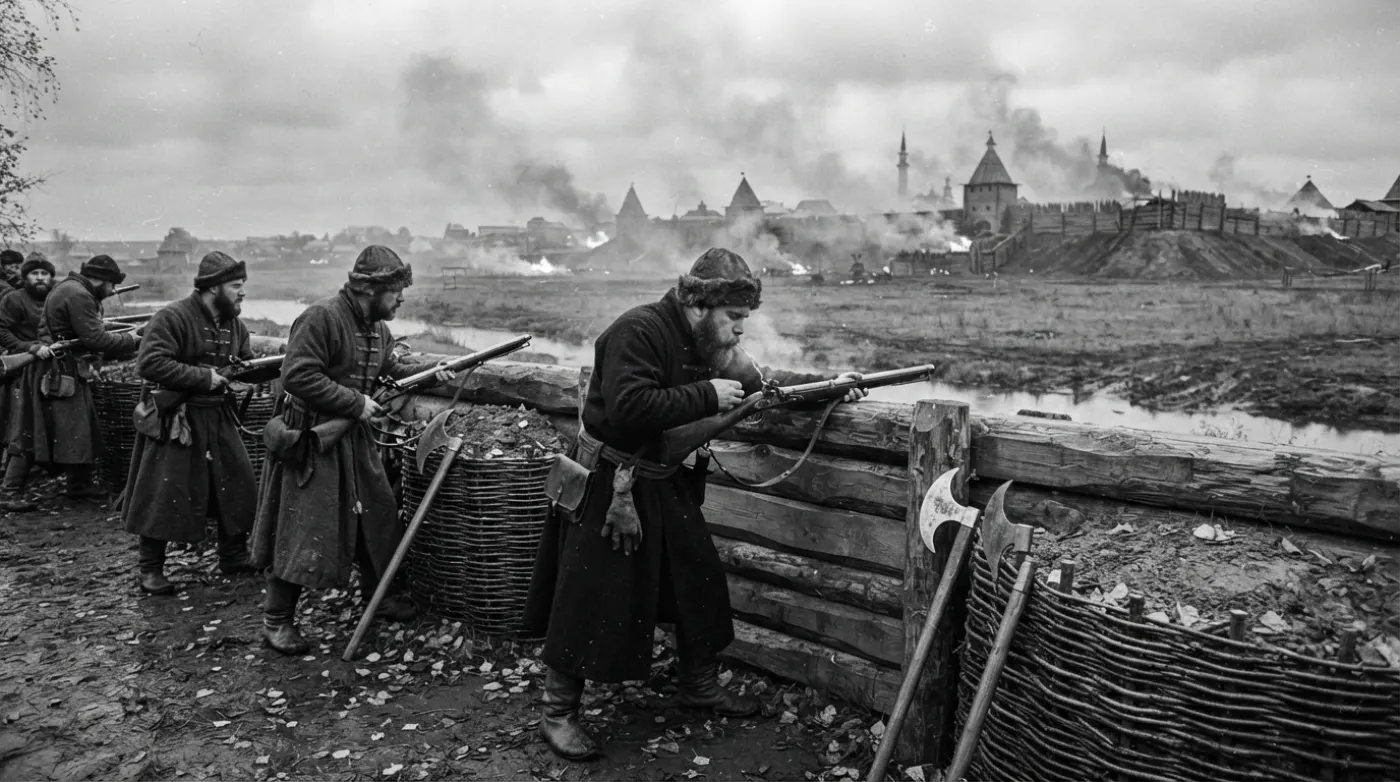
The BRE lists Kazan as the first proof of the corps' fighting value, followed by the Livonian War of 1558–83, the wars of the early 17th century and campaigns against the Polish–Lithuanian Commonwealth and the Crimean Khanate. During the oprichnina part of the streltsy served Ivan's private state: 500 stood guard at his palace every day, and 1,500 marched in the 15,000-strong oprichnina army on the campaign against Novgorod.
How were the streltsy organised and paid?
The corps grew fast. Giles Fletcher, the English envoy, wrote at the end of the 16th century that the tsar paid 12,000 streltsy, of whom 5,000 were always in Moscow and 2,000 stremyannye ("stirrup") streltsy guarded his household. Glazyev considers this close to reliable; Jerome Horsey's claim that 20,000 streltsy lined the route of Tsar Fyodor's coronation he calls a plain exaggeration.
The basic unit was the prikaz (also pribor), named after its commander. According to the historian O. A. Kurbatov, a hundred had two fifty-men, eight ten-men and 90 rank-and-file streltsy. The BRE gives prikazy of 500 (mounted) to 1,000 (foot) men. The number of Moscow prikazy rose from 8 in 1631 to 26 in 1671, according to M. Yu. Romanov; Kurbatov counts 24 from the 1660s to the early 1680s. In the 1680s the prikazy were renamed regiments, their heads colonels and their hundreds companies under captains. At its height, according to the BRE, the whole corps reached 55,000 men, about 15 per cent of them mounted.
| Rank | Russian | Command | Drawn from |
|---|---|---|---|
| Head (from 1680s colonel) | golova / polkovnik | A prikaz or regiment | Gentry |
| Half-head | polugolova | Deputy | Gentry |
| Captain of a hundred | sotnik | A hundred | Gentry |
| Fifty-man | pyatidesyatnik | Half a hundred | Streltsy |
| Ten-man | desyatnik | Ten men | Streltsy |
There were two kinds of streltsy. The Moscow ("chosen") streltsy guarded the tsar and the Kremlin and marched with the main army; the town streltsy garrisoned the frontier towns. The elite was the Stremyanny prikaz, which, Kotoshikhin explains, was called "stirrup" "because it is always with the tsar and the tsaritsa on every journey, for protection".
The state paid them in money and grain, and gave them their weapons and, each year, cloth for their coats. In frontier towns they also received land, held in common by the whole sloboda. The money was raised, Kotoshikhin writes, by a special levy collected by the Streletsky prikaz "from the whole Muscovite state", with grain supplies delivered by the peasants.
How did the streltsy live between campaigns?
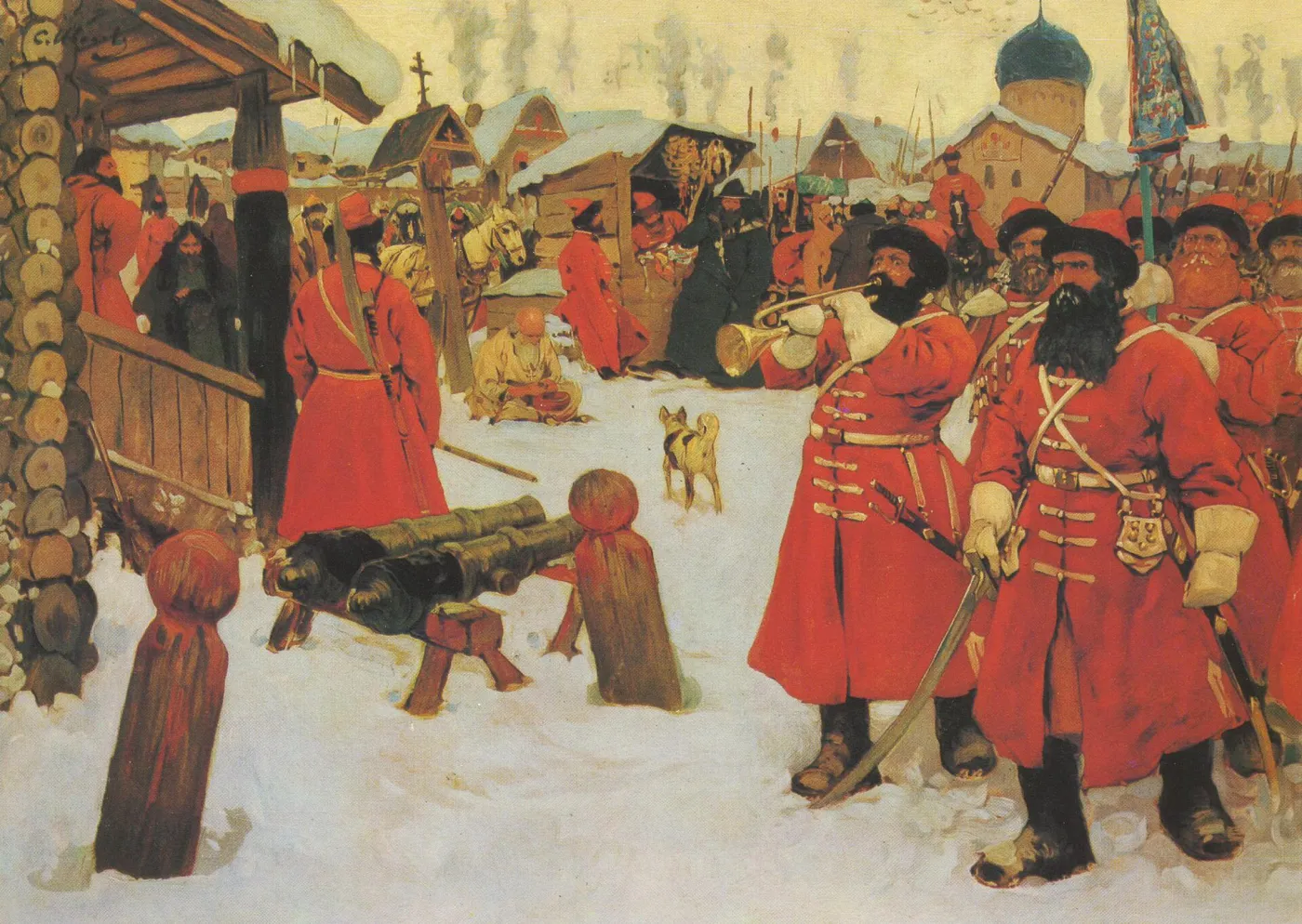
Streltsy lived with their families in their own settlements, the streletskie slobody, on the edge of the town. Each Moscow sloboda had its parish church: the Zamoskvorechye streltsy near the Kaluga Gate worshipped at the church of Saints Peter and Paul, rebuilt in stone in 1649–51, Romanov notes. Off duty, the same men worked for hire in the local smithies and traded.
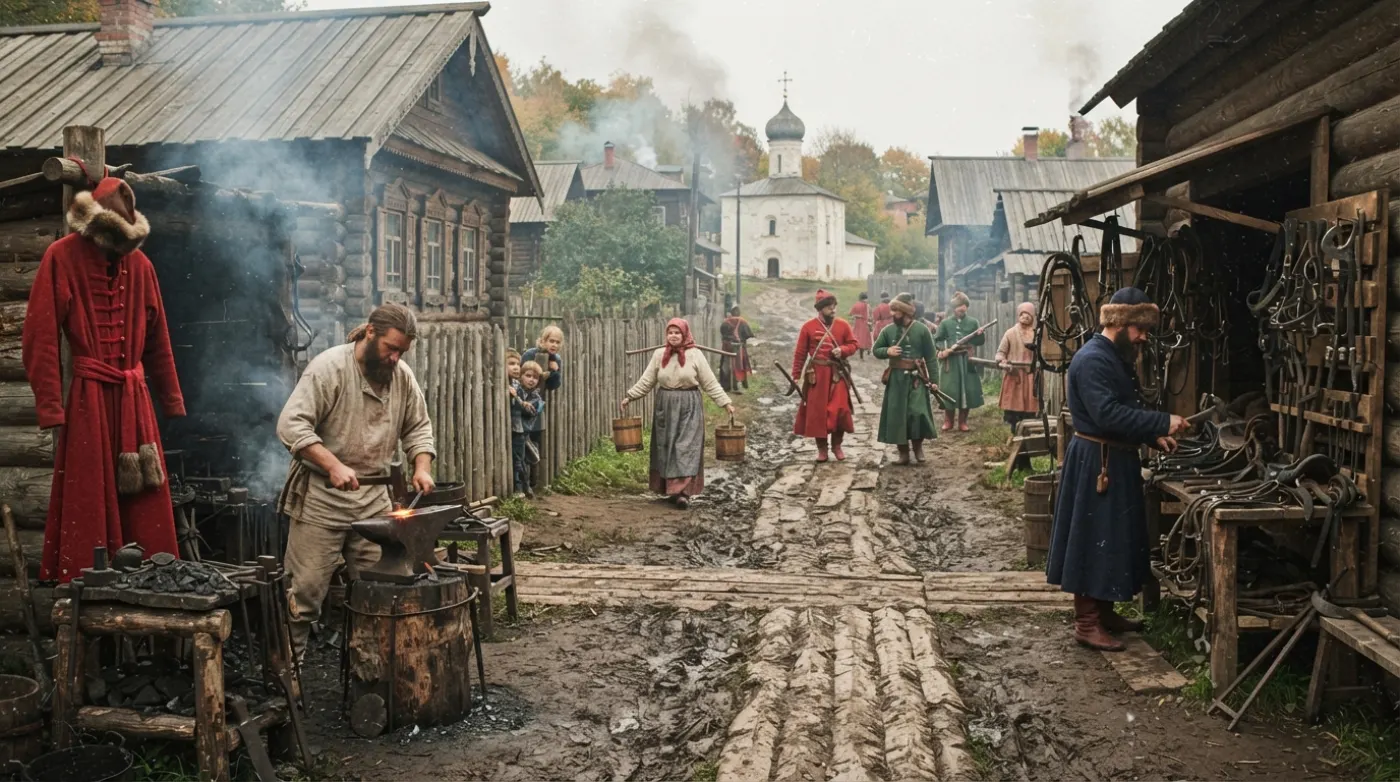
That was the privilege that mattered. The BRE stresses that streltsy were allowed to trade and practise crafts in their free time. In the northern towns of the Dvina, M. A. Ovchinnikov found, streltsy yards, like monastery yards, did not pay the tyaglo, the tax levied on ordinary townspeople, and the townsmen of Archangel complained that the streltsy's trade did better because they "bear neither town taxes nor services". Kotoshikhin remarked of the Moscow prikazy that "in those prikazy the streltsy are trading people and craftsmen of every kind, many of them rich".
This made the Moscow streltsy a peculiar army: soldiers who were also shopkeepers, butchers and smiths, rooted in their neighbourhoods and tied to the city's crowd. It also gave them a great deal to lose when pay was late, their colonels squeezed them, or they were sent far from their families and businesses.
Were the streltsy outdated by the late 17th century?
Partly. From the mid-17th century Muscovy built up regiments "of the new order", soldiers, reiters and dragoons trained by foreign officers, and the BRE judges that the streltsy "began to show backwardness" compared with them. In 1654 almost all the Moscow prikazy, 17 old and 2 new, marched out on campaign; most of the garrison left behind died of plague that autumn. Streltsy fought against Stenka Razin's rebels on the Volga and at Azov against the Ottoman Empire in 1695–96.
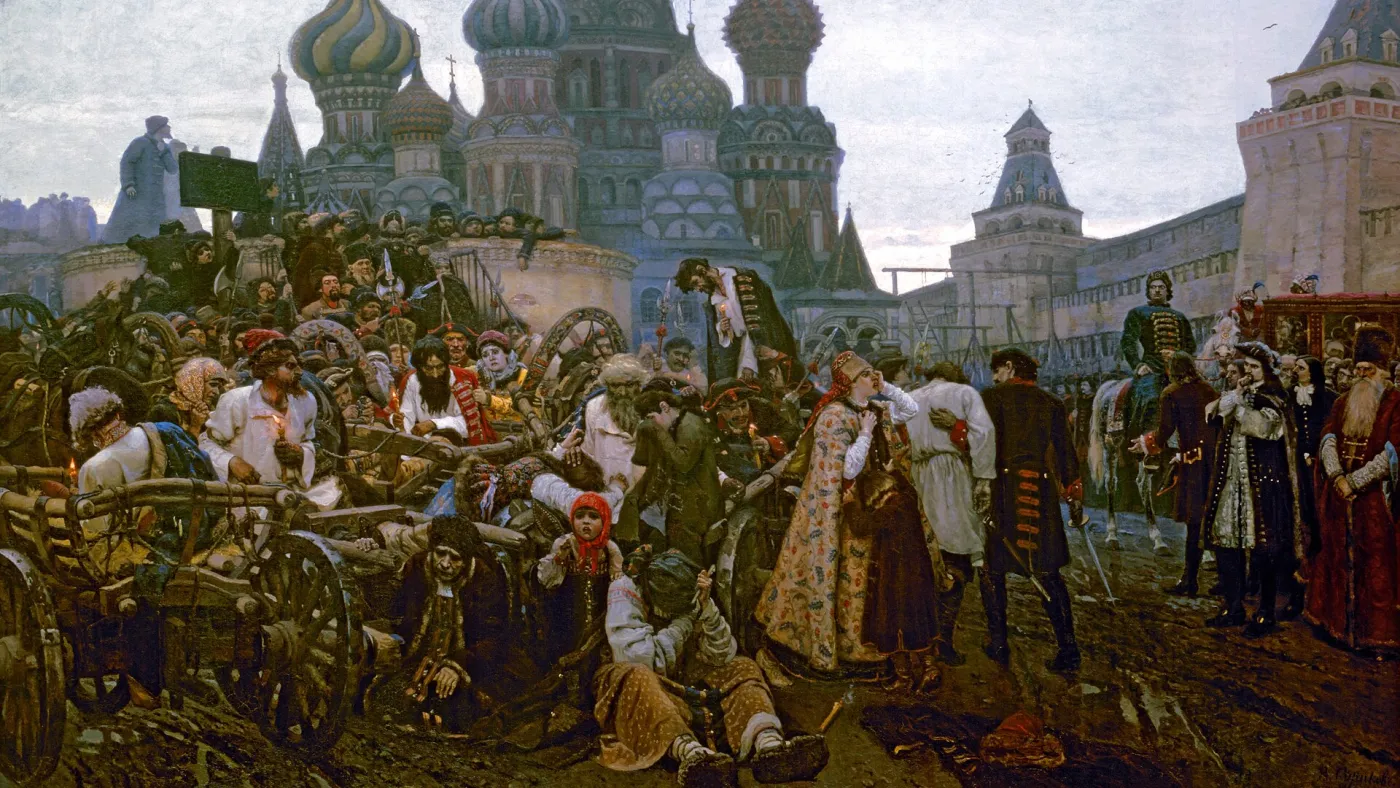
The historian A. E. Pisarev argues that the picture of the streltsy as useless, bearded reactionaries in red coats owes more to the 19th century than to the 17th. It was shaped, he says, by historians writing in praise of Peter, by Mussorgsky's opera Khovanshchina and Surikov's painting, and finally by Aleksei Tolstoy's novel Peter the First. Moscow streltsy wore uniform coats of expensive imported Dutch cloth; orders mention cloth "of lemon, yellow, crimson colours", and a list of coat colours from 1670–71 assigns them to particular prikazy. In his reckoning the Moscow streltsy stayed in the field until 1708–13.
Their real weakness was money. The BRE blames their revolts on "hard service, constant delays in pay, and the abuses of local authorities and of their own commanders". On the eve of 1682, according to the Presidential Library's summary, the Moscow streltsy resented growing abuse and violence from their commanders and pay that was cut and held back. In a capital with about 14,000 armed streltsy, that was dangerous.
What happened in the Moscow uprising of 1682?
Tsar Fyodor III died on 27 April 1682. The same day, part of the court had the ten-year-old Peter, son of Tsar Alexis by his second wife Natalya Naryshkina, proclaimed tsar, passing over his sickly elder half-brother Ivan, son of the first wife, Maria Miloslavskaya. According to Andrei Lavrov's BRE article, they were angry about arrears of pay, which had become worse after the switch to a household tax in 1679, and about colonels accused of "every kind of unjust bribe, wrong and imposition".
On 15 May a rumour spread that the Naryshkins had strangled Tsarevich Ivan. The streltsy marched into the Kremlin with banners and weapons. The Danish envoy Hildebrand von Horn, writing in October 1682 from what he had been told, says they came "with lit matches, with loaded cannon and mortars", and the palace guard let them in and joined them, crying: "Long live our lawful tsar Ivan Alekseevich!" Ivan and Peter were brought out to them alive on the palace porch. Artamon Matveev, the Naryshkins' leading statesman and himself a former head of a streltsy prikaz, almost calmed them down. Then Prince Mikhail Dolgoruky, head of several military departments and son of the head of the Streletsky prikaz, ordered them back to their quarters. In the words of the memoir attributed to Matveev's son Andrei, they "seized him and threw him from that porch onto their spears and hacked him with berdyshi".
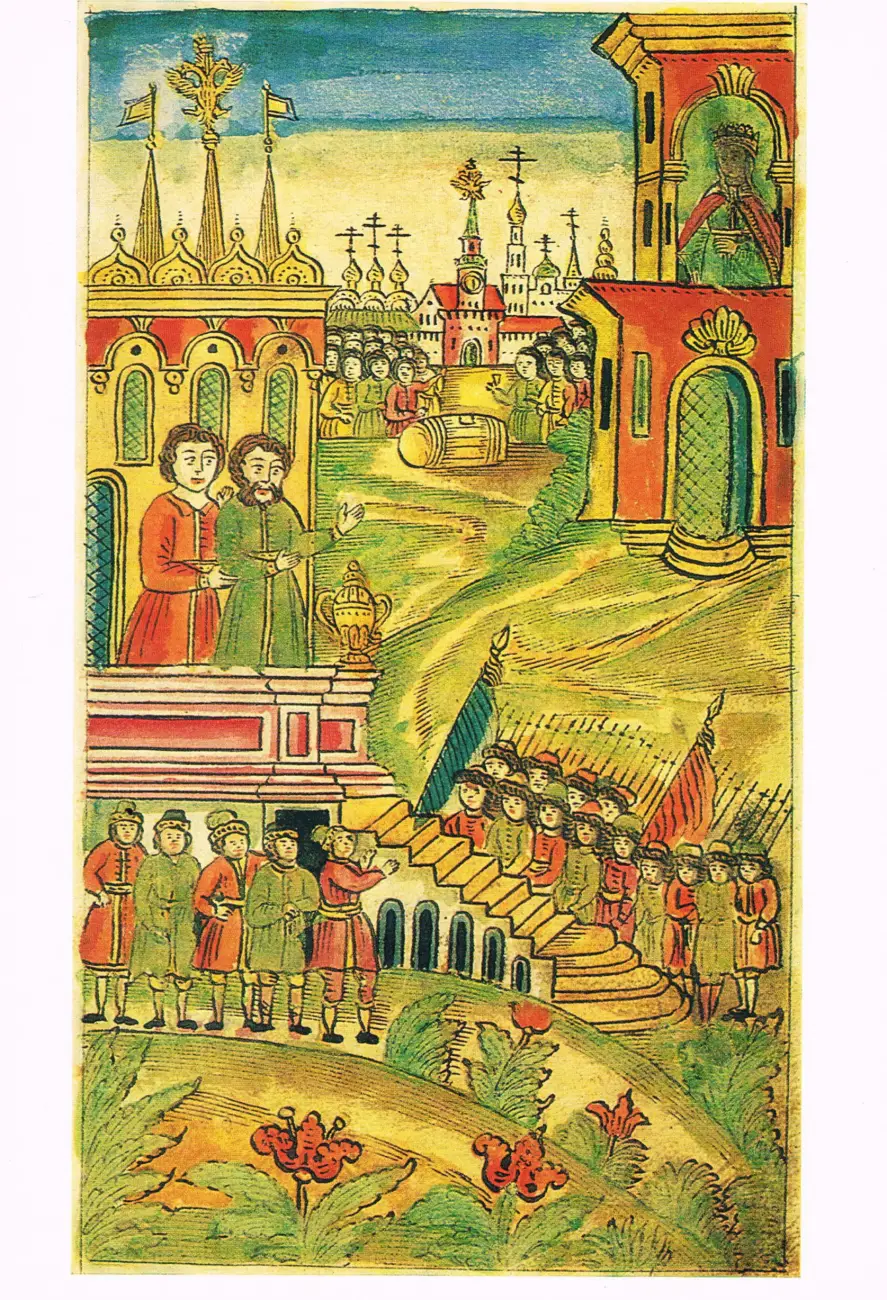
Matveev was dragged from the tsaritsa's side and cut to pieces. Over three days, 15–17 May, the streltsy killed 17 people, according to the BRE. The courtier Ivan Zhelyabuzhsky, a contemporary, lists among them Prince Yury Dolgoruky and his son Mikhail, Prince Grigory Romodanovsky, Ivan Yazykov, Matveev, the tsaritsa's brothers Ivan and Afanasy Naryshkin, two colonels and the court doctor Daniel with his son. Matveev's memoir tells how the streltsy apologised to old Prince Yury for killing his son, then returned to kill him when a servant reported his remark: "Though they have eaten the pike, its teeth remain."
The streltsy also took over the treasury, about 5,000 roubles, and, hoping to win over the bondmen, destroyed the records of the Kholopy prikaz (the department for bondmen) and of the Moscow judicial prikaz. Zhelyabuzhsky adds that some streltsy heads were beaten on the pravezh until they sold their villages to repay their men.
What was the Khovanshchina?
For the next four months the streltsy were the strongest force in Moscow. On 26 May both boys were declared tsars, Ivan as senior and Peter as junior, and their elder sister Sophia Alekseyevna gained influence; she became regent that autumn. The streltsy had themselves renamed the "court infantry" (nadvornaya pekhota). A royal charter of 6 June declared their killings just executions of traitors, and its text was put on a stone pillar on Red Square; Zhelyabuzhsky saw tin sheets on it recording "which boyar was killed and for what guilt".
The new head of the Streletsky prikaz, Prince Ivan Khovansky, gave the period its name, the Khovanshchina. Many streltsy wanted "the old Orthodox faith" back, and on 5 July they forced the church hierarchy into a public debate with the Old Believer Nikita Dobrynin. The court left Moscow in the summer. In September it summoned Khovansky to the village of Vozdvizhenskoe, where he and his son Andrei were seized and beheaded on 17 September. Gentry militia gathered at the Trinity monastery, the streltsy lost their nerve, and on 3 October their delegates begged forgiveness and received it. The pillar was demolished, new colonels were appointed and the worst offenders were flogged and exiled.
Historians disagree about who was behind 1682:
- A court plot. The BRE (Lavrov) says the rising was "in many ways prepared" by members of the Boyar Duma around Ivan Miloslavsky, and the Orthodox Encyclopaedia says Sophia's supporters provoked it. N. I. Pavlenko saw it chiefly as the result of court intrigue.
- A soldiers' revolt. V. I. Buganov treated it as an "anti-feudal" uprising of the streltsy and townspeople.
- A legend. A. P. Bogdanov argues that the conspiracy story was spread abroad by Matveev's son Andrei and his tutor Ivan Poborsky, and that the "plot" for which Khovansky died was invented by Sophia's government. Matveev's memoir, which calls the streltsy an "evil and God-hated kind", was written no earlier than 1716.
Why did the streltsy march on Moscow in 1698?
After 1689, when Peter removed Sophia and shut her in the Novodevichy convent, he sent eight streltsy regiments out of the capital to Sevsk, Belgorod and Kiev. Four Moscow regiments that had fought at Azov in 1695–96 were sent on in 1697 to the western border instead of going home. In spring 1698, according to the BRE, 175 of them left their posts and came to Moscow to petition for their pay, which the authorities treated as mutiny. Peter was abroad with the Great Embassy, and rumours spread that he had vanished.
The returning men told their comrades that Sophia wanted them in Moscow. They carried a letter, possibly written by her, possibly forged by the streltsy themselves. The Orthodox Encyclopaedia says Sophia did show them support through her sister Martha and passed on one or two letters. On 6 June the four regiments, about 2,200 men, gathered on the Western Dvina in the Toropets district, refused to obey their colonels, elected their own officers and set off for Moscow. Their aim, the BRE concludes, was to kill the boyars and put the boy Tsarevich Aleksei on the throne with Sophia as regent.
Their grievances also went beyond pay. The ten-man Vasily Zorin wrote a "black petition" which, V. V. Zapletin shows, was meant to be read aloud to the troops. It accused Peter's Swiss favourite, Franz Lefort, of overturning the faith and warned against the coming of the foreigners with their "beard-shaving and tobacco". Zorin, a veteran of 1682, boasted to his comrades: "In the year 90 [1682] I arranged everything my own way, and now nobody but me will bring this to an end."
How was the 1698 revolt crushed?
The boyars in charge of Moscow sent Tsarevich Aleksei to safety at the Trinity monastery and put General Patrick Gordon and the boyar Aleksei Shein at the head of more than 4,000 men with at least 25 guns. Both sides reached the New Jerusalem (Voskresensky) monastery west of Moscow on the night of 16 June. Zhelyabuzhsky, a royal official, recorded the streltsy telling Gordon: "We are going to Moscow to ask for mercy about our needs, and not to fight."
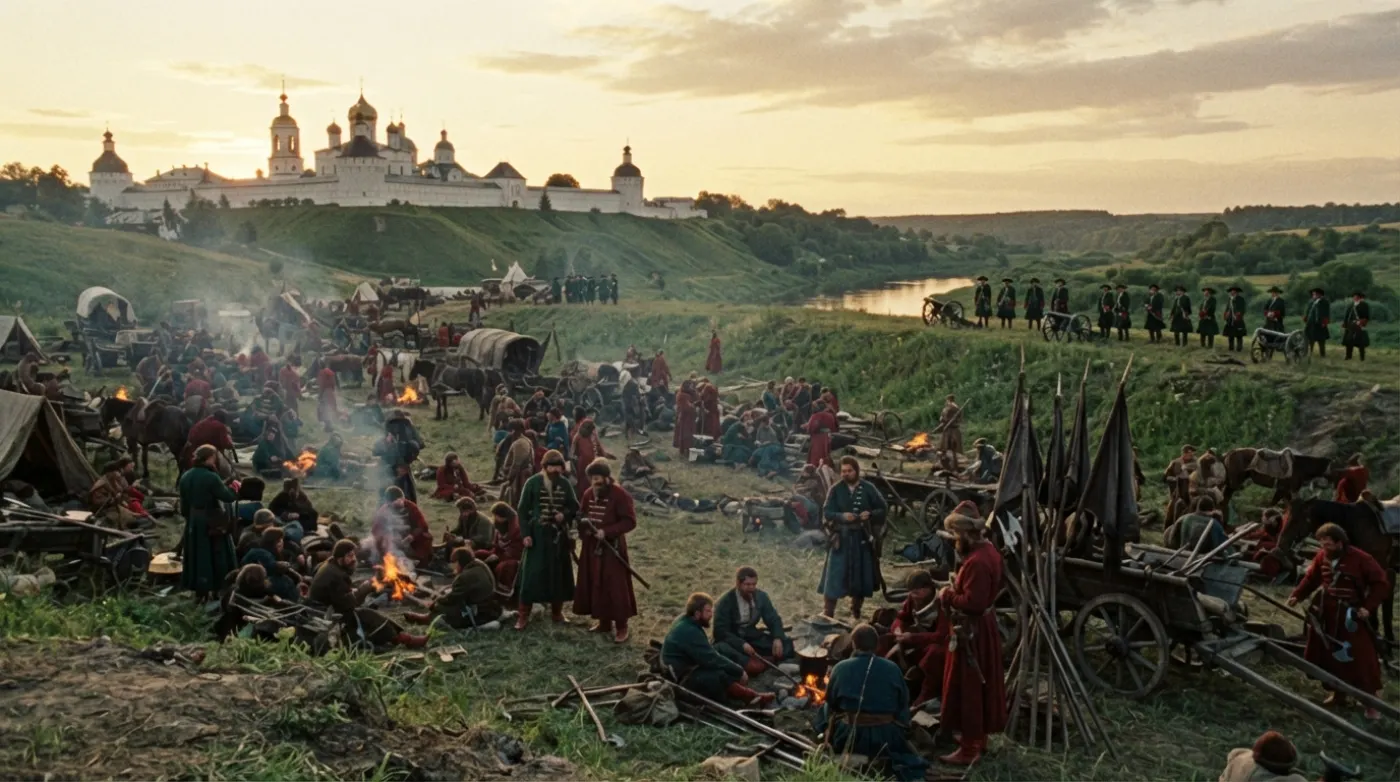
On the morning of 18 June Shein told them to take their pay and go to their posts. They refused and asked instead to see their wives and children in Moscow. After the men had prayed, kissed the cross and sworn to die for one another, Shein's envoy offered a pardon if they laid down their arms. They refused: "We are not afraid of that, we have seen cannon, and bigger ones than these." Shein's guns opened fire; the streltsy's own regimental cannon did little damage, and soon they were waving their caps and laying down their banners. Zhelyabuzhsky counts 107 killed and wounded in their camp. Shein's investigation followed at once: 57 men were executed and 67 hanged on the spot, and the rest were sent to prisons in other towns, each with a wooden block nailed to his leg.
How did Peter punish the streltsy?
Peter hurried home and reached Moscow on 25 August 1698. He reopened the inquiry and had the prisoners brought back from the provincial towns to his residence at Preobrazhenskoe. There, Zhelyabuzhsky writes, they were questioned and tortured in 20 separate torture chambers, each with boyars in attendance; women from Sophia's household in the Novodevichy convent were brought in too. On 27 September Peter questioned Sophia herself. She denied everything, and about 21 October she was made a nun under the name Susanna.
Johann Georg Korb, secretary to the envoy of Emperor Leopold I, kept a diary in Moscow throughout these months. It is our most detailed eyewitness account, but it has to be read carefully: Korb mixes what he saw with what he heard, he uses New Style dates, and his book, published in Latin in Vienna around 1700, so angered Peter, by the usual account, that the imperial court let the unsold copies be destroyed. Some entries:
- 10 October (NS): at Preobrazhenskoe, "allowing no stranger within their lines, the Czar, with his own hands, avenged with the axe the treason committed against him, on five of the traitors. Two hundred and thirty more expiated their crime by hanging". By his own account no foreigner was allowed near, so this is report, not sight.
- 13 October: 500 younger streltsy were spared because of their youth, but "their noses and ears were cut off, and they were transported to the remotest frontier provinces".
- 27 October: the boyars who had sat in judgement were each made to behead a prisoner. Korb records that Prince Romodanovsky, chief of four regiments before their revolt, killed four, and that Peter's favourite Aleksandr Menshikov boasted of twenty. "The Czar himself, sitting in his saddle, looked on with dry eyes".
- 28 October: near the convent "there were raised thirty gibbets in the shape of a square", and three ringleaders were hanged close to Sophia's window, the middle one holding "a paper, folded like a petition".
- 13 February 1699: 200 more were beheaded beside the Kremlin. When one man protested his innocence, Korb writes, Peter, a step away, answered: "Die, wretch! If thou be innocent, the guilt of thy blood will be mine". The next day, Korb heard, the tsar "is said to have cut off 84 rebel heads"; he did not see it.
Zhelyabuzhsky's Russian record confirms the method, if not every number. Bodies were laid on wheels along the roads, ten to a wheel, with their heads on stakes; men were hanged from beams pushed through the battlements at every gate of the Earthen and White Cities, and before the Novodevichy convent "with petitions stuck in their hands". The worst were broken on the wheel on Red Square and "lived on those wheels for almost a day, and groaned". He also confirms that "the boyars and all the palace people themselves" executed streltsy with axes and broadswords. The BRE puts the total executed in 1698, 1699, 1700 and 1707 at more than 1,300, with many more exiled. Their wives were banned from Moscow, and their houses were sold off.
When were the streltsy abolished?
After the revolt and fresh unrest among the streltsy at Azov, Peter ordered the whole corps disbanded. The Moscow streltsy who had not taken part were expelled from the capital with their families and enrolled as ordinary townspeople. The regiments at Azov were dissolved by a decree of 1698/99 that let the men register as townsmen in any town "they wish", except Moscow, Romanov found; their old sloboda in Zamoskvorechye was soon deserted.
The abolition was not completed at once. When the Great Northern War with the Swedish Empire began in 1700 and the Russian army was routed at Narva, the order was suspended and many former streltsy were taken back into service. Streltsy took part in one more rising, at Astrakhan in 1705–06. During the war the remaining regiments were broken up and absorbed into the regular army, and according to the BRE the corps was largely gone by the 1720s, in the early Russian Empire. Some town streltsy carried on as local servicemen almost to the end of the 18th century.
Today most people meet them on screen. In Age of Empires IV the Streltsy are the Rus civilisation's gunpowder infantry, "a powerful gunpowder unit" with "a huge axe"; the unit is named after Ivan IV's musketeers and carries their berdysh.
Common myths about the streltsy
| Myth | What the evidence says |
|---|---|
| Ivan IV's founding decree of 1550 survives | Only a chronicle note survives; Chernov doubted a written decree ever existed |
| The streltsy were Muscovy's first gunmen | Handgunners (pishchal'niki) served from the early 16th century; what was new in 1550 was a permanent, picked corps |
| Streltsy always wore red | Coat colours differed by prikaz; one list of 1670–71 includes lemon, yellow and crimson |
| They were full-time soldiers living in barracks | They lived in their own slobody with their families and traded and worked crafts on the side |
| The 1682 rising was simply Sophia's plot | Historians disagree; Bogdanov argues the conspiracy stories were later fabrications |
| Peter abolished the streltsy in 1698 | Disbanding was ordered after 1698, halted in 1700, and largely complete only by the 1720s |
| Peter beheaded 84 streltsy with his own hands | Korb reports it only as hearsay ("is said") |
| Surikov's painting shows the scene as it was | It was painted in 1881, 183 years later |
Timeline
| Date | Event |
|---|---|
| 1546–47 | "Fire streltsy" mentioned in campaigns against Kazan |
| February 1550 | Failed siege of Kazan |
| 1550 | 3,000 "chosen streltsy" in six units of 500 settled in the Vorobyovskaya sloboda |
| Autumn 1551 | 500 streltsy guard Khan Shah Ali in Kazan |
| 1552 | Siege and capture of Kazan |
| 1565–72 | Streltsy serve in the oprichnina |
| Late 16th century | Fletcher counts 12,000 paid streltsy |
| 1654 | Nearly all Moscow prikazy march out on campaign |
| 1660s–early 1680s | 24 Moscow prikazy |
| 27 April 1682 | Peter proclaimed tsar |
| 15–17 May 1682 | Streltsy in the Kremlin; 17 killed, among them Matveev and two Naryshkins |
| 26 May 1682 | Ivan V and Peter I declared joint tsars |
| 17 September 1682 | Khovansky and his son executed |
| 3 October 1682 | Streltsy submit and are pardoned |
| September 1689 | Sophia removed; eight regiments sent from Moscow |
| 1695–96 | Streltsy at the Azov campaigns |
| 6 June 1698 | Four regiments mutiny on the Western Dvina |
| 18 June 1698 | Streltsy defeated at the New Jerusalem monastery |
| 25 August 1698 | Peter returns to Moscow |
| Autumn 1698–February 1699 | Mass torture and executions; Sophia made a nun |
| 1700 | Disbanding halted after Narva |
| 1705–06 | Streltsy take part in the Astrakhan rising |
| 1720s | Corps largely gone |
What the map shows
At 1698 the Tsardom of Russia bordered the Swedish Empire and the Commonwealth in the west and the Ottoman Empire and the Crimean Khanate in the south. Its newest prize was Azov, won from the Ottomans in the campaigns of 1695–96 by an army that included the very streltsy who mutinied in 1698. Kazan, where their story began in 1552, had long been a Russian city on the middle Volga. For the ruler who founded them, see our article on Ivan the Terrible.
Sources
Primary sources
- Continuation of the Russian Chronograph, entry for 7058 (1550), as quoted in A. V. Chernov (see 9)
- Prince A. M. Kurbsky, History of the Grand Prince of Moscow, in Biblioteka literatury Drevnei Rusi, vol. 11, via lib.pushkinskijdom.ru
- G. K. Kotoshikhin, O Rossii v tsarstvovanie Alekseia Mikhailovicha (written 1666–67; 4th edn, St Petersburg, 1906)
- I. A. Zheliabuzhsky, Dnevnye zapiski, via vostlit.info
- A. A. Matveev, Zapiski (written after 1716; first published St Petersburg, 1841), via vostlit.info
- Hildebrand von Horn, report to the King of Denmark of 23 October 1682, tr. and ed. A. P. Bogdanov, Voprosy istorii 1986, no. 3
- J. G. Korb, Diary of an Austrian Secretary of Legation at the Court of Czar Peter the Great, tr. Count MacDonnell, 2 vols (London, 1863)
Studies and reference works
- "Streletskoe voisko", "Strel'tsy" (Ya. G. Solodkin), "Streletskoe vosstanie 1682" and "Streletskoe vosstanie 1698" (A. S. Lavrov), Bol'shaia rossiiskaia entsiklopediia, vol. 31 (2016)
- A. V. Chernov, Vooruzhennye sily Russkogo gosudarstva v XV–XVII vv. (Moscow, 1954), ch. 2
- V. N. Glazyev, "Strel'tsy i ikh nachal'niki v XVI v.", Istoriia voennogo dela: issledovaniia i istochniki (2013)
- A. N. Lobin, "K istorii obrazovaniia streletskogo voiska", Istoriia voennogo dela: issledovaniia i istochniki (2013)
- O. A. Kurbatov, "Russkoe voisko XV–XVII vv.: ocherk istorii organizatsionnykh struktur", Istoricheskii vestnik (2023)
- M. Yu. Romanov, "'I na boiakh bilis', ne shchedia golov svoikh…': opyt rekonstruktsii istorii 18-go moskovskogo streletskogo polka", Izvestiia Saratovskogo universiteta, ser. Istoriia (2020)
- A. E. Pisarev, "Moskovskie strel'tsy: khudozhestvennyi stereotip i real'nost' samosoznaniia", Vestnik RGGU (2016)
- M. A. Ovchinnikov, "'Sluzhilye po priboru' i posad: dvinskie strel'tsy…", Molodoi istorik (2025)
- A. P. Bogdanov, "Basnoslovie o zagovore Miloslavskogo i Sof'i vo vremia 'Khovanshchiny'", Istoricheskoe obozrenie 21 (2020)
- A. P. Bogdanov, "Rozhdenie Khovanshchiny", Istoricheskoe obozrenie (2022)
- V. V. Zapletin, "Ob ideologicheskoi funktsii 'Otkrytogo pis'ma' desiatnika V. Zorina v sobytiiakh streletskogo vosstaniia 1698 g.", Vestnik Samarskogo universiteta (2017)
- "Sofiia Alekseevna" and "Petr I", Pravoslavnaia entsiklopediia
- "Nachalsia streletskii bunt v Moskve", Presidential Library, prlib.ru
- "Rus", Age of Empires IV, ageofempires.com
Image credits
- Title image: Vasily Surikov, Morning of the Streltsy Execution, 1881, State Tretyakov Gallery. Public domain, via Wikimedia Commons, cropped to 16:9.
- Streltsy, lithograph from A. V. Viskovatov, Historical Description of the Clothes and Weapons of Russian Troops (1841–1861). Public domain, via Wikimedia Commons.
- Strelets and new-order equipment, State Historical Museum. Photo: Лапоть, 2012, CC0, via Wikimedia Commons.
- Sergei Ivanov, In the Streltsy Sloboda, 1908, State Tretyakov Gallery. Public domain, via Wikimedia Commons.
- Miniature from P. N. Krekshin, History of Peter I, first half of the 18th century, State Historical Museum. Public domain, via Wikimedia Commons.