Stepan Razin, known as Stenka, was a Don Cossack who led one of the most destructive Cossack rebellions in Russian history. Between 1667 and 1669 he raided the Volga, the Iaik and the Persian coast of the Caspian Sea, and was pardoned. In the spring of 1670 he came back to the Volga with a new army, took Tsaritsyn on 15 May and Astrakhan in June, and by September the revolt had spread up the river to Simbirsk and into the countryside to the west. Beaten at Simbirsk in October 1670, he fled to the Don, where Cossacks loyal to the tsar, led by his own godfather, captured him on 14 April 1671. He was quartered in Moscow on 6 June 1671 (16 June in the modern calendar). Later songs turned him into a hero who drowned a Persian princess for the sake of the Volga; the evidence for that story is thinner, and stranger, than the song.
Stenka Razin's rebellion at a glance
| Leader | Stepan Timofeevich Razin ("Stenka"), Don Cossack, born about 1630, executed 6 June 1671 |
| Ruler he rose against | Tsar Alexis (Aleksei Mikhailovich) |
| Raiding campaigns | Volga and Iaik 1667, Caspian Sea and Persian coast 1668–1669 |
| Rebellion | Spring 1670 to November 1671 |
| Towns taken | Tsaritsyn, Astrakhan, Saratov, Samara and part of Simbirsk, 1670 |
| Turning point | Failed siege of the Simbirsk kremlin, September–October 1670 |
| Participants | Up to 200,000 at the peak, according to the only overall estimate |
| Captured | 14 April 1671, at Kagal'nik on the Don, by Cossacks under Ataman Kornila Iakovlev |
| Executed | 6 June 1671, Moscow |
| Last rebel stronghold | Astrakhan, surrendered 27 November 1671 |
(Dates are Old Style, the Julian calendar then used in Russia; add ten days for the modern calendar.)
Who was Stenka Razin?
No record of Razin's birth survives. The historian Brian Davies gives "around 1630" and a birthplace near Cherkassk, the chief town of the Don Cossacks. The Great Russian Encyclopaedia (2015) leaves the birth year blank and says he was the son of a peasant who had fled to the Don and become a prosperous Cossack; his mother was "most likely a captive Crimean Tatar woman". The Swedish agent Christoff Koch, who watched him brought into Moscow in June 1671, guessed his age at "about 36 to 40".
Razin was no outsider among the Cossacks. He first appears in the sources in 1652, when he received permission to go on pilgrimage to the Solovetskii monastery on the White Sea, and he went again in 1661. In 1658–59 he was a member of the Don Host's stanitsa, the embassy sent to Moscow to collect the tsar's annual pay. In 1661 the Host sent him to negotiate with the leaders of the Kalmyks, steppe nomads who had accepted Russian overlordship, about joint action against the Crimean Khanate and the Nogais. In 1662–63 he led a Don Cossack detachment, with Zaporozhian Cossacks and Kalmyks, in a campaign against the Crimean Tatars. The ataman of the whole Host, Kornila Iakovlev, was his godfather.
The Great Russian Encyclopaedia reports that "it is generally held" that his turn against the authorities began with a family tragedy: in 1665, during the war with the Polish–Lithuanian Commonwealth, his elder brother Ivan was executed for desertion on the order of Prince Iurii Dolgorukov. The 1899 Brockhaus and Efron encyclopaedia was more cautious, noting that the story is known from foreigners and not confirmed by government documents.
Why did the Don Cossacks rebel?
The Don Cossacks were a self-governing frontier community on the lower Don, nominally loyal to the Tsardom of Russia and paid by Moscow to guard the steppe. Brian Davies traces the trouble to the 1660s. Russia's military colonisation of its southern frontier, the fortified Belgorod Line, had driven "thousands of deserters and fugitive peasants" south into the Don lands. Moscow's subsidies of cash, grain and gunpowder were not increased to match, harvests failed, and the poorer Cossacks of the upper Don sank into poverty.
At the same time the traditional outlet was closing. Moscow was trying to keep the Cossacks from raiding the Crimean Khanate and the Black Sea towns of the Ottoman Empire, because it wanted the sultan to restrain the Crimean Tatars. The Great Russian Encyclopaedia adds a longer cause: the spread of serfdom into the south and south-east of the country, which the newcomers on the Don had run away from.
A warning came in 1666, when about 700 Cossacks under Vasilii Us marched from the Don towards Moscow, through the Tula district and its neighbours. The following year Razin chose the Volga instead. The Cossacks called such expeditions going "for zipuny", for coats, which meant for loot.
What happened on Razin's Caspian and Persian raids (1667–1669)?
In the spring of 1667 Razin gathered a band at Panshin on the Don. Estimates of its size vary: Davies gives "some eight hundred", the Great Russian Encyclopaedia "over a thousand", and the Dutch officer Ludwig Fabritius, who later fought against him, "about 800". They seized the spring convoy of barges on the Volga, including salt-fish barges belonging to the patriarch and the monasteries, which the death sentence of 1671 would later list among his crimes.
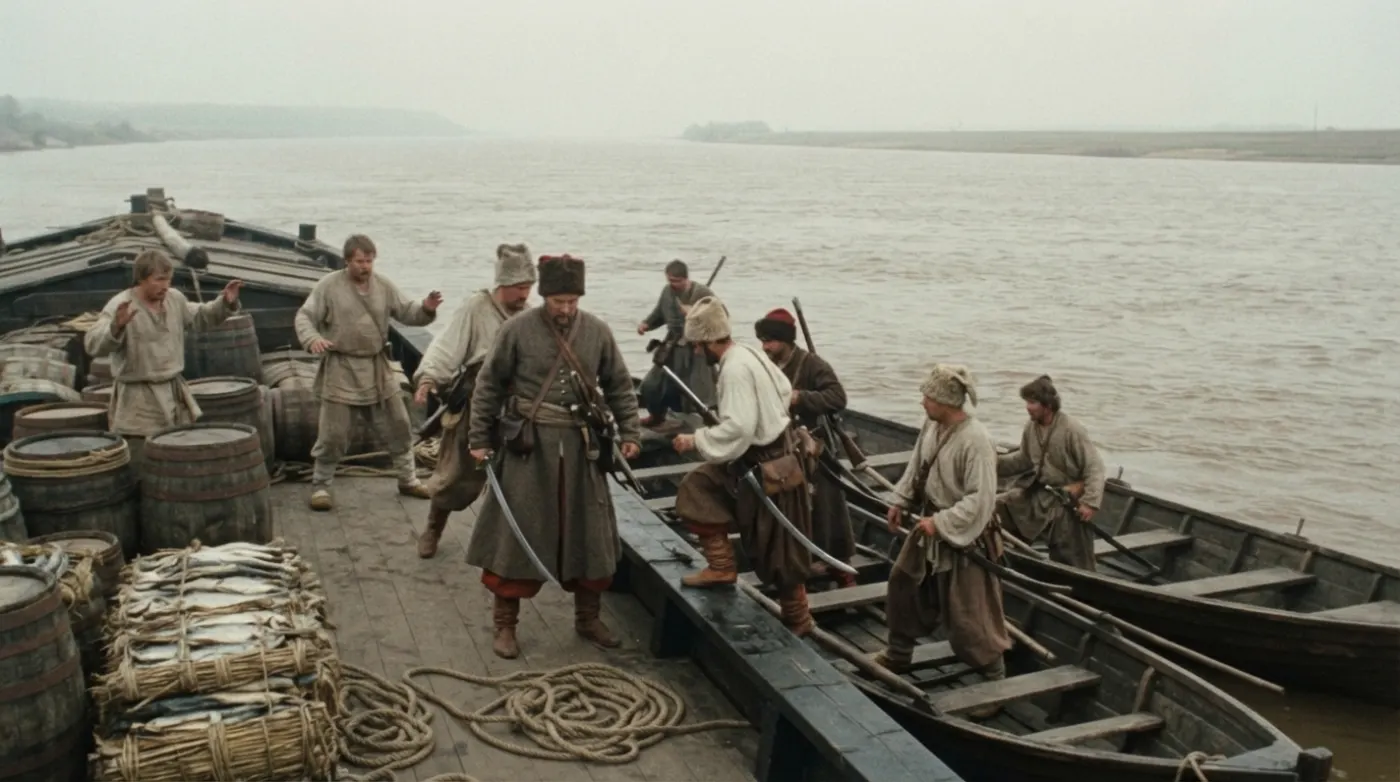
Then they slipped past Astrakhan into the Caspian and up the Iaik (today the Ural river). According to the Russian Biographical Dictionary (1910), Razin approached the fortified Iaik town with only 40 men and asked to be let in "to pray to God". Once inside, the Cossacks opened the gates to the rest; the commander of the garrison, the musketeer captain Iatsyn, and many of his men were beheaded. Razin wintered there and on 23 March 1668 sailed out into the Caspian Sea. For more than a year, the same dictionary says, Moscow did not know for certain where he was.
The narrative of the next year comes mainly from 19th-century historians working from Russian and Persian reports, so details vary. The Cossacks plundered the coast of Dagestan and the Safavid Empire from Derbent to Baku. At Resht, on the Persian coast, Razin opened negotiations with the local governor, even offering to enter the Shah's service; but the talks collapsed, and in a fight at Resht about 400 Cossacks were killed or captured. The Cossacks then sacked the town of Farabad and the Shah's pleasure palaces by the sea, and wintered on a peninsula opposite it.
In 1669, at Pig Island (Svinoi ostrov) off the Caspian coast, they defeated a Persian fleet under a commander the Russian sources call Menedy Khan. The size of the Persian fleet is given as 70 ships (the 1910 dictionary) or 50 (the historian A. G. Mankov, following the German traveller Engelbert Kaempfer), and the month as July or June. According to the dictionary, the Cossacks killed the commander's son and captured his daughter. Remember that daughter.
How many came back? Cossacks whom the Dutch sailmaker Jan Struys questioned at Astrakhan told him that they had once been 6,000 strong but returned with only 300 or 400. Struys did not believe that so few could have spread such terror, which is why he asked.
Why was Razin pardoned in 1669?
In August 1669 the battered band reached the mouth of the Volga. Prince Semen L'vov, second governor of Astrakhan, went out against them with several thousand men (Struys says more than 4,000, Fabritius 3,000), but he carried a pardon from the tsar. Razin accepted. He sent envoys to Moscow to ask for mercy, came to Astrakhan and laid down his bunchuk, the horsetail standard of a Cossack commander, in the governor's office. The date of his arrival is reported as 21, 22 or 25 August.
Struys, a sailmaker in the tsar's service whose ship lay at Astrakhan, saw him there "several times". He describes the Cossacks selling their silk at a third of its value and himself buying a gold chain "almost a fathom long" for not quite seven pounds sterling. Of Razin himself he writes, in the English translation of 1683:
"Stenko Radzin the Ringleader of that Rout, could not be distinguished from the rest, but by the Honour which was done him, being saluted by the name of Batske, Father; … he is a brave man as to his person, and well proportioned in his limbs, tall and streight"
Davies suggests that the campaign taught Razin two lessons: that he was unlikely to be pardoned again, and that he had little to fear from the weak garrisons on the Volga. In September 1669 he left Astrakhan for the Don and built a fortified camp, Kagal'nik, on an island in the river.
Did Stenka Razin really drown a Persian princess?
This is the story everyone knows: the Cossack chief, mocked by his men for going soft over a captive Persian princess, throws her into the Volga as a gift to the river. It is the plot of the most famous Russian song about him. What lies behind it is two contradictory accounts by two Dutchmen.
Struys's version. Struys says that at Astrakhan in August 1669 he saw Razin on a boat with "a Persian Princess which he had taken, together with her Brother". He had given the brother to the governor of Astrakhan and kept the sister "for his Concubine". Drunk, Razin addressed the river:
"Well, said he, thou art a noble River, and out of thee have I had so much Gold, Silver and many things of Value … I have never offered thee any thing: Well now, I am resolved to manifest my gratitude. With those words he took her into his Arms and threw her into the Wolga, with all her rich Habit and Ornaments"
Fabritius's version. Ludwig Fabritius, whose memoir was written between 1688 and 1693, tells it differently. His victim is "a beautiful and noble Tatar maiden" whom Razin had captured a year earlier. Before sailing out into the Caspian from the Iaik, Razin dressed her in her best clothes and told her that the water god "Ivan Gorinovich", lord of the river Iaik, had appeared to him in the night and reproached him for three years of luck without a gift. He threw her into the Iaik with the words: "Take this, my patron Gorinovich, I have nothing better to offer you than this beauty."
The folklorist Sergei Neklyudov, in a 552-page study of the Razin legend (2016), concludes that the two accounts differ in motive, circumstances, victim (Persian princess or Tatar maiden) and place (Volga or Iaik), and so record different versions of a legend rather than one event. Its core, he argues, is a sacrifice of a girl to a river god, a scheme that may go back to a local, possibly Turkic source. Struys's text, which Neklyudov thinks was probably written up by the Amsterdam scholar Olfert Dapper, dropped the sacrifice and made the killing a drunken whim, and that is the version that entered literature.
From legend to song. In 1858 the historian Nikolai Kostomarov added new motives: the princess gains power over the ataman, the Cossacks grow jealous, and Razin commits adultery, a crime punishable by death under Zaporozhian Cossack custom. According to Neklyudov, Kostomarov most probably took this last motive from Gogol's Taras Bulba. In 1883 the poet Dmitrii Sadovnikov turned Kostomarov's episode into a poem that begins:
"Iz-za ostrova na strezhen', / Na prostor rechnoi volny / Vybegaiut raspisnye, / Ostrogrudye cheliny."
("From behind the island to the midstream, / Out onto the open river wave, / Sail the painted, / Sharp-prowed boats.")
(The translations from Russian in this article are our own, except for Struys, quoted from the English edition of 1683.)
In the poem the Cossacks jeer that "the ataman has swapped us for a woman", and Razin, calling out "Volga, little mother river!", throws the captive into the waves. According to the editors of Sadovnikov's poems, it entered the folk repertoire from the 1890s and became one of the best-loved Russian songs. So the song is a poem of 1883, based on a historian of 1858, based on a Dutch travel book of 1676.
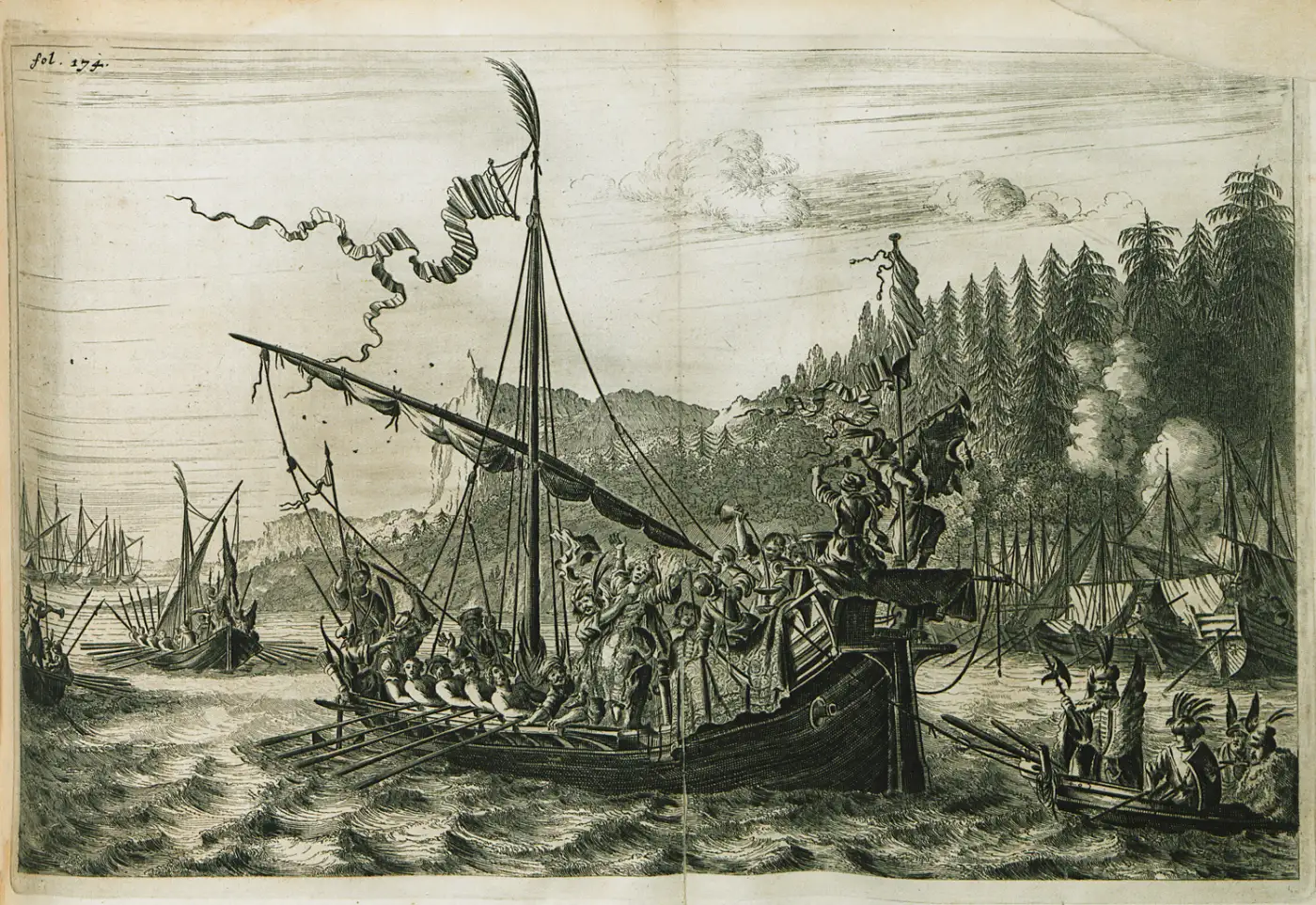
Did a real woman drown? Struys claims to have seen it, and 19th-century Russian historians had the Cossacks capture a daughter of the Persian commander at Pig Island. But no Russian or Persian document mentions her death, and the two eyewitnesses cannot agree on who she was, where it happened or why. The honest answer is that something like it may have happened, and that the story as sung did not.
How did the rebellion of 1670 begin?
In March 1670 Moscow sent an official, Gerasim Evdokimov, to the Don to find out what Razin was planning. On 12 April 1670, at Cherkassk, Razin had him killed in front of the Cossack assembly as a spy; according to Mankov, he was beaten half to death and thrown into the Don. Razin threatened his godfather, Ataman Iakovlev, with the same. Then he set out for the Volga, with about 4,000 men according to the Great Russian Encyclopaedia, or about 7,000 according to Davies.
On 15 May 1670 the Cossacks took Tsaritsyn (today Volgograd), and the governor, Timofei Turgenev, was killed. A relief force of musketeers under Colonel Ivan Lopatin, the 1671 sentence says, was beaten and its officers thrown into the river. At Chernyi Iar in June the army L'vov led out of Astrakhan mutinied and went over to Razin. Fabritius, who was with it, describes soldiers killing their own officers. For the musketeers who made up much of the garrisons on the Volga, see our article on the streltsy.
How did Razin take Astrakhan?
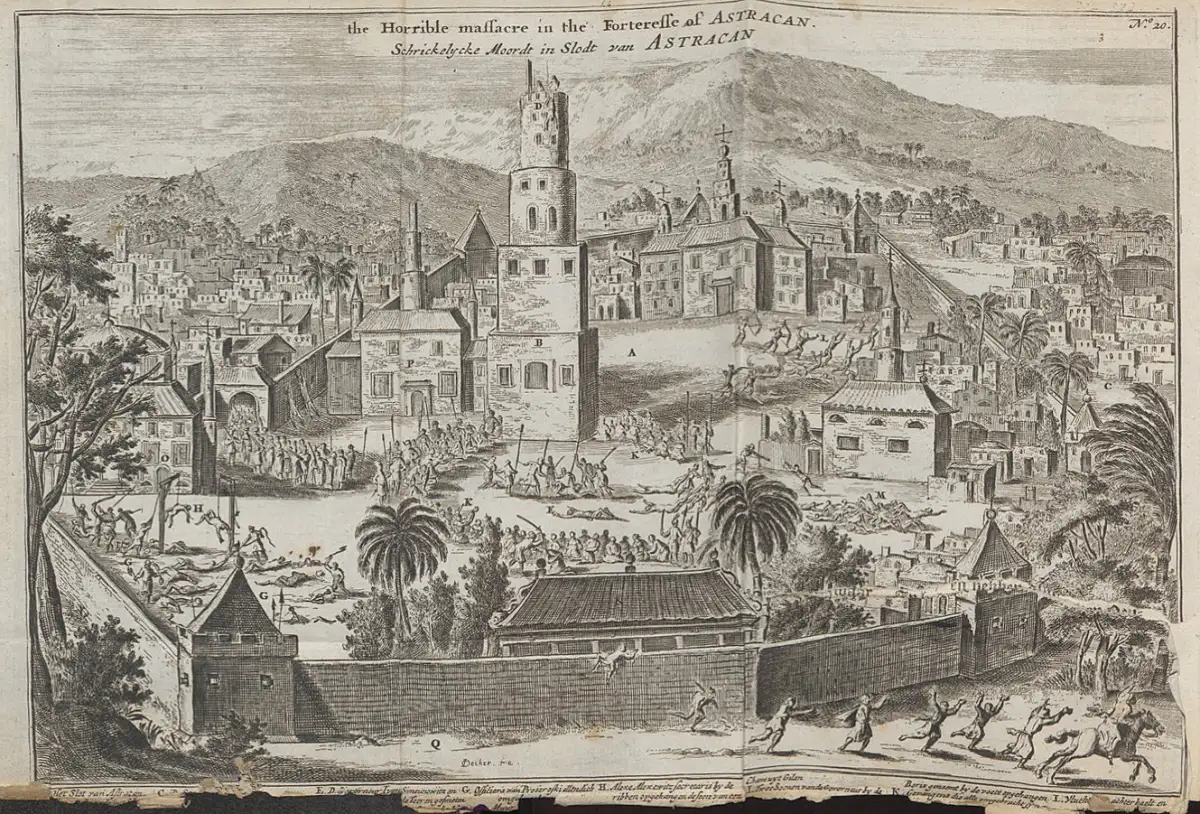
Astrakhan was the great Russian fortress and trading port at the mouth of the Volga, the capital of the old Astrakhan Khanate that Russia had conquered under Ivan the Terrible. It fell in June 1670: on 22 June according to the Great Russian Encyclopaedia, probably on the night of 24 June according to Mankov. According to Fabritius, when the Cossacks set their scaling ladders against the walls at about four o'clock, the besieged "gladly received" them.
Fabritius describes the storm as it reached the kremlin. The governor, Prince Ivan Prozorovskii, "was thrown from the high tower that stood in the middle of the Kremlin"; his brother and the officers who could be caught were hanged, hacked to pieces and thrown into the water. Persian envoys and merchants, he adds, barricaded themselves in a tower and, when they ran out of bullets, fired coins. Prozorovskii's two sons were hung up by their feet; the younger survived, the elder was thrown from the same tower as his father.
Razin set up Cossack government in the city. Leaving Vasilii Us and Fedor Sheludiak in charge, he went back up the river with about 8,000 men. At Tsaritsyn a Cossack assembly decided to march on Moscow along the Volga, with a second blow from the upper Don.
What did the rebels want?
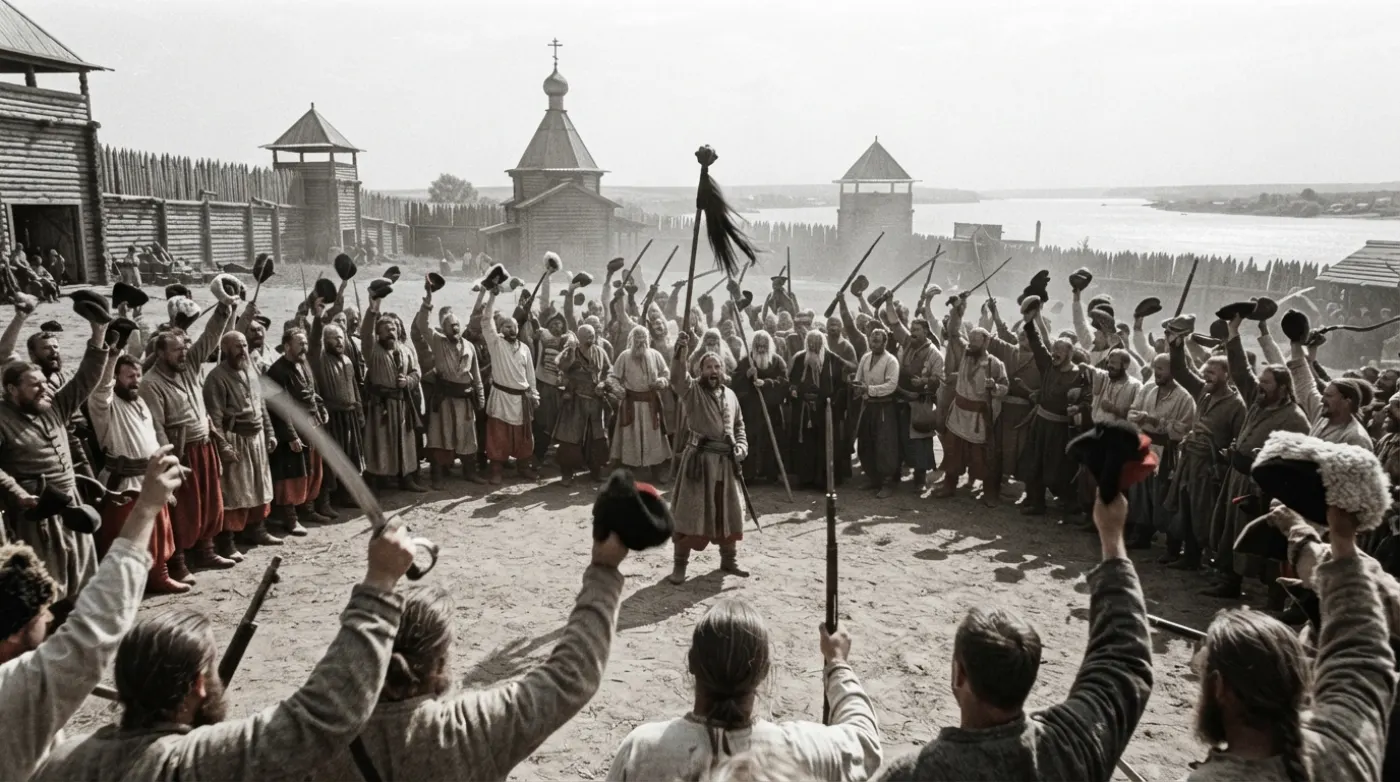
Razin did not claim to be fighting the tsar. From Tsaritsyn he sent out what the government called prelestnye pis'ma, "seductive letters". In the only one that survives in the original, from September 1670, he wrote:
"Stepan Timofeevich writes to you, all the common people. Whoever wants to serve God and the sovereign, and the great Host, and Stepan Timofeevich: I have sent out Cossacks, and you should join them in rooting out the traitors and the bloodsuckers of the commune."
According to the Great Russian Encyclopaedia, one of his main demands was "to give freedom to the black people", that is, to free the tax-paying population from taxes and dues to the state. The rebels killed or flogged governors, clerks, landowners and their stewards, shared out their property and elected their own atamans and elders.
They also borrowed legitimacy from above. Tsarevich Aleksei Alekseevich, the tsar's eldest son, had died on 17 January 1670. The rebels claimed he was alive and marching with Razin on his father's orders. The death sentence of 1671 accused Razin of sending "seditious letters" saying that the tsarevich "is alive to this day", and of claiming falsely "that the monk Nikon was with you", the patriarch deposed in 1666 and confined in the Ferapontov monastery. The historian I. L. Andreev found that three Cossacks did visit Nikon there in the spring of 1668 offering to free him, though whether they were Razin's men is hard to say. The anonymous English Relation of 1672 adds that the false tsarevich and Nikon sailed in boats lined with red and black velvet; Mankov points out that this detail occurs in no other source. The young man who played the tsarevich was, "in all probability", Mankov thought, Andrei Cherkasskii, the son of a Kabardian prince captured at Astrakhan.
Who joined the rebellion?
Many did, and not only peasants. The Great Russian Encyclopaedia lists Don Cossacks, peasants, townspeople, low-ranking servicemen such as musketeers, and the peoples of the Volga region, "Chuvash, Tatars and others". Davies adds the lower clergy, barge-haulers and the Mordvins. The anonymous Relation claimed the rebels grew to 200,000; Mankov notes that this is the only overall figure historians have.
One recruit became a legend of her own. In December 1670 Prince Dolgorukov reported capturing near Temnikov a nun called Alena, a peasant's widow from Arzamas, who "gathered many people" for the revolt and stood with the ataman Fedka Sidorov. She was accused of witchcraft and burned in a log frame. Mankov, writing in 1968, noted that this report contains "all we know" about her; the historian A. V. Bauer (2017) traces how she later became a "Russian Joan of Arc" leading 7,000 men, a figure the documents do not support.
What happened at Simbirsk?
The rebels entered Saratov on 15 August 1670 and Samara on 26 August without a fight, about 10,000 strong. On 6 September they occupied part of Simbirsk (today Ulyanovsk), but the governor Ivan Miloslavskii held the kremlin. Its 1670 inventory lists 24 cannon and five wall guns.
Four assaults failed. A captured Cossack, Kondrashka Danilov, testified that the defenders killed "many" with case shot and small arms, "and about three thousand of them were killed in the assaults at Simbirsk". Meanwhile Razin sent small detachments west of the Volga to raise the countryside. They besieged Tsivil'sk on 9 September, took Alatyr' on 16 September and Saransk on 19 September, and entered Penza without a fight on 25 September. His brother Frol led about 3,000 men into Sloboda Ukraine, where they held the fortress of Ostrogozhsk from 9 to 12 September.
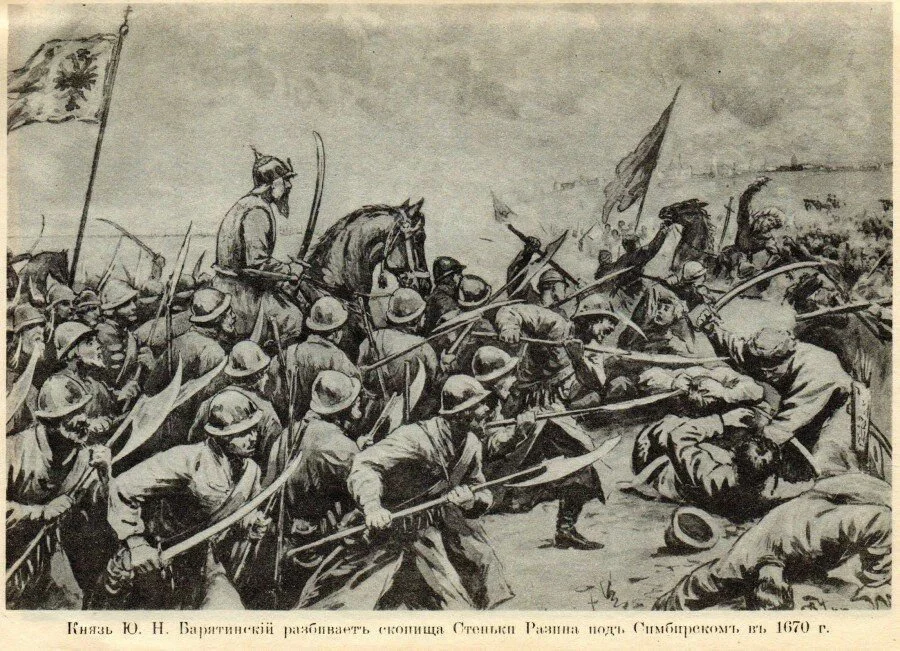
On 1 October 1670 a relief army under Prince Iurii Bariatinskii beat Razin outside the town, and on 3 October it reached the kremlin. Razin received two wounds, and three days after a failed assault he left with a few companions for the Don. Davies's verdict is blunt: Razin's forces never controlled the Volga north of Samara, and Simbirsk and Kazan did not fall.
How was the rebellion crushed?
The revolt went on without him. Prince Iurii Dolgorukov, commander of the main royal army, beat the rebels near Murashkino, north of Arzamas, on 22 October 1670; other commanders retook Kozmodemiansk, Alatyr', Saransk and Penza by the end of December. Dolgorukov made Arzamas his headquarters. The Relation describes gallows with 40 or 50 men hanging from each and rebels impaled on stakes, some still alive on the third day, and says that "in three months, by sentence, after questioning of witnesses, the executioners put eleven thousand people to death". The Great Russian Encyclopaedia also gives over 11,000 executed.
The foreign reports also speak of 100,000 killed in the fighting. The historian N. I. Nikitin (2017) thinks this unlikely: in a vast and thinly populated country, he argues, the government could not afford to wipe out the working population on which its revenues depended.
Astrakhan held out longest. Its Cossack rulers killed the metropolitan of Astrakhan, Iosif, on 11 May 1671, and Sheludiak even led a new campaign up the Volga to Simbirsk. The city surrendered to Miloslavskii on 27 November 1671.
Who captured Stenka Razin?
Not the tsar's army. Back on the Don, Razin tried and failed to take Cherkassk, the stronghold of the wealthier, "house-owning" Cossacks loyal to Moscow. On 14 April 1671 those Cossacks, led by his godfather Kornila Iakovlev, took Kagal'nik and captured Stepan and his brother Frol. They delivered them to Moscow themselves.
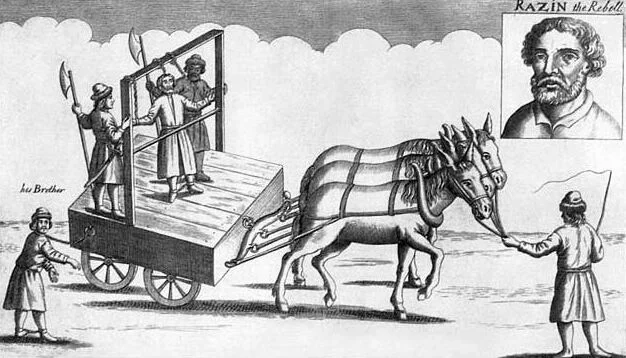
On Friday 2 June 1671 the brothers were brought into the city. The English merchant Thomas Hebdon, writing four days later, describes a procession of 300 foot soldiers in front and almost as many behind, with the Cossacks who had captured him around Razin and Iakovlev riding ahead with his own banner. Razin stood on a platform under a gallows, with a chain round his neck thrown over the crossbeam and his hands chained to the posts, his feet "in stockings only"; a chain from the platform went round the neck of his brother, who walked in irons. Three horses pulled it. Razin was tortured the same day: "besides 30 lashes of the whip he was tortured with fire".
Koch heard that when Dolgorukov called Razin a scoundrel and a traitor, Razin answered that the traitor was the prince, "through whom so much innocent peasant blood had been shed". Under torture, when Frol screamed, Stepan told him, Koch heard, to remember "what honour we had: we ruled not only the whole Don but the whole Volga". However hard Stepan himself was tortured, Koch adds, he did not make a sound.
How was Stenka Razin executed?
The execution, set for Saturday 3 June, was postponed so that both brothers could be tortured a third time. On Tuesday 6 June 1671 they were taken to the great market square by the Zemskii dvor, the Land Office. A document listing all Razin's deeds was read for half an hour, then the sentence. Koch, in his dispatch of the same day, describes what followed:
"They cut off his right arm at the elbow, then his left leg at the knee, then his left arm, his right leg and finally his head."
The five parts were set on five stakes; Hebdon adds that the trunk was left on the ground "for the dogs to eat". Koch heard that Razin had prayed, crossed himself, said "forgive" to the crowd and lain down, and that he "met his death fearlessly". At that moment Frol called out that he had something more to tell, and was taken back to be tortured again. He was beheaded in Moscow in May 1676, after what Coyet called six years in confinement and torture; the Dutch diplomat Balthasar Coyet watched him led to his death.
Where did it happen? The Great Russian Encyclopaedia says Bolotnaia Square, across the river from the Kremlin. The scholars Gleb Kazakov and Ingrid Maier (2017), who published Koch's dispatches, argue for Red Square, as M. N. Smentsovskii had in 1932: Hebdon speaks of the square "before the fortress", the Relation says Razin crossed himself towards the Kazan cathedral, and a Russian witness, Akinfii Goriainov, wrote that "on Red Square pits have been prepared and stakes sharpened". Only the stakes with the remains were moved across the river to the Boloto the next day, where Coyet saw them in 1676.
How was Stenka Razin remembered?
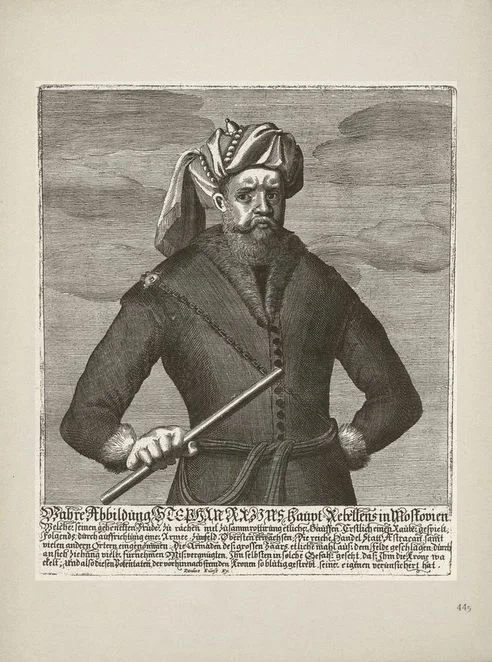
At first, as a monster for export. The rebellion was big news in Europe: Kazakov and Maier cite the German historian M. Welke's finding that between September 1670 and August 1671 one in every three or four issues of German-language newspapers mentioned it. German presses printed invented portraits of him in a turban, and some papers called him "Prince Stepan Razin Ottoman", which Kazakov and Maier (2018) explain as a misreading of "Attaman". On 29 July 1674 Johann Justus Marth defended a whole dissertation on him at the University of Wittenberg, under the title Stenko Razin Donski Kozak Izmennik, "Stenka Razin, Don Cossack, traitor".
Pushkin wrote Songs about Stenka Razin in 1824–26, Vladimir Giliarovskii (1882–88) and Velimir Khlebnikov (1920) wrote long poems about him, and Sadovnikov's poem of 1883 became the song. After the revolution he became a hero. On 1 May 1919 Lenin spoke on Red Square at the unveiling of a temporary monument to him: "This monument is erected to one who represented the rebellious peasants. On this spot he laid down his life in the struggle for freedom." Soviet tear-off calendars of 1927 marked "16 June 1671 – execution of Stenka Razin". Shostakovich set The Execution of Stepan Razin to music in 1964, and Vasilii Shukshin's novel I Have Come to Give You Freedom appeared in 1971. Towns, streets and a cliff on the Volga bear his name.
Was it a peasant war?
From 1934 Soviet historians called the rebellion a "Peasant War", a term borrowed from Friedrich Engels's The Peasant War in Germany. The Great Russian Encyclopaedia still gives "Peasant War" as an alternative name. Historians disagree about whether it fits:
- A peasant war. Soviet scholarship treated the rising as a class war against serfdom; in the 1920s some even called it a "Cossack-peasant revolution, bourgeois in character".
- A Cossack rising with many allies. Michael Khodarkovsky (1994) argued that the term "misleads more than it explains": the rebels were socially mixed, the movement had ethnic components and a broad anti-elite base, and "the Cossacks remained its core".
- Late peasant involvement. Nikitin (2017) stresses that the main force was the Cossacks, and that the peasants joined only in the last phase.
- Piracy on a larger scale. Davies thinks Soviet historiography "exaggerated" the rising as a general anti-feudal class war, and that Razin's "probable objective" was to seize the garrisons' resources on the lower Volga and expand Cossack piracy on the Caspian.
Common myths about Stenka Razin
| Myth | What the evidence says |
|---|---|
| Razin drowned a Persian princess in the Volga, as in the song | Only Struys says so; Fabritius describes a Tatar maiden thrown into the Iaik as a sacrifice to a river god. The song is Sadovnikov's poem of 1883 |
| He fought against the tsar | The rebels claimed to serve the tsar against "traitor" boyars and said the dead Tsarevich Aleksei was with them |
| The tsar's army captured him | Don Cossacks under his own godfather, Kornila Iakovlev, captured him and handed him over |
| He was executed at the Lobnoe Mesto or on Bolotnaia Square | The eyewitnesses point to Red Square near the Land Office; only his remains were moved to the Boloto |
| It was a peasant war led by peasants | The core force was Cossacks; peasants, townspeople, musketeers and Volga peoples joined, peasants mostly late |
| Alena of Arzamas led an army of 7,000 | The only Russian document says she gathered "many people" and was burned at Temnikov |
| His brother Frol was spared | Frol's execution was postponed in 1671; he was beheaded in 1676 |
Timeline
| Date (Old Style) | Event |
|---|---|
| c. 1630 | Stepan Razin born near Cherkassk on the Don |
| 1652 | First mention in the sources; pilgrimage to Solovki |
| 1661 | Negotiates with the Kalmyks for the Don Host |
| 1665 | His elder brother Ivan executed for desertion |
| Spring 1667 | Razin's band plunders the Volga convoy and takes the Iaik town |
| 23 March 1668 | Sails out into the Caspian Sea |
| 1668–1669 | Raids Dagestan and the Persian coast; battle at Pig Island |
| August 1669 | Pardoned; arrives at Astrakhan |
| 12 April 1670 | The tsar's envoy killed at Cherkassk |
| 15 May 1670 | Tsaritsyn taken |
| 22 or 24 June 1670 | Astrakhan taken; Governor Prozorovskii killed |
| 15 and 26 August 1670 | Saratov and Samara taken |
| 6 September 1670 | Rebels occupy part of Simbirsk |
| 1–3 October 1670 | Bariatinskii defeats Razin and relieves Simbirsk |
| 22 October 1670 | Rebels defeated at Murashkino |
| 14 April 1671 | Razin captured at Kagal'nik |
| 2 June 1671 | Brought into Moscow |
| 6 June 1671 | Executed (16 June in the modern calendar) |
| 27 November 1671 | Astrakhan surrenders |
| 1676 | Frol Razin executed |
| 1883 | Sadovnikov's poem "Iz-za ostrova na strezhen'" |
| 1 May 1919 | Lenin unveils a monument to Razin on Red Square |
What the map shows
At 1670 the Tsardom of Russia reached down the Volga to Astrakhan and the Caspian Sea, the route of Razin's rebellion. Across the sea lay the Safavid Empire whose coast he raided in 1668–69, and in the steppe the Kalmyks and the Crimean Khanate. The ruler Razin claimed to serve is the subject of our article on Tsar Alexis; for the last great crisis before him, see the Time of Troubles.
Sources
Primary sources
- A Relation Concerning the Particulars of the Rebellion Lately raised in Muscovy by Stenko Razin (London, 1672), with the sentence of 6 June 1671; Russian translation by L. E. Poliakova in A. G. Mankov (ed.), Zapiski inostrantsev o vosstanii Stepana Razina (Leningrad, 1968), with Mankov's commentary, via drevlit.ru
- Jan Struys, The Perillous and Most Unhappy Voyages of John Struys (London, 1683), via archive.org; Russian translation (1880), via vostlit.info
- Ludwig Fabritius, Zapiski, Russian translation in Mankov (ed.), 1968, via drevlit.ru
- Thomas Hebdon, letter to Richard Daniel, Moscow, 6 June 1671, Russian translation in Mankov (ed.), 1968, via vostlit.info
- Christoff Koch, dispatches of 6 and 13 June 1671, Russian translation in Kazakov and Maier 2017 (no. 12)
- Balthasar Coyet, Posol'stvo Kunraada fan-Klenka k tsariam Alekseiu Mikhailovichu i Feodoru Alekseevichu (St Petersburg, 1900), via vostlit.info
- D. N. Sadovnikov, "Iz-za ostrova na strezhen'", Volzhskii vestnik 1883, no. 12, via ru.wikisource
- V. I. Lenin, speech at the unveiling of a monument to Stepan Razin, 1 May 1919, Collected Works, vol. 29, via marxists.org
Studies and reference works
- "Razin" and "Razina vosstanie 1670–71", Bol'shaia rossiiskaia entsiklopediia, vol. 28 (Moscow, 2015)
- Brian Davies, "Razin, Stepan", in Europe, 1450 to 1789: Encyclopedia of the Early Modern World (New York, 2004)
- "Razin, Stepan Timofeevich", Entsiklopedicheskii slovar' Brokgauza i Efrona, vol. 26 (1899), and Russkii biograficheskii slovar', vol. 15 (1910), via ru.wikisource
- G. M. Kazakov and I. Maier, "Inostrannye izvestiia o kazni Stepana Razina: novye dokumenty iz Stokgol'mskogo arkhiva", Slověne 2017, no. 2
- G. M. Kazakov and I. Maier, "'Ottoman Razin'", Drevniaia Rus': voprosy medievistiki 2018, no. 2
- D. I. Antonov, review of S. Iu. Neklyudov, Legenda o Razine: persidskaia kniazhna i drugie siuzhety (Moscow, 2016), Antropologicheskii forum 2019
- Review of N. I. Nikitin, Razinskoe dvizhenie: vzgliad iz XXI v. (Moscow, 2017), Sotsial'nye i gumanitarnye nauki (INION), 2018
- V. Ia. Maul', on the Western critique of the concept of "peasant wars", Vestnik Tomskogo gosudarstvennogo universiteta. Istoriia 2025, no. 98, doi:10.17223/19988613/98/13
- A. A. Dolmatov, on the siege of Simbirsk in 1670, Voenno-istoricheskii zhurnal 2021
- I. L. Andreev, on Patriarch Nikon and the Cossacks, Istoricheskii vestnik 2014
- A. V. Bauer, on the myth of Alena Arzamasskaia (2017)
- V. A. Volkov, on the early Soviet historiography of the Razin rising (2025)
- On medieval events in Soviet tear-off calendars (2017), via CyberLeninka
Image credits
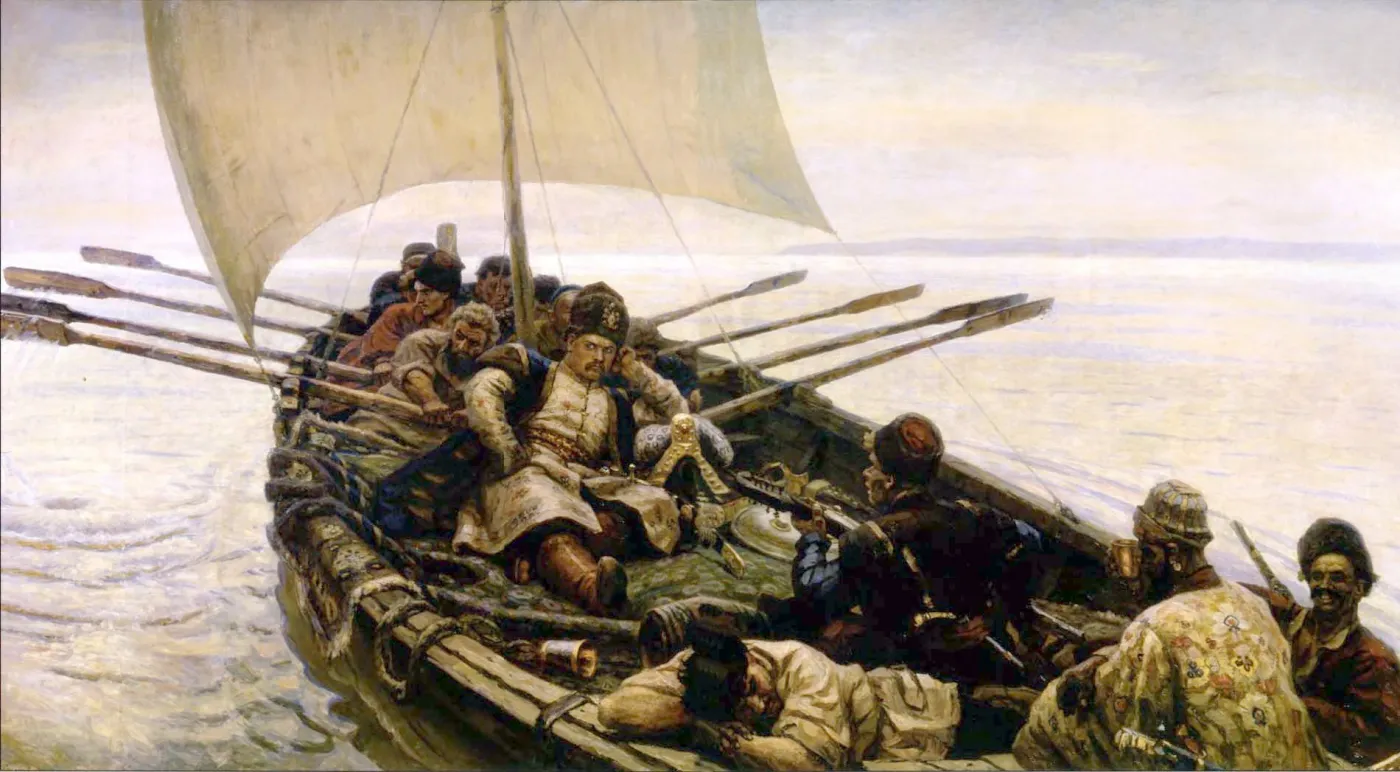
- Title image: Vasily Surikov, Stenka Razin, 1906, Russian Museum. Public domain, via Wikimedia Commons.
- Wahre Abbildung Stephan Razin, Nuremberg, Paul Fürst's widow and heirs, 1670s. CC BY-SA 4.0, via Wikimedia Commons.
- Princess plate from Jan Struys, Les voyages, Amsterdam 1681. Public domain, via Wikimedia Commons.
- Massacre at Astrakhan, from Jan Struys, Drie aanmerkelyke reizen, Amsterdam 1746, Radboud University Library. Public domain, via Wikimedia Commons.
- Bariatinskii at Simbirsk, unknown artist, late 19th century. CC0, via Wikimedia Commons.
- Razin brought to Moscow, English engraving, 1672. Public domain, via Wikimedia Commons.