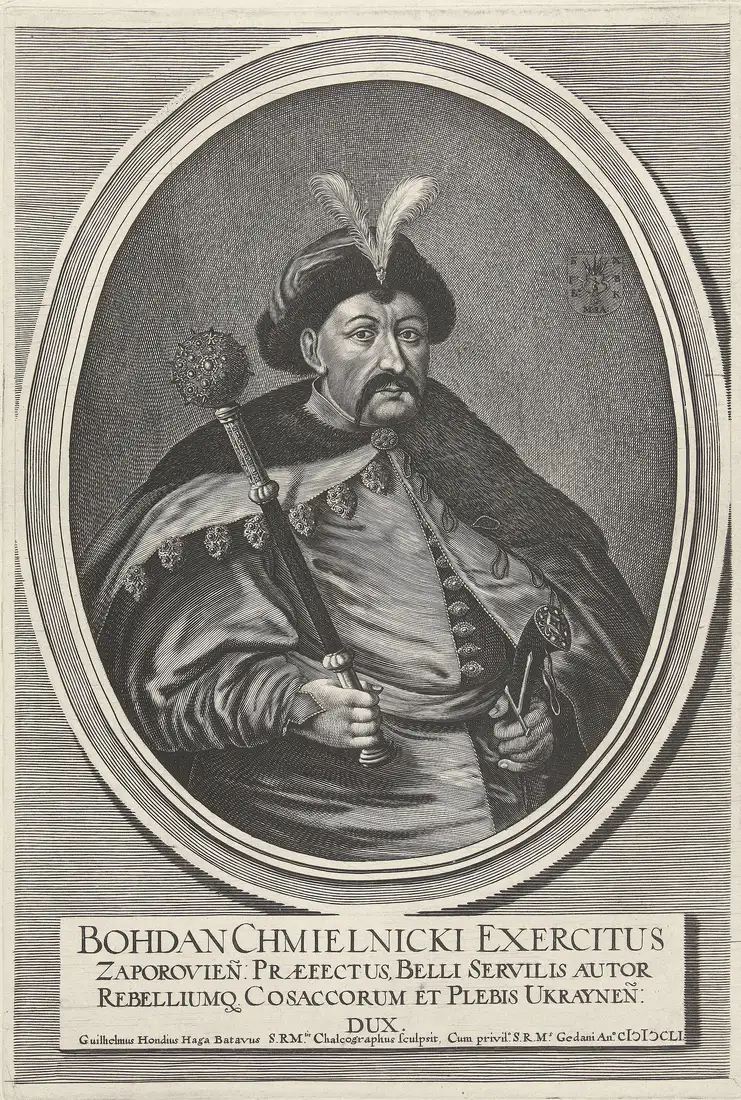
Bohdan Khmelnytsky (c. 1595/96–1657) was the Cossack officer who in 1648 led the rising that tore most of central Ukraine out of the Polish–Lithuanian Commonwealth and turned it into a Cossack state, the Hetmanate. A minor nobleman and former military chancellor of the registered Cossacks, he fled to the Zaporozhian Sich at the end of 1647 after a local official seized his estate, was elected hetman, and with Crimean Tatar help won three crushing victories over Polish armies in 1648: at Zhovti Vody, Korsun and Pyliavtsi. The war that followed lasted until his death on 6 August 1657. In January 1654, at Pereiaslav, he and his officers swore allegiance to the Muscovite tsar, a decision that Russians, Ukrainians and Poles have read in very different ways ever since. The uprising was also a catastrophe for the Jews of Ukraine: many thousands were killed and whole communities wiped out, though modern demographers put the toll far below the figures of the Jewish chronicles.
Bohdan Khmelnytsky at a glance
| Name | Bohdan (Fedir) Zinovii Khmelnytsky; Russian Bogdan Khmelnitsky, Polish Bohdan Chmielnicki |
| Born | c. 1595–96, place uncertain; family estate at Subotiv near Chyhyryn |
| Died | 6 August 1657, Chyhyryn; buried at Subotiv |
| Office | Hetman of the Zaporozhian Host, 1648–1657 |
| Great victories | Zhovti Vody (16 May 1648), Korsun (26 May 1648), Pyliavtsi (September 1648), Batih (1652) |
| Great defeat | Berestechko, 28–30 June 1651 |
| Treaties | Zboriv (1649), Bila Tserkva (1651), Pereiaslav and the March Articles (1654) |
| State created | The Cossack Hetmanate, 1648–1782 |
| Capital | Chyhyryn |
(Dates follow the Internet Encyclopedia of Ukraine, which uses the modern Gregorian calendar, as the Polish Commonwealth did. Muscovite and Orthodox sources used the Julian calendar, ten days behind: the Pereiaslav council of 8 January 1654 Old Style fell on 18 January in the modern calendar.)
Who was Bohdan Khmelnytsky before 1648?
He was born into the lesser nobility of Ukraine, then part of the Kingdom of Poland, around 1595 or 1596; nobody knows exactly where. According to the Internet Encyclopedia of Ukraine (IEU), his father Mykhailo served as an officer under the crown hetman Stanisław Żółkiewski, and Bohdan was probably educated at a Jesuit college, most likely in Lviv, which gave him fluent Polish and Latin. His first battle was the Polish disaster at Cecora in 1620, where his father was killed and he was taken prisoner by the Turks. He spent two years in Istanbul before his mother ransomed him.
Then the record goes almost blank. The IEU is blunt: "There is no reliable information about Khmelnytsky's activities from 1622 to 1637", and later stories of his exploits in those years "have no documentary foundation". What is certain is that he joined the registered Cossacks, the troops on the Polish crown's payroll, married Hanna Somko, a Cossack's daughter from Pereiaslav, and settled on his family's farmstead at Subotiv near Chyhyryn. By 1637 he was military chancellor of the Cossack Host, and his signature stands on the capitulation that ended a Cossack revolt in December of that year.
The defeat cost him. The Ordinance of 1638 abolished his office and put the registered Cossacks under Polish commanders; he was demoted to captain (sotnyk) of the Chyhyryn regiment. He did not look like a rebel in the making. In 1645 he served with a Cossack detachment of 2,000–2,500 men in France, and in 1646 King Władysław IV discussed his plans for a war against the Ottomans with Khmelnytsky and other Cossack envoys in Warsaw.
What was the quarrel with Czapliński?
The spark was personal. Daniel Czapliński, deputy governor (pidstarosta) of Chyhyryn, wanted Subotiv. The Cossack chronicle known as the Samovydets ("Eyewitness") chronicle, written by a contemporary, says simply that Czapliński "took the farmstead with its apiary and mill at the place called Subotiv, a mile and a half from Chyhyryn", and that this started the feud. (The translations from Ukrainian, Russian and Polish in this article are our own.)
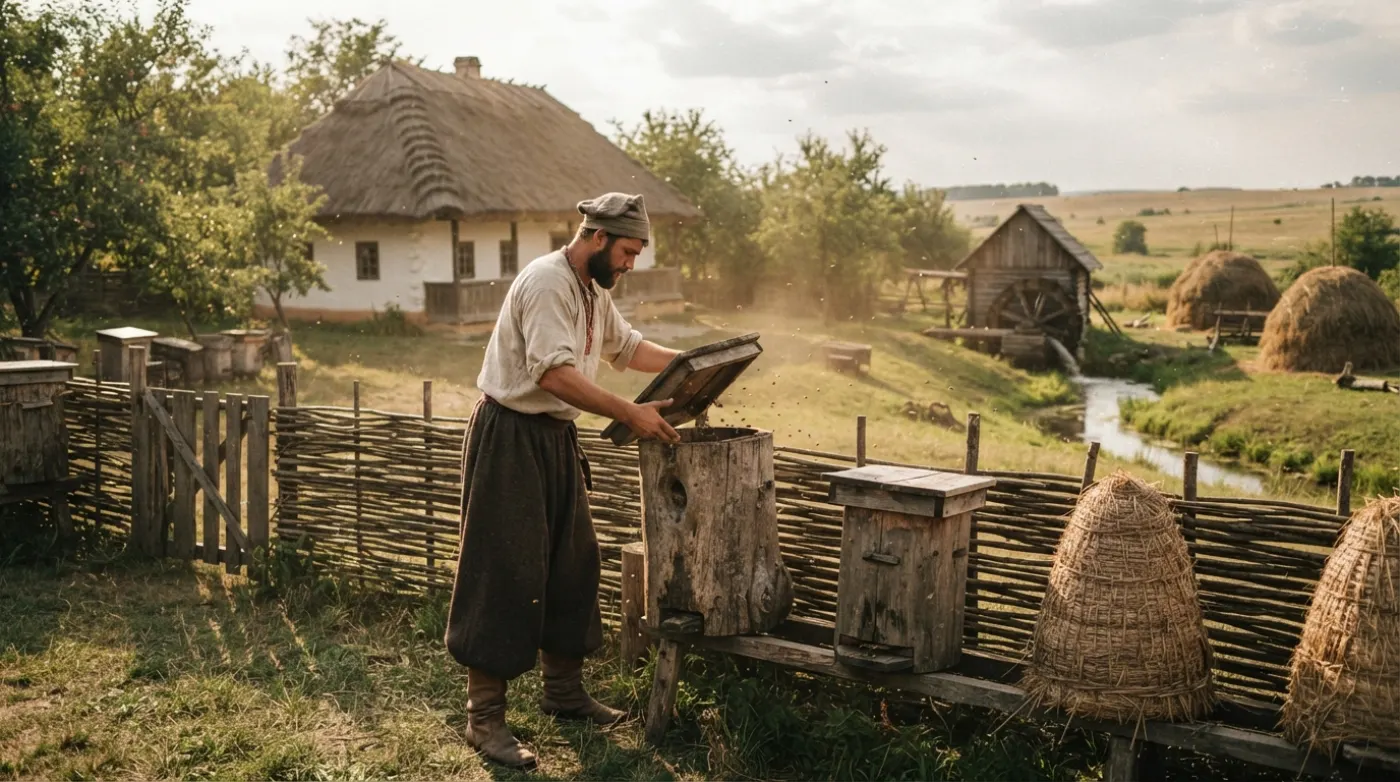
The IEU gives the fuller story. Although Khmelnytsky had obtained a royal title to Subotiv in 1646, Czapliński raided the estate and seized its movable property, and his servants beat Khmelnytsky's young son in the Chyhyryn marketplace. Khmelnytsky's wife died in 1647, and towards the end of that year the local magnate Aleksander Koniecpolski ordered his arrest. Friends among the Chyhyryn officers, above all Colonel Mykhailo Krychevsky, stood surety for him. At the end of December 1647 he left for the Zaporozhian Sich, the Cossack fortress on the lower Dnieper, with a few hundred men.
Hrushevsky, the great Ukrainian historian, retold the story in a popular book of 1909, noting the gossip "that a woman came between them, that Czapliński lured away Khmelnytsky's beloved", and adding that "that story was spun out later". It has a factual hook: early in 1649 Khmelnytsky married Matrona, Czapliński's former wife. Personal grievance alone would not have shaken a kingdom, though. The IEU puts it as a private feud that "quickly turned into a national revolution", fed by the anger of Cossacks excluded from the register, peasants on the new magnate estates and Orthodox townspeople.
How did the uprising of 1648 begin?
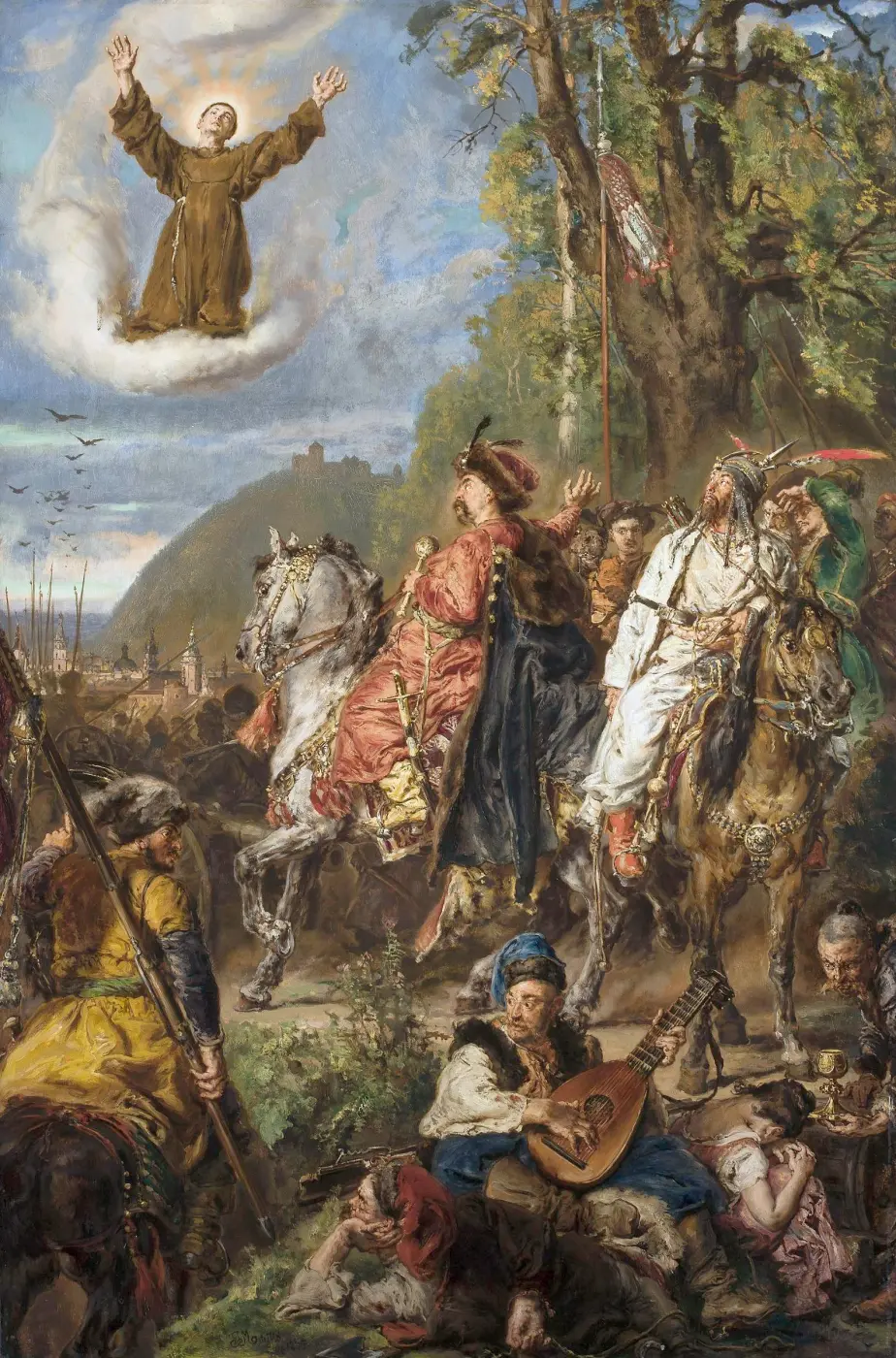
On 21 January 1648 Khmelnytsky's men overpowered the Polish garrison guarding the Sich, and the Zaporozhians elected him hetman. His decisive move was diplomatic. He made an alliance with the Crimean Khanate of Khan Islam Giray III, which sent cavalry under the commander Tuhai Bey. Orest Subtelny's IEU survey speaks of a 40,000-strong Tatar army; the IEU's battle entries count about 4,000 Tatars in each of the first two battles. Either way, the Cossacks now had the horsemen they had always lacked.
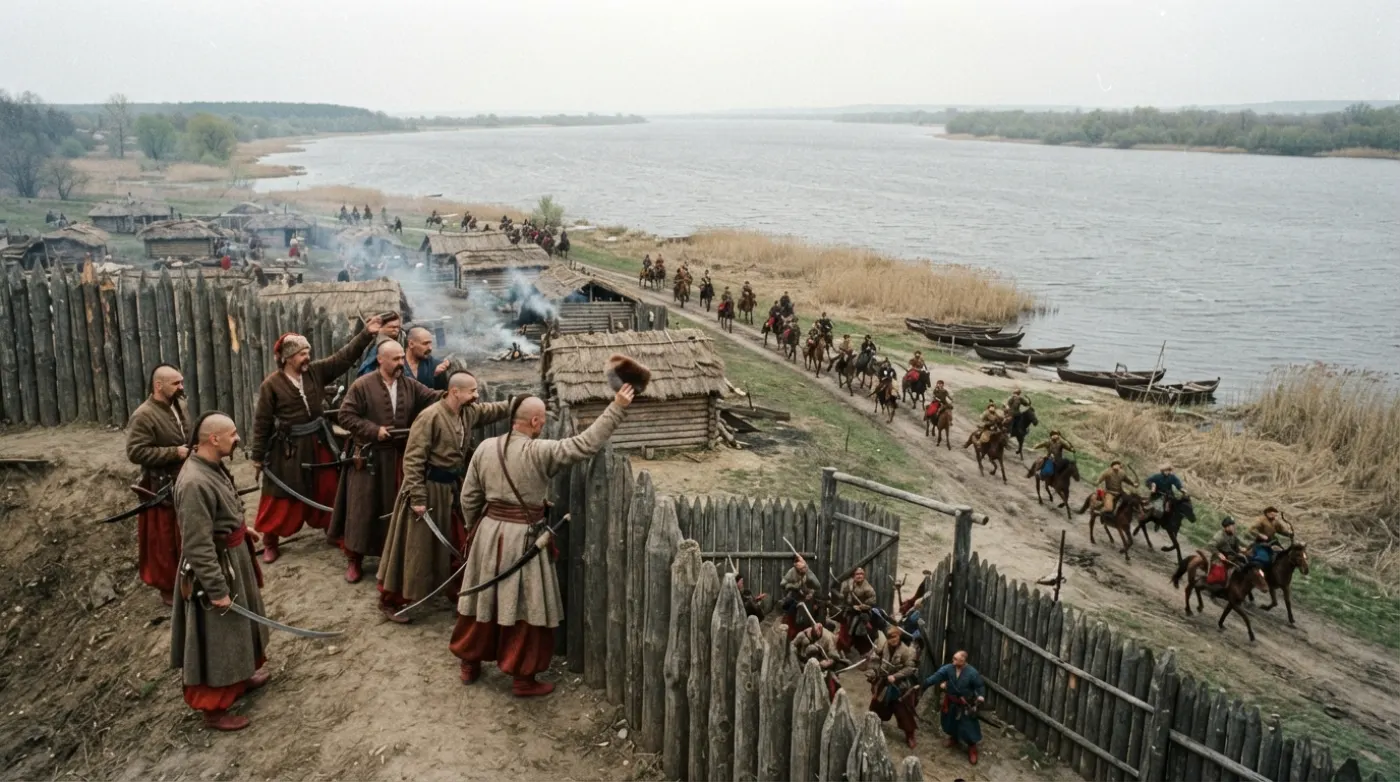
The Polish command expected a routine police action and split its forces. On 16 May 1648, in the marshes of the Zhovta river, the Cossacks and Tatars surrounded the advance guard under Stefan Potocki, son of the crown hetman, and destroyed it; according to the IEU, the registered Cossacks sent with it went over to Khmelnytsky. Ten days later, on 26 May, the main army was routed near Korsun. Both Polish hetmans, Mikołaj Potocki and Marcin Kalinowski, were taken prisoner by the Tatars, and the IEU puts the prisoners at more than 8,700. In one month the Commonwealth had lost its field army and both its commanders.
Why did the revolt become a war of all against all?
After Korsun the rising spread far beyond the Cossacks. Peasants and townspeople formed their own bands, and the IEU's war survey describes what followed without euphemism: Prince Jeremi Wiśniowiecki's troops "systematically killed all Cossacks and peasants, including women, children, and the old people who fell into their hands", while the rebels treated nobles, Catholic clergy and Jews "in a similar fashion".
The Cossack Samovydets chronicler, no friend of the Poles, describes the summer of 1648 in the same terms. Wherever "nobles, castle servants, Jews and town officials" were found, he writes, they were "all killed, sparing neither their wives nor children", churches were burned and priests killed; "most of the Jews perished in Nemyriv and in Tulchyn – a countless number." Some Jews saved themselves by baptism, he adds, and returned to Judaism once they reached Poland.
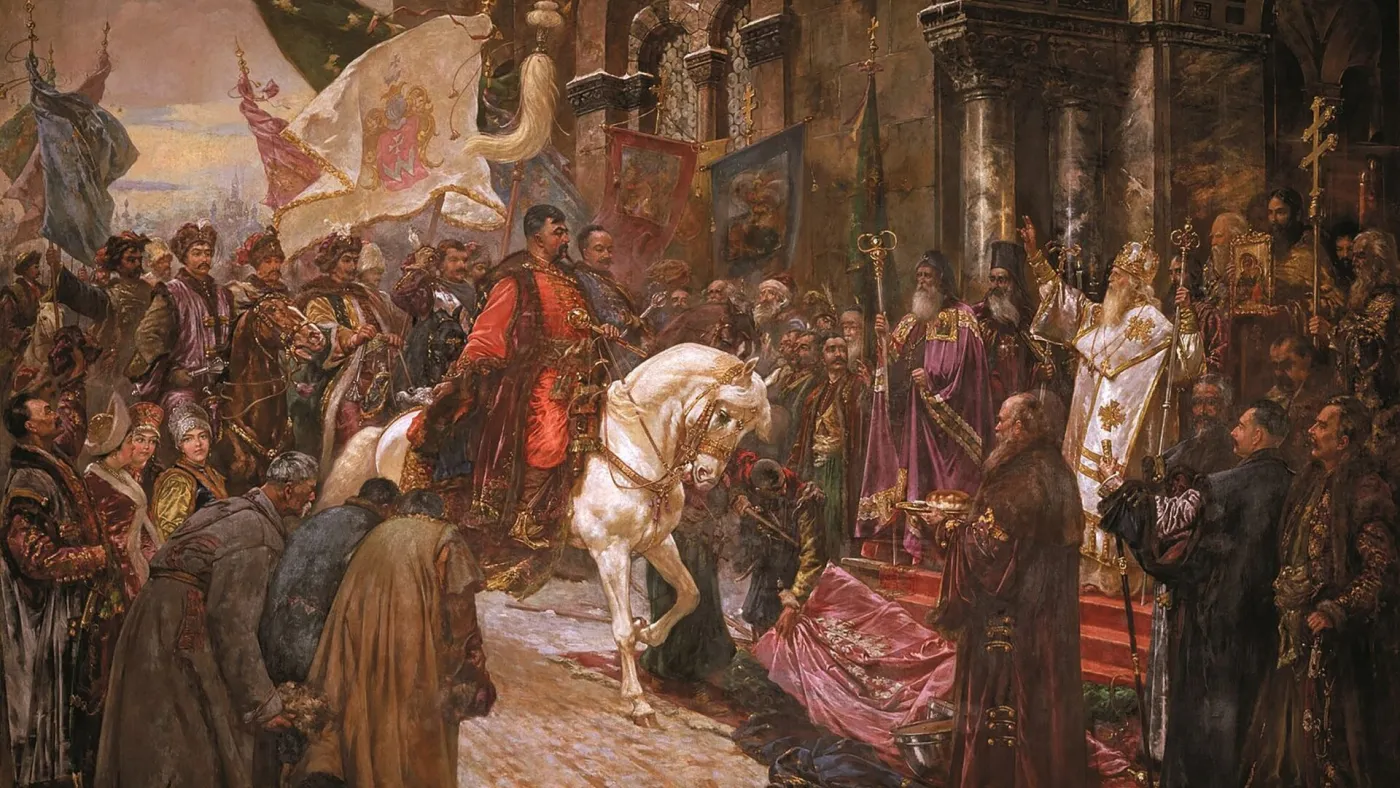
In September 1648 the Commonwealth sent a new army, commanded by three magnates whom the IEU calls "weak and inexperienced". At Pyliavtsi in Podolia, between 21 and 24 September (the IEU gives both the range and 23 September as the decisive day), it disintegrated and fled, leaving its artillery and baggage. Khmelnytsky marched west, besieged Lviv and then Zamość, and turned back after the election of a new king, Jan II Casimir, whose candidacy he had supported. He entered Kyiv in triumph at the turn of 1648/49, hailed, according to the IEU, as "the Moses, savior, redeemer, and liberator of the Rus' people".
What happened to the Jews in 1648–49?
For Jews, 1648–49 became the gzeyres takh vetat, the "evil decrees" of the Hebrew years 5408–5409. Many Jews in the Ukrainian lands earned their living serving the Polish nobility, including as tax collectors and lessees, and the peasants regarded them, in Shaul Stampfer's words in the YIVO Encyclopedia, "as part of the oppressive governing system". When towns fell, Jews were often killed together with Polish nobles and Catholic priests. Communities at Nemyriv (10 June 1648), Tulchyn and Bar were destroyed outright.
The most famous account is Yeven metsulah ("The Abyss of Despair") by Nathan Hannover, an eyewitness to some of the events. For Nemyriv alone he writes that the number of those slain and drowned "amounted to 6,000 souls"; at Narol he gives more than 12,000 Jewish dead. Stampfer stresses that Hannover's aim "was not to provide an objective history but to preserve the memory of the holy communities that had been destroyed" and to win support for survivors like himself. Contemporaries felt the shock immediately. The minute book of the Kraków community recorded, in Joel Raba's translation, that "since the destruction of the Temple no other cruel murder like this one was committed for the sanctification of the name." A fast day on 20 Sivan was instituted in memory of the victims.
How many died is a genuinely disputed question, and the answer depends on whom you ask:
| Who | Estimate of Jewish deaths | Basis |
|---|---|---|
| Shmuel Feibish, Tit ha-yaven (1650) | implies about 670,000 | chronicle (as read by Weinryb) |
| Nathan Hannover, Yeven metsulah (1653) | "more than 80,000" (Weinryb's reading); 100,000–120,000 (IEU's summary of the chroniclers) | chronicle |
| Council of Lithuanian Jewry, 1650 | "several tens of thousands" | community letter |
| Jits van Straten (2009) | 100,000–200,000 | demographic model assuming 370,000–500,000 Jews |
| Bernard Weinryb (1972) | about 40,000–50,000 | historian's estimate |
| Shaul Stampfer (2003, restated 2015) | fewer than 20,000, perhaps 18,000, of about 40,000 | house counts, tax and later census data |
| Tomasz Ciesielski (2014) | agrees with Stampfer: at most 20,000, not fewer than 6,000 | review of Polish and Jewish sources |
| Jaroslaw Pelenski (1990) | 6,000–7,000 minimum, 12,000–14,000 maximum | comparative estimate |
Stampfer's reasoning is demographic. He estimates that only about 40,000 Jews lived in the regions affected (the IEU cites an older figure of 51,325), so totals of 100,000 or more are impossible. Most Jews, he argues, fled once the danger was clear; several thousand were carried off by the Tatars and sold; some converted; and the number who died of hunger and disease "could easily have been equal to the number murdered". He also notes that many victims were killed by the Tatar allies and that "there was no consistent Cossack policy to kill all Jews". None of this, he insists, makes the catastrophe small: up to half of the Jewish population of the region may have died. "It was certainly a large number by any standard", he writes, and the Jews "did suffer more than others".
The chroniclers were not inventing massacres, but they did not count. Stampfer and Ciesielski both point out that the chronicles were written to commemorate martyrs, move readers to repentance and raise money for survivors, and that archival sources record fewer victims than the chronicles for towns such as Pinsk and Dubno. A recent local study shows the gap in miniature. For the town of Narol, the chronicler Meir of Szczebrzeszyn gave 10,000 Jewish dead and Hannover 12,000. A Hebrew memorial list probably written soon after the massacre, published by Dariusz Wojnarski in 2024, names 85 murdered Jewish men, about 12 per cent of the town's pre-war population by his calculation; it lists only men, and Wojnarski reckons that many of the women and children were carried off by the Tatars or died later of hunger and disease.
How did the war go after 1649?
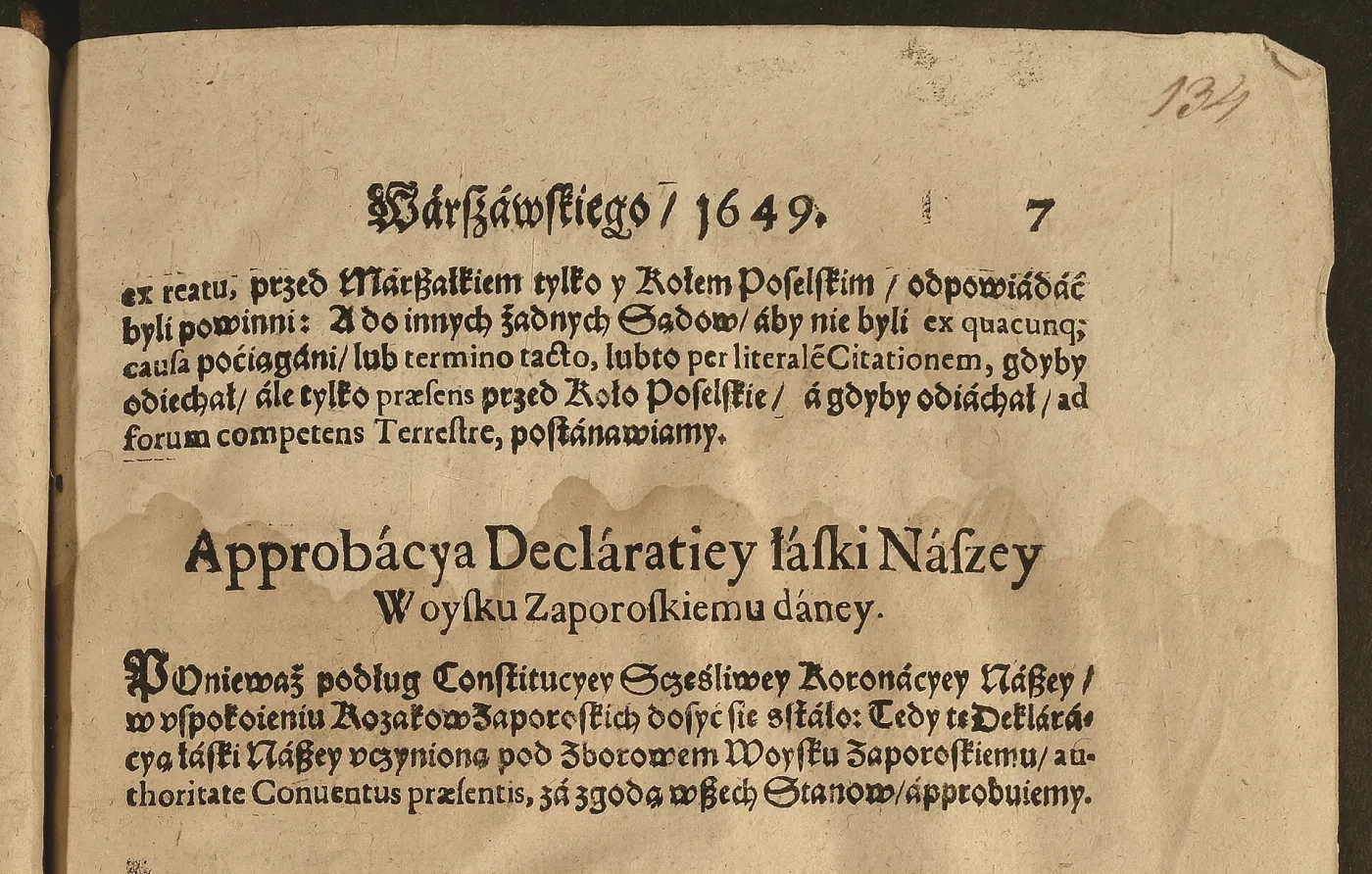
In the summer of 1649 the king himself took the field. Khmelnytsky and the khan besieged a Polish army at Zbarazh and, in August, caught the king's relief army at Zboriv. At that moment, according to the IEU, Islam Giray, "bribed by the Poles and disturbed by the rapid growth of the Ukrainian forces", made his own peace with the king and forced Khmelnytsky to negotiate. The Treaty of Zboriv (18 August 1649) gave the Cossacks a register of 40,000 men and put the provinces of Kyiv, Bratslav and Chernihiv under Cossack administration. Peasants not entered in the register were to return to their lords. Neither side was satisfied. The treaty was ratified by the Polish parliament, but, in the IEU's words, "Poland never complied with it".
Both sides spent 1650 looking for allies. Khmelnytsky invaded Moldavia and forced its ruler Vasile Lupu to promise his daughter to Khmelnytsky's son Tymish. In 1651 the Commonwealth struck back. At Berestechko in Volhynia, on 28–30 June 1651, both sides gathered huge forces (the IEU's estimates run to 150,000 on the Polish side alone). On the decisive day the Tatars left the field and took Khmelnytsky with them, releasing him days later for a ransom. Colonel Ivan Bohun led most of the leaderless Cossack army out of its encircled camp through the marshes, but the artillery and supplies were lost. The Treaty of Bila Tserkva (28 September 1651) halved the register to 20,000 and allowed the Polish landlords to return.
The pendulum swung again. At Batih in Podolia in 1652 (23 May according to the IEU's battle entry, 2 June in its war survey) Khmelnytsky's army destroyed a Polish army and killed its commander, Marcin Kalinowski. But the Moldavian policy collapsed: Tymish was killed defending Suceava on 15 September 1653. In December 1653, when a Polish army was surrounded at Zhvanets, the Tatars once again made a separate peace with the king. The IEU counts this as the third time the Tatars had betrayed the Cossacks.
Why did Khmelnytsky turn to Moscow, and what happened at Pereiaslav?
He had kept in touch with the Tsardom of Russia since 1648, but Tsar Alexis had refused to help, since that would mean war with Poland. Khmelnytsky also explored other protectors. The historian Brian Davies shows that Sultan Mehmed IV appears to have agreed in 1653 to take the Zaporozhian Host under his protection, sending regalia and instructions for an oath, but Khmelnytsky's colonels could not agree to ratify it. Moscow moved only late. Davies argues that the tsar's government was "unprepared to acknowledge protector 'responsibility' until quite late — the summer of 1653", and then did so mainly because an alliance with the Cossacks served its own war aims against Poland–Lithuania, above all the recovery of Smolensk. On 1 October 1653 the Muscovite Assembly of the Land agreed to "receive the Zaporozhian Host with its towns and lands" and to go to war with the Polish king.
For the tsar's side of the story, see our article on Tsar Alexis.
The tsar's envoy, the boyar Vasily Buturlin, met Khmelnytsky at Pereiaslav (Russian Pereyaslavl, Polish Perejasław) in January 1654. On 8 January (Old Style) a council of officers and then an open assembly of Cossacks and townspeople agreed to accept the tsar's protection. The Samovydets chronicler records that the colonels and captains agreed "to remain under the high hand of his tsarist majesty, no longer wishing in any way to be subjects of the Polish king".
Then came a dispute that historians still cite. Before swearing, Khmelnytsky and his officers asked Buturlin to swear in the tsar's name that the tsar would not hand them over to the Polish king and would preserve their liberties and estates, as Polish kings did by oath. According to Buturlin's own report, as summarised by Davies, he refused: he was the tsar's subject, and subjects of the Polish king might give such pledges, but Polish kings were neither autocrats nor Orthodox. Hrushevsky summed up the envoys' answer as "Muscovy is not Poland, the Muscovite tsar does not swear to his subjects, for he is an autocrat". After long arguing the Cossack leaders swore anyway, intending to obtain written guarantees from Moscow. Buturlin then gave Khmelnytsky a banner, mace, cap and robe from the tsar. Over the following weeks Muscovite officials administered the oath in 117 towns, where, according to the IEU, more than 127,300 men swore allegiance.
What did the March Articles actually say?
There is no single treaty of Pereiaslav. What survives, as Davies explains, is Buturlin's report, a Muscovite translation of the 23 "Articles of Petition" that Khmelnytsky's envoys, Samiilo Bohdanovych-Zarudny and Pavlo Teteria, brought to Moscow in March 1654, and the tsar's replies, known as the March Articles. The originals have not been preserved. Some historians think the text was later altered in Moscow's favour, particularly when new articles were imposed in 1659.
| Issue | Cossack request (where recorded) | Outcome |
|---|---|---|
| Rights of the estates | Confirmation of the liberties of Cossacks, nobles, townspeople and clergy | Confirmed |
| Hetman | — | Freely elected by the Host |
| Cossack register | — | 60,000 men, paid by the tsar from taxes collected in Ukraine |
| Self-government | — | Elected officials and courts; towns keep self-government under Magdeburg law |
| Foreign relations | Hetman free to receive envoys, informing the tsar | No dealings with the Polish king or the sultan without the tsar's permission |
| Muscovite governors | Only in Kyiv and Chernihiv, without interfering in civil or judicial matters | Governor and garrison in Kyiv; no explicit limit on their number or powers |
| Church | Church to stay under the patriarch of Constantinople, independent of Moscow | Not settled, according to Hrushevsky |
(Sources for the table: Davies 2009; IEU, "Pereiaslav Treaty of 1654"; Hrushevsky 1909.)
According to the IEU, the provisions restricting foreign relations and on collecting taxes for the tsar's treasury "were never enforced" in Khmelnytsky's lifetime. Davies notes that Khmelnytsky "never treated the Pereiaslav Agreement as limiting his freedom of action in the diplomatic sphere".
Was Pereiaslav a "reunification", a protectorate or an alliance?
Here the three historiographies part company most sharply.
Historians disagree
- The Russian imperial and Soviet reading. The 1954 "Theses" of the Soviet Communist Party, issued for the 300th anniversary, presented Pereiaslav as the "reunification of Ukraine with Russia", the fulfilment of the age-old wish of two fraternal peoples; the IEU notes that Soviet historians generally disputed that it was a treaty at all. The Russian scholar N. N. Oleinik (2013) still calls it a voluntary agreement of vassal and suzerain and concludes that Ukraine "had no better path". Vladimir Putin's 2021 essay "On the Historical Unity of Russians and Ukrainians" retells Pereiaslav as the moment the Assembly of the Land decided "to support their brothers in faith and take them under patronage".
- Ukrainian historians. The IEU lists the range: a personal union under one monarch, Ukraine's vassalage, a protectorate (Hrushevsky, Krypiakevych and others), or a temporary military alliance backed by the tsar's protection (Lypynsky, Ohloblyn). Lypynsky called the story of a voluntary union a "legend"; Nadiya Shyp's 2024 review of the debate shows how the Soviet term "reunification" was contested by Ukrainian scholars, among them Mykhailo Braichevsky in his essay published in English as Annexation or Unification?.
- Polish historians. For Artur Bracki (2019), Pereiaslav was a "military-economic" union signed in "unclear" circumstances that moved the hetmans' lands from a Polish to a Russian orientation; it later became, he writes, "an icon of Russian–Ukrainian brotherhood", and it was in its 300th anniversary year, 1954, that Crimea was added to Soviet Ukraine.
- Western historians. Brian Davies argues that "neither side came to Pereiaslav with a firm and concrete idea" of how protection would redefine sovereignty, and that the vagueness let each side revise the terms when it suited them. Buturlin's refusal of an oath showed that Moscow did not see the arrangement as a union of equals.
The diplomatic exchanges before Pereiaslav spoke the language of the time, of the Host being taken "under the Sovereign's lofty hand" as "subjects", without defining what that meant. They did not speak of nations being reunited.
How did Khmelnytsky's last years end?
The alliance with Moscow went well at first: in 1654–55 Muscovite and Cossack armies took Smolensk and Vilnius. But the allies quarrelled over who would hold the conquered lands in Belarus, and when the Swedish Empire seized northern Poland and Lithuania in 1655, Moscow made a truce with Poland at Vilnius in October 1656, excluding the Cossack envoys from the talks. Khmelnytsky answered by joining a coalition with Sweden, Brandenburg, Transylvania, Moldavia and Wallachia to partition the Commonwealth. A Cossack–Swedish treaty concluded at Korsun in October 1657, two months after his death, recognised Ukraine, in the IEU's quotation, as "a free people, subject to no one".
The coalition's campaign of 1657 collapsed. The Transylvanian prince György II Rákóczi was forced to capitulate in July 1657, and Cossack troops serving with him refused to fight on. Hrushevsky tells that when Khmelnytsky summoned their commander Antin Zhdanovych, he became so enraged "that a stroke struck him and took away his speech". He died at Chyhyryn on 6 August 1657 and was buried on 25 August in St Elijah's Church at Subotiv, which he had built. A tradition recorded by Hrushevsky holds that a few years later the Polish commander Stefan Czarniecki had his bones thrown out of the grave.
What was the Ruin?
Khmelnytsky had wanted his son Yurii, then 16, to succeed him, but after his death the Cossack council elected his chancellor Ivan Vyhovsky. In 1658 Vyhovsky made the Treaty of Hadiach with Poland, which would have brought Ukraine back into the Commonwealth as a Grand Duchy of Rus', and in 1659 defeated a Muscovite army at Konotop. Opposition at home brought him down. Yurii Khmelnytsky, restored as hetman, was made to accept the Pereiaslav Articles of 1659, which let Moscow appoint governors and keep garrisons in six Ukrainian towns.
What followed is known in Ukrainian historiography as the Ruin. Mykola Kostomarov limited it to 1663–1687 and the Left Bank; others, such as Borys Krupnytsky, date it from Khmelnytsky's death to the rise of Ivan Mazepa in 1687. The Hetmanate split along the Dnieper, rival hetmans sought Polish, Muscovite or Ottoman backing, and the Truce of Andrusovo in 1667 and the Eternal Peace of 1686 confirmed the partition. The Left-Bank Hetmanate survived under Russian rule until Catherine II abolished the office of hetman in 1764 and the Cossack regiments in 1782, when, according to the IEU, serfdom was introduced there too. That story continues in our article on serfdom in Russia.
How is Khmelnytsky remembered?
His memory divides along the same lines as Pereiaslav. The Ukrainian historian Vitalii Masnenko (2016) found that in Ukraine he is honoured as a founder of the state, yet in Russia he remains, in imperial tradition, the "only hetman who was not a traitor" and the man who united Ukraine with Russia. In Jewish memory, Masnenko writes, "Khmil the villain" is "one of the most odious and sinister figures". Natalia Yakovenko, quoted in the same article, put the gap bluntly: "Ukrainian memory of Khmelnytsky does not know the Jewish theme." Polish memory, by his account, keeps the traditional images, though it increasingly recognises his military and diplomatic gifts, while the picture of a "traitor" and "destroyer" survives on the margins.
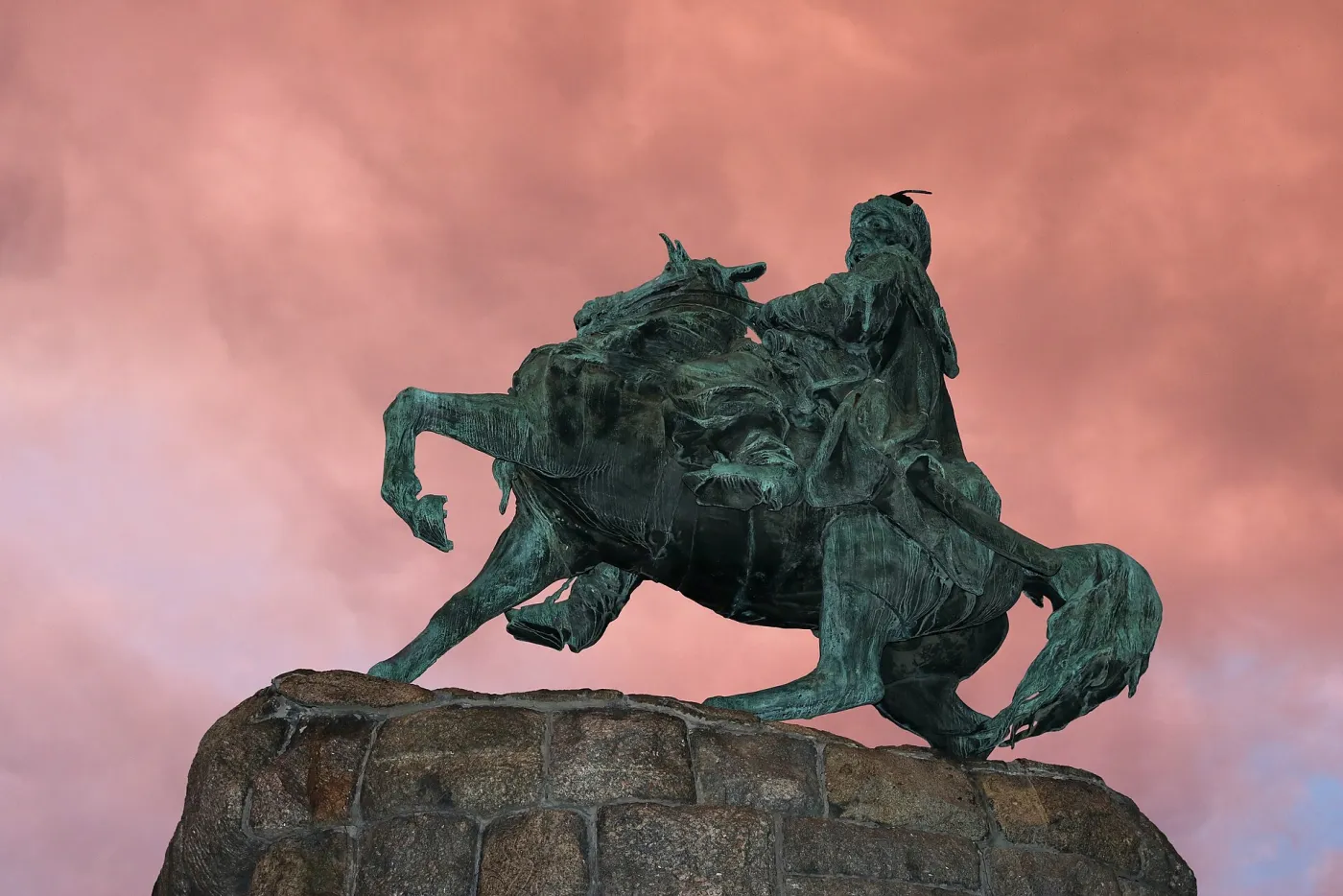
The first monument went up in Kyiv. The idea dated back to 1840; the tsarist government gave permission only in 1860, money was collected from 1870, the bronze horseman designed by Mikhail Mikeshin was cast in 1879, and the monument on St Sophia Square was unveiled in July 1888, the 900th anniversary of the baptism of Rus'. Soviet commemoration followed the "reunification" line: the town of Pereiaslav was renamed Pereiaslav-Khmelnytskyi in 1943, Proskuriv became Khmelnytskyi in 1954, and the Order of Bohdan Khmelnytsky, created in October 1943, was the only Soviet order with an inscription that was not in Russian. By Masnenko's count Ukraine had 125 monuments to him in 2016, of which one was pre-Soviet, 107 Soviet and 17 erected since independence.
Common myths about Bohdan Khmelnytsky
| Myth | What the evidence says |
|---|---|
| The revolt began because Czapliński stole Khmelnytsky's lover | The documented grievance was the seizure of Subotiv and violence against his family; Hrushevsky called the love story a later embellishment, though Khmelnytsky did later marry Czapliński's former wife |
| Khmelnytsky always wanted union with Russia | He tried a Polish settlement, an Ottoman protectorate in 1653, and in 1656–57 a coalition with Sweden against Moscow's wishes |
| Pereiaslav produced a signed treaty of "reunification" | The oath was sworn at Pereiaslav; the terms were settled in Moscow in March 1654, and no original text survives. "Reunification" is the 1954 Soviet formula |
| The tsar swore to protect Cossack liberties | His envoy Buturlin refused to take any oath on the tsar's behalf |
| The chroniclers' figures of 100,000 Jewish dead or more are counts | They are not counts; Stampfer, Ciesielski and Pelenski put the dead at roughly 6,000–20,000, Weinryb at 40,000–50,000; van Straten's 100,000–200,000 assumes a far larger Jewish population than other scholars accept |
| The Jewish losses were minor | Whole communities were destroyed; even the lowest serious estimates mean thousands killed, and Stampfer's figure amounts to nearly half the region's Jews |
| The Tatar alliance won his war | The Tatars won Zhovti Vody and Korsun with him, but abandoned him at Zboriv, Berestechko and Zhvanets |
Timeline
| Date | Event |
|---|---|
| c. 1595–96 | Khmelnytsky born |
| 1620 | Battle of Cecora; father killed, Bohdan captured by the Turks |
| December 1637 | Signs the Cossack capitulation at Borovytsia as military chancellor |
| 1638 | Ordinance abolishes Cossack self-rule; demoted to captain |
| 1646–47 | Czapliński raids Subotiv |
| End of December 1647 | Flees to the Zaporozhian Sich |
| 21 January 1648 | Polish garrison at the Sich overpowered; elected hetman |
| 16 May 1648 | Battle of Zhovti Vody |
| 26 May 1648 | Battle of Korsun; both Polish hetmans captured |
| 10 June 1648 | Massacre at Nemyriv |
| 21–24 September 1648 | Battle of Pyliavtsi |
| Turn of 1648/49 | Triumphal entry into Kyiv |
| 18 August 1649 | Treaty of Zboriv |
| 28–30 June 1651 | Battle of Berestechko |
| 28 September 1651 | Treaty of Bila Tserkva |
| May/June 1652 | Battle of Batih |
| 15 September 1653 | Tymish Khmelnytsky killed at Suceava |
| 1 October 1653 | Muscovite Assembly of the Land votes to accept the Host |
| 8 January 1654 (OS) | Pereiaslav council and oath |
| March 1654 | March Articles agreed in Moscow |
| October 1656 | Moscow–Poland truce of Vilnius |
| 6 August 1657 | Khmelnytsky dies at Chyhyryn |
| 1658 | Treaty of Hadiach |
| 1667 | Truce of Andrusovo divides Ukraine along the Dnieper |
| 1764 / 1782 | Office of hetman abolished; Cossack regiments dissolved |
| July 1888 | Mikeshin's monument unveiled in Kyiv |
What the map shows
The map of 1650 shows the Polish–Lithuanian Commonwealth whose south-eastern provinces Khmelnytsky's Cossacks then controlled. The atlas has no separate entry for the Hetmanate; formally, the Cossack-held provinces were still part of the Commonwealth until 1654. To the east lies the Tsardom of Russia, which took the Host under its protection four years later; to the south, the Crimean Khanate, his indispensable and unreliable ally, under the suzerainty of the Ottoman Empire. For Russia's road out of its own crisis a generation earlier, see our article on the Time of Troubles.
Sources
Primary sources
- Litopys Samovydtsia (the "Eyewitness" chronicle), part I (1648–1659), ed. Ya. Dziyra (Kyiv, 1971), online at Izbornyk: http://litopys.kiev.ua/samovyd/sam02.htm
- Nathan Hannover, Yeven metsulah (Venice, 1653), German translation Jawen Mezula (Hanover, 1863): https://archive.org/details/jawenmezula00hann
- Approval of the Zboriv declaration, constitution of the Sejm of 1649, in Volumina Legum, vol. 4 (St Petersburg, 1859), via Wikimedia Commons
- Willem Hondius, engraved portrait of Bohdan Khmelnytsky (Gdańsk, 1651), Rijksmuseum RP-P-OB-55.192
- Vladimir Putin, "On the Historical Unity of Russians and Ukrainians", 12 July 2021: http://en.kremlin.ru/events/president/news/66181
Studies and reference works
- O. Ohloblyn, "Khmelnytsky, Bohdan", Internet Encyclopedia of Ukraine (from Encyclopedia of Ukraine, vol. 2, 1989): https://www.encyclopediaofukraine.com/display.asp?linkpath=pages%5CK%5CH%5CKhmelnytskyBohdan.htm
- O. Subtelny, "Cossack-Polish War", Internet Encyclopedia of Ukraine (1984): https://www.encyclopediaofukraine.com/display.asp?linkpath=pages%5CC%5CO%5CCossack6PolishWar.htm
- O. Ohloblyn, "Pereiaslav Treaty of 1654", and further entries ("Zhovti Vody, Battle of", "Korsun, Battle of", "Pyliavtsi, Battle of", "Berestechko, Battle of", "Batih, Battle of", "Zboriv, Treaty of", "Bila Tserkva, Treaty of", "Hetman state", "Ruin", "Vyhovsky, Ivan", "Khmelnytsky, Yurii", "Subotiv", "Chyhyryn", "Jews"), Internet Encyclopedia of Ukraine: https://www.encyclopediaofukraine.com/display.asp?linkpath=pages%5CP%5CE%5CPereiaslavTreatyof1654.htm
- M. Hrushevsky, Pro batka kozatskoho Bohdana Khmelnytskoho (Kyiv, 1909; reprint 1918): https://archive.org/details/probatkakozatsko00hrus
- Shaul Stampfer, "Gzeyres Takh Vetat", YIVO Encyclopedia of Jews in Eastern Europe (2010): https://encyclopedia.yivo.org/article/2021
- Shaul Stampfer, "Jewish Population Losses in the Course of the Khmelnytsky Uprising", Judaica Ukrainica 4 (2015), restating his "What Actually Happened to the Jews of Ukraine in 1648?", Jewish History 17 (2003): https://judaicaukrainica.ukma.edu.ua/sites/default/files/files/JU_4_2015_Stampfer(1).pdf.pdf)
- Tomasz Ciesielski, "The Jews in Times of War and the Social and Political Riots in the Southeast of the Polish-Lithuanian Commonwealth in the 17th and 18th Centuries", Biuletyn Polskiej Misji Historycznej 9 (2014), doi:10.12775/BPMH.2014.011
- Dariusz Wojnarski, "'Paradise Lost' – Depopulation of the Jews of Narol in 1648", Przeszłość Demograficzna Polski 46 (2024): 7–36, doi:10.18276/pdp.2024.46-01
- Brian Davies, "The Road to Pereiaslav: Ukrainian and Muscovite Understandings of Protectorate, 1620–1654", Cahiers du monde russe 50 (2009): http://journals.openedition.org/monderusse/9725
- Nadiya Shyp, "Devaluation of the Pereyaslav Act and the 'March Articles' of 1654: Historiographical Discourse", Rukopysna ta knyzhkova spadshchyna Ukrainy 3 (34) (2024), doi:10.15407/rksu.34.197
- Artur Bracki, "Różne modele i przestrzenie unii – przypadek Ukrainy", Tematy i Konteksty 9 (14) (2019), doi:10.15584/tik.2019.5
- N. N. Oleinik, "Pereiaslavskaia rada 1654 goda: sovremennoe politiko-pravovoe issledovanie", Via in tempore. Istoriia. Politologiia, 2013, no. 22 (165), issue 28: https://cyberleninka.ru/article/n/pereyaslavskaya-rada-1654-goda-sovremennoe-politiko-pravovoe-issledovanie
- Vitalii Masnenko, "Obrazy Bohdana Khmelnytskoho u suchasnii kolektyvnii istorychnii pamiati ukraintsiv ta yikh susidiv" (2016): https://history-ejournal.cdu.edu.ua/article/download/456/463
- Vasyl Melnichenko, "Formy uvichnennia pamiati Bohdana Khmelnytskoho" (2016): https://history-ejournal.cdu.edu.ua/article/download/457/464
Image credits
- Title image: Mykola Ivasiuk, Bohdan Khmelnytsky's Entry into Kyiv, late 19th century, National Art Museum of Ukraine. Public domain, via Wikimedia Commons, cropped to 16:9.
- Willem Hondius, Portrait of Bohdan Khmelnytsky, 1651, Rijksmuseum, Amsterdam. CC0, via Wikimedia Commons.
- Jan Matejko, Bohdan Khmelnytsky with Tuhai Bey near Lviv, 1885, National Museum in Warsaw. Public domain, via Wikimedia Commons.
- Ratification of the Zboriv agreement by the Sejm, 1649, and its Volumina Legum edition. Public domain, via Wikimedia Commons (upper part of the file).
- Monument to Bohdan Khmelnytsky, Kyiv. Photo: George Chernilevsky, 2018, CC BY-SA 4.0, via Wikimedia Commons.