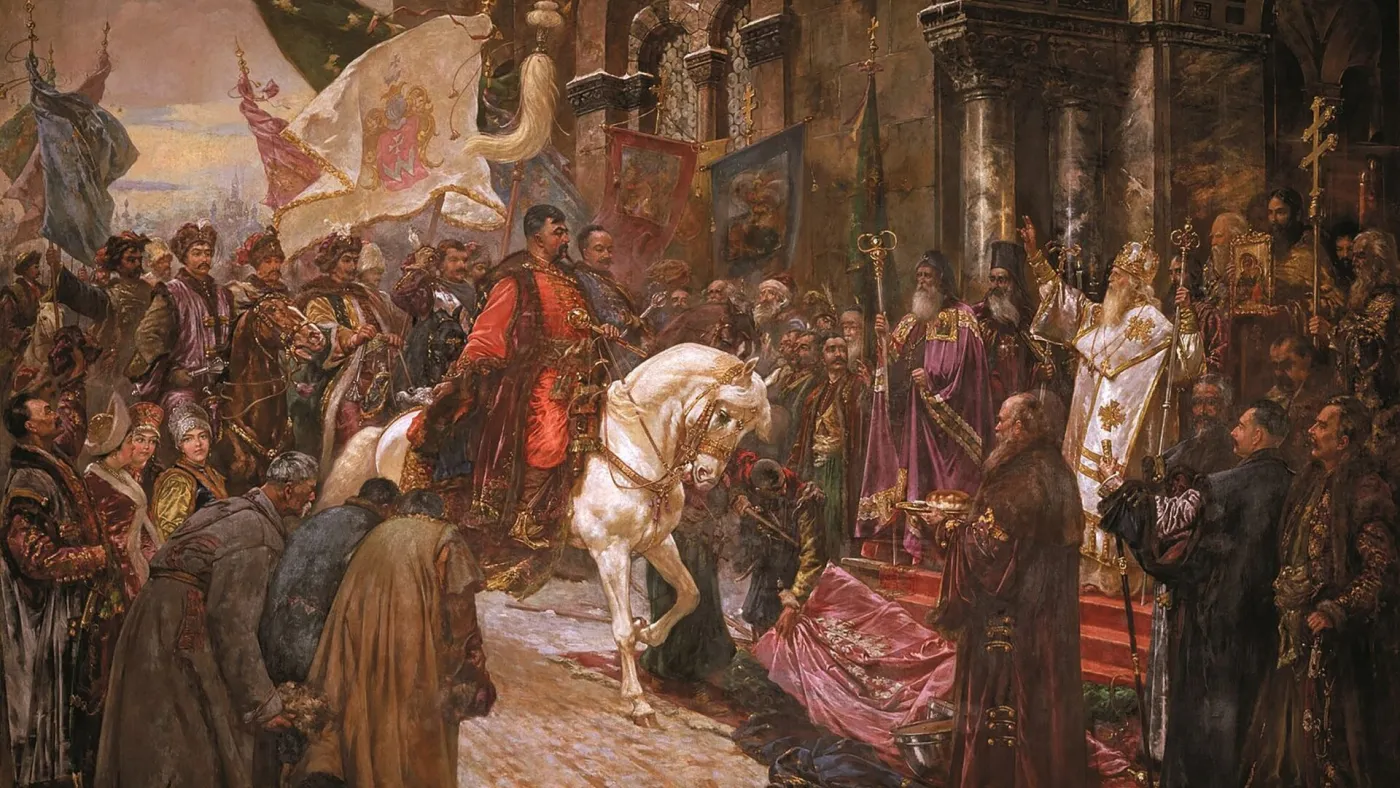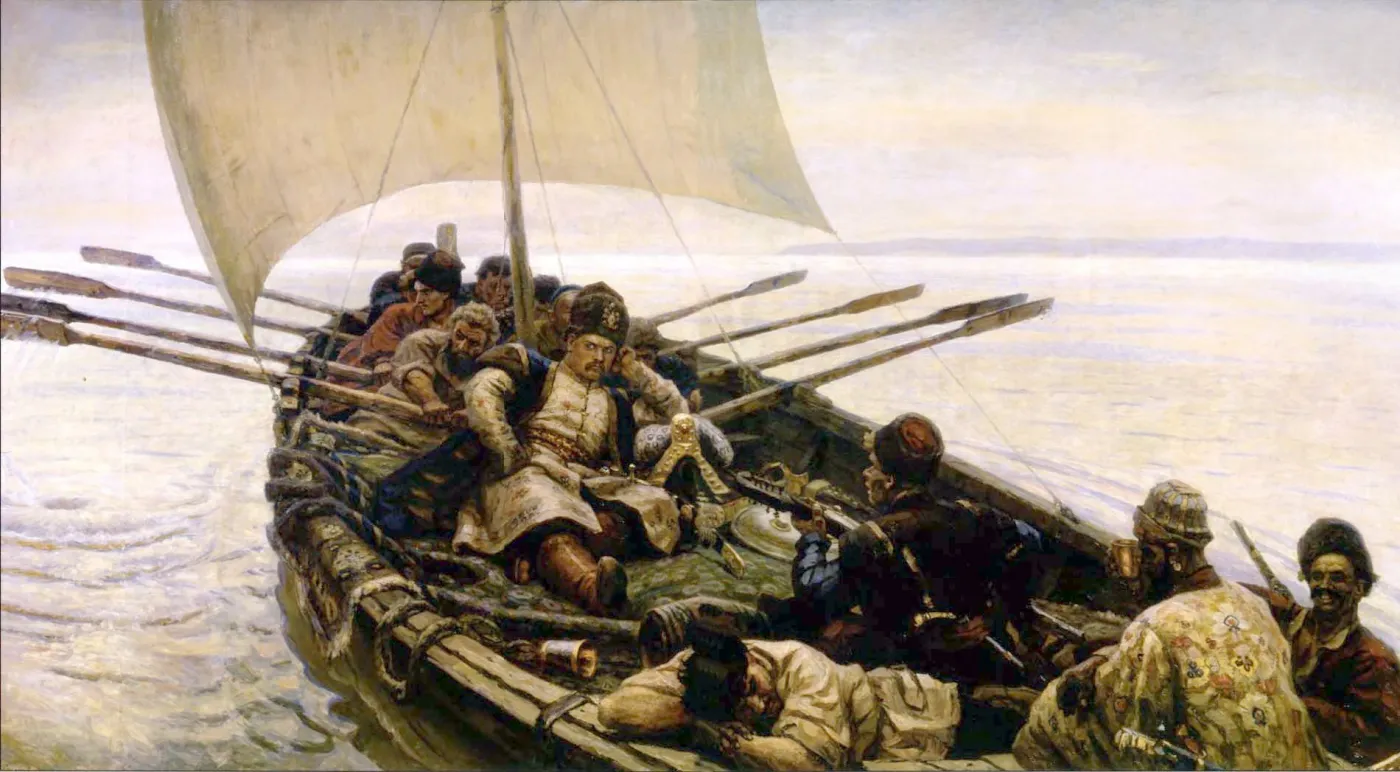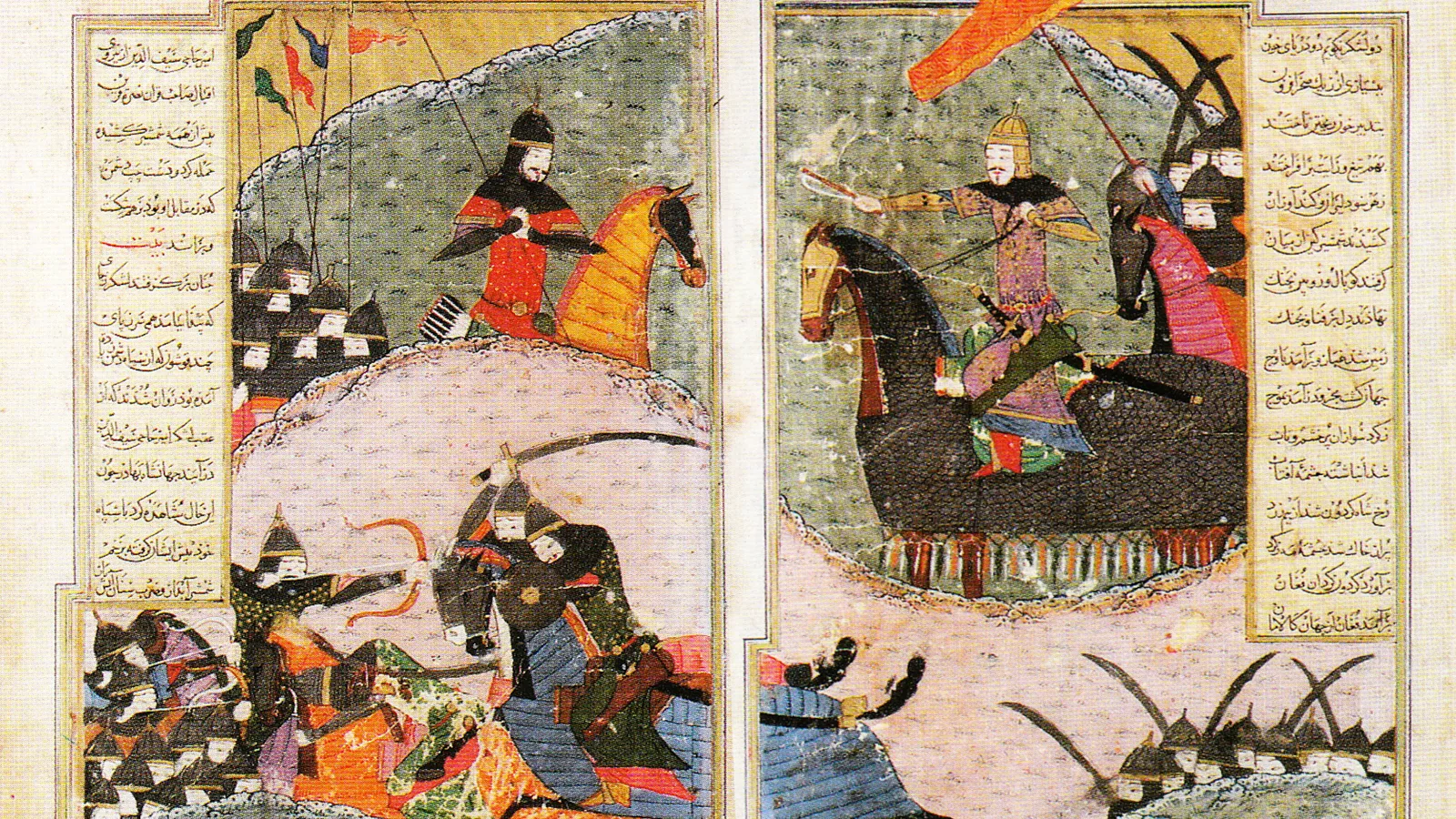
Kuzma Minin and Prince Dmitry Pozharsky led the Second Militia, the volunteer army that drove the Polish–Lithuanian garrison out of Moscow in 1612 and ended the worst years of Russia's Time of Troubles. Minin, a meat trader and elected head of the townspeople of Nizhny Novgorod, raised the money in the autumn of 1611. Pozharsky, a prince still recovering from his wounds, commanded the army. In August 1612 they beat off a Polish relief army outside Moscow, and in late October the starving Kremlin garrison surrendered. Their monument on Red Square was the first public monument in Moscow, and since 2005 Russia's Day of National Unity on 4 November has been linked to their victory. Much of the popular story, though, from Minin's surname to the date of the holiday, does not match the sources.
Minin and Pozharsky at a glance
| Kuzma Minin | Townsman and meat trader of Nizhny Novgorod; elected zemsky starosta in 1611; died 1616 |
| Prince Dmitry Pozharsky | Rurikid prince, born about 1577/1578; commander of the militia; boyar from 1613; died 20 April 1642 |
| Army | The Second Militia (Vtoroe opolchenie), formed at Nizhny Novgorod in 1611 |
| Government | The "Council of All the Land", based at Yaroslavl from spring 1612 |
| Decisive battles | 22 and 24 August 1612, against Hetman Jan Karol Chodkiewicz |
| Kitai-gorod taken | 22 October 1612 |
| Kremlin surrendered | 26–27 October 1612 |
| Memorials | Martos monument on Red Square (1818); Day of National Unity, 4 November (since 2005) |
(Dates are Old Style, the Julian calendar used in Russia; in 1612 add ten days for the modern calendar.)
Why did Moscow need to be freed?
By 1611 the Russian state had almost collapsed. After the death of the last tsar of the old dynasty in 1598 came famine, pretenders and civil war, the period known as the Time of Troubles. In 1610 the boyars in Moscow accepted Władysław, son of King Sigismund III of Poland, as tsar, and a Polish–Lithuanian garrison occupied the Kremlin. Swedish troops held Novgorod.
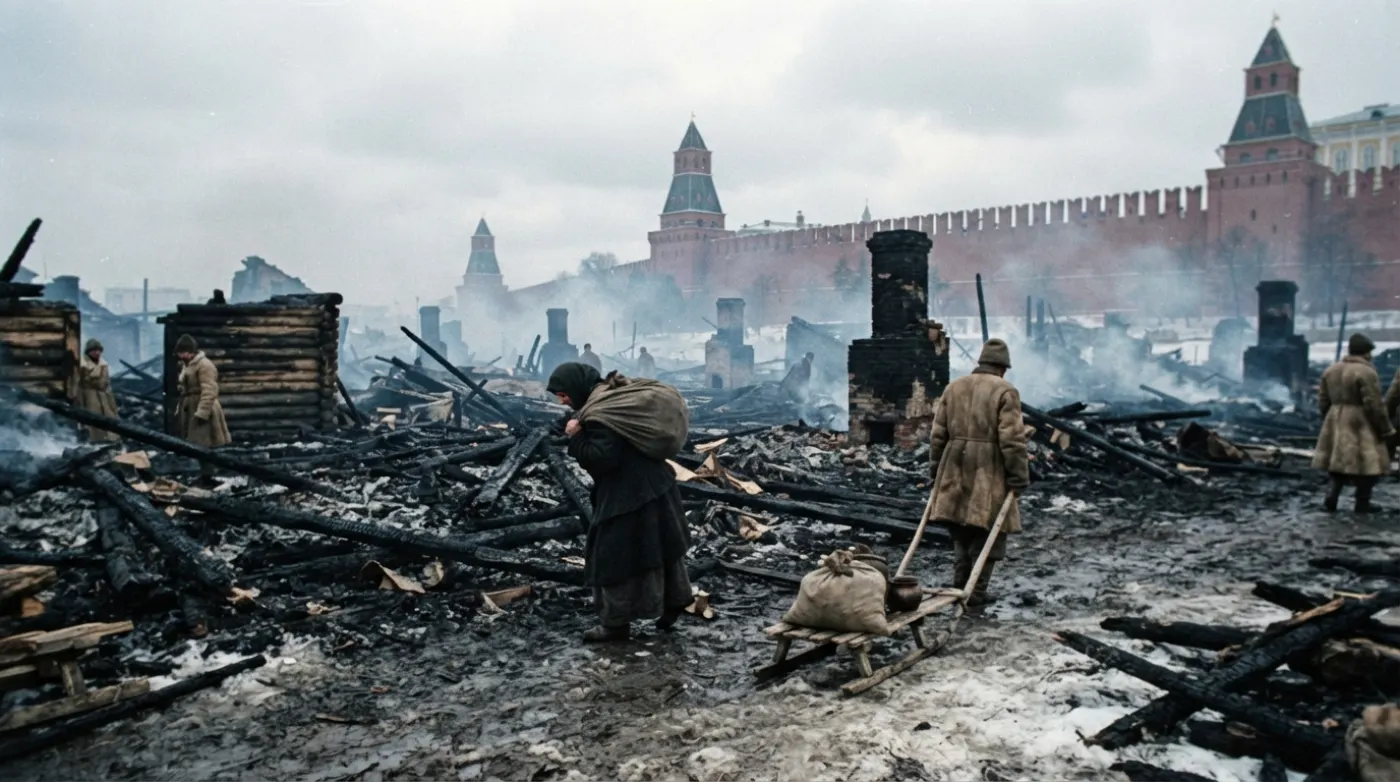
A first attempt to free the capital failed. In March 1611 Moscow rose against the garrison and much of the city burned. Prince Dmitry Pozharsky, who fought in the rising, was badly wounded and taken to the Trinity monastery and then to his estates. A First Militia of nobles and Cossacks besieged the Kremlin, but it broke apart after its leader Prokopy Lyapunov was killed by Cossacks in July 1611. The Cossack forces of Prince Dmitry Trubetskoy stayed in their camps outside Moscow.
Who was Kuzma Minin?
Very little is known about Minin before 1611. The Orthodox Encyclopaedia describes him as a townsman (posadsky chelovek) of Nizhny Novgorod "from the molodshie", that is, of modest means. The New Chronicle, written a generation later, says he "had a meat trade". His father was called Mina, which gave him his name: Minin, or in official documents after 1613, Kuzma Minich.
Several well-known details are doubtful:
- "Sukhoruk". The New Chronicle calls him "Kozma Minin, called Sukhoruk" ("withered arm"). The historian V. B. Perkhavko (2018) points out that a different man, "Kuzma Zakharyev son Sukhoruk", owned a house in Nizhny Novgorod in 1602, and that later writers merged the two. The Orthodox Encyclopaedia states that the nickname, "like the suggestions of his birth in Balakhna and his Tatar origin, is not confirmed by modern research".
- His birth. No document gives his date or place of birth.
- Reading and writing. A militia charter of 7 April 1612 ends with the note that Prince Pozharsky signed "in place of Kozma Minin, the man elected by all the land". Perkhavko takes this as evidence that Minin could not write, or only barely.
How did the Second Militia begin?
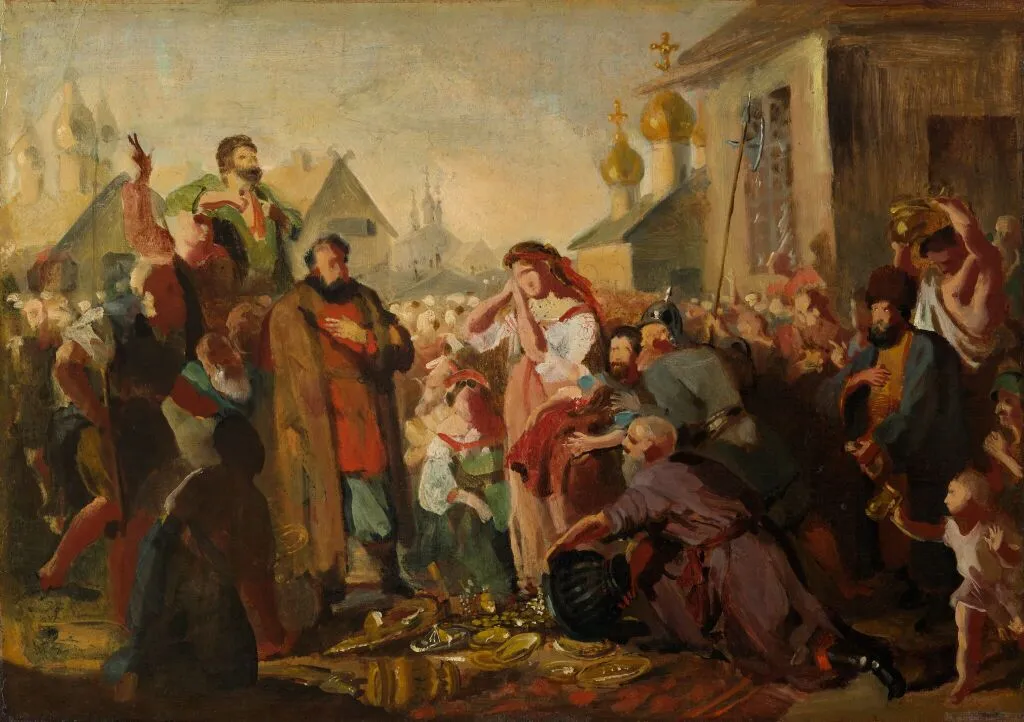
In August 1611 an appeal from Patriarch Hermogen, a prisoner of the Poles in the Kremlin, reached Nizhny Novgorod, the great trading town on the Volga. About 1 September the townspeople elected Minin as one of their two zemsky starosty, the heads of the town community. According to the Orthodox Encyclopaedia, between August and October 1611 he called on them to fight.
The New Chronicle gives his appeal:
"If we want to help the Muscovite state, then we must not spare our goods; and not only our goods, but we must not spare even to sell our houses and to pawn our wives and children, and to petition someone who would stand up for the true Orthodox faith and be our leader."
(The translations from the Old Russian in this article are our own.)
The historians A. V. Morokhin and A. A. Kuznetsov (2012) point out that this speech survives in three different versions, all written decades later. Where Minin spoke is not recorded; the tradition that it was at the Ivanovskaya tower of the Nizhny kremlin has no early source.
Money. The town raised voluntary donations, introduced a compulsory levy and later forced loans from merchants. The size of the levy is uncertain. The Great Russian Encyclopaedia says that "according to some data" it was a "fifth money", a fifth of property or income; other sources speak of a third.
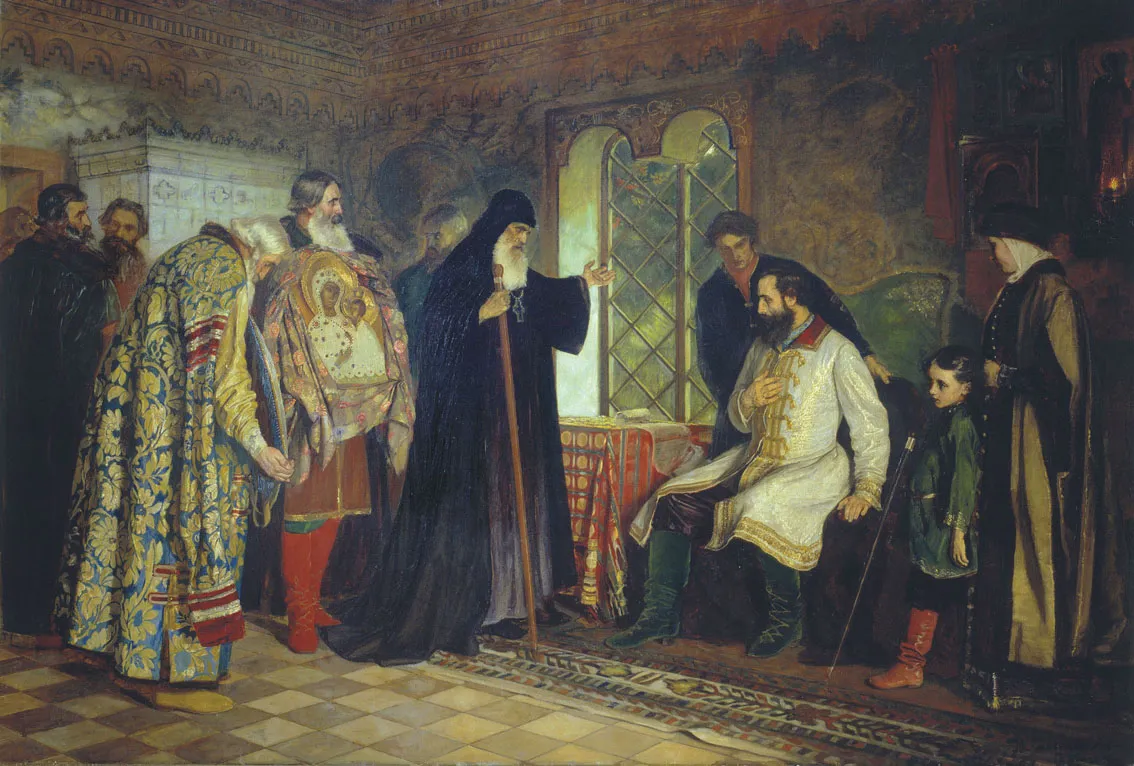
A commander. The townspeople needed a leader. They chose Pozharsky, who was recovering on his estate near Nizhny Novgorod. According to the New Chronicle, when the envoys asked him whom he would trust with the treasury, he told them: "You have Kuzma Minin; he has been a man of service, this business is familiar to him." Pozharsky arrived in Nizhny Novgorod at the end of October 1611 with servicemen from Smolensk and other western towns. In the words of Pozharsky's own circular letter of 1612, Minin, "the elected man, zealous for the common good, not sparing his own property", began to pay the soldiers.
Who was Prince Pozharsky?
Prince Dmitry Mikhailovich Pozharsky was born about 1577 or 1578 into a minor branch of the Rurikid princes of Starodub. He served at court from the 1590s, became a stol'nik in 1602 and from February 1610 was governor of Zaraisk, where he stayed loyal to Tsar Vasily Shuisky. He was not one of the great boyars; according to Perkhavko, he stood in tenth place in the documents of the Council of All the Land.
How did the militia reach Moscow?
The militia left Nizhny Novgorod in February and March 1612 and marched up the Volga. By the end of March it was in Yaroslavl, where it stayed about four months. There it set up its own government, the "Council of All the Land", with its own government departments, and grew to about 10,000 men, according to the Orthodox Encyclopaedia; the Great Russian Encyclopaedia gives at least 15,000–20,000 by mid-July.
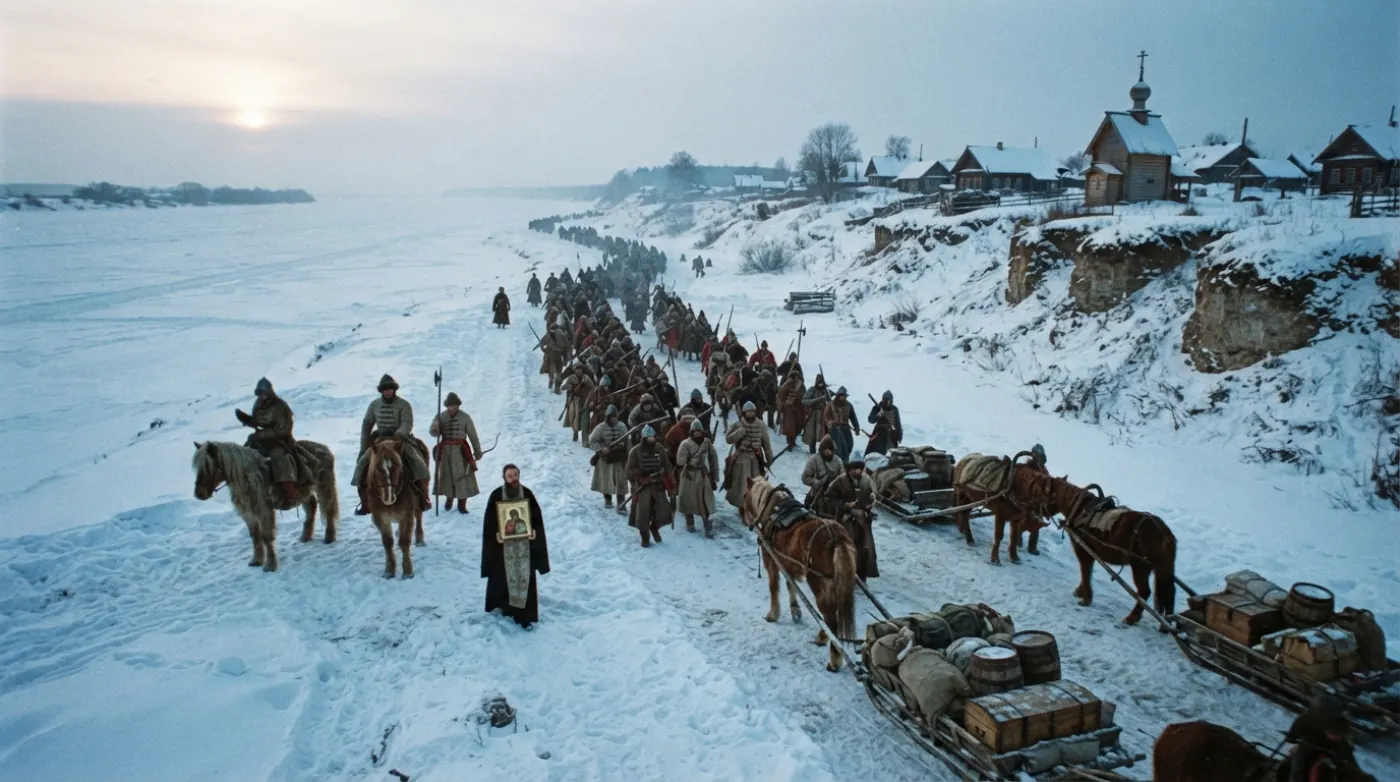
At Yaroslavl Pozharsky also negotiated with the Swedes in Novgorod. According to the Orthodox Encyclopaedia, he did not object to the Swedish prince Karl Filip as tsar, on condition that he came quickly, became Orthodox and returned occupied territory. At the end of July 1612 news came that a Polish–Lithuanian relief army under the hetman Jan Karol Chodkiewicz was approaching Moscow. The militia set out, and on 20 August 1612 it reached the capital, with 7,000–8,000 servicemen and about 3,000 Cossacks.
What happened in the battle for Moscow?
Chodkiewicz, with about 8,000 men according to the Orthodox Encyclopaedia (other estimates are higher), tried to break through to the Kremlin with a supply train for the starving garrison.
22 August. In a battle lasting thirteen hours, the militia stopped Chodkiewicz west of the Kremlin. At the decisive moment Trubetskoy's Cossacks came to its aid, according to the Orthodox Encyclopaedia "without the order" of Trubetskoy himself. The Great Russian Encyclopaedia credits a flank attack by five picked squadrons of militia cavalry and part of the Cossacks.
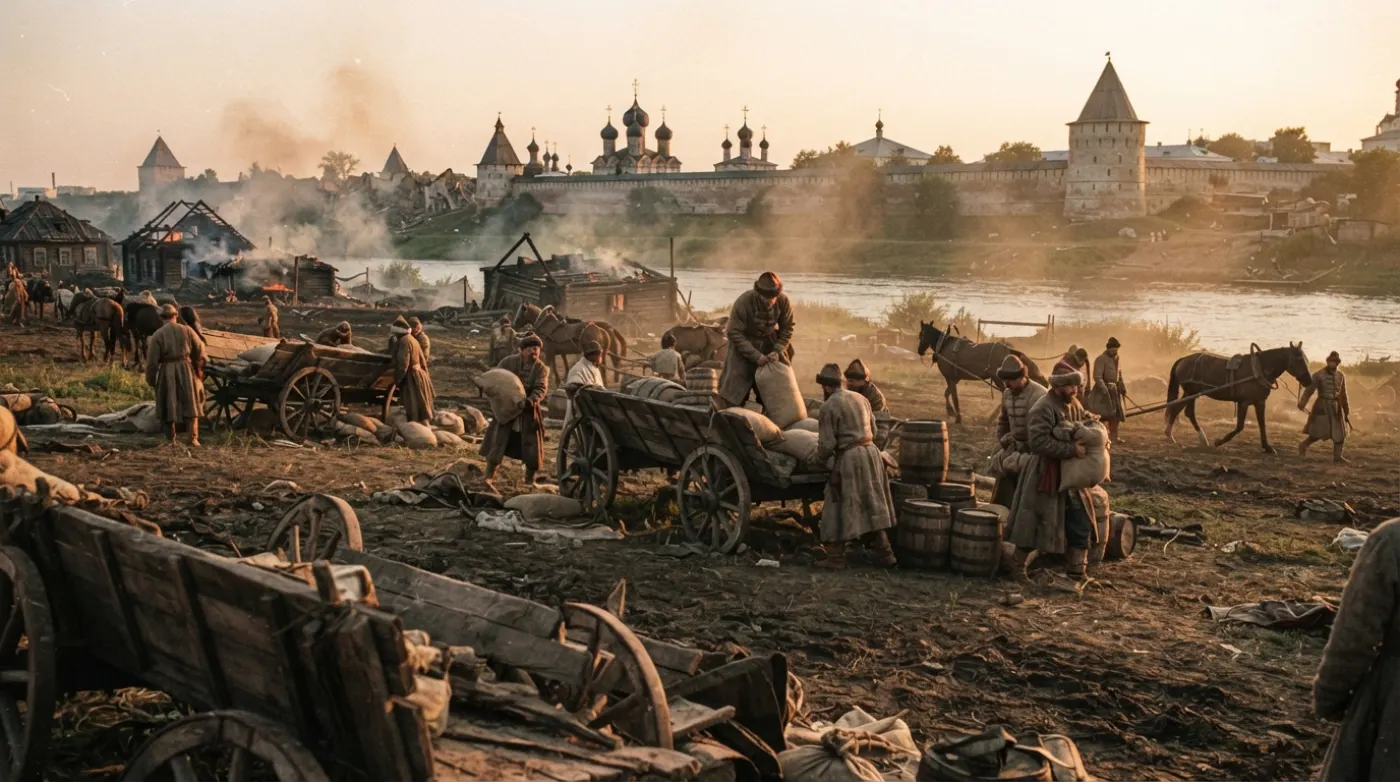
24 August. Chodkiewicz tried again from the south, through Zamoskvorechye across the river. The fighting for fortified posts by the churches went back and forth, and Pozharsky was wounded by a bullet in the arm. Trubetskoy's Cossacks again joined in; the monk Avraamy Palitsyn later claimed the credit for persuading them. Towards evening, the New Chronicle says, "God put courage into the weak: Kuzma Minin came to Prince Dmitry Mikhailovich and asked him for men. Prince Dmitry told him: 'Take whom you want.'" With three squadrons and a Polish officer in Russian service, Minin struck at the enemy near the Crimean Court on the Moscow river. Chodkiewicz lost most of his supply train, more than 400 carts, and withdrew.
How did the Kremlin fall?
The garrison held out for two more months. At the end of September 1612 the two militias united under a single command of Trubetskoy and Pozharsky. The besieged mocked their attackers. The Polish colonel Józef Budiła, who kept a diary inside the Kremlin, records the garrison's reply to an offer of surrender: "let the peasant till the land as before, let the priest know his church, let the Kuzmas get on with their trade."
Famine inside the walls was terrible. On 22 October 1612, the feast of Saint Averky, the militia stormed Kitai-gorod, the walled trading quarter beside the Kremlin. The New Chronicle adds: "When we took Kitai, we saw with our own eyes that many tubs had been filled with salted human flesh." On 26 October the garrison agreed to surrender and released the boyars it had held, among them the young Michael Romanov and his mother. On 27 October one Polish regiment surrendered to Trubetskoy's Cossacks, who killed most of its men, and the other to Pozharsky and Minin.
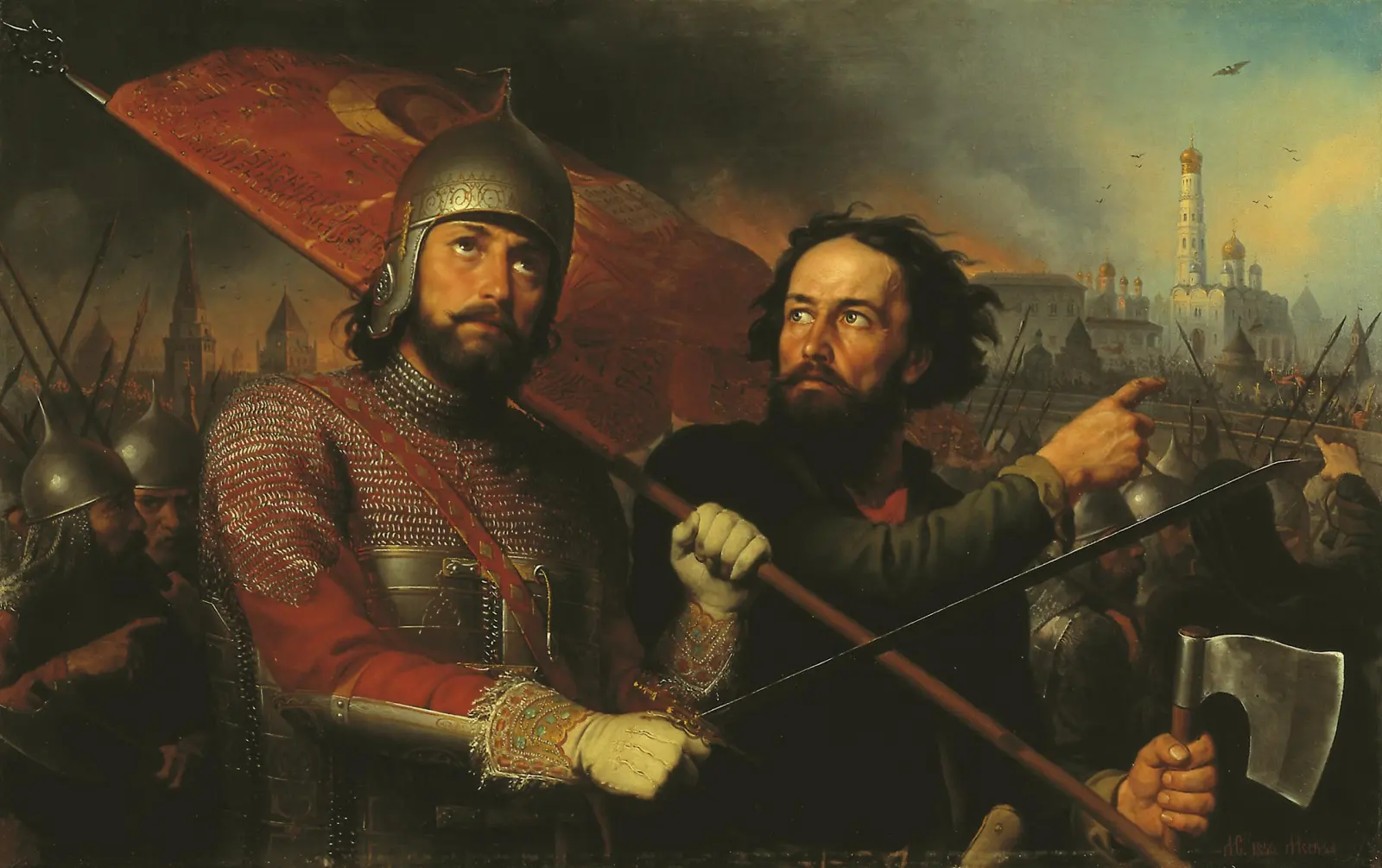
What happened to Minin and Pozharsky afterwards?
The Council of All the Land governed Russia until the election of a new tsar. According to the Orthodox Encyclopaedia, both Minin and Pozharsky probably preferred the Swedish candidate, Karl Filip. On 21 February 1613 the Assembly of the Land elected Michael Romanov instead.
The new tsar rewarded them. At his coronation on 11 July 1613 Pozharsky was made a boyar. The next day, the palace records say, the tsar "granted Kuzma Minin the rank of dumny dvoryanin", making the meat trader a member of the royal council. Minin collected taxes for the new government, was among those left to guard Moscow when the tsar went on pilgrimage in 1615, and was then sent to the Kazan region. He died on the way back, in the spring of 1616; the exact day is not known. He was buried in Nizhny Novgorod; his remains were later moved into the cathedral of the Nizhny Novgorod kremlin. His only son, Nefed, died in 1632 or 1633, and the family died out.
Pozharsky commanded armies and ran government departments for another quarter of a century. He died in Moscow on 20 April 1642 and was buried in the family vault at the Spaso-Evfimiev monastery in Suzdal.
Is 4 November the day Moscow was freed?
In December 2004 the Russian parliament replaced the 7 November holiday, the anniversary of the October Revolution, with a new holiday: "4 November – Day of National Unity". The explanatory note to the bill said that on "4 November 1612 the warriors of the people's militia led by Kuzma Minin and Dmitry Pozharsky stormed Kitai-gorod, freeing Moscow from the Polish invaders". That is not quite right.
- Kitai-gorod was taken on 22 October 1612 Old Style, which is 1 November in the modern calendar.
- The surrender came on 26–27 October Old Style, 5–6 November in the modern calendar.
- 4 November 1612 (modern calendar) is 25 October Old Style. Budiła's diary records only that "the Russians again went to storm Kitai-gorod but were beaten back". As the historian Vladislav Nazarov wrote in 2004, on that day "not a single noticeable event" connected with the liberation of Moscow took place.
The real link is through the church calendar. The militia carried a copy of the icon of Our Lady of Kazan, and the New Chronicle records that its feast was to be kept on 22 October "in memory of how the Muscovite state was cleansed". In 1649 the feast became a celebration for the whole country. Because the Russian Orthodox Church still uses the Julian calendar, which is now thirteen days behind, the feast of 22 October falls on 4 November in the modern calendar.
How are Minin and Pozharsky remembered?
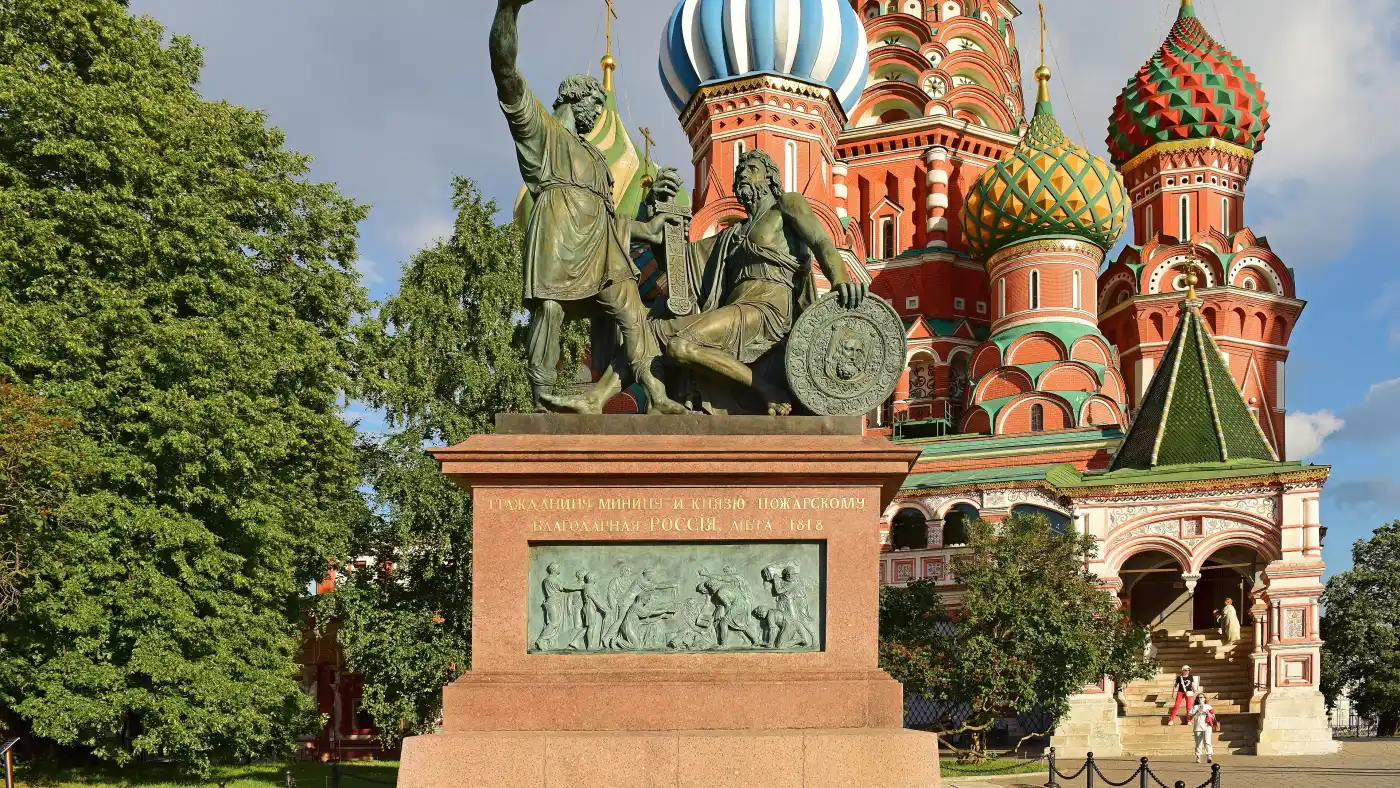
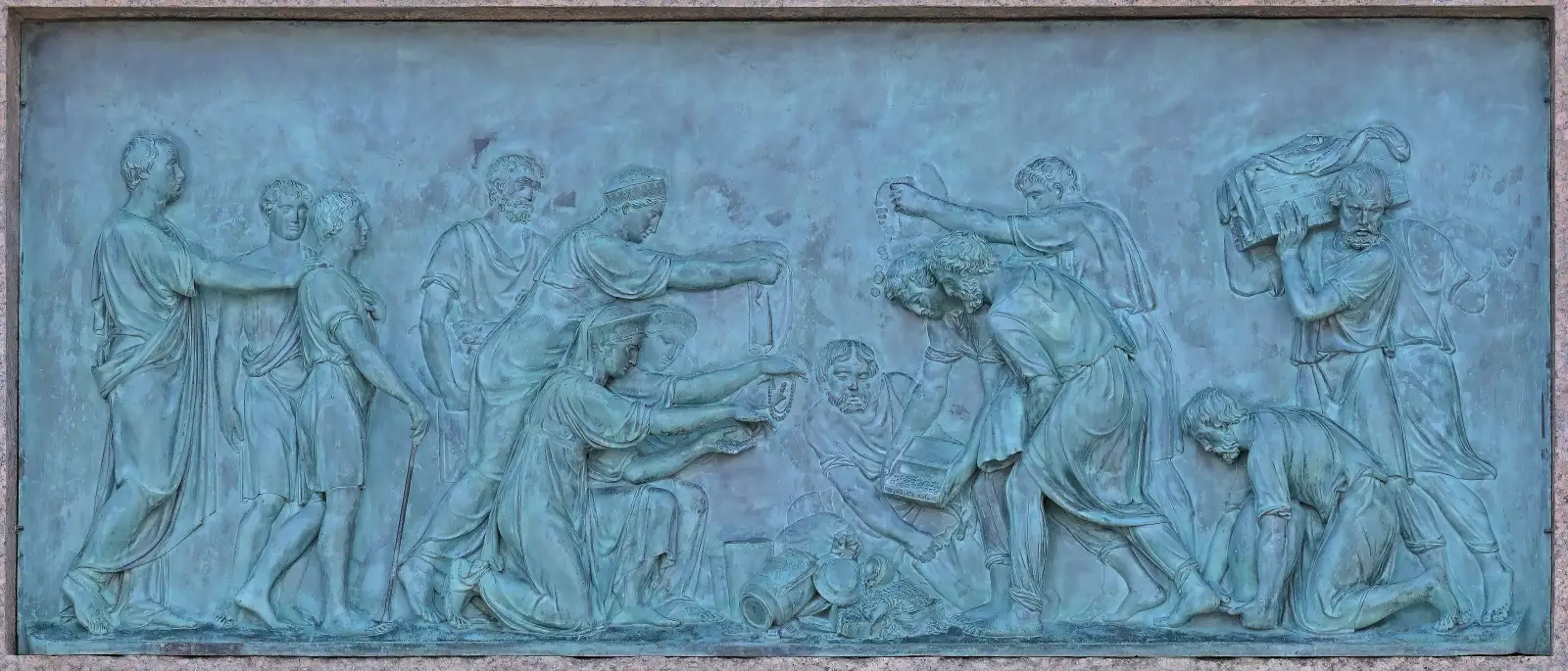
The sculptor Ivan Martos began work on a monument in 1804, and it was paid for by a public subscription. It was unveiled on Red Square in 1818, after the wars against Napoleon, in the presence of Alexander I. The historian A. I. Stepanov calls it the first monument in Moscow. Its inscription reads: "To citizen Minin and Prince Pozharsky, from a grateful Russia, in the year 1818". It originally stood in front of the Upper Trading Rows (today the GUM store); in 1931, when Red Square was rebuilt around Lenin's Mausoleum, it was moved to stand in front of St Basil's Cathedral.
Over two centuries the pair has stood for very different things: a merchant and a prince united in patriotism under Alexander I, popular heroes of the people in Soviet times, and since 2005 the symbols of "national unity".
Common myths about Minin and Pozharsky
| Myth | What the evidence says |
|---|---|
| Moscow was freed on 4 November 1612 | Kitai-gorod fell on 1 November and the Kremlin surrendered on 5–6 November (modern calendar); 4 November is the feast of the Kazan icon |
| Minin's surname was Sukhoruk and his patronymic Zakharyevich | His father was called Mina; "Kuzma Zakharyev Sukhoruk" was a different man |
| Minin was a rich merchant | He was a townsman of modest means who traded in meat |
| Minin was a Tatar or born in Balakhna | Neither is confirmed by modern research |
| Minin gave his famous speech from the Ivanovskaya tower | No early source says where he spoke; his words survive in three later versions |
| Pozharsky defeated Chodkiewicz alone | Trubetskoy's Cossacks helped decide both battles in August 1612 |
| Minin and Pozharsky put Michael Romanov on the throne | Both probably preferred the Swedish prince Karl Filip |
Timeline
| Date (Old Style) | Event |
|---|---|
| 19–20 March 1611 | Moscow rising; Pozharsky badly wounded |
| July 1611 | The First Militia's leader Lyapunov killed |
| c. 1 September 1611 | Minin elected zemsky starosta of Nizhny Novgorod |
| End of October 1611 | Pozharsky arrives in Nizhny Novgorod |
| February–March 1612 | The militia marches up the Volga |
| Spring–July 1612 | The militia and the "Council of All the Land" at Yaroslavl |
| 20 August 1612 | The militia reaches Moscow |
| 22 and 24 August 1612 | Chodkiewicz defeated; Minin's attack at the Crimean Court |
| 22 October 1612 | Kitai-gorod stormed |
| 26–27 October 1612 | The Kremlin garrison surrenders |
| 21 February 1613 | Michael Romanov elected tsar |
| 11–12 July 1613 | Pozharsky made boyar, Minin dumny dvoryanin |
| Spring 1616 | Minin dies |
| 1818 | Martos monument unveiled on Red Square |
| 20 April 1642 | Pozharsky dies |
| 29 December 2004 | Law creating the Day of National Unity on 4 November |
What the map shows
At 1612 the Tsardom of Russia was fighting both the Polish–Lithuanian Commonwealth, whose garrison held the Kremlin, and the Swedish Empire, which had occupied Novgorod. For the wider crisis, see our article on the Time of Troubles.
Sources
Primary sources
- Novyi letopisets, in Polnoe sobranie russkikh letopisei, vol. 14 (St Petersburg, 1910)
- Skazanie Avraamiia Palitsyna, ed. O. A. Derzhavina and E. V. Kolosova (Moscow and Leningrad, 1955)
- Prince D. M. Pozharsky, circular letter of 1612, in Sobranie gosudarstvennykh gramot i dogovorov, part 2 (Moscow, 1819), no. 281
- Józef Budiła, diary, Russian translation in Russkaia istoricheskaia biblioteka, vol. 1 (1872), via vostlit.info
- Federal Law of 29 December 2004 No. 200-FZ
Studies and reference works
- "Minin", Pravoslavnaia entsiklopediia, vol. 45 (2021)
- "Pozharskii, Dmitrii Mikhailovich", Pravoslavnaia entsiklopediia, vol. 57 (2024)
- V. D. Nazarov, "Vtoroe opolchenie 1611–12", Bol'shaia rossiiskaia entsiklopediia, vol. 6 (2006)
- "Pozharskii, Dmitrii Mikhailovich", Bol'shaia rossiiskaia entsiklopediia, vol. 26 (2014)
- V. B. Perkhavko, "Voenno-organizatorskaia deiatel'nost' Kuz'my Minina", Voenno-istoricheskii zhurnal 2018, no. 4
- A. V. Morokhin and A. A. Kuznetsov, "Spornye momenty biografii Kuz'my Minina", Vestnik Nizhegorodskogo universiteta (2012)
- V. D. Nazarov, "Chto budut prazdnovat' v Rossii 4 noiabria 2005 goda?", Otechestvennye zapiski 2004, no. 5
- V. N. Efremova, "Den' narodnogo edinstva: izobretenie prazdnika", Simvolicheskaia politika (2012)
- I. O. Tiumentsev, "Kazaki v dvizhenii zemskikh opolchenii", Vestnik VolGU, ser. 4 (2019), doi:10.15688/jvolsu4.2019.4.1
- E. F. Krinko and E. M. Goriushina, on the Time of Troubles in Russian memorial culture, Vestnik VolGU, ser. 4 (2019), doi:10.15688/jvolsu4.2019.2.17
- A. I. Stepanov, "Dva starykh pamiatnika i odin novyi prazdnik" (2006)
Image credits
- Title image: Monument to Minin and Pozharsky, Red Square. Photo: Юрий Д.К., 2024, CC BY 4.0, via Wikimedia Commons, cropped to 16:9.
- Vasily Savinsky, Envoys from Nizhny Novgorod and Prince Pozharsky, 1882. Public domain, via Wikimedia Commons.
- Mikhail Scotti, Minin and Pozharsky, 1850. Public domain, via Wikimedia Commons.
- Relief of the Martos monument. Photo: Юрий Д.К., 2025, CC BY 4.0, via Wikimedia Commons.
- Konstantin Makovsky, Citizen Minin Accepts Donations, 1870s. Public domain, via Wikimedia Commons.