The Tale of Igor's Campaign (Old East Slavic Slovo o pŭlku Igorevě) is a poem about a failed raid by Prince Igor Svyatoslavich of Novgorod-Seversky against the Polovtsians (Cumans) in spring 1185. It is the most famous work of medieval Russian, Ukrainian and Belarusian literature. It survived in one manuscript, which a Russian count found in the 1790s and which burned in the Moscow fire of 1812.
Because the original is lost, scholars have argued for two centuries over whether the poem is a genuine work of the late 12th century or a clever forgery of the 18th. Today most specialists consider it genuine. The strongest argument came not from historians but from a linguist, Andrei Zaliznyak, who showed in 2004 that a forger would have needed knowledge of Old East Slavic grammar that nobody had in the 1790s.
The Tale of Igor's Campaign at a glance
| Original title | Slovo o pŭlku Igorevě, Igorja syna Svjatŭslavlja, vnuka Olgova ("The Tale of the Campaign of Igor, son of Svyatoslav, grandson of Oleg") |
| Subject | Prince Igor's raid on the Polovtsians, April–May 1185 |
| Written | Probably 1185–1187 (most scholars) |
| Author | Unknown |
| Only manuscript | Part of a 15th- or 16th-century collection, bought by Count A. I. Musin-Pushkin; burned in 1812 |
| What survives | A copy made for Catherine II (by 1793) and the first edition of 1800 |
| Main debate | Genuine 12th-century poem or 18th-century forgery |
What happened in 1185?
The raid itself is well documented outside the poem. Two independent chronicles describe it: a long account in the Ipatian Chronicle and a shorter one in the Laurentian Chronicle.
Igor Svyatoslavich, prince of Novgorod-Seversky (in today's Chernihiv region of Ukraine) and a grandson of Oleg of Chernigov, set out on a Tuesday in late April 1185. With him went his brother Vsevolod of Trubchevsk, his nephew Svyatoslav Olgovich of Rylsk, his son Vladimir of Putivl and a troop of the Kovui, Turkic auxiliaries sent by Yaroslav of Chernigov. They did not tell the senior prince of their family, Svyatoslav Vsevolodich of Kiev. The Laurentian Chronicle gives their motive in their own words:
"Are we not princes too? Let us win such glory for ourselves." (Laurentian Chronicle, s.a. 6694, our translation)
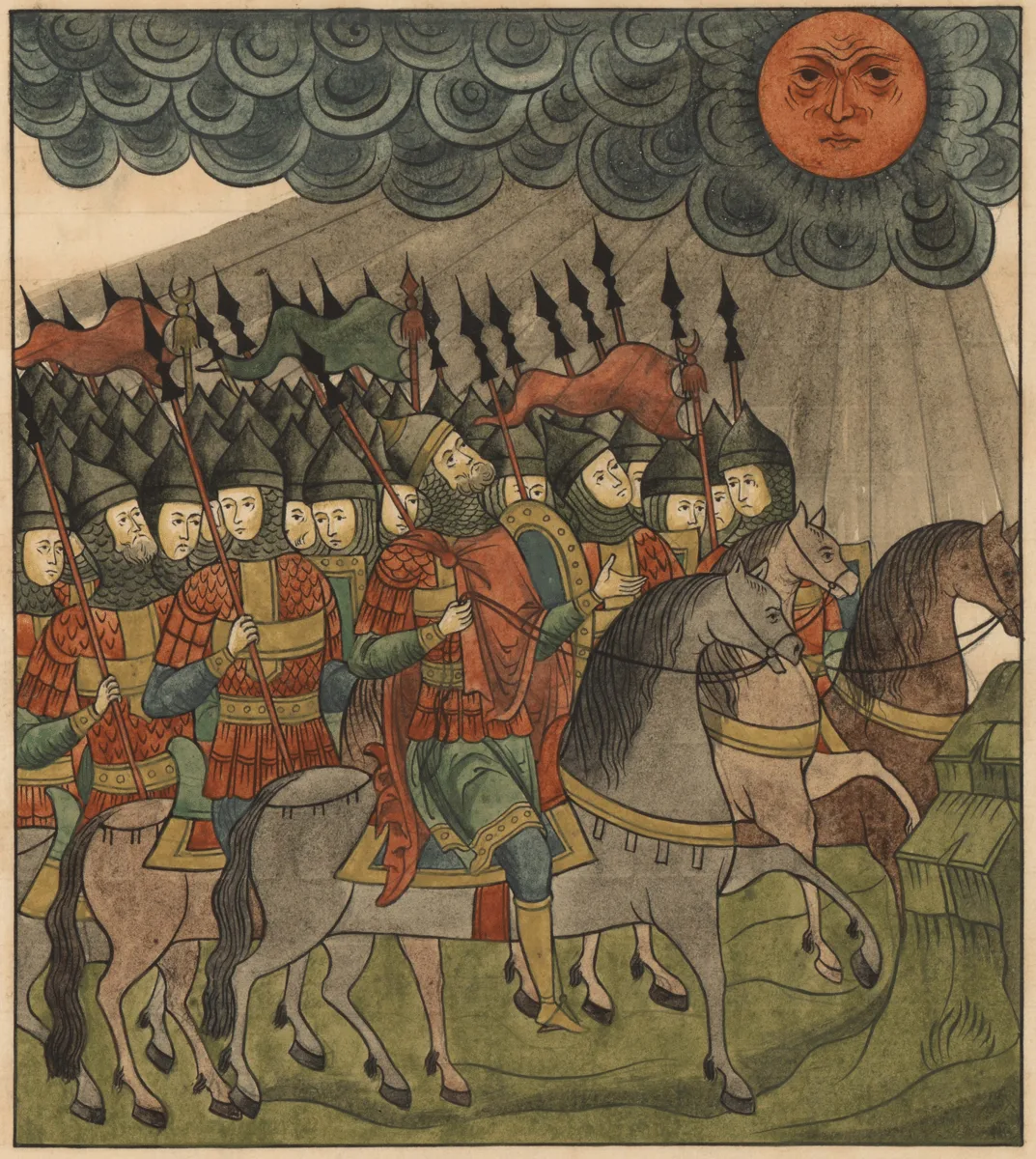
On the march, a solar eclipse darkened the sky. The Laurentian Chronicle dates it to Wednesday 1 May, "at vespers", and says the darkness was so deep "that stars were seen" and the sun looked "like a moon". The date is correct: there was a total solar eclipse on 1 May 1185, and 1 May fell on a Wednesday that year (NASA). In the Ipatian Chronicle, Igor's men took it as a bad omen, but he refused to turn back. When his scouts later reported that the Polovtsians were ready for battle, he said that to return without fighting "would be a shame worse than death".
Victory, then disaster on the Kayala
On a Friday the Rus' won a first skirmish and plundered the Polovtsians' tent camps. The next morning, according to the Ipatian Chronicle, they found the whole steppe army facing them, the clans of Konchak and others gathered "like forests". The Rus' fought on foot for the rest of Saturday and through the night, trying to reach the river Donets without abandoning their foot soldiers. On Sunday the Kovui fled, and Igor, riding after them to bring them back, was captured. The defeat came on the river Kayala, whose location is still debated.
The chronicle says that only about fifteen of the Rus' escaped. All four princes were taken prisoner. The Polovtsians then counter-attacked Pereyaslavl and the region of the Seim, and burned the outer works of Putivl.
Igor's escape
Igor's captivity was not harsh. The Ipatian Chronicle says he had twenty guards, but could go hunting with hawks wherever he wished, and even had a priest brought from Rus'. A Polovtsian named Lavor offered to help him flee. One evening, while the guards were drunk on kumys (fermented mare's milk), Igor crossed the river Tor, where Lavor waited with a horse. He reached the town of Donets after eleven days on foot, then went on to Novgorod-Seversky, Chernigov and Kiev. His son Vladimir stayed behind and later came home with the daughter of Khan Konchak as his wife.
What does the poem say?
The Tale does not simply retell these events. It is a lament and an appeal. The narrator begins by asking whether he should sing in the old manner of Boyan, a legendary bard, or "according to the ballads of this time". He then follows Igor's army into the steppe, the eclipse, the battle and the capture, and turns to the princes of Rus', urging them by name to stop their feuds and unite against the steppe peoples.
The poem looks back to the civil wars of the 11th century, above all those of Oleg Svyatoslavich, Igor's grandfather. It calls him "Oleg Gorislavich", a nickname built on the word gore, "woe", and says that under him the land "was sown and grew with feuds".
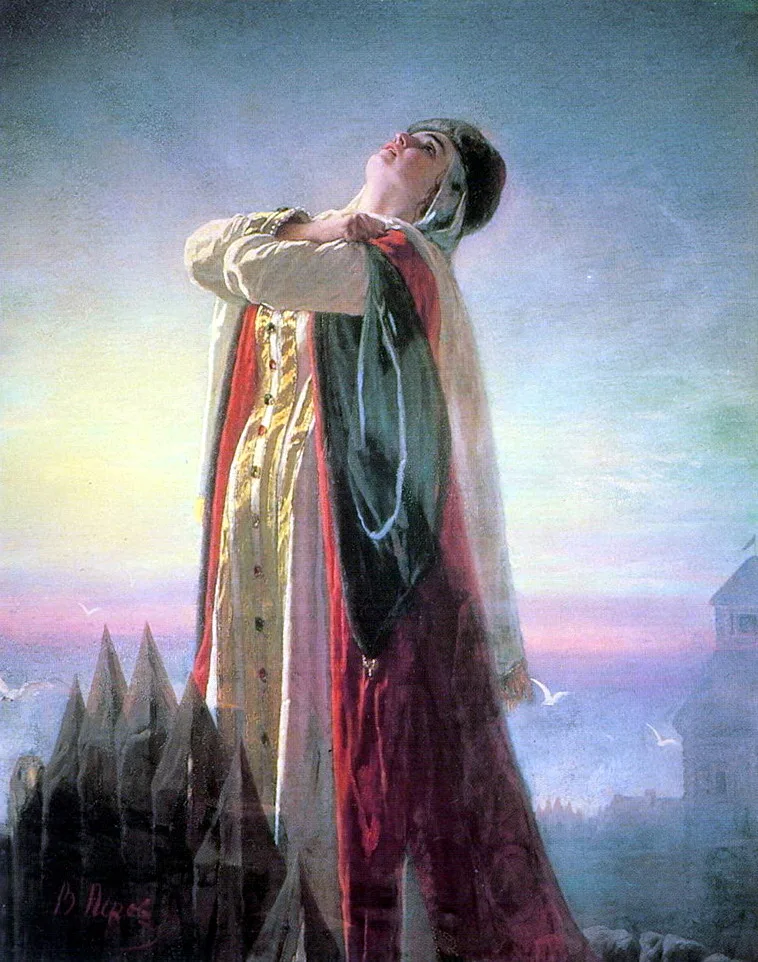
Its best-known passage is the lament of Igor's wife Yaroslavna on the walls of Putivl. Leonard Magnus's translation of 1915 renders it:
"I will fly," she spoke, "like a cuckoo along the Danube; I will wet my beaver sleeves in the Kayala river, I will wipe away for the prince his bloody wounds on his stricken body." (trans. Magnus, 1915)
She calls on the wind, the Dnieper and the sun, and Igor escapes. The poem ends with his return to Kiev and a toast: "Glory to Igor Svyatoslavich, the wild bull Vsevolod, Vladimir Igorevich!"
Poem and chronicle do not always agree
The poem and the chronicles share the main facts but differ in detail, as one would expect from a poet writing soon after the events and chroniclers using other information:
| Detail | Chronicles | Poem |
|---|---|---|
| The eclipse | On the march, 1 May (Laurentian) | At the start of the campaign |
| Igor's helper in the escape | Lavor (Ipatian) | Ovlur |
| How long the battle lasted | Friday to Sunday (Ipatian); three days without water (Laurentian) | "They fought one day, they fought another; on the third day, towards noon, Igor's banners fell" |
| Igor's motive | Glory, and a rivalry with Kiev | Glory: "I wish to shatter a spear on the borders of the land of the Polovtsy" (trans. Magnus) |
When was the poem written? It speaks of Igor as alive, and Igor died in 1202. Most scholars date it more narrowly to 1185–1187: the closing toast greets Vladimir Igorevich, who seems already to be home, while a prince of Pereyaslavl who died in April 1187 is mentioned as alive (Dictionary of Scribes, Pushkin House).
How was the manuscript found?
The only manuscript belonged to Count Aleksei Ivanovich Musin-Pushkin (1744–1817), a collector of Russian antiquities and, from 1791, Ober-Procurator of the Holy Synod. In a letter of 1813 he described how he had obtained it: his agent bought all the Russian books of Ioil Bykovsky, the former archimandrite of the Spaso-Yaroslavl monastery, and "among them in one, under No. 323, entitled Chronograph, at the end was found the Slovo o polku Igoreve" (quoted by L. A. Dmitriev, 1962, our translation).
When this happened is disputed. Older scholars said 1795. L. A. Dmitriev argued that the manuscript was with Musin-Pushkin from 1792. The earliest known trace of it, found by the historian V. P. Kozlov, is a quotation in I. P. Elagin's Opyt povestvovaniia o Rossii ("An Essay of a Narrative about Russia"), which reflects an earlier stage of the editors' work than the later copies (Gorsky).
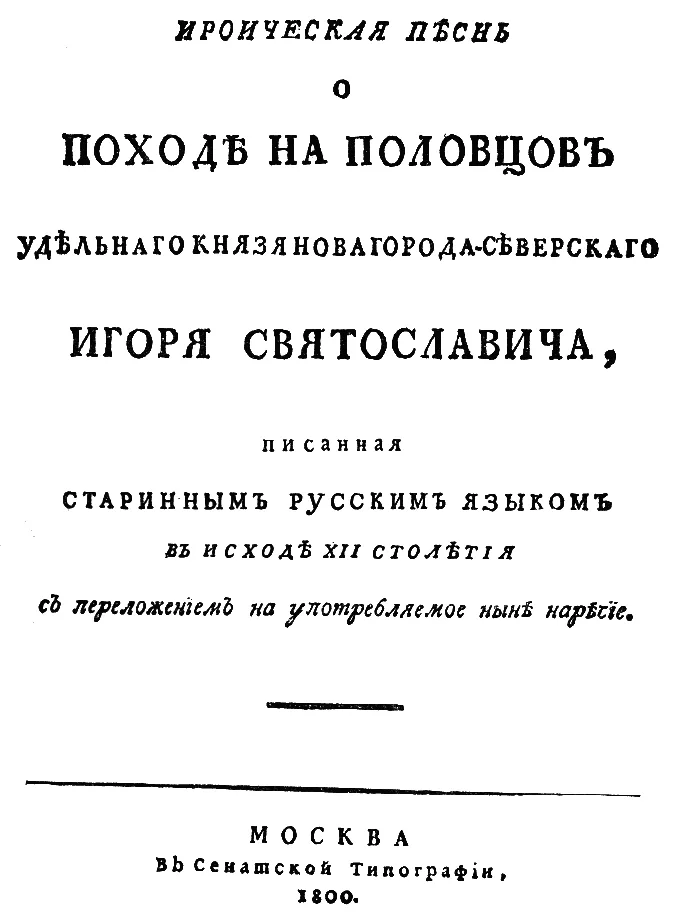
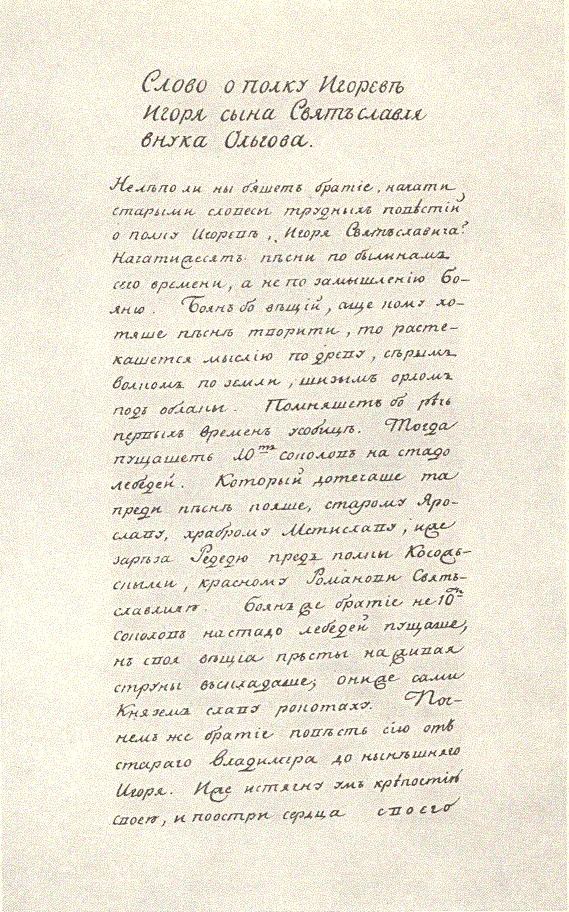
Musin-Pushkin's circle needed years to read the text. They produced a copy for Empress Catherine II no later than 1793 (Pushkin House edition). It lay forgotten among her papers until P. P. Pekarsky published it in 1864. In 1800 Musin-Pushkin, with A. F. Malinovsky and N. N. Bantysh-Kamensky, published the first edition, under the title A Heroic Song about the Campaign against the Polovtsians of the Appanage Prince of Novgorod-Seversky, Igor Svyatoslavich. According to Magnus, 1,200 copies were printed.
The fire of 1812
In September 1812, when Napoleon's army occupied Moscow, the city burned. Musin-Pushkin's house on the Razgulyai was destroyed with his whole library, including the manuscript and most copies of the 1800 edition. The historian Nikolai Karamzin wrote to Malinovsky in February 1813:
"I rejoice that the Synodal library is intact, and I do not cease grieving for Pushkin's. Our history has lost a treasure." (Karamzin to Malinovsky, 17 February 1813, quoted by Dmitriev, our translation)
Several people saw the manuscript before the fire, among them Karamzin, Malinovsky and Bantysh-Kamensky. Malinovsky thought its handwriting dated from the end of the 14th century, another reader from the mid-15th; later scholars, comparing the copies, think it was a 16th-century copy of an older text (Magnus).
Is the Tale of Igor's Campaign a forgery?
The doubts began soon after the fire. A loose manuscript from an obscure monastery, published by a well-connected collector and then lost, looked suspicious to many readers in an age of literary hoaxes. Magnus noted in 1915 that the poem "was flashed on the world very soon after MacPherson had roused all the scepticism of London with his Ossian", the famous forged Gaelic epics of the 1760s.
The main sceptics, each with a different candidate for the forger:
| Sceptic | Date | Proposed author |
|---|---|---|
| The "sceptical school" (M. T. Kachenovsky and others) | 1810s–1840s | Unspecified; poem too polished for the 12th century |
| André Mazon, French Slavist | 1938–1944 | Musin-Pushkin's circle (Bantysh-Kamensky, Bykovsky) |
| Aleksandr Zimin, Soviet historian | 1963–1980 | Ioil Bykovsky (1726–1798) |
| Klaus Trost | 1970s–1990s | Nikolai Karamzin |
| Edward L. Keenan, Harvard | 2003 | Josef Dobrovský (1753–1829), the Czech Slavist |
Andrei Zaliznyak pointed out that the sceptics contradict each other: Mazon found traces of French in the poem, Trost of German, Rudolf Aitzetmüller of Polish and Keenan of Czech (review by Galinskaia, 2005).
The Zadonshchina question
The central argument of the sceptics concerned the Zadonshchina, a poem about the Battle of Kulikovo of 1380. It shares about fifty passages with the Tale of Igor's Campaign, in different order. Either the author of the Zadonshchina imitated the Tale, or a later forger built the Tale out of the Zadonshchina.
Zimin argued for the second view. The Soviet academic establishment treated him badly: his study was printed in 1963 in a tiny run on a duplicating machine, not sent to libraries and read only by those who took part in the discussions at the Academy of Sciences. The historian A. A. Gorsky calls the discussion "discriminatory towards the author, on the instructions of those in power". Zimin nevertheless published his main arguments in eleven articles, and his full book appeared only in 2006, long after his death in 1980.
Two later studies weighed against him. In 1992 Gorsky compared how the shared passages were spread across both works and concluded that the borrowing ran from the Tale to the Zadonshchina, not the reverse. Zaliznyak added syntactic arguments in the same direction.
Zaliznyak's linguistic argument
The decisive work was Andrei Zaliznyak's "Slovo o polku Igoreve": vzgliad lingvista ("The Tale of Igor's Campaign: A Linguist's View", 2004; third edition 2008). Zaliznyak, the leading specialist on the Novgorod birchbark letters, examined how the text uses grammar that scholars only worked out in the 19th and 20th centuries:
- Enclitics. Small unstressed words, such as particles and short pronouns, follow strict rules of position in early East Slavic texts. The Tale follows these rules with a precision matching the Novgorod birchbark letters, which were only excavated from the 1950s onwards.
- Dual forms. Old East Slavic had separate verb and noun forms for two people or things. The Tale uses them correctly, and also shows the typical mistakes that 15th- and 16th-century copyists made with them.
- Copyist's dialect. Spellings in the text point to a copyist from the north-west, the Pskov or Novgorod area, exactly as one would expect of a real late-medieval copy.
Zaliznyak concluded that a forger would have had to be a genius, not as a writer but as a scholar:
"If the Slovo was created by some 18th-century mystifier, then we are dealing with an author of genius. … What we mean is scientific genius." (Zaliznyak, 2008, our translation)
The probability that the forgery theory is right, he wrote, is "not strictly zero; it is merely vanishingly small".
Keenan and Dobrovský
Edward Keenan's book Josef Dobrovský and the Origins of the Igor' Tale (2003) proposed that the Czech scholar Josef Dobrovský wrote the poem during his visit to Russia in 1792–1793, when he could have seen copies of the Zadonshchina and the Ipatian Chronicle. Reviewers were not persuaded. They pointed to the lack of any evidence linking Dobrovský to the text, and the linguist V. M. Zhivov answered Keenan in a long review in 2004 (Halperin, 2006). Zaliznyak devoted a chapter of his book to the Dobrovský hypothesis.
The 1307 colophon
One small piece of evidence has been quoted since 1813. In 1307 a scribe named Domid, copying a book of the Apostles in Pskov, added a note about a war between two princes over Novgorod: "Under these princes there was sowing and growing of feuds, our life was perishing, and the lifetimes of men grew short" (our translation). The wording is almost the same as the Tale's line about Oleg Gorislavich.
Mazon dismissed the match as a commonplace. Roman Jakobson called the phrase one of the most original in Old Russian literature, found nowhere else (Zaliznyak, 2008). Zimin argued that Musin-Pushkin's circle could have used the 1307 book; the Encyclopedia of the Slovo replies that archival evidence shows the book was not known to Musin-Pushkin at that time.
Common myths about the Tale of Igor's Campaign
| Myth | What the evidence says |
|---|---|
| Nobody but Musin-Pushkin ever saw the manuscript | Several contemporaries saw it, and a copy made for Catherine II survives |
| The manuscript disappeared mysteriously | It burned with Musin-Pushkin's library in the Moscow fire of 1812, a loss mourned at the time |
| The eclipse proves the poem genuine | The eclipse is also in the chronicles, which a forger could have used; it confirms the chronicles' date |
| Soviet scholars silenced Zimin entirely | His work was restricted and he was treated unfairly, but he published his main arguments in eleven articles |
| Keenan proved that Dobrovský wrote it | His hypothesis has not been accepted by specialists |
| The Polovtsian Dances come from the poem | They come from Borodin's opera Prince Igor (1890); the poem has no such scene |
What the map shows next
The map of 1185 shows Igor's home region within the Principality of Chernigov, beside the Principality of Kiev and the Principality of Pereyaslavl, which bore the brunt of the Polovtsian counter-attack. To the south-east stretched the steppe of the Kipchak (Polovtsian) confederation. In the north lay the lands of Vladimir-Suzdal, whose prince Vsevolod "Big Nest" the poem calls on for help.
Sources
Primary sources
- Slovo o polku Igoreve, Old East Slavic text with modern Russian translation by D. S. Likhachev, Biblioteka literatury Drevnei Rusi, vol. 4 (Pushkin House): http://lib.pushkinskijdom.ru/Default.aspx?tabid=4941
- L. A. Magnus (trans.), The Tale of the Armament of Igor, A.D. 1185 (Oxford, 1915), with translations of the chronicle accounts: https://archive.org/details/taleofarmamentof00magnuoft
- Ipatian Chronicle, Polnoe sobranie russkikh letopisei, vol. 2, s.a. 6693: https://archive.org/details/2_20241121_20241121_1922
- Laurentian Chronicle, Polnoe sobranie russkikh letopisei, vol. 1 (1926), s.a. 6694: https://archive.org/details/psrl_tom1_lavrentyevskaya_letopis_1926
Studies
- A. A. Zaliznyak, "Slovo o polku Igoreve": vzgliad lingvista, 3rd ed. (Moscow, 2008): inslav.ru (PDF)
- L. A. Dmitriev, "Istoriia otkrytiia rukopisi 'Slova o polku Igoreve'", in Slovo o polku Igoreve: pamiatnik XII veka (1962): http://feb-web.ru/feb/slovo/critics/s62/s62-406-.htm
- A. A. Gorsky, Rus': ot slavianskogo rasseleniia do Moskovskogo tsarstva (Moscow, 2004), essay 3: https://statehistory.ru/books/Anton-Gorskiy_Rus-Ot-slavyanskogo-Rasseleniya-do-Moskovskogo-tsarstva/12
- "Domid", Entsiklopediia "Slova o polku Igoreve", vol. 2 (1995): http://feb-web.ru/feb/slovenc/es/es2/es2-1301.htm
- "Avtor 'Slova o polku Igoreve'", Slovar' knizhnikov i knizhnosti Drevnei Rusi (Pushkin House): http://lib.pushkinskijdom.ru/Default.aspx?tabid=3656
- C. J. Halperin, review of E. L. Keenan, Josef Dobrovský and the Origins of the Igor' Tale (2003), Russian translation: https://cyberleninka.ru/article/n/podlinnik-poddelka-opyat-poddelka-edvard-kinan-yozef-dobrovskiy-i-proishozhdenie-slova-o-polku-igoreve
- N. A. Galinskaia, review of Zaliznyak (2005): https://cyberleninka.ru/article/n/a-a-zaliznyak-slovo-o-polku-igoreve-vzglyad-lingvista
- NASA, "Total Solar Eclipse of 1185 May 01" (F. Espenak): https://eclipse.gsfc.nasa.gov/SEsearch/SEsearchmap.php?Ecl=11850501
Image credits
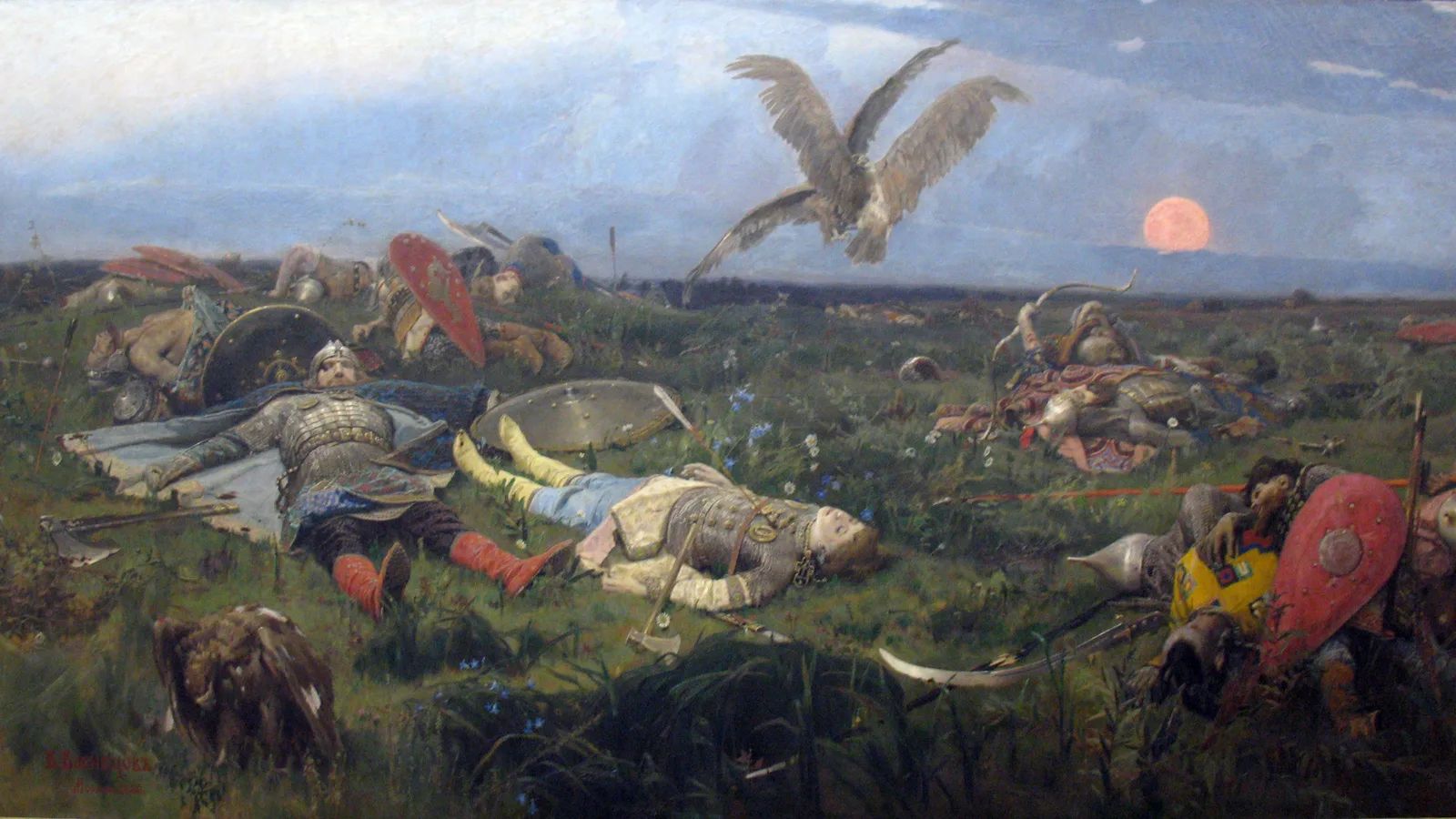
- Title image: Viktor Vasnetsov, After Igor's Battle with the Polovtsians, 1880, Tretyakov Gallery. Public domain, via Wikimedia Commons, cropped to 16:9.
- Ivan Blinov, illustration of the eclipse, 1912. Public domain, via Wikimedia Commons.
- Vasily Perov, Yaroslavna's Lament, 1881. Public domain, via Wikimedia Commons.
- Title page of the first edition, Moscow 1800. Public domain, via Wikimedia Commons.
- First page of the Catherine copy, 1790s. Public domain, via Wikimedia Commons.