The Primary Chronicle, also called the Tale of Bygone Years (Povest' vremennykh let), is the oldest surviving history of early Rus'. Monks in Kyiv compiled it in the 1110s, and it runs from a biblical prologue to the early twelfth century. No original survives: we read it in later copies, above all the Laurentian Codex of 1377 and the Hypatian Codex of about 1425.
Almost everything popular histories say about Rurik, Oleg, Olga and Vladimir's baptism passes through this one text. That is why historians depend on it and test it at the same time. This guide is about the chronicle as a source: who made it, how it survived, what it says, and how its claims hold up against independent evidence.
What is the Primary Chronicle?
The Primary Chronicle is a year-by-year narrative history of the East Slavs and of the dynasty that ruled Kievan Rus'. In the Laurentian copy it opens with the sentence that gave the work its name. In Samuel Hazzard Cross and Olgerd P. Sherbowitz-Wetzor's English translation (1953) it reads: "These are the narratives of bygone years regarding the origin of the land of Rus', the first princes of Kiev, and from what source the land of Rus' had its beginning."
Specialists call it a chronicle compilation, or svod (Russian for "compilation" or "code"). The word matters, because the text is not one author's free composition. It was stitched together from earlier annals, Byzantine chronicles, treaty texts, saints' lives and oral tradition. Britannica sums it up as a work "compiled in Kyiv about 1113" and "based on materials taken from Byzantine chronicles, west and south Slavonic literary sources, official documents, and oral sagas".
The language is a blend of Old Church Slavonic, the literary language of the Orthodox Slavs, and the spoken East Slavic of the period. The Internet Encyclopedia of Ukraine puts it this way: "a combination of Old Church Slavonic and the contemporary Rus' vernacular". In the same entry the encyclopedia names the chronicle's central idea as "the unity of the Rus' land and state, as symbolized by the Riurykide dynasty in Kyiv".
For the earlier, more shadowy world the chronicle describes, see our glossary entries for the Rus' polity and for Kievan Rus'.
Who wrote the Primary Chronicle?
Nobody knows for certain. Tradition names Nestor (c. 1056–1113), a monk of the Kyiv Caves Monastery (Pechersk Lavra). The only name the text actually signs, though, is that of Sylvester, abbot (hegumen) of St Michael's Monastery at Vydubychi. Most modern scholars see the work as the product of several hands over two decades or more.
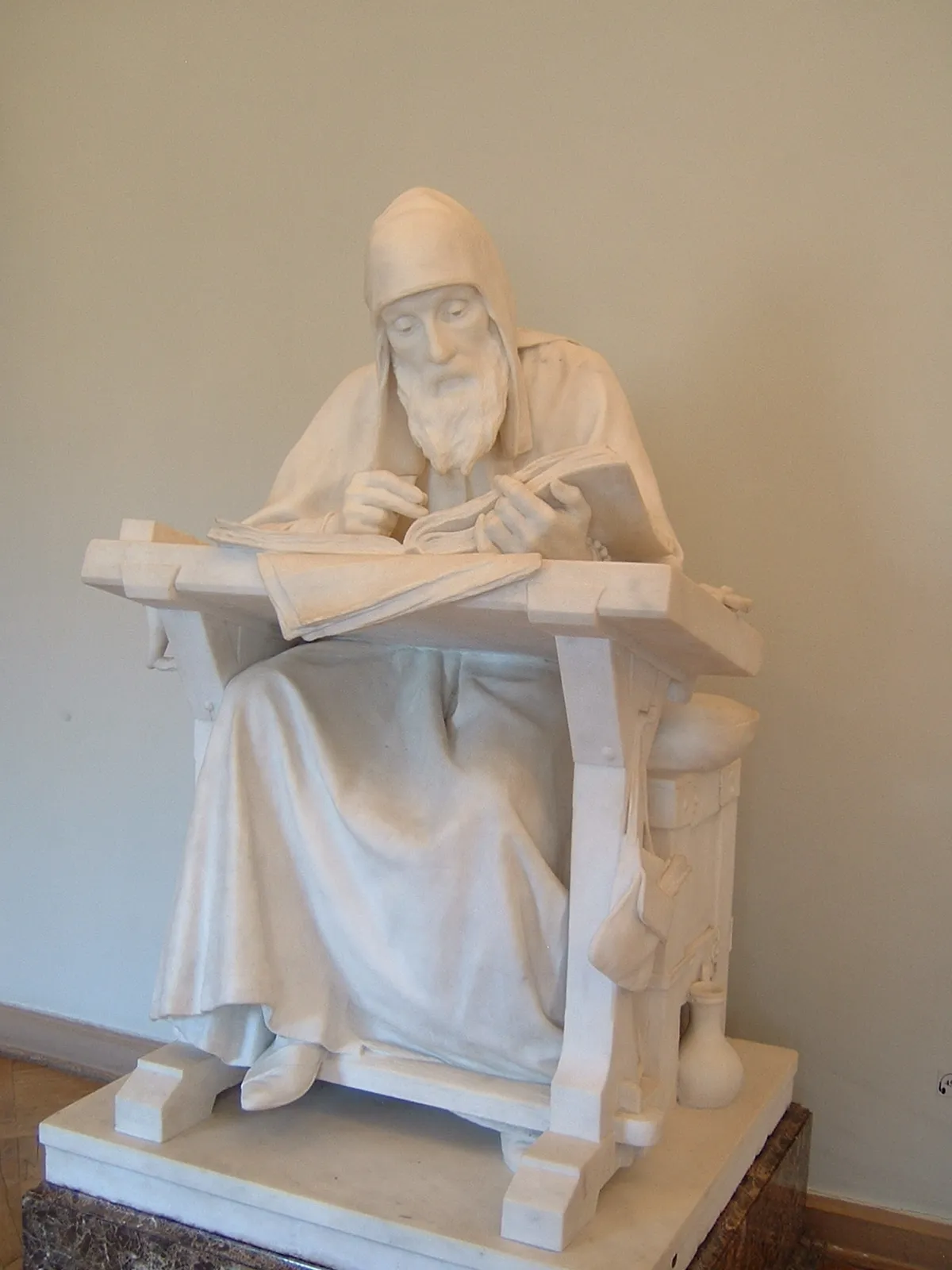
The case for Nestor
Nestor is the undisputed author of two saints' lives: one of the princes Boris and Gleb, murdered in 1015, and one of Theodosius, abbot of the Caves Monastery. Britannica notes that "a tradition that was first recorded in the 13th century" credits him with the chronicle. Cross traces that tradition to the Kyiv Caves Paterikon, a thirteenth-century collection of lives of the monastery's monks. He also traces it to one sixteenth-century manuscript, the Khlebnikov copy, which "mentions Nestor specifically as the author".
That Khlebnikov reading is weak evidence. In the introduction to his interlinear edition, the historian Donald Ostrowski shows that the name ("Nestera", Nestor's) appears only in the Khlebnikov copy and not in the other main copies. In his words, it "was added in Kh, and thus cannot be used as evidence for the name of the compiler of the PVL". The Laurentian copy's title, as Cross notes, says nothing at all about the author or his monastery. The Hypatian heading calls him only "a monk of Theodosius's Caves Monastery".
The case against Nestor
Cross's introduction sets out the problem in detail. In Nestor's Life of Theodosius the hagiographer says he was received into the monastery by Abbot Stephen, who succeeded Theodosius after his death in 1074. The chronicle's narrator, under the year 1051, says Theodosius himself "accepted me in my seventeenth year". The two accounts also disagree on the facts of the monastery's founding and of Theodosius's death.
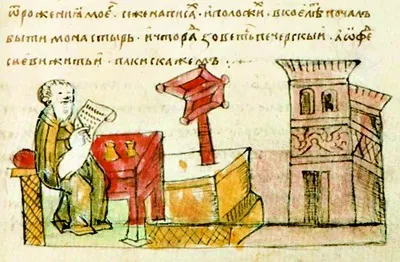
Cross concluded that "the internal evidence of the Povest', along with the lack of coincidence of its contents with Nestor's works wherever the two are related, is distinctly opposed to the tradition of Nestorian authorship". He also noted a difference in style. The chronicle is concise and factual, while Nestor's lives are full of biblical comparison and repetition.
Sylvester's colophon
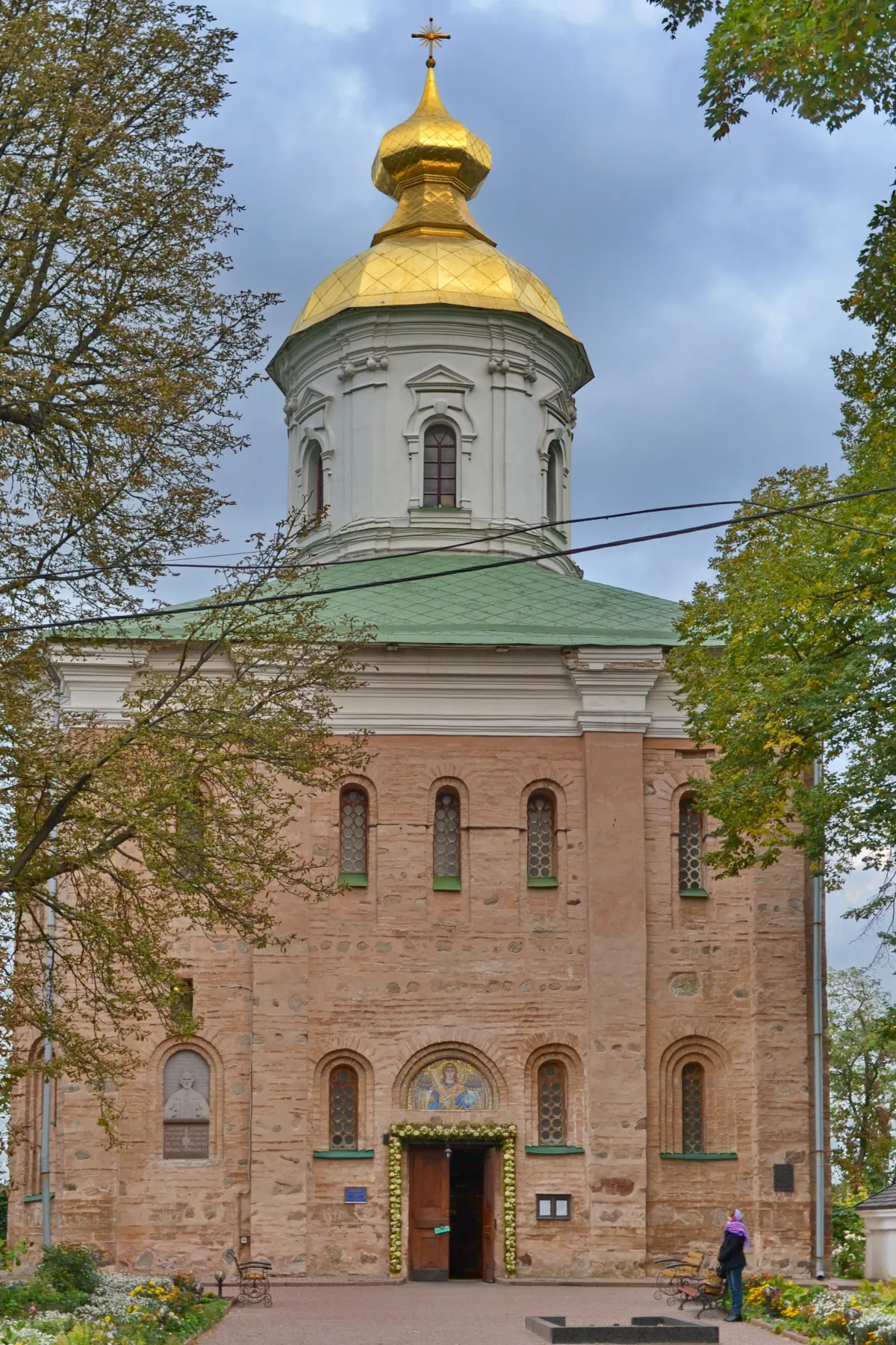
A colophon is a scribe's or author's note at the end of a manuscript. In the Laurentian text one follows the entry for 1110. Cross translates it as: "In the hope of God's grace, I Sylvester, Prior of St. Michael's, wrote this Chronicle in the year 6624 (1116), the ninth of the indiction, during the reign of Prince Vladimir in Kiev, while I was presiding over St. Michael's Monastery. May whosoever reads this book remember me in his prayers."
Whether "wrote" means composed, edited or simply copied is the heart of the authorship debate. In the Encyclopedia of Russian History, Ostrowski suggests that "the simplest explanation is that Silvestr used an earlier (perhaps unfinished) chronicle by an unknown monk of the Caves Monastery along with other sources". The Internet Encyclopedia of Ukraine represents the older majority view. It says the 1116 redaction was made "at the behest of Grand Prince Volodymyr Monomakh", on top of a first redaction finished by Nestor in 1113.
Historians disagree: did Nestor write the Primary Chronicle?
- Traditional view: Nestor compiled the chronicle around 1113 (Paterikon, Khlebnikov copy; still the view of the Internet Encyclopedia of Ukraine and, cautiously, Britannica).
- Shakhmatov's compromise: Nestor compiled a first redaction of about 1111–1113, which Sylvester's 1116 version replaced.
- Sceptical view: the compiler was an unnamed Caves monk, with Sylvester as editor or perhaps the real compiler (Cross 1953; Ostrowski).
Verdict: The attribution to Nestor is a tradition first written down about a century after his death. It rests on manuscripts that cannot bear the weight, and his authentic works contradict the chronicle on facts he would have known. Call the author "the compiler" or "the Kyiv chronicler", and treat "Nestor's chronicle" as a traditional label, not a proven attribution.
When was the Tale of Bygone Years written?
The version we read was finished in the second decade of the twelfth century. Its main text ends in 1110, Sylvester's note is dated 1116, and its chronological table runs to the death of Prince Sviatopolk in 1113. But a Kyiv chronicle almost certainly existed in some form before then. How many earlier layers there were is one of the longest-running debates in medieval Slavic studies.
Shakhmatov's layers
The philologist Aleksei Shakhmatov (d. 1920) worked backwards from late chronicles to reconstruct lost ones. Cross summarises his scheme of redactions (successive edited versions). It begins with a "most ancient Kiev compilation" of about 1039, linked to the founding of the Kyiv metropolitanate. Next came a continuation of 1073 prepared in the Caves Monastery, attributed to the monk Nikon. A "primary compilation" (nachal'nyi svod) of about 1095 followed, and on top of it came the Povest' itself in three redactions of about 1111, 1116 and 1118.
The evidence for the 1095 layer comes from the Novgorod First Chronicle. Its early part lacks the quotations from Hamartolos and Nikephoros, the treaties and the legend of the apostle Andrew. Shakhmatov read that absence as a sign of an older text. He attributed the third redaction of 1118, made at the Caves Monastery, to a monk close to Mstislav Vladimirovich, son of Vladimir Monomakh and prince of Novgorod.
The critics
Cross admired Shakhmatov's learning but called his reconstructions "at best a tissue of highly tempting hypotheses based upon a subjective and sometimes temperamental interpretation". He preferred to treat the Povest' as essentially one compiler's work "dating from about 1113". Another early twentieth-century scholar, V. M. Istrin, rejected the 1039 text altogether and stressed translated Byzantine models instead.
The debate is still live. Ostrowski has questioned the nachal'nyi svod theory. In a 2014 article in Russian Linguistics, Aleksei Gippius answered him with "additional evidence" that the Novgorod First Chronicle version "is independent of the archetype of its six full copies". If Gippius is right, the Novgorod text really does preserve something older than the Povest'.
The three redactions and the main manuscripts
| Text | Date | Place | Who | What survives |
|---|---|---|---|---|
| "Primary compilation" (nachal'nyi svod) | c. 1093–1095 (hypothetical) | Kyiv Caves Monastery | Unknown (Shakhmatov suggested Abbot John) | Partly reflected in the Novgorod First Chronicle |
| First redaction of the Povest' | c. 1111–1113 | Kyiv Caves Monastery | Traditionally Nestor | No independent copy |
| Second redaction | 1116 | St Michael's, Vydubychi | Abbot Sylvester | Laurentian line (Laurentian, Radziwiłł, Academic, lost Trinity) |
| Third redaction | c. 1118 | Kyiv Caves Monastery | Unknown; associated with Mstislav Vladimirovich | Hypatian line (Hypatian, Khlebnikov) |
| Laurentian Codex | 1377 | North-eastern Rus' (Suzdal–Nizhny Novgorod principality) | Monk Lavrentii for Prince Dmitrii Konstantinovich | National Library of Russia, F.p.IV.2 |
| Hypatian Codex | c. 1425 | Probably Pskov, from a southern original (Cross) | Unknown scribes | Library of the Russian Academy of Sciences, 16.4.4 |
| Radziwiłł Chronicle | late 15th century | Uncertain | Unknown; illustrated | Library of the Russian Academy of Sciences, 34.5.30 |
What manuscripts preserve the Primary Chronicle?
A codex is a handwritten book with bound pages, as opposed to a scroll. The Primary Chronicle survives only as the opening section of later codices, each of which goes on to regional chronicles. Paleography, the study of old handwriting, together with scribes' dated notes, is how these copies are dated.
The Laurentian Codex (1377)
The National Library of Russia in St Petersburg holds the Laurentian Codex under shelfmark F.p.IV.2. It describes it as "the oldest extant 'dated' Russian chronicle". According to Cross, its colophon states that it was copied "between January 14 and March 20, 1377, by the monk Lawrence (Lavrentiy) for Prince Dmitriy Konstantinovich of Suzdal'". After the Povest' it continues with north-eastern material to 1305, so it is a key source for Vladimir-Suzdal.
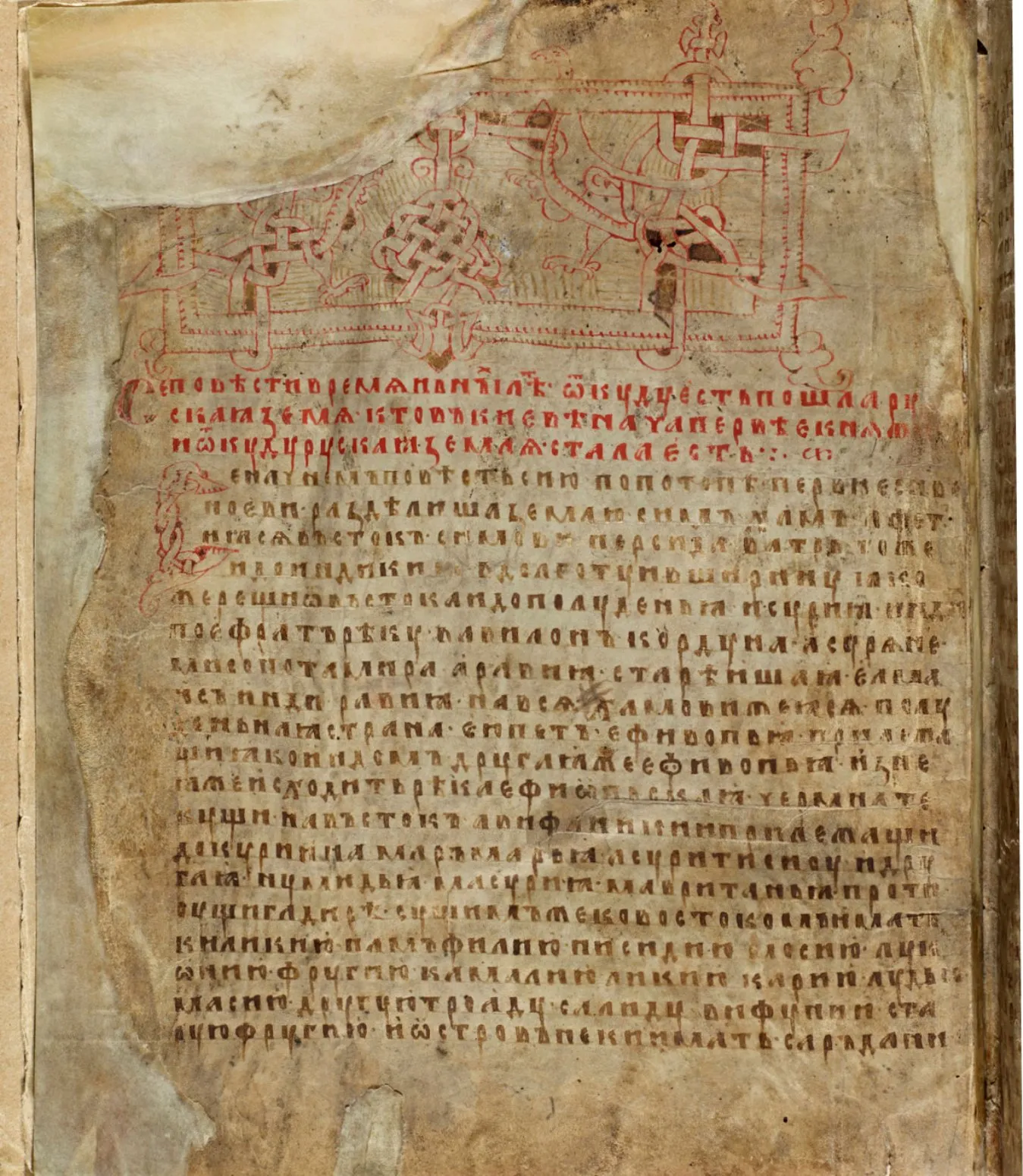
The codex alone preserves Vladimir Monomakh's Instruction (Testament) and his letter to Oleg of Chernihiv, inserted under 1096. Count Aleksei Musin-Pushkin acquired it in 1791 (some sources say 1792) and presented it to Emperor Alexander I, and it has been in the library since 1811. UNESCO's Memory of the World nomination calls it "the earliest extant Russian chronicle containing The Tale of Bygone Years", and it was inscribed on the register in 2013.
The Hypatian Codex (c. 1425)
The Hypatian (Ipatiev) Codex takes its name from the Ipatiev Monastery at Kostroma, from which it reached the St Petersburg Academy of Sciences in 1767. It then lay forgotten in the Academy's library until the historian Nikolai Karamzin had it traced in 1809. It contains three chronicles in sequence: the Povest', the Kyiv Chronicle (to about 1200) and the Galician–Volhynian Chronicle (to the 1290s). This makes it the main source for southern Rus', the lands of modern Ukraine.
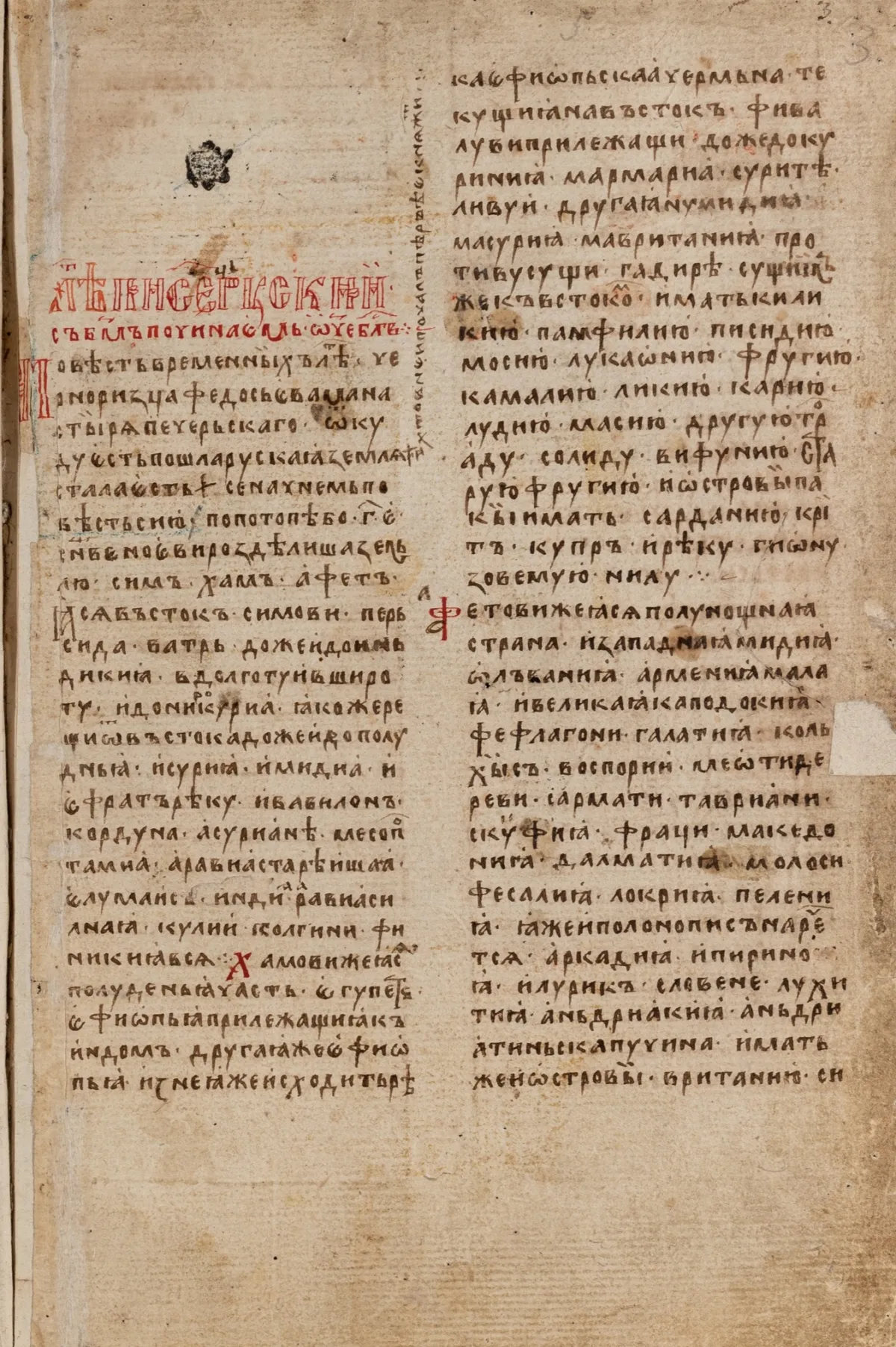
Its Povest' text reflects the 1118 redaction. It lacks Sylvester's colophon and continues the year 1110 into a Rus' victory over the Polovtsians in 1111. The closely related Khlebnikov Codex of the sixteenth century, the copy that names Nestor, is now in the National Library of Russia.
The Radziwiłł Chronicle (late fifteenth century)
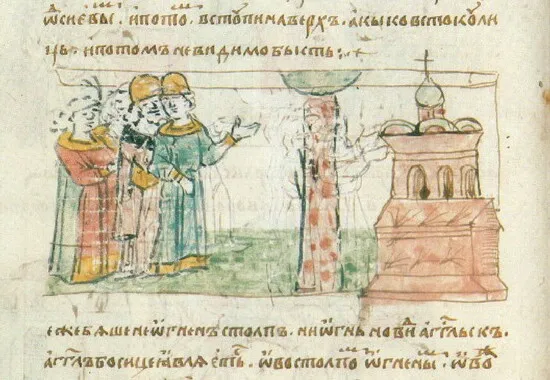
The Radziwiłł or Königsberg Chronicle is the oldest surviving illustrated Rus' chronicle, with a long cycle of colour miniatures. Its Povest' text belongs to the Laurentian group. UNESCO describes it as "a fifteenth century copy of a thirteenth century archetype". Counts of its miniatures differ. I. N. Danilevsky says it "contains almost 600 miniatures". In a 1944 study, A. V. Artsikhovsky counted 617, against 604 in a librarian's note in the manuscript, while Oleksiy Tolochko gives 613.
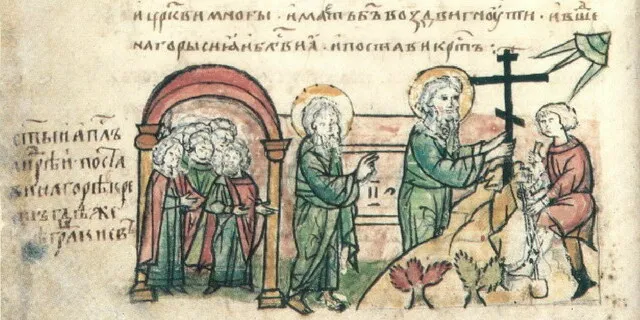
Its travels mirror the region's political history. Tolochko (Studi Slavistici, 2013) argues that the chronicle "was not a 'familial relic'" of the Radziwiłłs. In his account Janusz Radziwiłł, Grand Hetman of Lithuania, received it as a gift shortly before his death in 1655. It then passed to his cousin Bogusław Radziwiłł, who died at Königsberg in 1669, and a stamp dated 1671 marks its arrival in the Königsberg library. Peter the Great saw it there in 1711 and ordered a copy, finished in 1713. After Russian troops occupied Königsberg in 1758, during the Seven Years' War, the original was taken to St Petersburg as a trophy.
The Novgorod First Chronicle and the lost Trinity Chronicle
The Novgorod First Chronicle is not a copy of the Povest', but it matters enormously. Its "younger redaction" contains an account of early Rus' that differs from the Povest' in content and dates. The Trinity Chronicle, a Laurentian-type text, burned in the Moscow fire of 1812. It survives only in Karamzin's quotations and in variant readings printed in an unfinished 1804 edition of the Laurentian text.
What does the Primary Chronicle say?
The chronicle moves from world history to dynastic history. It begins with the sons of Noah dividing the earth, places the Slavs in Japheth's share, and describes how they settled from the Danube to Lake Ilmen. It tells the legend of the apostle Andrew blessing the hills where Kyiv would rise, and the founding of the city by Kyi and his brothers. Then come the Slavic tribes and their neighbours, including the Khazars who took tribute from the Polianians.
From AD 852 to the Calling of the Varangians
The first dated entry is AD 852 (anno mundi 6360), tied to the reign of the Byzantine emperor Michael III. Under 860–862 comes the most-quoted passage in early Rus' history. In Cross's translation, the Chuds, Slavs, Krivichians and Ves' said to the Rus': "Our land is great and rich, but there is no order in it. Come to rule and reign over us." Popular versions often add "whole" ("Our whole land"), but the 1953 Cross–Sherbowitz-Wetzor text, at page 59, does not.
According to the chronicle, three brothers answered: Rurik at Novgorod, Sineus at Beloozero and Truvor at Izborsk. On the people behind these names, see Rurik, founder of the Rurikid dynasty and who the Varangians were.
The tenth-century princes
The chronicle then tells how Oleg of Novgorod seized Kyiv from Askold and Dir, attacked Constantinople and made treaties with the Byzantine Empire. It has him die from a snake that crawls out of his dead horse's skull. Next come Igor of Kiev and his failed sea attack on Constantinople, and his killing by the Derevlians. Olga of Kiev takes a fourfold revenge on them, and later accepts baptism in Constantinople.
The campaigns of Sviatoslav I of Kiev are covered next, against Khazaria and in the Balkans against the First Bulgarian Empire and Byzantium. Cross pointed out how much of this early material is legend: Oleg's death, Olga's "complicated procedure of revenge" and much of Sviatoslav's story come from popular tradition.
Conversion, saints and princes
The longest set piece is the conversion of Vladimir the Great. Under 986 missionaries arrive from the Volga Bulgars, the Germans, the Khazar Jews and the Greeks. Vladimir then sends envoys to test each faith, and in 987 they report on worship in Constantinople: "we knew not whether we were in heaven or on earth". The narrative then gives his siege of Kherson, his marriage to the Byzantine princess Anna and the baptism of Kyiv (988).
The eleventh century brings the murder of Boris and Gleb, the reign of Yaroslav the Wise, the founding of the Caves Monastery and the quarrels among Yaroslav's grandsons. Under 1097 an eyewitness who names himself Vasilii tells of the princes' congress at Liubech and the blinding of Prince Vasylko of Terebovlia soon afterwards. The narrative ends with portents and the year 1110.
The chronicle's agenda
The chronicle is not neutral. It was written by monks writing under the princes of Kyiv. It presents one dynasty, descended from a single invited founder, as the only legitimate rulers of all the Rus' lands, and it treats Kyiv as their natural centre. History is told as Christian providence: pagan beginnings, the apostle's blessing, conversion, and divine punishment through nomad raids when princes quarrel. Reading the chronicle well means keeping this agenda in mind.
Can we trust the Primary Chronicle?
Partly. From the mid-eleventh century it rests on living memory and eyewitness accounts, and it is generally reliable in outline. For the ninth and early tenth centuries it is a twelfth-century reconstruction built on very little native evidence. Its dates for that period are mostly computed, not remembered.
What the chroniclers borrowed
The compiler's main written source was the Byzantine chronicle of George Hamartolos (George the Monk) in Slavonic translation, with its continuation to 948. Cross lists twenty passages based on it or echoing it, from the division of the earth among Noah's sons to Igor's attack of 941 and portents under 1064. The chronicle names it twice, as "Georgius says in his Chronicle" and "as is written in the Greek chronicle". The opening chronological table, according to Cross, follows the Short Chronography of Patriarch Nikephoros.
Other borrowings include the Revelations of Pseudo-Methodius of Patara, an apocalyptic text about peoples shut away by Alexander the Great. They also include the Paleya, a retelling of Old Testament history used in the missionary's speech to Vladimir, a Creed by Michael Syncellus, and the Pannonian Life of Methodius. The only true documents are the Rus'–Byzantine treaties and Monomakh's writings. The chronicle enters the treaties under 907, 912, 945 and 971, and they preserve lists of envoys with mostly Scandinavian names.
The problem of the early dates
Cross showed that the chronicle opens with an error. Michael III began to reign in January 842, not in 852. The compiler reached 852 by adding up Nikephoros's faulty intervals. Other early dates were computed from Hamartolos, sometimes by converting his indictions (15-year Byzantine tax cycles) into years. Russian events were then, in Cross's words, "conventionally inserted among the Greek data at points which appeared logical to the compiler". His conclusion: "the skeleton of dates is entirely derived from Greek sources, and that the content of surviving traditions has been overlaid upon this framework."
The long runs of "empty years" (dated headings with no entry) point the same way. So does the fact that, as Shakhmatov noticed, the surviving copies differ in their chronology only before 945. Even the Rurik story is shaky. Cross wrote that "we are therefore fully justified in rejecting the Povest' tradition of the 'calling of the princes'". He nonetheless accepted that a Scandinavian warrior-merchant elite was real.
Historians disagree: how reliable are the dates before 945?
- Optimists treat entries such as 862 or 882 as roughly right, especially where treaties anchor them.
- Sceptics (Cross, following Shakhmatov's chronological study) treat pre-945 dates as calculations made around 1100.
Verdict: Before about 945, treat any year in the chronicle as the compiler's best guess unless an independent source confirms it. The treaty dates are the strongest anchors. Dates such as 852, 862 and Oleg's death in 912 are schematic.
How an anno mundi date works
The chronicle counts years anno mundi ("in the year of the world"), from Creation. It uses the Byzantine era, which puts Creation 5,508 years before the birth of Christ. To convert, subtract 5,508:
- 6370 − 5508 = 862 (the Calling of the Varangians)
- 6360 − 5508 = 852 (the first dated entry)
- 6624 − 5508 = 1116 (Sylvester's colophon)
There is a catch. In Rus' the civil year began on 1 March, while the church year, as in Byzantium, began on 1 September. Depending on the month and the scribe's system, a given anno mundi year can therefore overlap two of our years, so dates can be out by one.
How do historians check the Primary Chronicle?
They compare it with sources written independently and closer to the events: Byzantine, Frankish, Arabic, Hebrew and Scandinavian texts, plus archaeology and coin finds. Where these agree with the chronicle, its account gains weight. Where they disagree, the outside source usually wins for dates.
Checking the chronicle against other sources
| Chronicle entry / date | External source | Agrees? | Note |
|---|---|---|---|
| No Rus' before the 850s; Varangians "called" in 862 | Annals of St-Bertin, 839 | No | Envoys of the "Rhos" reached Louis the Pious in 839 with a Byzantine embassy, and Louis concluded they were Swedes |
| 852: Michael III begins to reign | Byzantine chronology | No | Michael III acceded in January 842 |
| 866: Askold and Dir attack Constantinople | Patriarch Photios's homilies; Chronicon Bruxellense | Event yes, date no | The attack took place on 18 June 860; the chronicle's date is, in Cross's words, "purely arbitrary fixation" |
| 912: death of Oleg | Novgorod First Chronicle | No | The Novgorod text dates Oleg's death to 922 |
| Oleg as ruler before Igor | Cambridge Document (Schechter Letter) | Unclear | A Khazar Hebrew letter of about 949 names a Rus' king HLGW (Helgu), often identified with Oleg, who attacked Constantinople and then died on a Caspian campaign in the 940s |
| 941: Igor attacks Constantinople | Hamartolos continuation; Liudprand of Cremona | Yes | The chronicle takes this date from the Greek chronicle; Liudprand, who had the story from his stepfather, an envoy in Constantinople, describes Igor's fleet of "a thousand ships or more" destroyed by Greek fire |
| 907–971: treaties with Byzantium | Byzantine diplomatic practice | Largely | Treaty texts follow Greek forms; Cross notes only one Greek allusion to them |
| 965: Sviatoslav defeats the Khazars | Ibn Hawqal | Partly | Ibn Hawqal dates the Rus' destruction of Itil, Samandar and Bulgar to AH 358 (AD 968/969), later than the chronicle's campaign |
| 1018: Bolesław of Poland in Kyiv | Thietmar of Merseburg | Yes | Thietmar describes Bolesław's 1018 expedition, the treasure shown to him in Kyiv, and a city of "more than 400 churches and eight markets" |
Some of these checks support the chronicle's story while correcting its dates. The 839 Frankish entry and the Arabic geographers show Rus' active on the waterways well before 862. Our article on Ibn Fadlan's account of the Rus' shows what an outside observer saw on the Volga, near the trading state of Volga Bulgaria, whose people the chronicle calls Volga Bulgars. Constantine VII's De administrando imperio gives Rus' and Slavic names for the Dnieper rapids, and its Rus' names are Norse.
In a 2006 article in Ruthenica, Ildar Garipzanov calls the 839 entry "the first written record on the Rus'/Rhos". Those envoys had travelled west with an embassy from the Byzantine emperor Theophilos, an early sign of the contacts that later brought Scandinavians into imperial service in the Varangian Guard. On the 860 raid, a 2022 study by Oleksandr Fylypchuk notes that since Carl de Boor's work "the date June 18, 860 was accepted by all scholars".
Archaeology and coins
Excavation gives the chronicle a physical context it cannot supply itself. Cross already cited Scandinavian settlement on the south-western shore of Lake Ladoga in the first half of the ninth century and a Scandinavian presence at Gnezdovo near Smolensk around 900. He also cited finds of Arabic silver coins (dirhams) dated 745–900 across northern Russia. Later excavation at Staraya Ladoga, Novgorod and Gnezdovo, with tree-ring dating (dendrochronology), has added detail, and Novgorod's birch-bark letters give an independent written record from the eleventh century on. The overall picture is a long, gradual Scandinavian and Slavic build-up, not a single invitation in 862.
The Normanist debate
The 862 entry sparked the "Normanist" controversy over whether Scandinavians founded the Rus' state. It goes back to the German scholars of the eighteenth-century St Petersburg Academy. Cross records that in 1749 Mikhail Lomonosov helped prevent G. F. Müller from delivering his oration on the origin of the Rus' before the Academy. Today most specialists accept a Scandinavian origin for the name Rus' and for the early ruling elite. They also stress Slavic, Finnic and steppe contributions and reject the chronicle's tidy story of an invitation.
Why is the Primary Chronicle politically contested?
The Primary Chronicle is a founding text for three modern nations, the Russian Federation, Ukraine and the Republic of Belarus, and each reads it differently. Russian state tradition takes 862 and Novgorod as the start of statehood. Ukrainian historiography stresses Kyiv as the chronicle's centre and the Hypatian line as a southern Rus' record. Belarusian scholars point to Polotsk, whose princes the chronicle describes, and to the Radziwiłł manuscript's history in the Grand Duchy of Lithuania.
The 862 date still serves as a political anchor. On 3 March 2011 President Dmitry Medvedev signed a decree (No. 267) on celebrating the 1150th anniversary of Russian statehood in 2012. In July 2011, at a meeting with historians in Vladimir, he said he would welcome representatives of Ukraine and Belarus at the celebrations, while noting that the decree applied only to Russia. The main celebrations took place in Veliky Novgorod on 21–23 September 2012. The Bank of Russia issued a commemorative series, including a 10-rouble circulation coin showing Novgorod's Millennium of Russia monument with the dates 862 and 2012.
Ukraine marks a different anniversary. On 20 December 2013 the National Bank of Ukraine issued a 10-hryvnia silver coin, "900 Years of the Tale of Bygone Years", in its "Spiritual Treasures of Ukraine" series, with Nestor on the reverse. It came nine hundred years after 1113, the traditional date of the chronicle's first version.
Historians generally treat these anniversaries as commemoration, not chronology. The year 862 is, as shown above, one of the chronicle's computed dates.
Where can I read the Primary Chronicle in English?
The standard English version is The Russian Primary Chronicle: Laurentian Text, translated and edited by Samuel Hazzard Cross and Olgerd P. Sherbowitz-Wetzor (Mediaeval Academy of America, 1953; reprinted). It revises Cross's 1930 first English translation, and its fifty-page introduction is still one of the best short guides to the chronicle's problems. A full PDF is hosted by the library of the Monumenta Germaniae Historica.
For the original text, the scholarly standard is Donald Ostrowski's The Pověst' vremennykh lět: An Interlinear Collation and Paradosis, published in 2003 by the Harvard Ukrainian Research Institute with David J. Birnbaum and Horace G. Lunt. It sets the main manuscripts line by line and adds Ostrowski's reconstructed "paradosis" (best-attested reading). Ostrowski keeps an online version with his essays on scribal practice and the nachal'nyi svod.
Russian readers use D. S. Likhachev's edition and translation, first published in 1950 with B. A. Romanov. A revised and expanded second edition, prepared by M. B. Sverdlov, appeared from Nauka in St Petersburg in 1996 in the Literaturnye pamiatniki series. They also use the Pushkin House Library of Literature of Ancient Rus', which gives the text with a modern Russian translation and commentary. The Laurentian and Hypatian texts appear in volumes 1 and 2 of the Complete Collection of Russian Chronicles (PSRL). Ukrainian translations include Leonid Makhnovets's version of the Hypatian text (Litopys Ruskyi za Ipatskym spyskom, Kyiv: Dnipro, 1989) and Vasyl Yaremenko's (1990). The National Library of Russia offers a digital facsimile of the Laurentian Codex.
What the map shows next
The chronicle's world broke apart soon after it was written. By 1240 on the map the Mongol conquest had ended Kyiv's primacy. Meanwhile the Novgorod Republic kept its own annals, and north-eastern princes copied the Povest' into their own histories. By 1377 on the map, when Lavrentii finished his copy for a Suzdalian prince, the Golden Horde dominated the Rus' lands and Moscow was rising. By 1425 on the map, around the date of the Hypatian Codex, the old Rus' lands were divided between Moscow, Lithuania and the Polish crown, and each of them had its own reasons to read the Tale of Bygone Years.
Sources
Primary sources, editions and translations
- The Russian Primary Chronicle: Laurentian Text, trans. and ed. Samuel Hazzard Cross and Olgerd P. Sherbowitz-Wetzor (Cambridge, MA: Mediaeval Academy of America, 1953). Introduction pp. 3–50; text from p. 51. PDF: https://www.mgh-bibliothek.de/dokumente/a/a011458.pdf
- Donald Ostrowski (ed.), with David J. Birnbaum and Horace G. Lunt, The Pověst' vremennykh lět: An Interlinear Collation and Paradosis (Cambridge, MA: Harvard Ukrainian Research Institute, 2003). Online version and introduction: https://donostrowski2.bitbucket.io/pvl/index.html
- Povest' vremennykh let, ed. D. S. Likhachev, trans. D. S. Likhachev and B. A. Romanov, ed. V. P. Adrianova-Peretts, 2 vols (Moscow–Leningrad, 1950); 2nd edn, revised and expanded, prepared by M. B. Sverdlov (St Petersburg: Nauka, 1996; Literaturnye pamiatniki; reprinted 1999): https://litpamyatniki.ru/library/4599
- Biblioteka literatury Drevnei Rusi, vol. 1, Povest' vremennykh let (Pushkin House / IRLI RAN): http://lib.pushkinskijdom.ru/Default.aspx?tabid=4869
- Polnoe sobranie russkikh letopisei, vol. 1 (Laurentian) and vol. 2 (Hypatian, ed. A. A. Shakhmatov, 1908).
- Litopys Ruskyi za Ipatskym spyskom, trans. L. Ye. Makhnovets (Kyiv: Dnipro, 1989).
- National Library of Russia, Laurentian Codex. 1377, digital exposition: https://expositions.nlr.ru/LaurentianCodex/eng/manuscript1.html
- Thietmar of Merseburg, Chronicon, Book VIII (Latin text): https://www.hs-augsburg.de/~harsch/Chronologia/Lspost11/Thietmar/thi_chr8.html
- Liudprand of Cremona, Antapodosis V.14–15, in The Works of Liudprand of Cremona, trans. F. A. Wright (London, 1930): https://archive.org/stream/in.ernet.dli.2015.168391/2015.168391.The-Works-Of-Liudprand-Of-Cremona_djvu.txt
Scholarship
- Alexey A. Gippius, "Reconstructing the original of the Povest' vremennyx let: a contribution to the debate", Russian Linguistics 38/3 (2014), 341–366: https://link.springer.com/article/10.1007/s11185-014-9137-y
- Oleksandr Fylypchuk, "The Attack of the Rus' on Constantinople in the Light of the Chronicon Bruxellense", Studia Ceranea 12 (2022), 417–435: https://czasopisma.uni.lodz.pl/sceranea/article/download/10261/15084/37685
- Ildar Garipzanov, "The Annals of St. Bertin (839) and Chacanus of the Rhos", Ruthenica 5 (2006): https://history.org.ua/JournALL/ruthenica/5/1.pdf
- Oleksiy Tolochko, "Notes on the Radziwiłł Codex", Studi Slavistici 10 (2013), 29–42: https://oaj.fupress.net/index.php/ss/article/download/2297/2297/2273
- Alexander V. Maiorov, "Schlözer and Karamzin. Struggle for Priority in Studying Russian Chronicles", Studi Slavistici 15/1 (2018), 111–130: https://oaj.fupress.net/index.php/ss/article/download/2022/2022
- I. N. Danilevsky, "The Symbolism of Miniatures in the Radziwiłł Chronicle": https://memo.imareal.sbg.ac.at/?edmc=5571
- A. V. Artsikhovsky, Medieval Russian Miniatures as Historical Sources (1944), chapter in English translation, Brewminate: https://brewminate.com/elements-of-medieval-russian-life-as-depicted-in-the-konigsberg-chronicle/
- Mikołaj Banaszkiewicz, "The depreciation of the great jubilee: the celebrations of the 1150th anniversary of Russian statehood in Novgorod the Great (2012)", Studia z Dziejów Rosji i Europy Środkowo-Wschodniej 51 (2016): https://sdr-ihpan.edu.pl/images/volume51no1SI/07-Banaszkiewicz.pdf
- Dan D. Y. Shapira, "Khazars", Encyclopaedia Iranica (Schechter Letter / HLGW; Ibn Hawqal's AH 358): https://www.iranicaonline.org/articles/khazars/
Reference works and official pages
- Britannica, "The Primary Chronicle": https://www.britannica.com/topic/The-Primary-Chronicle
- Britannica, "Nestor": https://www.britannica.com/biography/Nestor-Russian-monk
- Internet Encyclopedia of Ukraine, "Povist' vremennykh lit" (A. Zhukovsky, 1993): https://www.encyclopediaofukraine.com/display.asp?linkpath=pages%5CP%5CO%5CPovisthDAvremennykhlitIT.htm
- Internet Encyclopedia of Ukraine, "Oleh": https://www.encyclopediaofukraine.com/pages%5CO%5CL%5COlehPrince.htm
- Internet Encyclopedia of Ukraine, "Calendar": https://www.encyclopediaofukraine.com/display.asp?linkpath=pages%5CC%5CA%5CCalendar.htm
- Donald Ostrowski, "Primary Chronicle", Encyclopedia of Russian History (Encyclopedia.com): https://www.encyclopedia.com/history/encyclopedias-almanacs-transcripts-and-maps/primary-chronicle
- UNESCO Memory of the World, Laurentian Chronicle nomination (inscribed 2013): https://media.unesco.org/sites/default/files/webform/mow001/russian_federation_laurentian_chronicle_1377.pdf
- UNESCO, "Russian Federation – The Radzivill Chronicle" (project page): https://www.unesco.org/en/articles/russian-federation-radzivill-chronicle
- Slovar' knizhnikov i knizhnosti Drevnei Rusi (Trinity Chronicle; Laurentian Chronicle): https://azbyka.ru/otechnik/bibliog/slovar-knizhnikov-i-knizhnosti-drevnej-rusi/416
- Bank of Russia, commemorative coins 2012 (1150th anniversary of Russian statehood): https://cbr.ru/Content/Document/File/123659/coins_cbr_2012_pr.pdf
- National Bank of Ukraine, coin "900 Years of the Tale of Bygone Years" (archived): https://web.archive.org/web/20200427114547/https://old.bank.gov.ua/control/uk/currentmoney/cmcoin/details?coin_id=607
- LB.ua, "Медведев пригласил Украину отметить в Новгороде зарождение ее государственности" (23 July 2011): https://lb.ua/news/2011/07/23/107447_medvedev_priglasil_ukrainu_otmet.html
- Russia Beyond, "Anniversary of Russian statehood celebrated in Novgorod" (28 Sept 2012): https://www.rbth.com/articles/2012/09/28/anniversary_of_russian_statehood_celebrated_in_novgorod_18667.html
- Harvard Ukrainian Research Institute, Don Ostrowski profile: https://www.huri.harvard.edu/people/don-ostrowski
Image credits
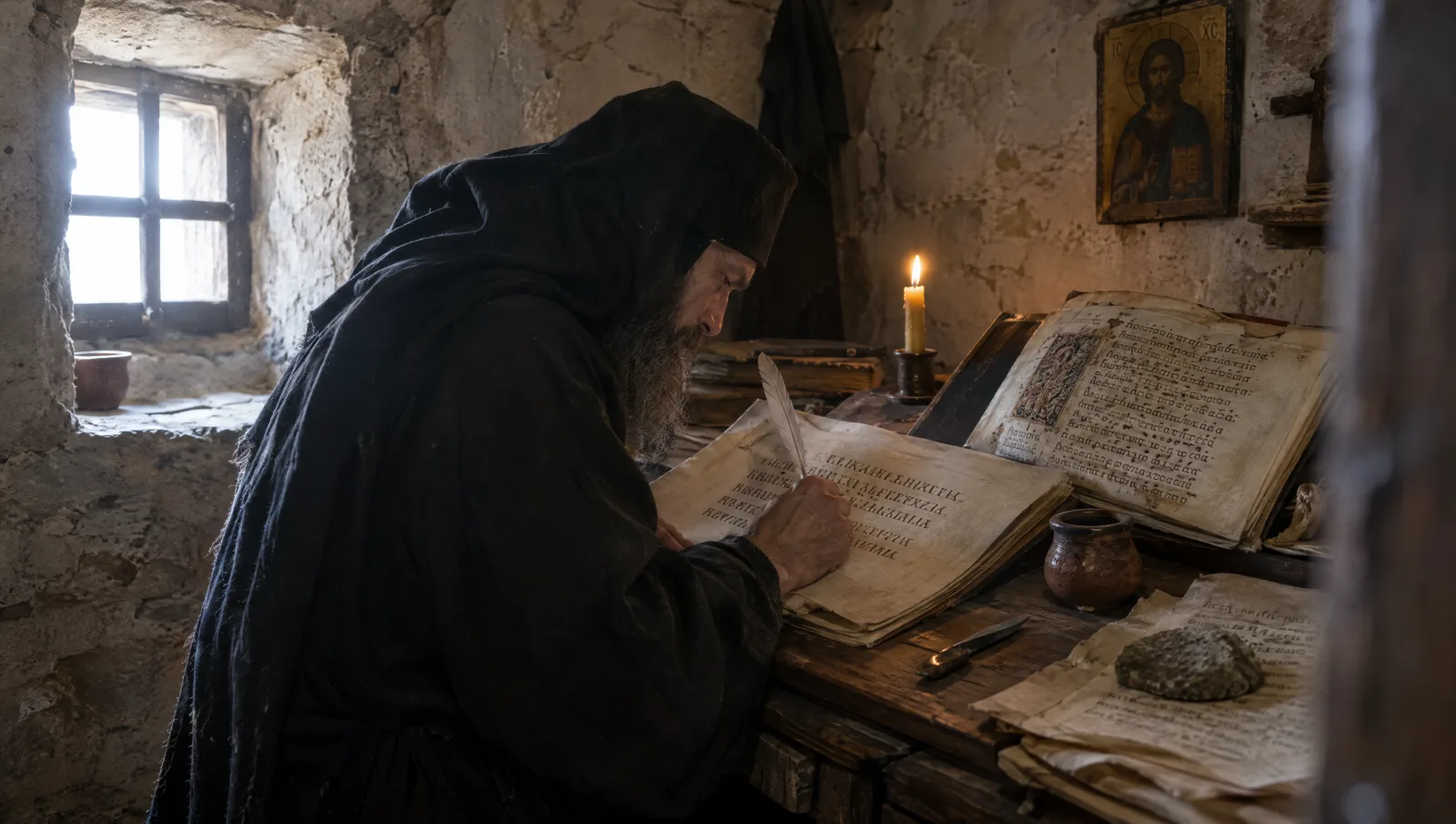
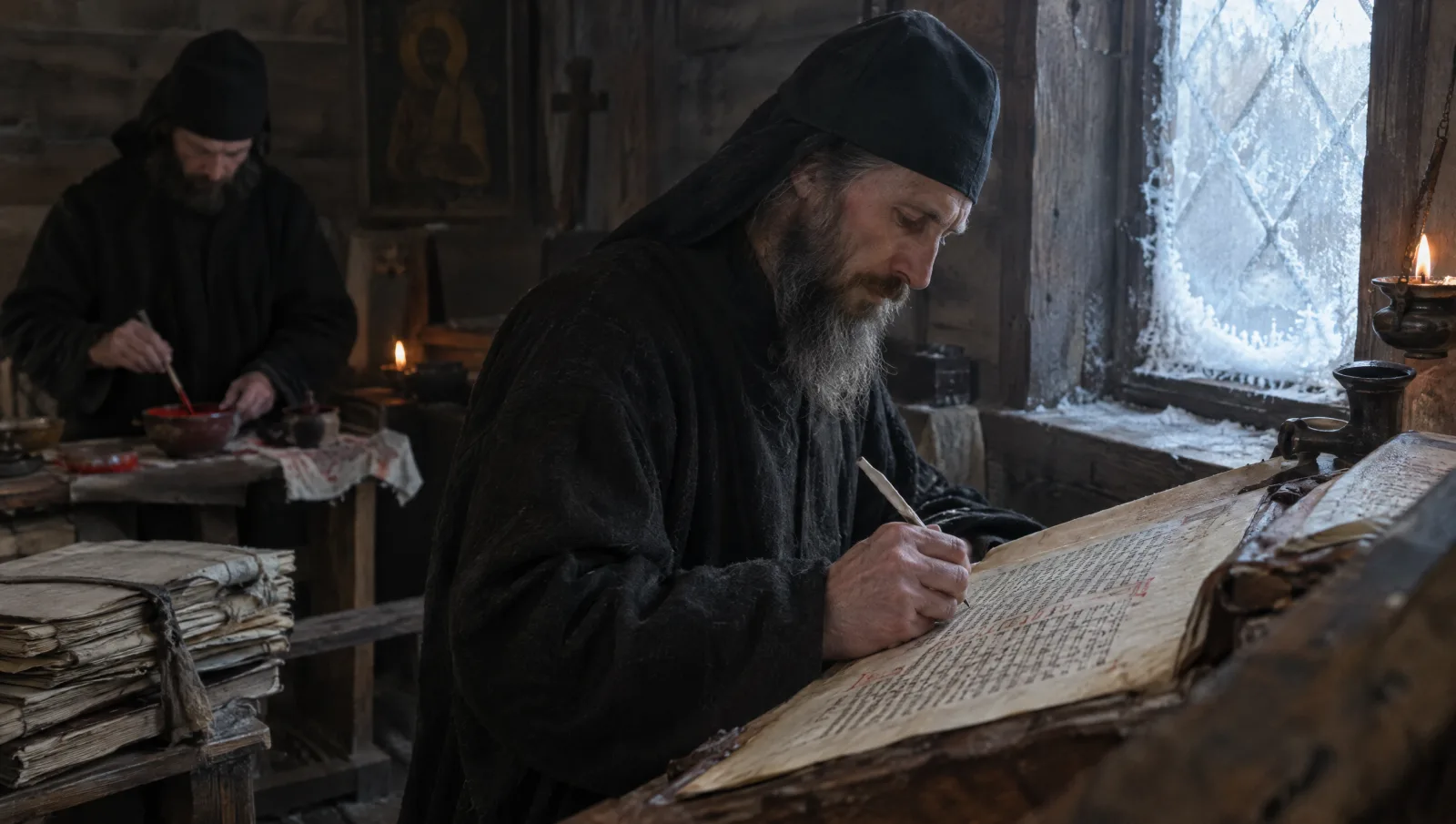
- Title image (a Kyiv chronicler at work, around 1113): AI-generated illustration.
- Mark Antokolsky, Nestor the Chronicler (1890), State Russian Museum. Photo: Alex Bakharev, public domain, via Wikimedia Commons.
- Nestor the Chronicler, Radziwiłł Chronicle miniature, late 15th century (BAN 34.5.30, fol. 93). Public domain, via Wikimedia Commons.
- St Michael's Church, Vydubychi Monastery, Kyiv. Photo: Galvm, CC BY-SA 4.0, via Wikimedia Commons.
- Laurentian Codex, 1377, fol. 1v (National Library of Russia, F.p.IV.2). Photo: Nikolay Omonov, CC BY-SA 4.0, via Wikimedia Commons.
- Hypatian Codex, c. 1425, fol. 3 (Library of the Russian Academy of Sciences, 16.4.4). Photo: Nikolay Omonov, CC0, via Wikimedia Commons.
- The apostle Andrew at the hills of Kyiv, Radziwiłł Chronicle miniature, late 15th century. Public domain, via Wikimedia Commons.
- The pillar of fire over the Caves Monastery in 1110, Radziwiłł Chronicle miniature, late 15th century. Public domain, via Wikimedia Commons.
- A philologist comparing chronicle copies, early 1900s: AI-generated illustration.
- A monk copying a chronicle in 1377: AI-generated illustration.